
Diabetics Doing Things Podcast · Diabetics Doing Things
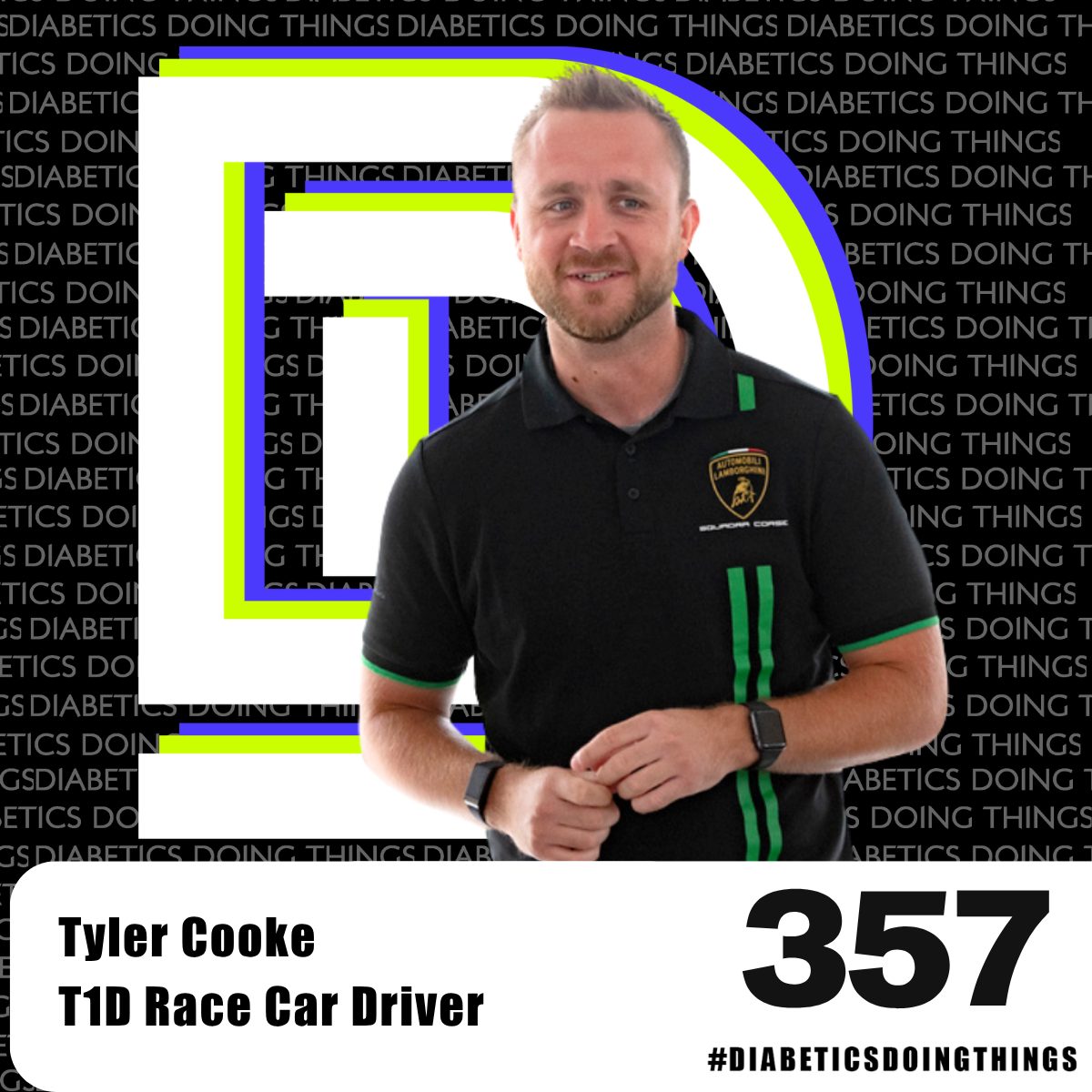
Tyler Cook is a professional GT3 racing driver who has competed in some of the most grueling endurance races on the planet, the 24 Hours of Spa, the 24 Hours of Nürburgring, IMSA, and GT World Challenge Europe. He's also been living with type 1 diabetes since he was 11 years old. This episode gets into what it actually looks like to manage blood sugar in a fire suit, in a 130-degree cockpit, at 150 miles per hour, sometimes at 3 a.m. Tyler takes us back to his diagnosis in 2006 — an ICU stay, four IVs, and a very specific grief over the chocolate mousse at Epcot's France pavilion. From there, he walks us through the journey from go-karts in his dad's garage to GT3 race cars with 650 horsepower. Along the way, there was bullying in middle school over his diet, sneaking to the bathroom to give injections on dates, and a decision somewhere along the line to stop hiding his diabetes and start owning it. We get into the technical side, too: how OmniPod changed his race management strategy, why adrenaline sends his blood sugar climbing instead of crashing, what a 24-hour-race insulin plan actually looks like, and what it means to have a Gatorade button wired into your cockpit as an emergency low-blood-sugar protocol. Tyler also talks about the physical training side of racing — heart rate zone work, neck day (yes, neck day), and why a GT3 driver can be pressing 1,200 pounds of brake force per pedal. The episode wraps with something that's been sitting with both Rob and Tyler: the idea of trusting the process. For Tyler, the lesson comes through racing — you can't skip steps from spec Miata to GT3. For people with T1D, it's the same. Wherever you are in your management journey, that's where you are — and it's going to get better if you just keep going. Chapters: 00:00 Climbing out of a race car at 2 a.m. 00:51 Introducing Tyler Cook, GT3 driver with T1D 01:52 Diagnosis at 11: ICU, four IVs, and Epcot chocolate mousse 04:16 Go-karts at three, racing in the family DNA 06:20 Racing pre-CGM: going off vibes and feeling lows 07:29 Bullied for his diet in middle school 09:53 Dating with diabetes and deciding to stop hiding it 12:29 Going public: from fear of losing opportunities to advocacy 13:35 A potential cure and why staying healthy now matters 17:19 What GT3 racing actually is — and why you should go watch it 23:02 The Gatorade button: CGM and cockpit glucose management 24:28 130-degree cockpits, adrenaline spikes, and pre-race hydration 25:39 WHOOP strain scores: practice vs. race stint 28:37 Training for the car: heart rate zones, neck day, 1,200-lb brakes 36:45 What Tyler would tell 11-year-old himself: trust the process Resources: * Tyler Cooke Instagram * Breakthrough T1D * Conor Daly (T1D IndyCar driver Tyler mentioned)
0:00Rob HoweImagine you just climbed out of a race car at 2am on one of the most demanding circuits in the world. You've been driving for two hours straight in 130 degree heat inside your car, your heart is pounding, your muscles are wrecked, and before you can even think about sleep, you gotta check your blood sugar and figure out your insulin strategy for the next stint. That's a normal Saturday night for my guest today. Tyler Cook is a professional GT driver who's raced at the 24 Hours of Spa, the 24 Hours of Nürburgring, and IMSA and GT World Challenge Europe. And he's doing all of it with type 1 diabetes since he was 11 years old. Tyler, you can find on Instagram at TylerCookRacing. And I'm really excited to share this interview with you today. So here's the episode. Guys, who was MVP of the chat? Rob Powell! Rob Boyd Powell! What were you on? We need more of that. Hey listeners, welcome back to Diabetics Doing Things. My guest today is Tyler Cook. Tyler is a professional GT3 racing driver who's competed in some of the biggest endurance races on the planet, and we're gonna talk about those, especially three in particular. He was also diagnosed with type 1 diabetes at age 11, way back in 2006, and he's been managing his glucose at 150 miles an hour plus in a fire suit at 3 a.m. for his entire racing career. Tyler, welcome to the show.
1:16Tyler CookYeah, thanks for having me. Super pumped to talk and have some fun with this.
1:19Rob HoweYeah, so we have had some conversations with drivers over the years, and we've heard some stories of drivers that are more of a traditional, we'll call it a traditional style race that maybe we're more familiar with, whether it's IndyCar, whether it's NASCAR, etc. I really am excited to dig into the nitty gritty of managing type 1 diabetes while being behind the wheel of a car for an extended period of time in like a 24 hour Daytona type of race. But first, let's start kind of with your diabetes story. So, like, take us back to 2006. You're 11 years old. Like, what do you remember about that diagnosis?
1:52Tyler CookWell, probably, like, a lot of diabetics. I remember every minute. So I remember we actually came up to North Carolina. We lived in Florida at the time. Came out of North Carolina, and I was losing a lot of weight, and it didn't look good. It didn't look healthy. And I was eating a lot. My dad said he's definitely not eating. He's pounding back food like it's going out of style. I remember getting back to Florida for middle school again after winter break and went to school. I remember sitting in my homeroom and I looked at my homeroom teacher and he looked at me. He's like, you don't look too good. I was like, oh, I don't feel good. And he's like, all right, maybe just go to the bathroom and see. And so I walked out, go to the bathroom, ended up puking all over a girl, lost that shot. But puked all over a girl. And I was like, I'm so sorry. I sprinted to the bathroom and I proceeded to puke about five more times. with the school, it was as soon as you throw up, you have to go home. So my dad picks me up and he had a pretty good idea of maybe what was going on because my dad, you know, did a lot of studying. So he takes me to the doctor and the doctor does a finger prick. And I remember me and my dad are sitting in a room. They pull my dad out of the room and they said, you got to get your son to ICU now. You know, if you don't take him now, he doesn't have much longer to live. You know, my body is going into shock. My dad's emotional, frantic, you know, and rusted me at Joe DiMaggio. they admit me um i remember getting four ivs putting into my body just to get my body back to normal actually one of them they forgot to take the band off so my sister walks in very emotional from high school knowing i was in icu and she's like why is his arm turning colors and they forgot to release the band um and i thought it was funny at the time i was like you know what it's just been a day um so i was in icu for two days and then they moved me to a normal room where I was in there for another five days. I still remember me and my dad would always walk outside. He would get some fresh air with all the IVs. I remember like walking out there and I saw a kid eating like chocolate mousse, like on the painting on the wall. And I started crying. And he's like, why are you crying? I was like, because I can't get the chocolate mousse at Epcot in France anymore. You know, I'm so disappointed in that. He's like, you just got a life altering disease and you're worried about the France chocolate mousse. I was like, yes. I was like, I love that. Like, I absolutely love that stuff. And, um, you know, so I went there, got to go home for a week and then took a year off racing. We had to figure out what normal was and how, you know, big, big change to the family and big change to everybody.
4:16Rob HoweAnd let's talk about that because you were, I mean, you're 11 years old at the time. So like taking a year off when you're 11 years old to someone who's not really plugged into the racing community may not seem like a big deal, but like racing is in your family and has been what you wanted to do since you were very little so like tell us a little bit about like how you
4:32Tyler Cookgot started in racing uh so i actually got started in racing when i was three years old my dad built me a go-kart from scratch in our garage and i started that go-kart to this day i'm restoring it i want to bring it back to life and it's just a memory with him and so i started when i was three my grandfather had a late model team uh that uh dave rudeman uh borrowed his car Rusty Wallace drove his car for a race. Eric Amarola drove his car for a race. It was really cool. I got to maybe meet those guys. I was a little young to remember that, but, you know, it was definitely cool when my grandfather told me those stories. And so I would get out of school. My dad would get off work. He worked as a mechanic at Cadillac for a long time, and we'd go to the shop, and we'd help my grandfather with the car. I could do anything. I could just take the wheels off, make vroom-vroom noises in the seat, but I felt like I was just a part of it. Um, and then, so I went into go-kart racing when I was about nine years old, started a little bit the later part of it. A lot of kids start when they're six, seven years old. And, you know, it's just every year you're developing, just like you're developing in school. So every year does matter and every year does count. And taking that year off, you know, obviously it was a big deal, but it was something that was needed because it's, you know, it's life altering. It's a full different change of a life. The last thing you want is to rush back into something and you don't know why you're shaking in the go-kart. You know, it's because of a low, low sugar. And I actually had that happen once where I got into a crash and turned one and a kid like drove over me on the go-kart. And I remember he was sitting on top of me. So I like shoved him off. And for the rest of like the 18-lap race, I was shaking. And I thought I was just nervous. And, you know, I think I finished like fifth or something like that. I come back in the pits. I go back to our pit area and I check my blood sugar and I'm 42. And I was like, oh, wow, like I actually went low. And, you know, it was years after I got diagnosed. But, you know, it's always a learning thing. We're always learning our bodies.
6:28Rob HoweWell, I was going to say, too, like at that point, maybe, you know, 2008, 2009 time frame. So you've been diagnosed a couple of years. There's still not like a continuous glucose monitor or a system where you can have somebody in the pit or you can have something on your dash where you're monitoring your sugar. So you're just kind of going off vibes at that point.
6:45Tyler CookYeah. And you had to, yeah, I mean, I mean, a lot of diabetes know that you'd have to feel, oh, I'm tired. That must mean I'm high. Or I'm getting like jittery. You know, I would start talking a lot. Or like, my dad would have to go like, just please stop talking for a second. And I'm just like, when you're low, you start to talk a lot? Yeah, I was like freaking Bugs Bunny trying to run the marathon. I was going, and then my dad started to realize, like, you're going low. But, like, you know, here's a little bit of sugar. You know, I get a Reese's cup, you know, which is always great, you know, because me and my dad. Those medicinal Reese's is, like, top tier, you know. It's like, hey, sorry, I got to have this candy to save my life. It's better than Michelin star restaurants when you get a Reese's cup when you're a little low. It just hits right. That dopamine hit of, like, your brain's like, yes, we're safe now. Now eat this, enjoy this chocolate and peanut butter.
7:34Rob HoweI want to talk about before we move on more towards your professional career, you shared as an ambassador for Breakthrough T1D throughout your life, being open about being bullied about your diabetes as a kid or at school. Tell us a little bit about that. And I think that's something that a lot of people either can relate to or are afraid of, whether it's a person with diabetes or a caregiver. Tell us a little bit about that and kind of how it shapes your relationship with diabetes.
7:58Tyler CookWell, you know, kids can be kids. when kids don't know something they can be a little on the harsher side of things so kids cannot figure out like i remember going to middle school and i always had to bring like tofu chicken that my mom made me and like green beans because my family wanted me on a pretty strict diet because at the time we knew that one fast 10 slow and if that didn't work i couldn't have that food you know before we didn't really learn about counting carbs so it was pretty much just that so it was like if he ran high that food's gone and so we got down to like certain foods i could eat with that and i'd bring it to school and you know all the kids look at me like what's this weirdo eating like we're having like school lunches or you know sandwiches stuff that i just couldn't have and at the time middle school kids are like experts at pointing out anything different and laughing about it yeah they really are and i mean they they're i mean they were my nutritionists as well because they were just telling me like what i was eating was so stupid and i was like i know thank you and you know if there was like a birthday party I would have to go like no I'm sorry I can't I can't have cake and then they would look at me weird and kind of sometimes make fun of me of like oh well you can't have cake and you know it did get to me I remember going back to my family a few times or my parents going like what is wrong with me like why can't I you know why can't I be like these kids and you know they they definitely sat me down a few times when I was younger like while I was crying I remember I went out trick-or-treating my dad really did not want me to go trick-or-treating and I went trick-or-treating and I got a bunch of candy and I was so excited and my dad's like, I have to take this. You can't have this, you know, because again, before we knew about counting carbs or anything. So he just thought that is the right thing for us to do. And so I remember him taking it and he bore like cried, you know, taking it because he just was, he could see my excitement. And, you know, then you're dealing with kids that don't understand that and they're going to go like, you know, it's cooler to make fun of somebody than it is to understand because you're at the age where you're developing nonstop. Yeah, your brain will not develop. No, it's definitely not a fault. Like I look back at now, you know, it was tough, but it made me a stronger person. And then I remember, you know, getting older, my 17, 18, 19, you know, start dating. I would both think I had a bathroom problem because I would constantly go to the bathroom and go do insulin for like what we were eating, what we were doing or anything. And I just realized, I was like, if this girl doesn't like me because I'm a diabetic, this is just never going to work. I can't hide this. So, I mean, I just started going on dates and I would just go, you know what? I have to do a shot. Like we're having cake right here. And they respected that more because I was more open and honest about it because like it was like, okay, like I understand what you're doing, like what you have to go through. But then back to the bullying part of it, you know, it's just kids being kids. And like, I never steer away from who you are because something that I love is I think type 1 diabetics are actually cooler people because we get to have little computers on us to feed us stuff. I mean, how many people get to say that? We get computers.
10:51Rob HoweWell, I think, too, like even just digging into that more. But every carb, you know how every meal has affected you for going on 21 years. Right. So I think a lot of people, it is a burden. Sure. and I think a lot of people will really resonate with the story of your dad like feeling really guilty when he had he took your candy away but he didn't have the knowledge to help you enjoy that at that time and you know I think that's one of the things where wherever you are in your in your diabetes journey that's that's where you are and and you will get better at it's like there's this idea of an infinite ladder so no matter where you are there's somebody ahead of you and there's somebody behind you that's why I'm I've been so fortunate to learn from other people in the community who tried things or like having somebody like yourself, because maybe somebody or a parent is out there listening and they want to get their kid into kart racing and they don't know where to start. And now they know that you've done this with type 1 diabetes and they have a dream of being a professional driver. These are all those things where I think I just think that having that example can really help someone and, you know, being willing to share it, especially that it wasn't always good. I think we have this idea where I see that photo behind you, like you're in Winner's Circle, checkered flag, there's confetti dropping all around you. Like we just assume it was always like that. And so to hear you say, I was going to the bathroom to give my injections. I had to make a decision to be open and upfront about my diabetes. So I guess like, how did you decide that you were going to kind of be more public and be an example, even after you experienced that bullying and that resistance or those negative interactions early on?
12:28Tyler CookWell, for a bit, I was scared to talk about it. I did try to hide it. I thought I was going to lose opportunities. By being that, I thought, you know, I was going to lose people in my life, you know, because they would look at this weirdo that has to take injections. And it was mostly just in my head, you know. And so it was more or less, hey, I am a type 1 diabetic and there's nothing I'm going to be able to change about that. And hell, at this point, I think it's weird if I don't give myself insulin because I've actually thought about as we keep going down the road of developing a cure. I'm like, I don't know if that does ever come out. Like, you know, while I'm still alive, I'm like, I don't know how that would go if I don't have to do anything. It'd be weird. Like, it'd be very weird.
13:10Rob HoweYou know, you're the second person I've talked to recently who brought up this idea where the cure comes out. He was saying that, like, he wants to make sure that he's in a position to be eligible to get it. So he's like, that's his motivation for taking care of himself today is that eventually, based on what we're seeing now with these clinical trials, where we're having tremendous success, getting people with diabetes off of insulin and in a sustainable way with fewer side effects, he wants to be able to be able to get that stuff. And so it's like now it's like counting carbs, taking insulin, exercise, whatever is like potentially framing that as a gateway to potentially a life down the road where that doesn't have to be part of your life.
13:50Tyler CookYeah. And I mean, it is so cool what we're doing and it's so cool to see the advancements we're having. And I'm completely in agreeance with that. Hey, I just want to stay healthy just in case it doesn't happen. You know, I want to just be a healthy person, live into my 90s, hopefully triple digits. But, you know, if it does happen, I agree with that. Being able where your body's not damaged that much. you know at the end of the day you see where everybody says be 120 be 130 or be even lower than that that's really hard it's a big challenge and it's almost like a medical practice because you're practicing to see i've had you know i eat iq bars in the morning and i've had sometimes as iq bars i give myself barely any insulin and they you know will drop me and then i'll have an iq bar and then it'll spike me but i've given myself a little bit more insulin and it's just you don't know why it's doing that you know everybody in the community knows when you get sick when you have surgery it is so hard to get that blood sugar out of the 200s you know two to three hundreds because your body is so focused on what got damaged instead of you know kind of focusing on the sugar and it's difficult but again it makes us cool we get to know like more things about how our body's doing that than the most most human humans can and i do love how Dexcom made the Stelo where a normal human can kind of track and see things like i would i would really love
15:06Rob Howemore people to be on that because you just don't know how your body's reacting well yeah and i think initially there's a lot of maybe resistance to that in the type 1 community because like you know for most people who have normal functioning pancreases and like no metabolic disease you're not going to see a whole lot from that but if we read the numbers there's like 100 million people in the united states living with pre-diabetes so what better way for them to discover that than to you know, over the counter without a prescription, you know, trial like like a Stella or a lingo where they can get that and see what's going on in their body or at least like rule out what's going on. Because, you know, some of those things they're having symptoms. They're like your dad. They're doing Google searches. They're talking to AI and they're like, hey, what's going on with my body? I do want to go back to what you've been saying about feeling cooler. You know, for me, you're a little younger than me. So guys my age, you know, in their late 30s, all of a sudden start to be like, oh, well, I should probably take care of better care of myself because I'm at risk for heart attack or I'm at risk for whatever. And so I'm like, yeah, dude, I've literally counted every single carb I've eaten for 21 years. I've literally got to get three labs done every year to track to see how I'm doing. And so it's interesting to be like it actually is an advantage for me in some ways, obviously, like not in all the day to day inconveniences and like the costs and the mental burden and all those things. but I know what's going on in my body. I don't have to go get caught up. I've been managing this for a long time. And, you know, I look at that as an advantage long-term.