
Diabetics Doing Things Podcast · Diabetics Doing Things
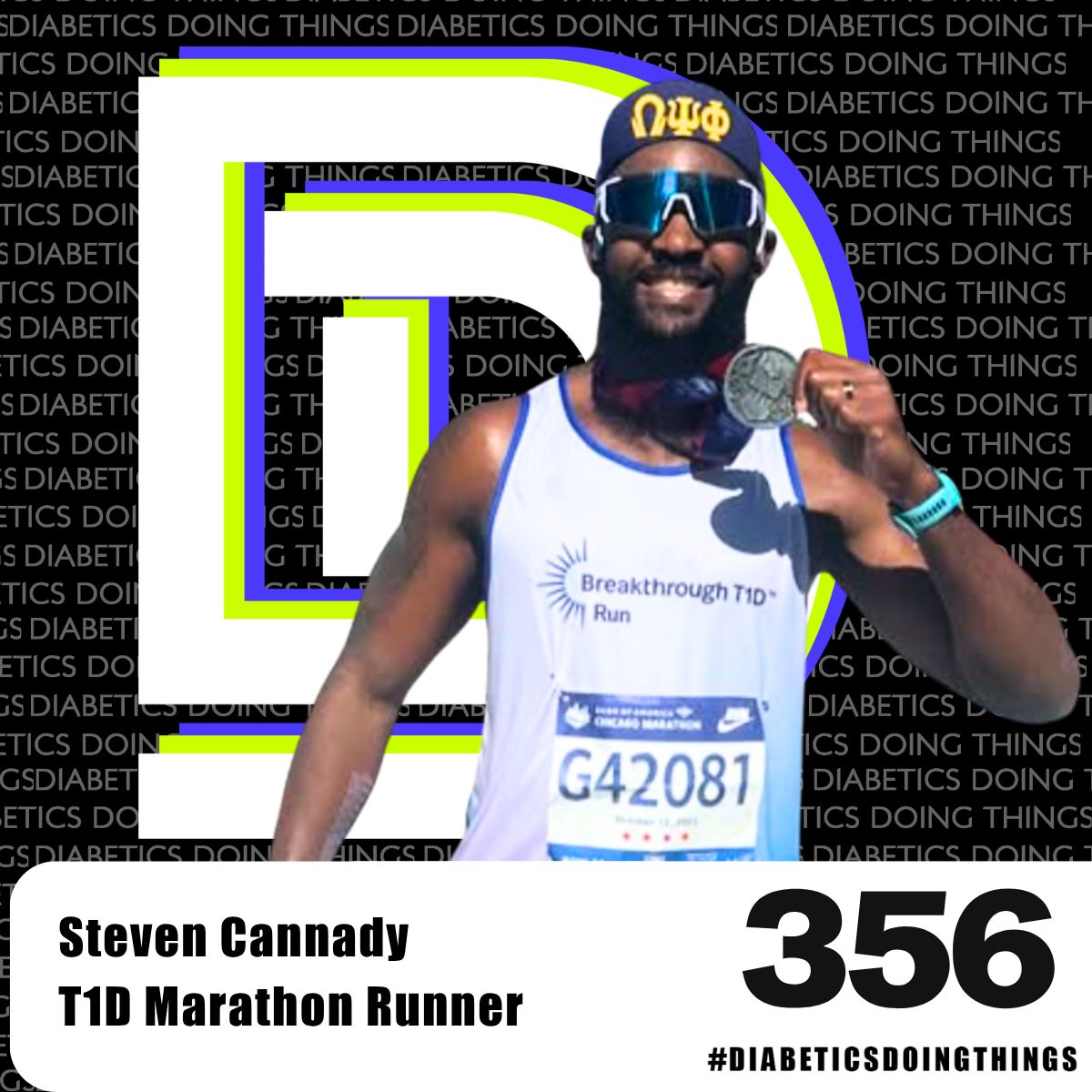
Steven Cannady was diagnosed with Type 1 diabetes on December 21, 2004, during Christmas break, in eighth grade, after eating a family-size box of Fruit Loops and spending hours on the kitchen floor before his mom got home from work. Rob was diagnosed one week later on New Year's Day 2005. Neither of them knew this until they were halfway through this conversation. Twenty-one years later, they're both living actively with T1D and talking openly about it, and it shows. Steven has run six marathons in roughly two years, starting with the New York City Marathon in 2024 as part of the Beyond Type 1 team. He just earned a spot on Team Abbott for the Sydney Marathon, a seriously competitive field. But the race that meant the most wasn't the fastest one — it was the Raleigh-Durham marathon earlier this year, where he ran slowly through the streets of the city that raised him, stopped to talk to friends at mile markers, and decided that running doesn't always have to be about the clock. This episode gets into the nuts and bolts of marathon prep with T1D — carb loading with Maurten, skipping insulin entirely on race day, why Steven would rather run high than risk going low at mile 20, and how 77% time-in-range can be genuinely excellent management. He also gets into how a doctor scared him straight during his second DKA in 11th grade, why he doesn't drink Diet Coke and won't pretend otherwise, and how a single conversation shifted how he thinks about living with diabetes versus managing around it. Steven is MDI — no pump — and runs with fruit snacks in his pocket. He's not interested in letting diabetes set the terms of his life. This one's worth a full listen. Chapters: 00:00 Introduction — who is Steven Cannady? 01:17 Duke fan crashes Carolina basketball camp 02:14 Eighth grade, Christmas break, DKA diagnosis 04:05 First weeks with T1D — family holds him down 05:42 Rob and Steven were diagnosed one week apart 06:35 Going back to school and the Seattle trip prank 08:58 Going public with diabetes — why Steven started sharing 10:45 Six marathons in two years — how it started 11:42 Running as therapy and running through Durham 15:08 Running is more mental than physical 16:56 Race prep breakdown: 3 miles vs. 10 miles vs. marathon 19:12 Carb loading, Maurten, MDI, and skipping insulin on race day 22:32 Diabetes in the background — not the only conversation 24:23 Diet Coke, cookies, and the food police 25:40 Learning to run while high — reframing the numbers 28:59 Duke Camp, honeymoon phase, and bringing diabetes along for the ride 31:33 Wrapping up — Diabetes Legends camps and Team Abbott Resources: Steven Cannady Instagram Maurten Gel Packs
0:00Rob HoweHey podcast listeners, very exciting episode for you guys today. You may have seen this man running all over social media from the past couple of years. His name is Steven Cannady. He's from North Carolina and he and I dig in and talk about not only his diagnosis, we were diagnosed one week apart. He was diagnosed in 2004 and I was diagnosed at the end of 2004 and I was diagnosed January 1st, 2005. So that's a fun discovery that we make halfway through this podcast. Steven has also run a number of marathons over the past few years. And started with the New York City Marathon on the Beyond Type 1 team, which he's done now twice. And at the time of posting, I wanted to give Steven a big congratulations because he just published that he's going to be joining Team Abbott, which is a very competitive marathon team for the Sydney Marathon that's coming soon. So I want to wish Steven a great race prep. And he breaks down sort of his race prep checklist, his training checklist, and why his most recent marathon, which he ran in Raleigh-Durham, was his most meaningful. So please enjoy this podcast episode's special conversation with Steven Cannady. Guys, who was MVP of the chat? Rob Powell! Rob Morgan Powell! What were you on? We need more of that. It's official. We got Steven Cannady here on the pod. The man that needs no introduction when he's not running a marathon. He's the first ever undercover Duke participant in the Carolina men's basketball camp and survived it. Steven, man, welcome to the show.
1:30Steven CannadyHey, thanks, Rob, for having me. Yeah, that camp was, I'm not going, it was a fun camp. I can't, an opportunity came up. Again, I know a lot of people. My mom worked for CareSource, who was a sponsor. He didn't want to go, asked me if I wanted to go. I looked at the itinerary and said, yeah, sign me up. And I let it be known that I was a Duke fan to everyone there. I got a lot of hate for it, but wonderful camp. The facilities at UNC were amazing. We got, you know, free swag that I gave out.
1:58Rob HoweYou keep any of the swag from the camp?
1:59Steven CannadyI kept the Jordans because they're Jordans. Yeah. I kept like two shirts. Anything that was Jordan branded only, I kept. But if it was like UNC, I was like, anybody want this?
2:08Rob HoweYou can't. Let's talk about, because I was digging into like the box scores. I was like locked in for you on this camp. Oh, yeah, yeah, yeah. Love those like... opportunities to do like the adult basketball camps. We had a Ben Zeal friend of the pod, like a adult spring training with like one of the MLB teams. So like the fantasy camps, like a cool, really cool thing. Um, all right. Anyway, let's talk about you, man. Let's talk about your life with diabetes. How did you learn that you got type one?
2:32Steven CannadyEighth grade Christmas break. I was 13 and I'm just, you know, doing what any young man would do on Christmas break, eating cereal and watching cartoons. I think that day I might've had an entire box of Froot Loops, the family size box. I was just eating Froot Loops. And I kept using the bathroom. I felt nauseous. I was thirsty as I don't know what, really thirsty. And at the time we were staying all together. So it was like me, my three brothers and sisters, which was four of us. And then my grandma and my mom, we're all staying in the same house. And my mom was the only person who drove at the time and she was at work. And I don't know, from like four to six, I was just laying on the kitchen floor, could barely move. And my mom gets home, takes me to the hospital. I'm in the ER for four to five hours. They finally take me back. Now I'm in the back for another additional, like an hour and a half. And I kept using the bathroom. And one of the nurses was like, hey, you used to use the bathroom maybe like 10 times in the last hour, hour and a half. They said, okay, somebody took his blood sugar and ketones and all that stuff. Again, two and a half hours after I'm in the back. And then they was like, oh, yeah, you have diabetes. So that was the story. I think my sugar was like five, five, five weeks. And again, this is 04. So I guess people didn't know what to do then or maybe that they weren't trained enough to know like, oh, let's take the blood sugar when you first go back. But yeah, that's how I found out. When they told me, I really didn't understand it because all I knew about diabetes was something about sugar. And that was the extent of me knowing anything about diabetes. So it definitely was a shock.
4:05Rob HoweI think you'd still be surprised, like even now with all the knowledge we have, depending on where you are and the time of day or like what people notice, it doesn't get flagged sometimes. Like some people get sent out without their sugars getting checked at times. So it is interesting though how somebody noticed you going back and forth to the restroom so much. Like, oh, hey, let's check his sugars based on everything else that's going on.
4:27Steven CannadyThat seems like it.
4:28Rob HoweWhat do you remember about like your first couple of weeks, months, like adjusting and learning how to care for yourself?
4:33Steven CannadyYeah. So again, it's since Christmas break. I actually left the hospital Christmas morning in 2004, left the hospital Christmas morning. I remember the night before we went back to school, I like that in the hallway. So everybody can hear me crying. I wanted some attention, but no, I was just like nervous and scared. Like I got to go to school. I have to go to the nurse's office. I was like, what is going to happen to me? Diabetes. You know, that Monday or Tuesday, my mom goes up to school. We have a meeting with the nurse, do all the things. Honestly, what I remember the most is the support I had for my family. Like I said, it was seven of us all staying together at the time. And everyone like pitched in. Like my aunt, my grandma. We went to classes at Duke, Lennox Baker, which is the children's hospital still, or was the children. No, Lennox Baker stood around, so the children's side of things at Duke University. The classes were amazing. But yeah, my family, yo, my family held me down. Made sure that we would go to Hardee's. I would do the low carb burger, just the lettuce burger. And then, and then they would count my fries out. It was, yeah. So those first weeks, months definitely was more family support. And as I got used to it, which didn't really happen until like 10th grade, it was, it was most of my
5:41Rob Howefamily helping me out. I'm sitting here listening to you share your story. We were diagnosed over the same Christmas break, bro. Well, because I was diagnosed on New Year's day, 2005. So you were Christmas day, 2004, you know, six days later, I was right where you were. So that's,
5:56Steven CannadySo that's crazy.
5:56Rob Howe21 years ago.
5:57Steven CannadyHappy New Year.
5:58Rob HoweRight.