
DeviceTalks Weekly · DeviceTalks Podcast Network
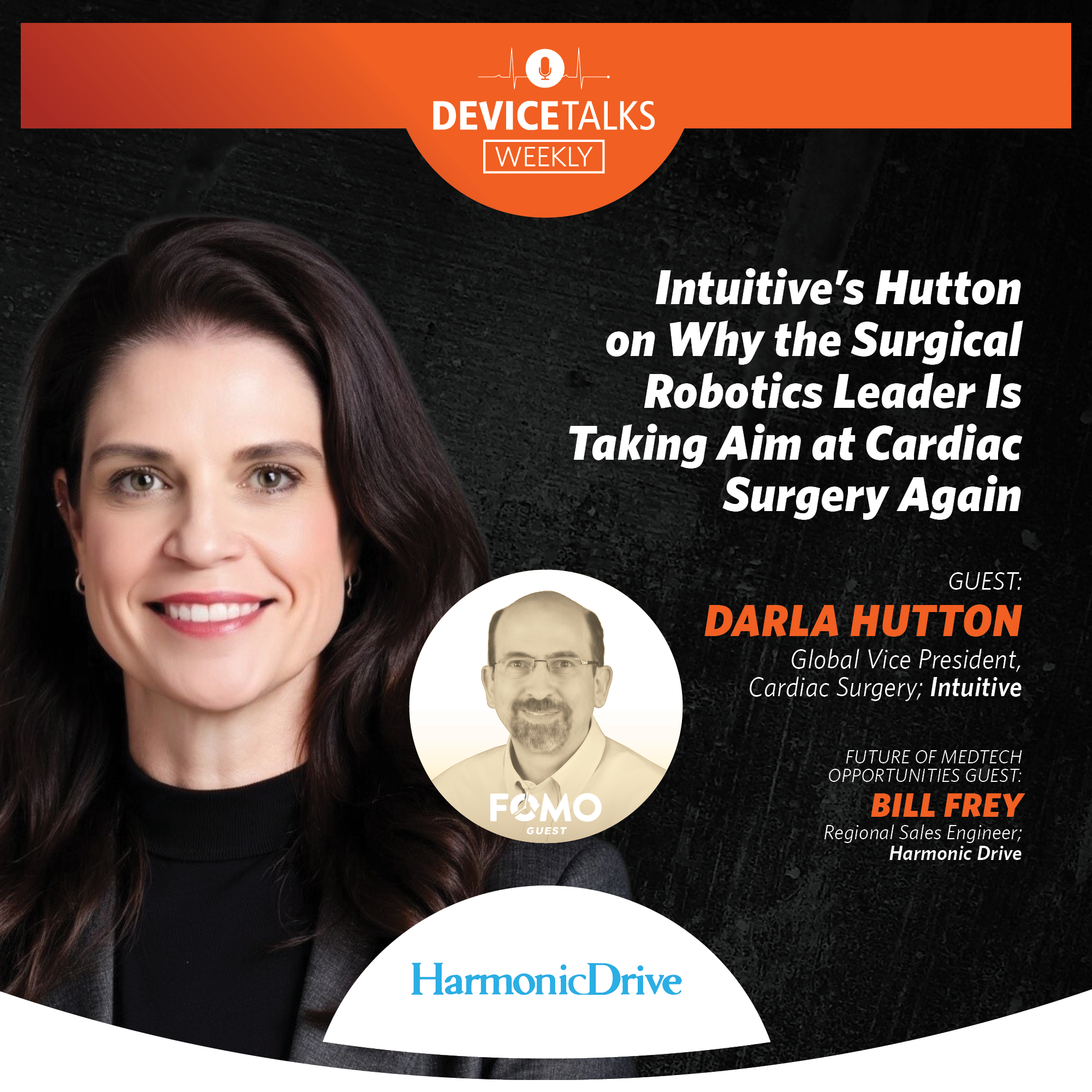
In this episode, Host Tom Salemi is joined by Darla Hutton, Intuitive’s global vice president of cardiac surgery, to discuss the surgical robotics giant’s return to cardiac surgery. Intuitive famously aimed for the heart at its outset but pivoted when cardiac surgery proved too complicated. Today, heart patients and surgeons are pushing for minimally invasive procedures, and Hutton, a former cardiac surgery OR nurse, has been tapped to lead the company’s push into an increasingly competitive specialty. But first, Harmonic Drive’s Bill Frey, regional sales engineer, joins us in the FOMO Studio. Go to HarmonicDrive.net for more information. Filling in for MassDevice’s Chris Newmarker, Senior Editor Sean Whooley wraps up the five biggest stories to come out of the American Diabetes Association meeting — Abbott, Senseonics, Sequel, Dexcom, and Insulet. *** Enjoy the show? Follow DeviceTalks Weekly on all major podcast players + Follow us on YouTube.com/@DeviceTalks to ensure you never miss an episode. Want access to the complete DeviceTalks Podcast Network (DTPN)? Follow us today at https://devicetalks.castos.com/subscribe Chapters (00:04:43) - Abbott studies reinforce DKA opportunity following dual sensor milestone (00:07:13) - Senseonics study supports Eversense 365 CGM with automated insulin delivery tech (00:09:20) - Sequel Med Tech data supports twiist automated insulin delivery in type 2 diabetes (00:11:18) - Dexcom study highlights benefits of G7 CGM in non-insulin type 2 diabetes (00:13:01) - Insulet data backs Omnipod 6, fully closed-loop AID systems (00:16:29) - FOMO Studio - Bill Frey, regional sales engineer, Harmonic Drive (00:27:14) - Keynote Interview - Darla Hutton, Global Vice President, Cardiac Surgery Intuitive
0:00Speaker AHey, everyone. Tom Salemi here. Thanks for joining us on the Device Talks weekly podcast. A little later in the podcast, I'll speak with Darla Hutton. She's the global vice president of cardiac surgery at Intuitive. We'll talk about Intuitives, move back into that critical space. Before that, Bill Frey, regional sales engineer of Harmonic Drive, joins us in the FOMO studio. We'll talk about the future of surgical robotics from Harmonic Drive's perspective. But we'll kick it all off with the conversation between me and. And not Chris Neubarker, but the amazing Sean Hooley, senior editor of Mass Device. Sean's filling in for Chris, and he's going to focus on the news that came out of the American Diabetes association meeting. Before we let you go, Please go to devicetalks.com and register for our upcoming webinar on biocompatibility. You can go to devicetalks.com for more information. Now, let's get this podcast started. All right, you ready for this? Ready. Sean Hooley, welcome to the podcast, my friend.
1:19Speaker BThank you very much for having me. Good to be back.
1:21Speaker AYeah, it's nice that we got rid of that old guy Newmarker, finally made him take some time off, celebrate his big 50th birthday. But very happy to have you filling in. And we're gonna do things a little bit differently. We're gonna have a little bit of a tighter focus on this week's newsmakers. Sean Hooley, what have you chosen for our focus of the episode?
1:46Speaker BI got big shoes to fill with Chris gone, so I decided to just go in a different direction so it didn't look like I was trying to fill them at all.
1:53Speaker AThere you go.
1:54Speaker BNo, as sort of the de facto cover of diabetes tech news within the Mass Device drug delivery business, medical design outsourcing enterprise. ADA was this past weekend, and I wasn't there, as I have been the past couple years, but I was still keeping an eye on all the reports and data coming out of there. So quite a few stories over the weekend that cover some really interesting diabetes tech at the American Diabetes association scientific sessions. So we're gonna talk about five stories from that.
2:29Speaker AYou're more than de facto, my friend. I think you are in facto our diabetes lead. Correct?
2:36Speaker BSure, why not?
2:37Speaker CI'll take the nickel.
2:38Speaker AYou are the one. So you've been to ADA before? I think because of Device Talks, Boston, you weren't able to make it this time around. But we'll. What. What was. What has been your takeaway from. From these meetings? I mean, these meetings can just sometimes be so, so big that you're almost. There's too much to cover and you can get lost in it all.
2:59Speaker BDefinitely. I mean, it's. And it's one of those things that, that's probably not smart for me to admit on these airwaves, but the scientific sessions. So sometimes the data can be a little bit out of my league in terms of some, some of the things they're talking about. I am not a scientist to.
3:14Speaker AI cover the. I follow those entire conversations now. I, I hear you. You kind of sit there. You're like this title, like, Almost Understood. So I was hoping I could get a glimpse of what was being hap. Of what was being said.
3:26Speaker BI heard Glucose in there somewhere. Everything else, no, but it, it's, you know, they're interesting to sit in on and, and try and wrap your head around. But for the most part, when I've attended, you know, it's been about taking the opportunity to actually meet in person with a lot of the companies. And, you know, they have really cool, you know, expo floor setups where you can, you know, it's my first experience holding an Omnipod or, you know, seeing sort of some of these devices up close. So that, that's, you know, really the, the best opportunities for someone like me or someone like you at ADA would be, you know, being up close and personal with some of the shakers and movers in the industry.
4:05Speaker AAbsolutely. No, that's always a good thing. And it's, and it's great to meet the people you, you talk to via Zoom, to meet them in person, even connect with the comms folks who always kindly return emails and set up dolls. It's nice to put actual people to the, to the. Used to say faces to the names, but now I guess we have to say people to the Zoom images. Right.
4:26Speaker BAs a short man, I often find that people are a lot taller than they look on Zoom, so that's usually my takeaway.