
Design Downtime · Guy Segal
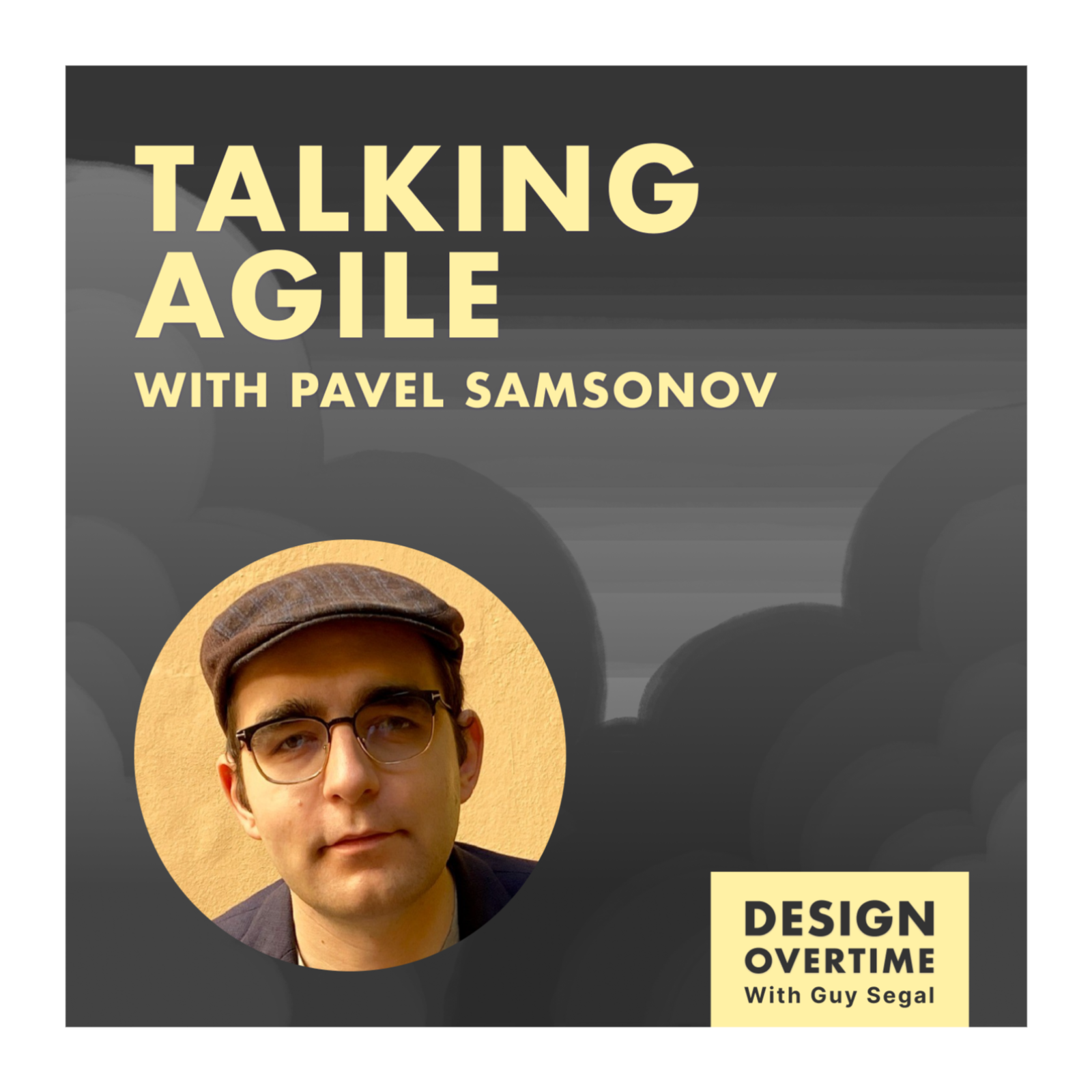
In this inaugural episode, Pavel and I dig into the history and dysfunction of Agile, not to relitigate waterfall vs. Agile, but to examine why modern Agile practice has drifted so far from its original intent. We explore how the Agile manifesto was written entirely without designers in mind, how the "Scrum industrial complex" turned a flexible philosophy into a rigid checklist, and why two-week sprints often amount to waterfall in disguise. We cover the critical role of feedback loops, the danger of prioritizing outputs over outcomes, and why shared problem understanding is what teams actually need. We also make a case that good design principles are the closest thing we have to a genuine fix, because design is built around the kind of iterative, goal-questioning thinking that Agile always promised and rarely delivered. Guest Bio Pavel Samsonov (he/him) is a Principal Experience Designer at Justworks in New York. His approach to product & UX draws from his research at Nielsen Norman Group, experience building design practice at AWS, and managing product teams at Bloomberg. Pavel often describes himself as a Problem Designer, because the biggest influence on the solution is always the framing of the problem. Credits Cover design by Kristine Planche (inspired by Raquel Rubio Breternitz).
Guy Segal [00:00:08] Welcome to Design Overtime, the podcast where we go beyond the surface -level discourse and actually sit with the ideas that shape how we work as design professionals. I'm your host, Guy Segal, a design director in Toronto, Canada. And while my other show, Design Downtime, is about stepping away from work to live a fuller life, some topics are just too important to be reduced to a hot take or a LinkedIn post. They deserve nuance and a real conversation. And that's what Design Overtime is for. And I'm glad you're joining us. Welcome to a very unstructured conversation between myself and my esteemed guest, Pavel Samsonov from beautiful New York City. Pavel, why don't you give a quick introduction of who you are for the one person who doesn't know you? Pavel Samsonov [00:00:59] Well, for that one person, I'm glad that they're joining us. I am currently a principal experience designer at JustWorks. Before this, I was at Nielsen Norman Group. Before that, I was at AWS. Before that, I was a product manager at Bloomberg. It's been a very interesting career where I've done all kinds of design and design adjacent things, which makes me extremely annoying to people who have only ever done one role in our industry and have developed certain perspectives that are not as universal as they might expect. Guy Segal [00:01:33] That is a beautiful introduction. Thank you, Pavel. And a bit of a context on why we're talking today is that Pavel and I have been chatting for a while, and I like to send him links that I know will annoy him. And he is in turn annoyed by that, which is wonderful. And we see eye to eye on almost everything, I think, or a lot of things. But we have a slightly different perspective on agile, which is fine. We don't share a brain. I do believe we probably agree on 98% of things. But the areas where we have slightly different perspective, I said to Pavel one day, hey, why don't we just have a chat about this? This chat is less about who is right, agile yes or no, but... More of the nuances that you can't really get from a 300 character message on Bluesky. And I thought in my hubris that this conversation might be beneficial or entertaining for other people as well. So that's why you're listening to it right now. As I like to do on my other podcast, I always like to start with the origin story. So Pavel, I'll ask you the first question. Where did you first come into contact with Agile? And then I'll tell my story. Pavel Samsonov [00:02:50] So it's a bit of a complex question because I think Agile has so many different parts to it. And broadly speaking, I think if you asked two different people, you'd get three different answers. I came across different Agile principles at different points in time. All the way back in grad school, one of my professors introduced us to Kanban. as a simple method of tracking the work we were doing and making sure we were only working on one thing at a time, rather than having 10 projects that were all 10% finished. As I graduated and moved into industry, I was working at a startup. They heavily relied on outsourcing the development. And so we had developers in an office in Minsk and developers in New York. And between the two of them, there was a very interesting kind of pseudo agile, pseudo scrum monster that can kind of consolidate itself out of, I think, everyone's conflicting ideas of best practices. And then when I finally made it to Bloomberg, was where I encountered more formal Agile with dedicated Scrum Master and Agile coach. We were talking about implementing SAFe for a frighteningly long time. And really, that was kind of that multi-step introduction from extremely informal and what I believe actually best represents the original spirit of Agile all the way into the ultra-formal, super Scrum. kind of way of implementing it, which I think many people believe is the only way to implement it rather than one of and perhaps the worst of the approaches. Guy Segal [00:04:43] So here's my story. And I think it's important to understand where people got into Agile or what flavor of Agile people are familiar with, because it paints a lot of your perception of what Agile is and where the limitations are. I started my career in software development, and I worked for a number of years as a software developer. Everything was waterfall back then. I remember a very egregious example of a 90-page technical requirements document that had to be approved several times before we were allowed to write one line of code. One of the things that I loved about that document, loved in quotes, of course, is the fact that it listed every possible error message the system would give you. Everything had to be thought of in advance. I can't even imagine how that is possible and how you can do a successful job in doing that. But that was my impression of this is how software development is done in a large company. And then in the mid-2000s, I worked at a startup and they introduced Agile, which was fairly... It wasn't the origins of... But it was the early days of the Scrum industrial complex. And we had estimation poker with the special deck of cards. And we were introduced to the Agile manifesto. For me, that short stint working like that was the purest form of Agile that I say is the closest to what I would expect Agile to be. And then every other company I went to afterwards. Agile was a series of two-week waterfalls. So Pavel, looking at your experience with Agile and looking at your, because I know you're very, very knowledgeable about the origins of Agile. I know you've done research into that. What was the promise of Agile? Pavel Samsonov [00:10:14] I think the ultimate promise of Agile. So I guess the question is to whom? Because I think Agile was sold to the business on not necessarily honest terms, not by the developers. I think the developers had different interests in mind. It was sold to them by consultants as things will go more quickly. And I think that has kind of ultimately tainted a lot of the downstream conversations around Agile because that's kind of the expectation that people have. Agile is going to make us go faster. It's going to make us get to the thing faster. It's going to make us deliver value every two weeks. and not every six months, which is faster. In the meantime, I think the value that Agile gave to developers successfully is covering their behinds because they ended up holding the short straw in every single time that waterfall went wrong. They were the ones at the very end of the process. I've heard this referred to as the goalie problem, where in hockey, the goalie gets blamed when the opposing team scores. And it's kind of like, if it's late, it blames the developers, blame the people implementing. And so one of the interesting things about Agile was that when the manifesto talks about customers, it is framing the business as the customer of the development team. The job of the development team is to deliver the thing. And so they are focusing on making the customer tell them what they want and then making the thing and being absolved of the blame for delivering the wrong thing. We just delivered the thing that was in the requirements. And I think that in that way, Agile has been extremely successful. I would say that nowadays, politically speaking, in terms of influence within an organization and power within an organization, most companies that use Agile, that power lies in the development team. And this may reflect my background, because obviously Bloomberg and Amazon are extremely engineering -heavy companies, but if the developers don't want to do something, it doesn't get done. Ultimately, they are able to say, We are not building this. And you need to have influence outside of the Agile process to kind of put weight on the people who can tell them, no, you actually do have to do that. And, you know, getting them to follow through on that. So I think that those are really the two promises that Agile is making. The velocity piece, which, you know, it has some truth. I think that one of the great things about Agile is that it lets you know when you are wrong more quickly. So you spend less time building the wrong thing, but it doesn't actually help you build the right thing faster. It just helps you figure out what the right thing is. Whereas on the political front, I think it has delivered value in spades to the organizations that were able to adopt it. And I think that in a way, it creates a model for design to fall. But in other ways, I think Agile falls. extremely short in creating the kind of workplace dynamic that would be helpful for designers rather than merely isolating us from people who want us to do things for them. Guy Segal [00:10:14] So I think a lot of the nostalgia I have for those early days of working in agile compared with waterfall before that is that a lot of the things that you're talking about just did not exist for my specific situation. I was working at a company that had no designers. In fact, I didn't even know that UX is something that exists up until two years later. We had people who were essentially product managers who were defining the strategy or a roadmap of what the features of the product should be. But the power was pretty much in the hands of us developers. And we never assigned... I know that you're not supposed to, but... I've seen it everywhere that people correlate story points with duration of work. We were very, very adamant on this does not reflect how long it's going to take. And it was never about delivering faster. It was honestly about building something that we can quickly see if it's the right thing to do. So I think a lot of that intention of can we have something quicker instead of like you said in six months that we're going to discover oh we shouldn't have built that we can discover it much quicker there was never any sort of push of you need to have something ready by this date which again a huge trap of what people call you know agile today because once you put a date on something then you might as well be working in waterfall by that point. Pavel Samsonov [00:11:46] Yeah and i think that is fascinating that And you can really see that in the way that the manifesto is written. And honestly, in the way that even Scrum is designed, even though Scrum is a bit older than Agile, that the people writing it had no idea designers existed, even though human-centered design or HCI or human factors engineering or whatever you want to call it is decades older than Agile. And I would say decades older than software programming. But the people working on it had no idea. And I think that isolation is a huge disservice. But what you said about waterfall, where you write out this whole spec and you kind of assume this is how it's going to go. This is everything the software will do. This is every error you can possibly throw. You kind of get that sense from the way that the Agile manifesto is written, where you still have exactly that same problem. The manifesto says nothing about... defining the requirement. It has nothing about understanding what the customer's needs actually are. That is all someone else's job. And you only put the responsibility upon yourself of building the thing they asked you to build. And I think that is one of the biggest flaws. It's sort of the legacy of that manifesto that has continued to hound the entire discipline since that day. I think now, you know, you go on LinkedIn and I don't recommend this, but you go on LinkedIn and everyone is talking about how this is the opportunity for designers to be more strategic, for developers to be more strategic, for product managers to be more strategic. And you would think that those are the people who are supposed to be strategic all along. But everyone is saying AI is going to take care of implementation and you're going to do strategy. And I'm just sitting here wondering what the hell were you doing before this? You were supposed to be doing strategy all along. And I don't think a new experimental technology is the thing that's suddenly going to enable you doing strategy. If you look at any company in the world, were they already taking 100% full advantage of experimental tech, cutting edge things in 2021, 2022 before chat GPT came out? No, they weren't. And they still aren't. So this pursuit of let's take the most experimental thing we can find and jam it into everything and it's somehow going to make things better is to me extremely silly. And when you don't have those fundamentals down, those fundamentals of what are we actually building? How do we tell if something is good in the first place? How do we make sure the requirements are the right requirements? No amount of agile is going to work. And I think that this is something the original authors of the manifesto have admitted themselves was naive about the manifesto. And it's something that was already known at the time. They should have been looking at the broader spectrum of computer science under which human-computer interaction would fall and cybernetics and psychology and all those other things and looked at... For example, decision-making loops, where agile is very much a level two learning loop. It's a double loop learning, where waterfall is a single loop, where you do the work, you check if the work is done. If it's not done, you keep doing the work. A second loop is you do the work and you see, is the thing that I did bringing me closer to the goal? And if not, you do something else. So the OODA loop is a very common example of double loop learning however user experience design has been operating in triple loop learning for essentially ever since it has existed and the third loop is is our goal even the correct goal that we're working towards and so double loop learning can never question the goal because that is not a feedback loop as part of of that model It's not a feedback loop that's part of Agile. You just fulfill the requirements and then you send them off to someone else and they tell you this was the right thing to have built, go build more of this, or we are pivoting. And then you say, cool, I'm glad we only spent two weeks on this. But that all happens outside of that system. And the understanding of that type of dynamic already existed at the time Agile was being created. And I think it's partly because the whole thing was kind of a cover your butt maneuver. that the authors of the manifesto were not able to conceive of the fact that they could have influence on what the problem was. They could have influence on the definition of the problem, or what I like to call problem design. If you are on LinkedIn, which I again do not recommend, you may have seen myself labeled as a problem designer. That is not a designer who is a problem, but a designer of problems. Well, yeah, you're doing this sort of so-so gesture. It's fair. I cause my share of problems. But the main reason I use that term is because the problem framing contains within itself 80% of the solution. And you can't really think about whether or not what you're doing is fit for purpose unless you also have a legal understanding of why the problem is framed the way it is framed and what parts of it you have chosen not to engage with. And I see this happening all the time. with another piece of, I think, what is considered to be agile, but what has nothing to do with agile at all, just the MVP. Everyone also will give you a different definition of what an MVP is. But ultimately, I think the MVP is kind of like, what does the person with the most influence want to put into the thing? Let's get a list of features. We rank the list of features based on priority, quote unquote, where priority is, once again, the highest paid person's opinion. And then we time box and everything that fits into the time box. And that is a recipe for making the worst possible software that you can imagine. Because there's no coherent experience. It's just how long is our checklist of features going to be? And this is where you get kind of the arguments around velocity. How do we squeeze more features into it? And the answer is you make every single feature worse. And the less time you spend on it and the more crappy you make it, the more features you get fit in. But a hundred crappy features don't equal one good product. No amount of crappy features can be. And so because people don't understand the problem and more importantly, there's no shared understanding of the problem. They just go and build those features and they cut corners wherever they need to in order to deliver something that is feature shaped and not necessarily a solution. to the actual problem they were supposed to be solving. That is now the job of someone else. But the problem is that our timelines don't reflect feedback loops. And this is such a scrum thing that teams will get together for quarterly planning. And there's a set of story points. We can deliver, let's say, 60 story points per quarter. We're going to slice them up like this and go and do it. What happens when you deliver something after those two weeks, you figure out it was the wrong thing to build? Well, you didn't leave any slack in your timeline for changing it. So effectively, like you said, it's just waterfall with extra steps. It's just waterfall and two-week sprints. You find out that the thing you built is the wrong thing, but you have no power to do anything about it. And so you create this pressure on those very same product managers. to sign off on what we shipped and pretend like it was the thing that's valuable in the first place, because no one is actually empowered to say, hang on a minute, that's not the right thing. And so this is where the whole build, measure, learn loop breaks apart, where it just becomes build, build, build. And it's politically infeasible for someone to say, we measured it and it's the wrong thing. Guy Segal [00:19:57] Everything you said helps me solidify for myself. What makes modern day Agile practice such a departure from my beautiful experience working in those early days of Agile. Because you're absolutely right. I don't think there was any sort of consideration to design or human computer interaction by the people writing the manifesto and creating Agile. It was purely a mechanism. The problem they were solving is how do we avoid discovering in six months that we build something not even wrong, something that isn't working or isn't doing the thing we wanted to do. Because the assumption was that the requirements are the requirements. We're going to build those, whether they're right or not. I don't think there was any thinking of, is this the right thing or not? It's more of a every two weeks, we're going to have something and we're going to see, does it work? Did it break something before? And it's quicker to pivot to something that, you know what, instead of making this. move this thing around here. We actually want to move it up. The original sin of then going from that to a company-wide process that is sold by consultants is taking that model and saying it applies to everything we do at the company. It's going to apply to how we build products in general, not just the small part, not small, but the part of the work that is about taking the requirements and implementing them. And there was never any talk of, are we building the right thing? What is the right thing to build anyway? Pavel Samsonov [00:21:34] Yeah. And I think you touched on something really important there, which is scaling out this agile process to everything. Because first of all, it's not really scaled out towards everything. Business does not make decisions on a two-week cycle. Business makes decisions on a one-year cycle. And so really you have year-long sprints. And that's part of why... When the features go wrong and you find out you've built the wrong thing, you can't actually admit it. It's because the business made all of its decisions assuming that it was correct. And there's no feedback loop that goes into it until the end of the year and planning starts again. But the other piece I think is even more important, which is the manifesto starts by talking about, you know, we are doing software development. We have found ways of doing it. and we want to help others do it. It has nothing to do with product managers. It doesn't say that. It's developers. It's the specific developers who were practicing doing things in that way, wrote down what they were doing. And the lesson I think that was taken away from this was this is the right way to do things. And personally, I hate best practices anything. And the reason I hate best practices anything is because it helps people turn off their brains and say, we are going to implement best practices. Here's the book of best practices that we bought from Mr. Best Practices, who has, you know, the best rated one on Amazon. We bought this book and we're going to run down the checklist and we're going to start implementing all the things that are in this book. So first of all, it creates a proxy for success. The proxy is now not we build good software, but We implemented the right process. And so you can say, cool, we did things the way that Scrum tells us to do things, the way that Agile tells us to do things. There's no conception of is this helping? It's kind of in the same way that it was assumed that the requirements were correct. We're assuming these requirements are correct. And therefore, because we are doing things agilely, it is better than it was before. Metrics are hard. It's really difficult to figure out how to measure as you're actually creating value. And I think people buy into this idea of we have switched our process to the process that everyone who is successful does and therefore we're successful. And the Spotify method is another one. React is another one where everyone's using React because Facebook is using React, even though the problems that you're like 50 developer website. is facing is nothing like the problems that Facebook and WhatsApp and Reality Labs and all those other products are facing. The thing that people should have taken away from Agile, which I think a lot of modern Agile coaches actually do talk about, I think Allen Holub and Tim Ottinger talk about this, is that the rules, the specific rules don't actually translate between teams. What translates is autonomy. Give the team the autonomy. to figure out what works for them, and let them do that thing. It's not really important what they decide to do, as long as it's working. And this is, I think, also part of lean. It's the Toyota way starts with this. And people also took away the wrong lesson, and they took away the lesson that if you do everything lean, you get things more quickly. I think lean has kind of become integrated into agile in a weird way that makes no sense to me. And the chimera that has come out of this is we are going to do everything in high fidelity because it's faster. And we are just going to go build this thing in two weeks. We're going to have a prototype. We're going to have a release. It's going to go out into production. And it's kind of like the opposite of lean, actually. Because the whole point of lean is that you do the smallest possible amount of work to teach you what you need to learn. And people thought, oh, that means we can skip. the low fidelity stages. But actually, what that should have meant to them is you can stop at the low fidelity stages. Because once again, the whole point is to figure out what is the dead end? Where should we stop? Where should we discontinue? What is the signal that something is not working? And these processes never anticipate that. People look at the double diamond and they're like, cool. So it has four steps. We do these four things that we did design. No, no, it's a feedback loop. If you actually read the thing, the text that accompanies the graphic, it's a feedback loop. You do the diversions, you do the conversions, and then you keep doing it until you find what you're looking for. But people don't implement it that way. People implement it as a linear process. People implement agile as a linear process. And so you get this whole like design works two weeks ahead of agile thing. And you're supposed to give the developers, you know, mock-ups in those two weeks. And then they go and they implement those mock -ups. And people think that's agile. Whereas it's not. It's the furthest thing from... Like if you told the authors of the manifesto that people were doing this, they'd be horrified. Guy Segal [00:27:03] I totally agree with you about best practices. I'm a big fan of understanding what are the core principles that you want to uphold and then finding a way that works for you to implement those. Based on how design that includes user research, for example, works, the feedback loop is already built into the way designers work or should in an ideal world. They should have the time to try something. learn from it, refine it, and so forth. Have those ongoing feedback loops. Design is already working in a way, in an agile way in that sense. If we inject the concept of a feedback loop of learning from what you're doing into the intention of agile. So where does agile go wrong for design? Is it the fact that it forces designers to adapt to the two-week sprints that developers are working in? Pavel Samsonov [00:27:59] I mean, quite frankly, I think that is the same place that Agile goes wrong for developers, is telling them to work in two -week sprints. No one except the authors of Scrum picked two weeks as like the golden standard. It's one of those things that kind of just happened somewhere and everyone went and ran with it. And for a lot of things that you want to do, two weeks is not enough time. And for a lot of things that you want to do, two weeks is way too much time. And so I think the main problem, though, is what you said, right, is design is working in an agile way, but development is not working in an agile way. And I think the mistake is treating design as something that goes within agile, because what you get then is not necessarily that it's bad that designers should be two weeks ahead of the developers. What's bad is what designers are excited to provide two weeks ahead of developers is mock-ups. Because, unfortunately, modern agile means JIRA. And JIRA, like any other tool, constrains the possible courses of action. It trains us to do certain things over other things. And people, the same people who take agile to decide what their goals should be, what the ideal process should be, look to their tools. to tell them what their goals should be as well. And they look at Jira and Jira has certain fields for certain things. And one of the fields that it has is upload file. And so what that trains teams to think is design is when you upload the file. And you go search LinkedIn or search Reddit or search anywhere for attach mock-up to Jira. And you will see thousands of results of designers being treated as though that is their job. Is they are done when there is a mock-up attached to Jira. And it's because, JIRA is shaped in a way that that is how design fits into. It's the only way that design fits into it. There's nothing about research findings. There's nothing about reports. There's a field for acceptance criteria and a place to attach your mock-up. And so the conversation between designers and developers becomes... What do you want me to do? What does it look like? Describe it. And now we've gotten to a place where people make the most monstrous and ridiculous prototypes in Figma to articulate how the thing should work. And I think that's extremely pointless. It's a waste of everyone's time. It's a waste of my time to make that. It's a waste of a developer's time to look at it. Because there are two much better ways of articulating how it should behave. One is code. And I don't want people to take this the wrong way. I actually think that designers coding is most often counterproductive. It makes you think that code is a solution to all your problems. But also a developer is always going to be better at coding than you are. And so a lot of designers who code think that certain things are impossible that are actually quite straightforward. Of course. Some designers think things are straightforward that are actually impossible. And the reason they're impossible is not because of the code. And so you get into a lot of different conversations that are not very productive around that. But the reason that I'm bringing up code as being, you know, a better way to communicate what you want is the developers should be writing the code. But the developer should be writing the code based on an understanding of what the problem is, not what the solution is. Because quite frankly, the solution takes the shape of its materials. And the code is the material. What the developers need to do is understand the problem. They need to understand the things that are in the research report. They need to understand what parts of the problem are valuable for the business to solve. If you look at the Venn diagram of what is it, viable, feasible, desirable. There's no such thing as something that is just feasible. And I had this come up all the time at Bloomberg. People would say, well, is this feasible for us to solve? Now we'll say, feasibility has nothing to do with it. This is a problem that is going to earn us a billion dollars if we solve it. I'm willing to put as many developers on this problem as it takes to solve it. What is feasible? in the context of a billion dollars, is completely different from what is feasible in the context of, you know, your dinky hobby project that, you know, you work on for an hour or two every month. It's a direct proportional relationship between feasibility and resourcing. We are willing to invest in this, therefore it is feasible. Tell me how much resourcing you need. And without understanding that, you kind of get to a point where you're making decisions based on arbitrary things. You're making decisions based on what should be true. This is impossible, period, therefore we will not do it. And not, this will take us this much time and this many people and this much effort. And not, here are the uncertainties and we will need to figure them out in this way. And so there's processes in Scrum and in Agile for dealing with uncertainties. but they don't start with a mock-up. And so I think that's really the disconnect is you kind of have the product manager in their role as Jira operator become the bridge between an understanding of the problem and an expression of the solution. But the bridge is not actually serving any purpose because the designers and the developers are on the same team in the same building. They can just talk to each other. And I think the way that Agile mediates that conversation is very frequently not productive. It's the opposite. Because the developers treat it as their job to implement the mock -up. And they dig their heels in quite often. And they're not willing to attend meetings. They're not willing to learn about the problem. They're not willing to help conceptualize what the solution will be. All the way up until it gets to them. And then they're willing to say, well, I don't like it. I don't think this is intuitive. Well, it's not your job. The time to determine whether it was intuitive or not was like two months ago. It was upstream. It was when we were framing what the problem is. We weren't framing who the audience is. Now, we already know who the audience is. And the audience is not developers. I don't care what's intuitive to you. And this is part of the problem because, as I mentioned before, the developers have political power they have a lot of influence they're the highest paid people mostly on a team even of equals even on a team where the developers are lower level on the scale that designers often they're still paid more and so they're considered more valuable they're considered more influential and someone will just say i'm not going to do it i think this is wrong and you have to deal with it and that's not a problem that knowing how to code is going to solve That is a problem that alignment around what the actual value customers need is. And I think that one of the problems with the original formulation of Agile, where it kind of separated developers from needing to know what the problem is, resonates throughout time up until this point and creates kind of this impasse. I'm not saying that Waterfall was better. I think every single time Agile comes up, someone will say, oh, well, you know, in the past, it was so much worse. Waterfall was worse. But I think that Agile didn't actually save us from quite a few of the ways in which Waterfall was bad. Guy Segal [00:36:02] Because it didn't really address the problem. Like there was no understanding of what is the actual problem. And I think... A big part of it is the A word you said, alignment. That's one of the things that I try to push for as much as I can whenever I can, because it doesn't matter if you're using Waterfall, Agile, what the next thing is going to be, that's going to be a reaction to the myriad versions of Agile and Scrum. If you don't have that alignment, you didn't solve things. If you don't have a shared understanding of what is the problem and why we want to solve it and why we want to solve it in a certain way and what are the other solutions. you didn't really fix anything. And I think that is exactly as you said, having a designer and an engineer sit next to each other and just like, hey, what do you think of this? What do you think of that? Oh, you know what? I think I can do it in a better way here. That conversation removes so many obstacles and removes a lot of the need for improving handoff between designers and developers and all those things. And then you can work in two-week sprints if you want to. But as long as you have that initial understanding, I've seen a lot of developers who could not care less about the problem, but I've seen a lot of developers who, and I think they were better developers as a result, who did show interest, who did want to be involved, who were curious because they realized that their job is not, just like a designer, their job is not to put lines and rectangles on a screen. But their job comes way before that. The job of an engineer is not to produce. I think you just had it in one of your recent newsletters, the difference between coder and or programmer and engineer. The engineer needs to understand the problem. And then the output afterwards is lines of code. But that's not the actual job they have. Pavel Samsonov [00:37:56] Yeah, I think that honestly, that's such a big part of the problem is the incentive is very much around lines of code. And I think a lot of, especially junior programmers, I'm not going to say engineers, they're not engineers. They see themselves as coders. They see themselves as producing code. And that's kind of where the 10x programmer thing comes from is they write 10 times more code. And so with that mindset, I think Agile actually works really well for those people. Because what they make sure is that by the time you hit go on a sprint, they have everything they need to write code. And they couldn't care whether or not that code is valuable. That's not their job. Their job is to write the code. And so they have all the inputs. They have the mockup. They have the premise. I mean, tell us what it's supposed to look like. And they see their job as doing that. And then they ship it off and they don't care. And I think that honestly, that attitude of I did my job, I checked my box is a big cause of why both AI adoption is so high among developers. And why the quality of the code is so bad. Because it's so much easier to check the box when you have a box check. But it doesn't actually help you make a thing that is valuable or useful or something that people will want. It just helps you check the box. And a lot of the time, the box feels checked. And then you pass it on to the users and the users find out. And well, that's job security. Because now you get to write more code to fix the bad code that you shipped in the first place and it's not a very good way of working and i don't think that most people want to work that way i think it's very common among UX designers to kind of assume that everyone is stupid except and everyone wants to make bad software that sucks and they are the only champion of the user and i think that is an interesting attitude to have. Because anyone who's ever tried applying that attitude in practice quickly finds that no one listens to them. And they have no influence and they have no friends. And all they do is complain on Twitter about how everyone is, you know, doing the wrong thing. And if only they listened to the designer, everything would work super well. Well, like I said, I was a PM for three years, PMs want to make good products. You know, developers want to make good products. I think if developers didn't want to make good products, Agile would look a lot different. Ultimately, given the choice, no one would choose to make a bad thing over making a good thing. But it's a combination of bad incentives and people not really knowing how to do a good job. And this is where the design comes in. I think that you're right. You know, I've written about this extensively that the solution to agile not working well is design principles, is loops. It's in a way fighting the trend of certainty and velocity because there are certain things that we can't, you know, be 100% about. And I think that managers really, really, really want that sense of control and a sense of transparency and a sense of predictability. And that's why they love story points and they love two-week sprints, because it makes software development feel predictable. And it's not. You're never going to be able to predict everything. You're never going to be able to anticipate all the error messages that will come up or all the ways in. which your understanding of the user's problem or their context is incompatible with the actual situation. But you get outputs every two weeks. And a lot of companies cannot tell the difference between an output and an outcome. And quite frankly, a lot of teams are not capable of shipping something every two weeks in the first place. And so kind of the output feels like an achievable goal. Hey, you know, we're not that good at this whole software thing. We're just going to focus on getting something out there. And they kind of stop there. And they kind of decide, hey, we got one thing out there in two weeks. Let's try for two things. And that's, I think, the wrong attitude. Because getting one thing out there doesn't mean that you're done. It is the starting point. It's the part at which you need to be able to stop and look at what you did and see if it was effective. And that's not part of agile. That's not part of really anybody's job. And it kind of falls by the wayside. And in a way, you're incentivized to pretend that what you did was successful. My former manager at Amazon, her favorite word was storytelling. She would always say, it's really important for a team to tell the story of our success. And for five years, we kind of chased after that story. And I think that no one really slowed down to think about, well, are we doing the right thing? The focus was entirely on spinning it to make it peeling rather than changing what we were doing. And I think that's really endemic across the industry. That kind of attitude of we are doing the right thing because dot, dot, dot. Whatever the actual phrase inserted in the dot dot dot is, the actual thing they are saying is we're doing the right thing because we don't know how to do anything else. And so how do we make it look like the only thing we know how to do is work? And I think that is really the value of design is design almost says, I don't really care what you know how to do, because here is a way of learning how to do new things. Here's a way of playing. Here's a way of experimenting. Here's a way of trying new things, learning new things, and applying those things back to what you're doing. I think there is a trend, especially in companies who have this solution-oriented mindset. And any product manager, I think, really feels this. When you apply for a job, the thing you will see on every single PM job description is domain expertise. You need to have had, you know, five years, seven years, 10 years building products in this domain. Design has this a little bit. You'll see a lot of like, oh, mobile versus a desktop versus whatever. But PM is really, really, really industry specific. And the reason it's that way is because these companies don't actually believe that design is possible or exists. What they believe in is we're going to find a person who already knows what the answers are. We're going to hire them, and then they can just tell us what to do. So they're hiring to learn rather than building to learn or doing research. They're basically saying it is impossible for us to know what the right thing to do is unless we hire someone who already knows. And that is frankly ridiculous. And I think that design and the design process is how we rescue the industry from, this kind of thinking and when i say the design process i don't mean design thinking uh design thinking is kind of similar to agile in the sense that it popularized design but i think the public understanding of what design is was very different from what we were trying to say and i think we landed in a place where it has done a significant disservice for us but the actual design process is based around feedback loops it's based around how do you roll with the unpredictability? How do you become comfortable with ambiguity, but not in a way that lets the ambiguity take over, but in a way that allows you to find your path towards clarity? And I think that a lot of the time when I write about, you know, different topics on the Product Picnic or, you know, on Medium or on LinkedIn, I kind of think, hey, you don't have to say design. If you just replace design with development or business or something, 90% of this would still make sense. And I think in a way, that's because the principles are universal. And there's a reason that we talk about design thinking and not developer thinking or product management thinking. It's because design is a kind of all-encompassing framework. that absorbs these different things, that absorbs cybernetics, that absorbs management consulting, that absorbs time and motion studies, that absorbs human factors engineering. And it takes those and it takes the design process, which is the feedback loops, the iteration, the play, and it makes something that is applicable to any kind of problem solving. And I talk about this all the time, that design of products is just one of the many applications of design to anything. You can design your process and your organization in the same way that you can design a product using the same tools. And a lot of extremely expensive consultants will tell you basically that if you pay them lots and lots of money, and I'm telling you that right now for free, that that is the power of design. That's the reason that a lot of my writing could be applied to more than just user interfaces or software because the principles are consistent. They run through everything. My training originally is as a graphic designer. Back in design school, I took all of the interaction design courses that were offered and I kind of fell in love with it. That's why I went deeper into this field. Originally, the principles we learned were design principles that are not connected to user experience and not limited by it. But I think that the fact that they're universal was what allowed me to be effective in this field. And I think there's also this kind of attitude of, oh, graphic designers came and colonized UX and they are to blame for everything that's happening. I think that's a really interesting attitude to have. And it's kind of in the same bucket of everyone is wrong, except for me. Everyone else is stupid. Only us, the chosen few. And, you know, it doesn't really matter how you categorize that because everyone has a different categorization. But it always comes down to everyone who thinks like me is correct and everyone who disagrees. I think that. The focus of the industry on visuals and on user interfaces has nothing to do with graphic designers and has everything to do with the emergence of different processes that kind of prioritize having a cool user interface and downplaying these core design principles of discovery and experimentation. We could be here for hours and hours, I think, talking about this history and talking about why it is that visuals have become so emphasized in a field that has always described itself as problem solving and used, you know, visual only as an adjective to problem solving. But I think, you know, any simple narrative that doesn't actually offer a solution is not helpful. Okay, cool. Let's say for the sake of argument that, yeah, it's the graphic designer's fault. You know, everyone who started doing this job after 2008 is the reason we're here in the first place. Okay, so why? What are you going to do about it? Let's fire everyone and you have to show that you're an old timer to get a job. Well, good luck with that. I think that ship has sailed a very long time ago. I think that you need to figure out what is a productive path forward that reconciles what should be happening with where we are today. And I think that is much more to do with understanding where we are and what we're capable of and what the incentives are and doing some systems thinking around how do we get from where we are to where we want to be and not around sitting down and saying, this is the official design playbook in the same way that an agile company might say, this is the official strong playbook that we must do everything solely in the way that this book describes. And if we do things in that way, we win, otherwise we lose. Because what's going to happen is immediately someone with actual authority is going to tell you we can't do this. And so either what we do is we take a process we already do, we rename it to something from your book, we pretend we did something even though nothing has changed, or you start using your brain and you start thinking about what goals should we have, and then with methods, do we use to chase down those goals rather than starting with your methods and allowing them to define your goals for you? Guy Segal [00:51:39] We talked a bit about feedback loops, and this is a point that I'd love to hear your perspective on because companies are familiar with the concept of a feedback loop, how the market reacts to a new product being launched. That's a feedback loop. Whether it's a good one or not, that's debatable, but it is a sort of a feedback loop. Everyone's favorite metric, the NPS, is a form of a feedback loop. Again, right or wrong, it's something that a company looks at as an indicator of, are we doing good or not? What is the reason that there's a lot less consideration of smaller feedback loops on the way before you get to those? Pavel Samsonov [00:52:20] I think one of the problems is the way that work is allocated to the roadmap. Frankly, the whole concept of a roadmap is ridiculous. It's not a roadmap. It is a release plan. And so you kind of get this release plan of we're going to release this on this date. We're going to release this on this date. And so it's very, very brittle because you don't actually have a feedback loop. Your feedback loop is the size of your time box. In your time box, you did one feedback loop. Well, what happens if you are wrong? You're screwed is what happens. In order for feedback loops to be functional, you need to have multiple feedback loops inside of one time box so you try something and then you see okay this is getting us closer to where we want to be let's double down on this and you try something else and you're like okay this is actually not working and so you need to have multiple opportunities to do this so that by the end of that time box you can say we tried three things one of them worked and then we iterated on that to kind of get it further and here's our result If you only have one iteration, you're basically gambling. You're saying we're placing our bet on whether or not this works, and then you learn nothing from that and you move on to the next feature. So you're kind of throwing away all the benefits because you can't act on them. You can't actually iterate. You can't implement the next step of that loop. And I think one of the secrets of actually making this work is to go lower fidelity. And people will say, well, we have Figma Make now. Why should we go low fidelity when we could just generate prototypes instead of sketching? And I've written a lot on why it's a terrible idea. But the main thing is there is nothing that you can do that is quicker than trying to sketch out a problem and seeing that your problem is framed incorrectly. And the more you get involved with detail, and this is, I think, another part of my designer's coding. can be a distraction because you're going to think about implementation. You're not going to think about, is this the right salt? One of the ways we approached this at Amazon and my team was we thought of different artifacts as prototypes. It was a spectrum of lowest to highest fidelity where a wireframe or even a storyboard is a prototype. I can take a storyboard and I can write out a very simple scenario. I can take this to a customer research participant. And the most valuable thing they can tell me is this is wrong. I didn't need to code a prototype. I didn't need to ask them, is the font on this right? I showed them my understanding of their problem. And they told me this doesn't resonate with me. If you shipped this, it wouldn't help me because that's not how I understand my struggle. And then I asked them, cool. So What would happen? We have a conversation that is much more illuminating than shipping any number of things because I'm understanding what does it mean for them to solve their problem. And so you can repeat that with increasingly higher fidelity artifacts all the way up until you can actually click on it and things happen. But by that point, you have such a good understanding of the problem. and what it means to solve it and the capabilities of your user that you're more and more sure you don't need to repeat the questions and now you can invest time in high fidelity it's kind of you know we're talking about the multiple feedback loops just now you can do multiple iterations of of a storyboard much more quickly that you can do multiple iterations of a prototype test And the reason is not because it takes longer or shorter to make. The reason is that the bottleneck is people. I can show you five storyboards, 10 storyboards in the same amount of time that it would take you to navigate through one clickable prototype and understand all the different components of it. It's much more effective to leverage those feedback loops in that way. Also gives you what's called warm data, which is, it can be... quantitative, but it's enriched with qualitative data, where it doesn't just tell you what happened, but why that thing happened. And so the example you gave, NPS, is such a great example of a terrible metric, because it doesn't tell you what happened. The number is useless. And I think this is a piece of advice I first heard from Jared Spool, is forget the number. The number is not important. Read the comment. Read what people thought, because sometimes people will say, perfect service, wonderful experience, you know, five out of ten. Why is it five out of 10? Well, you know, it was great. Like it's, it's, it's the average, you know, what more do you want? You did the thing that I wanted. And other people will say everything was terrible, but you know, Bob from support was nice to me, 10 stars. And people, you know, it's the same way that on Uber, every driver has a 4.99 star rating because we know that their salary and their livelihood is directly dependent on a five-star rate. And we know that, you know, if you talk to a support person in chat or on the phone, the number you give is going to be used as a way to evaluate them much more so than it's going to be used as a way to fix the product. And so the incentives are completely out of whack for giving you any useful information. On top of the fact that people just don't see ratings in the same way. It's not, you know, the same scale. for everyone, even though it's out of 10. So you kind of get a situation where it tells you nothing. The other problem is that they are trailing indicators. You don't know what caused it to change. You have so many teams upstream of that number that you don't know what work it was. You don't know what decision. And then you kind of get to a point where everyone's taking credit for the same work, for the same impact. Unless it's bad, then no one's taking credit for it. And you escape accountability. And so you need leading indicators to be plugged into those trailing indicators. And design, with its tight feedback loops, is the perfect place to do iterations on those leading indicators. Because you can learn so much about whether or not something is a good bet not by waiting for it to happen, and to see if it was reflective. But by having a good hypothesis of, we believe that if users can, you know, click on this button more easily, they can check out more easily and we make more money. You don't have to wait until you've made more money. You can just do the thing that makes checkout faster and then see if that works. And then if it worked, you can say, well, we can take credit for this. You know, this is attributable to our work because we have this number that is a proxy for revenue going up. It's a proxy for more checkouts. And it was achieved with this piece of work. Whereas all kinds of other people who make the same claim, it's like, well, what did you do that contributed to that number? And they can't tell you. They just say, well, I did my job. Guy Segal [00:59:55] Another thing that I love about low fidelity prototypes, whether, I mean, my favorite is a whiteboard, just catching something on a whiteboard. is that you are less likely to be attached to it and then reason away feedback that you got about it. By the time you get to a full-fledged working prototype, any sort of, hey, this is like, I don't understand this, there's already emotional attachment. And you're going to say, oh, this person is just not, one of my pet peeves is the term tech savvy. Oh, this person is just not tech savvy, which is code for this person doesn't read my mind. Pavel Samsonov [01:00:31] Yeah, I think. Tech savvy is such a loaded term. The word is a briefcase word because you have to unpack it, which I think is a hilarious expression. But yeah, ultimately what it comes down to is we are building a product for the development team. And if you are tech savvy, you will figure it out. There was a Nielsen Norman survey probably years and years ago, I think 2005 or something. And I think it found that. I think later, but it found that something like 5% of people are what's considered tech savvy. 50% of people can't even open an email, basically. When we talk about tech savvy, I think it's kind of a way of excusing the product for being bad so that you can just build things for yourself. And this is also why I think a lot of development teams fall into the trap of, we're making dev tools. Therefore, we don't need a designer because we are developers. We know what we want. Well, if you're making dev tools for yourself, sure. But if you're making dev tools other developers need to use, you need a designer. You need to talk to other people. You need people to check your assumptions. So I think that the whole tech savvy thing is a huge problem. And ultimately, it makes it really difficult, as you say, to apply the feedback that you get. And this is another part that we learned in design school. This is extremely common for graphic design that I think is actually not true to nearly that extent in quote unquote conventional user experience. And at this point, I don't even know what people mean by that. But if you have, you know, a design you're working on, you sketch a hundred things and then you take 99 of those sketches and you throw them away. Sometimes you take all 100 and you throw them away. But then the point is you're not precious about any one idea because you are a fountain of ideas. You can make as many ideas as you need to. You can evaluate each one on its merits and get rid of the rest. And I think that product design and product management and, you know, software engineering to a certain extent thinks the opposite way. The best idea is your first idea because it took the least amount of time to come up with it. If you had to come up with two ideas, well, that took twice as long as coming up with one idea. And so it's only half as good. And so people just have one idea and they're like, let's go and build it. And then every single conversation now becomes about how do we build it and not is this the right idea? And you become so precious about your solitary idea that. Any evidence that it's not a good idea is unacceptable. You have to reinterpret it in a way that makes it seem good. You have to do the storytelling. And I think it's absolutely critical to just stop being so precious with your ideas. Everyone has ideas. Ideas are the easiest thing. I think you'll even find that there was a survey around what chatbots are being used for in 2024, I believe it was in the top five, certainly, but it might have actually been number one. Idea generation was the number one use case. And the following year, it fell off the ranking entirely. I think people realize, in fact, the idea is not the hard part. Coming up with an idea is worthless. It's not very important. The important thing is to figure out which ideas are good. That's hard. And then implementation is also hard. And so I think people who have never found it easy to come up with ideas suddenly had this thing giving them ideas and they thought, wow, that's so valuable. And it took them that year to catch up to where the rest of us are, which is that, no, it's really, really not. For decades and decades, you've heard stories of creatives being approached by people who say, I have an idea. Can you write the book based on my idea? Or can you, you know? develop a video game based on my idea and we'll split the profits 50/50 and it's like well no every creative person has many more ideas than they know what to do if they don't have the time for their own ideas i have so many drafts i have so many designs that will never see the light of day because there's too many ideas and so i think this this veneration of the idea is holding back the industry in a way that I think is kind of an own goal. And it's a big part of why design doesn't have the influence that I think it ought to have in kind of in the software development process. It's because we have the product manager as the owner of the idea. And a lot of the time, it's not even the PM's idea. It's a stakeholder's idea. The stakeholder tells the PM, build this thing for me. And the PM's influence and their authority relies on having buy-in from stakeholders. And so when the PM comes to us and says, build this thing, this is the idea, and we push back and we say, this is not a good idea, we find it really difficult to push back against that idea because the idea has stakeholder buy-in. And so I think a lot of designers actually think, I'm going to become a product manager. And then all my problems will be solved because my ideas will be good instead of bad. And, you know, I've been in their shoes and it doesn't work that way. The idea is not the PM's idea either. You cannot fix everything just because you're a product manager. It's not because they love the bad idea and that's what they want to build. It's because that's what the org has been able to get by it for. And the entire job is if you want to change what gets built. If you want to get buy-in for a different idea, you need to get better at coming up with better ideas. And the way you do that is by allowing yourself to throw away the ones that are bad, to throw away the first idea you come up with, and allow yourself to play around with other things. And I think that out of all of the different whiteboard concepts that are completely useless, the one I wish people would use more is the parking lot. Something comes up. We have an idea. It's our first idea. Cool. Put it in the parking lot. Shut up about it. Let's come up with something else. Let's think about the other things that need to be talked about. And then we can come back to it. And you know what? We never come back to it. Because it turns out that it's not actually the most important thing in the world. It's not the bestest idea ever. It just felt that way at the time. And we gave ourselves the time to sit on it and think about it. And we realize that it's not all that it's cracked up to be. There's different opportunities out there that are even more valuable. So I think that the whiteboarding is definitely important because it kind of gives you a sense of that is the appropriate level of respect these ideas deserve. If you go and whack it into Claude and you burn $5,000 on credits for a prototype, well, you've now created an illusion. where it looks like someone thought through all the angles. It looks like, well, this idea is a really good idea because we made this investment into it. But it's kind of backwards that you're using the trappings of quality, the trappings of thought to prove that it has quality. But it's just circular. There's nothing behind it. Guy Segal [01:08:21] So going back to our original topic of agile, is there any way to redeem agile in your perspective? Or do we need to burn it to the ground and start anew? Pavel Samsonov [01:08:30] I think that in a way, it has already been burned to the ground. Everything has been burned to the ground. All the different principles around agile's, you know, that are outlined in the initial manifesto, all the different ideas, even in the original iterations of Scrum, the design thinking processes, all of that has been essentially worn down to a nub. All we talk about now is velocity. And how do we get outputs faster? And I honestly think that there's nothing left. And a lot of people will say we need to go back to those principles. But I actually kind of think that they never really worked. I think that people were thinking that they worked because they worked for them. And in different contexts, they worked more or less successfully. But once again, the important thing is not the principles. The important thing is whether or not they work for people. And so just by starting to adopt principles that people didn't choose, we already lost the plot. It was already too late. So I think that the most important thing, if we were to try and push the industry towards a reset, is to go back not to the manifesto. The manifesto is not special. It's just like 10 guys got together and wrote it. But to go back to the idea of autonomous teams thinking about goals, thinking about what does it mean for us to do good work we get proud of, and then implementing those things. Because I think we've come so much further than we were in, you know, the beginning of this century. We have designers. We have different kinds of designers. We have content designers. We have service designers. We have information architects, which I think were also not really integrated into the whole software development lifecycle back then, but are now for sure. We have user research as its own separate and well-established role. We have product managers who were definitely not really present back then, who were really project managers. And most of them were called that. You have all these different roles. The way that software is deployed has changed. We don't have to ship CDs out anymore. So I think we need to take a look at what are the new conditions under which teams work? And what principles make sense in those conditions? And what principles make sense in the conditions that you're in? Because every team is different. It's the Anna Karenina principle. All unhappy families are unhappy in their own way. All dysfunctional teams are dysfunctional in their own way. So what principles will help you fix your specific problem is something that can only be determined by the people that work. Guy Segal [01:11:33] Making the specific process fit the people who are going to be using it, not the other way around. Pavel Samsonov [01:11:39] Yeah, you need to design your own process, basically. And I think the step change there is you need to take ownership of what you want. It's very easy to outsource that kind of leadership and say, I read this book. It's called How to Do Scrum. We're now all doing Scrum. But why do you think that's the thing everyone should be doing? If you never think about that, you just say everyone else is doing Scrum. Everyone else is doing the Spotify method. Everyone else is doing... The hokey pokey. We're going to do that too. That's not leadership. That's, you know, you're catching up to what other people are doing. And maybe they've already moved on. Maybe they've realized it doesn't work for them. Why are you copying when you don't even know it worked? And you don't know why they adopted. So I think that if we start by challenging teams to think about what it is they want. They can't get away from that ownership. They can't. It's uncomfortable. It's complicated, but they can't get away from it. They have to kind of confront the fact that if they want to be leaders, they have to own their goals. They can't outsource that to their tools. They can't outsource that to their methods. They have to own their goals first and the tools and the methods come out of what it is they actually want to accomplish. And I think a lot of managers have abdicated that responsibility. They don't see themselves as leaders. They don't see themselves as owning system design, the design of the system that is their organization, the design of the system that is work and collaboration. They see themselves as dashboard managers. They look at the dashboard and they report the number up to the next level of management. And a big part of that is managers aren't trained anymore. You have a high-performing IC and they get promoted and they go up the career ladder and maybe they didn't even want to be a manager. They didn't want to manage people. They didn't want to design a team. They wanted to design software. And so they kind of approach a new problem space without the tools to deal with it. And they get stuck chasing after dashboard metrics because it's the most salient thing. It's the most obvious thing. It's their tools handing them an easy answer. And I think that we're really never going to get out of that rut if that's all we have, if that's the kind of leadership we have. If someone gets promoted to a manager and they say, well, now I better read a book about how to do this and they go read the book on Scrum and then they think that is what I should be doing. And obviously that's hard because the people that got promoted to a director level and who now have an opening for a manager, probably also came out from that tradition of, we're just going to promote an IC. And they probably also have very limited ideas of what productivity looks like. But that doesn't work. You can't implement a system that is going to fix things if from the top you still have that understanding of Agile is when you have story points and two-week sprints. And I think a lot of even more senior people were only recently converted to the understanding that two-week sprints are how things are done now. And so coming in and telling them we should do things differently, you can't dictate that kind of thing. One of the other folks who's a product manager that I really respect, John Cutler, he has this idea of how do you drive change in a system that is very backwards and low maturity. And the way you drive change is you do the things that are asked of you, but you also do the things that you should be doing. And when you present the results or you read out what you were doing, that's your opportunity to read out the valuable activities and the valuable metrics and insights in addition to the things. Sure, we delivered 10 story points worth of work, but also here's a problem we solved. Here's a research insight that we had. And that's what it takes to stay in the role and not get fired for as long as you need to to drive that change. And that's what it takes to win other people over to your cause who see you presenting. Your leadership probably has not been a budge for a very long time. But you'll see other people who are presenting and you're like, holy shit, I want that. I want to be able to talk about my impact, not just in terms of deliverables, but in terms of revenue, in terms of actual measurable user impact, in terms of customer quotes, in terms of stories, in terms of things I can demo, and sales, basically. You're doing sales. You're doing sales of user experience. You're doing sales of quality to an organization that has most likely forgotten how to tell. whether or not something has quality. And I mean, I'm dropping names all day long today, but Rob Snyder, he's a sales guy. I followed him on LinkedIn and he talks about all kinds of things that if you look at from the lens of a user researcher, it's user research. He's talking about learning by selling. He's talking about going out there and seeing what problems customers have that they can't avoid solving. They can't say, well, this thing kind of sucks, but I'm going to put off dealing with it because I have bigger problems. They have to figure out how to deal with it now. They've tried things and things didn't work. That's user research. It's all user research. And so I think that there's very, very clear and obvious measurable benefits to user experience that reflect well on all kinds of parts of the business. But you need to be able to pitch those in an effective way. And I think there's a big difference between storytelling and doing this, doing sales for quality. Because when you are storytelling, you're just taking the same numbers everyone else has. And you're just trying to spin them in a way that makes you look good. The goal is to make yourself look good. But if you want to drive process change, you need to come up with those numbers. You need to come up with a way of communicating value. There's an article recently by Eileen Wang around how to be a product manager for internal tooling. And one of her lessons, her takeaways, is that is exactly it. You need to be able to set your own measurements. No one's going to tell you what good internal tooling looks like. Most companies don't really know about that. They don't care about that. And they just focus on revenue generating. consumer-facing tools or products or whatever. Whatever it is they make and sell. But in those companies, when you look at the backend tooling and your job is to make that tooling more efficient and their processes more efficient, it's really a blank canvas. And your job becomes, how do you explain to people that what you're doing is actually driving the needle when it comes to the things they care about? And I think that for anyone who wants to build good products and who wants to have effective feedback loops, which are necessary to work in an agile way, you need to answer that question for yourself. What does good work look like? And how do you know it's good work? It can't just be about your taste as a designer or how performant your code is as a developer. It has to come back to why does the business care about that? And most of the time, but not all of the time, That is going to come back to who is your customer? What does the customer care about? And why is the problem you are solving related to the problem they care about being solved for that? Which is design. That's design. Like if you've read the intro to the Design 101 textbook, that's what it says. And if it doesn't say that, find a different text. This is why, like I mentioned, all of my writing is it doesn't necessarily sound like it's design writing. I don't talk about tools. I don't talk about Figma. Because that is design. It's that feedback loop. It's that understanding of what are we doing and how do we tell if the activities we're performing help us reach that goal. Guy Segal [01:20:31] I love the focus on accountability and responsibility. Pavel, are you actually implying that designers should learn how to design? Pavel Samsonov [01:20:40] That's an interesting question. Can anyone truly know what it is to design? I do think that when we talk about should designers learn how to code, should designers learn strategy or product management, in a way, what we are saying is we're implicitly admitting that what we do doesn't matter. And the way we create value is by copying what other people do. But your team already has a product manager. Your team already has developers. If you add a junior PM or a junior developer, do you really get value out of that? I think the answer in most cases is no. It's not all cases. I've definitely been on teams where the product manager is doing nothing and I had to step in and kind of drive that. I've been on teams where the developers, despite coupling themselves full stack, didn't actually know what they were doing at the front end and I kind of had to make sure that if my vision was going to be implemented faithfully i had to help them out there but outside of those cases you're adding much more value to your team by being the expert on user experience and that includes both the product and the process and if what you are doing is not producing a good user experience it's not capable of producing a good user experience you need to know how to steer that process back towards what works for you i think a lot of designers don't do that or don't know how to do that and so you get a lot of people telling you how do i deal with a situation where stakeholders ask me to bring them nine different designs and they choose from one of them and it's like that's not what you should be doing you need to get them to respect your design judgment You need to get them to align on what the right thing to do is in a way that's more effective than you doing your job nine times and then asking them to make the decisions you should make. And that happens upstream of delivery. That happens upstream of agile. And as long as you're stuck as design within agile, you're not able to do that. You're not able to create that alignment. And then ultimately, you're not actually able to do good design. You're just iterating on interfaces until a stakeholder says, I think this works. And when your feedback loop is between you and your stakeholder, you're not doing user experience because the user's not involved. You're doing stakeholder experience design. It's basically a hobby. It's a vanity project that the business is paying for, but the stakeholder's ego is the only thing that actually benefits. And if you're stuck in that position, it's your job to get out of that position. No one's going to do it for you. No one's going to wake up one day and say, oh, design should have a seat at the table. Design should do strategy. You need to make the case yourself. And you need to kind of meet people where they are and help them help you. do a good job. Because no one really is taught how to work with designers. I think designers are taught how to work with developers, more or less. Agile was kind of a surprise for me when I was coming into the industry. But I understood the general concept of okay, there's code, there's implementation, there's going to be things that are on the back end that provide the front end with data and provide the front end with interactions that don't necessarily fall within my scope. But I think developers don't really get that experience of there's going to be a person giving you this vision for you to implement. You know, I've taken programming classes, I've taken development classes, they don't talk about that. Product managers certainly don't learn about designers in the myriad different training programs that you could go through to become a PM. And so you get to a point where people don't know how to work with you. as a designer. You have to teach them. That's your job. And if they don't respond well to wireframes, if they expect you to give them high fidelity screens or clickable prototypes or interactive prototypes before they can render judgment, that's because they were trained to do that by someone they worked with in the past. You can either complain or you can train them differently. And yeah, it's going to be uncomfortable. You're going to have to find a way to push back without being difficult or sounding impolite. That's the job. And I think that's kind of the dimension that any new agile or agile reset or whatever you want to call it needs to account for. That the things that are getting built are a function of the people and a function of political decisions as much as it is a function of what makes sense. from a software perspective or from a requirements perspective. But requirements are not set in stone. And I think that's kind of an attitude you really see that is very true to OG Agile is the requirements are set in stone. That there's only one person who has the power to change and it's the product manager. It's the quote unquote customer. And the only way to change the requirements is to show what you built and have them react to it. And I think that is a very passive approach that is really a big part of the problem. Guy Segal [01:26:28] I feel like we can be talking for hours on this, but I want to be mindful of the people listening. Pavel, as always, it's a pleasure chatting with you. Tell people about Product Picnic. Pavel Samsonov [01:26:41] I mean, what's there to say? Product Picnic is kind of a fusion between a newsletter and a series of essays. It's me responding to what's going on in the industry and tying it back to things that have happened in the industry in the past. For example, there's a ton of very early academic research into topics that we today call design that were under computer science or under human factors engineering, psychology. Same thing with artificial intelligence. People in the 60s and 70s and 80s did a ton of research into automation and cybernetic systems that is extremely applicable to what's happening today in the industry. And I love to kind of archive dive for these things and bring them up and connect them to what's happening in the news and what's happening in our field and kind of help people maybe see that. What's happening today is not necessarily what should be happening tomorrow. There are alternatives and there are different opportunities for what we can be doing as professionals. At the same time, I started it around the time that Twitter kind of fell apart. And a big part of what I'm trying to do is bring back that community of design Twitter that has now atomized and gone to different places. And so I'll quote a lot of social media posts in a way that a conventional newsletter might not. And I'll draw some relationships between the different things people are saying, regardless of whether or not, you know, it's a medium post. And so you'll kind of click on a link and sometimes it's an article and sometimes it's only two sentences long, but it kind of creates this interesting dynamic of people have a lot to say. Practitioners are doing work that is important and thinking about the work in important ways and are not necessarily articulating it in big manifestos. And I think that's kind of how we should be looking at our own practice too. I dedicate a lot of time to writing. Most people probably don't. But I think that if you have something to say, you should say it. And I always prompt people to send me an email or reply to one of my posts and just tell me what you think about the writing. Tell me what ideas it helped spark and keep the conversation going because the conversation is the important part. I think that if we just listen to some guy who is on a soapbox talking about what he believes is true, it's going to lead us back to the same problems that Agile had in the first place. That is going to lead us back to where we are today, where people are just waiting for someone to give them the answer instead of practicing thinking for themselves. Guy Segal [01:29:52] It's always a great read every weekend. And you've been going on for over a year now. Pavel Samsonov [01:29:57] Yes, I started it in January of last year. I missed one week, which was Thanksgiving. But other than that, I've been able to send it every week. Guy Segal [01:30:08] Incredible. Pavel, thank you so much for your time. I had no idea where the conversation would take us, and I'm glad you found enough to talk about. Pavel Samsonov [01:30:17] I'm still not sure where it took us, but hopefully when I'm listening back to this, you will have done your editing magic and it will somehow make sense. Guy Segal [01:30:24] I mean, it makes sense to me, but again, who's to tell if that's the right thing? Pavel Samsonov [01:30:28] There you go. Guy Segal [01:30:29] And with that, thank you, Pavel, and thank you everyone for listening.