
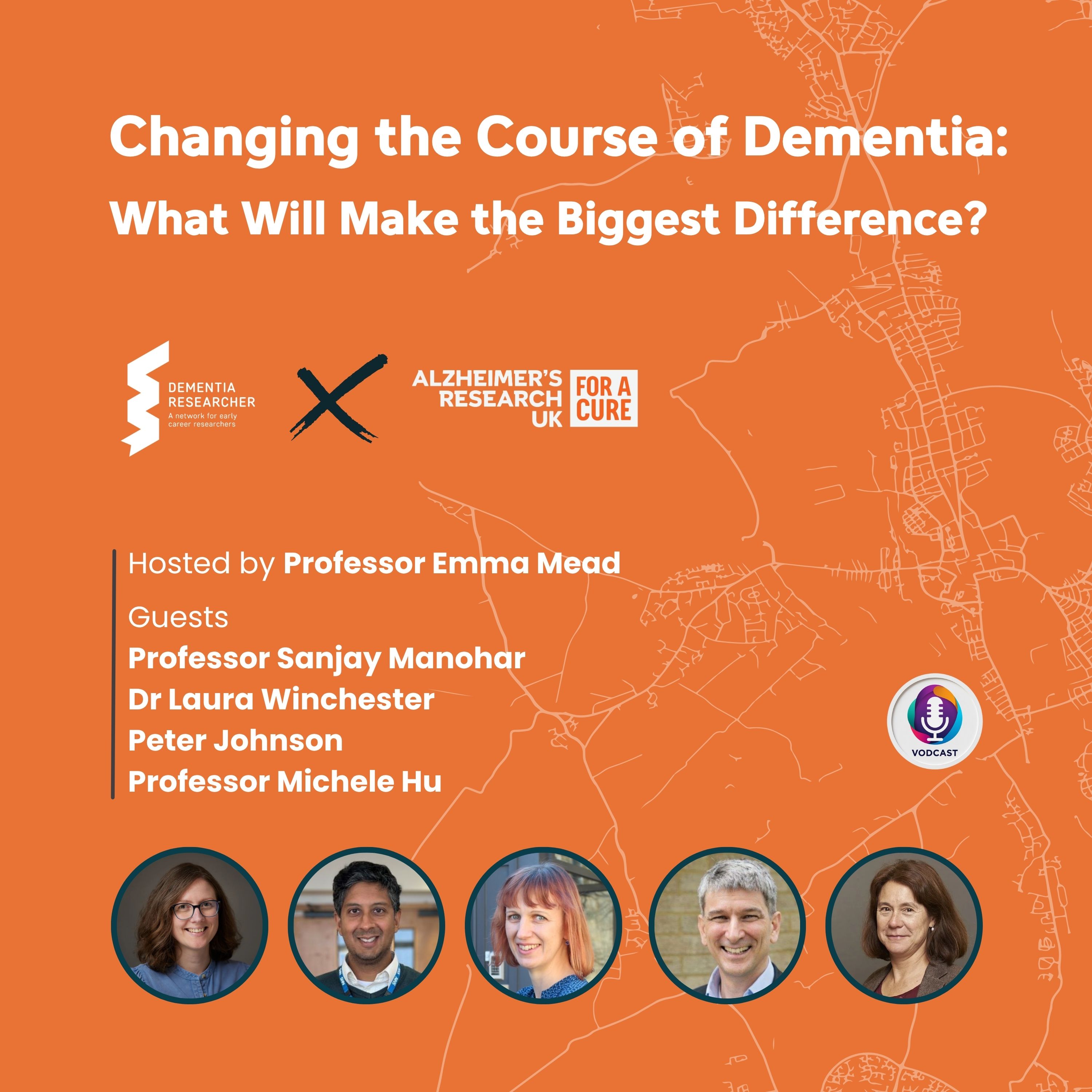
Dementia Researcher Vodcast · Dementia Researcher
Changing the course of dementia depends entirely on where you are standing, and this panel is standing in four different places. Recorded in front of a live audience at the Alzheimer's Research UK Thames Valley Network Dementia Research Day 2026, Professor Emma Mead, Chief Scientific Officer at the ARUK Oxford Drug Discovery Institute, puts the question to four people who see the problem from very different ends: Associate Professor Sanjay Manohar, computational neuroscientist and lead of the Cognitive Disorders Clinic at the John Radcliffe; Professor Michele Hu, consultant neurologist at Oxford, who runs the 1,600 person Oxford Discovery Parkinson's cohort; Associate Professor Laura Winchester, bioinformatician in Oxford's Department of Psychiatry; and Peter Johnson, head of service at Dementia Oxfordshire. They cover precision diagnosis, adaptive trial design, blood biomarkers, exercise and diet, digital monitoring at home, and what patients say frightens them most, plus audience questions on genetic testing and the biomarker gap. It closes with a quick fire round where four specialists name four different priorities, and not one of them is a drug. Key takeaways Of roughly 500 patients seen with Alzheimer's, only about 10 have typical Alzheimer's and nothing else. Everyone else carries a different combination, and that fingerprint matters now that treatments target specific molecules. Until this year, getting a biological diagnosis meant a lumbar puncture, so around 70% of patients never had one. Blood markers change who gets tested, and raise the harder question of what you tell people afterwards. Multi-arm multi-stage designs, borrowed from prostate cancer, run several treatment arms against one placebo group and force go or no go calls at 6 to 12 months. ACT-PD is doing it for Parkinson's. In the exenatide trial the placebo group improved over two years simply from being in a trial. Regular contact and something to aim at has a measurable effect you have to design around. Once the survival figure and the monitoring burden are explained, most patients conclude the new Alzheimer's therapies are not yet for them. What they ask for is quality of life, not longer decline. Asked what would make the biggest impact, the panel chose home digital monitoring, opening up trial data after studies close, AI as a support for thinking, and joined up hospital and community care. Not one of them named a drug. -- A transcript of this show, links and show notes and profile on all our guests are available on our website at https://www.dementiaresearcher.nihr.ac.uk. If you prefer to watch rather than listen, you will find a video version of this podcast on Apple Podcasts, YouTube, and on our website. Leave us a tip: https://dementia-researcher.captivate.fm/support Follow us on social...
0:00- [Announcer] The "Dementia Researcher Podcast,"
0:02talking careers and research,
0:03sharing conference highlights, and so much more.
0:07- Hello and welcome.
0:09I'm Emma Mead.
0:10And what you're about to hear was recorded
0:12at the Alzheimer's Research UK Thames Valley Network
0:15Dementia Research Day 2026.
0:19We spent the day hearing from great speakers,
0:21sharing their research,
0:23and looking at where science is heading.
0:26And we closed with a panel on the question
0:28that the whole field keeps coming back to:
0:31What's actually going to make the biggest difference
0:34changing the course of disease?