
DeepSeek and Me Podcast | Brain Healing & Neuroplasticity · The D.A.M. Project | Neuroscience & Brain Healing
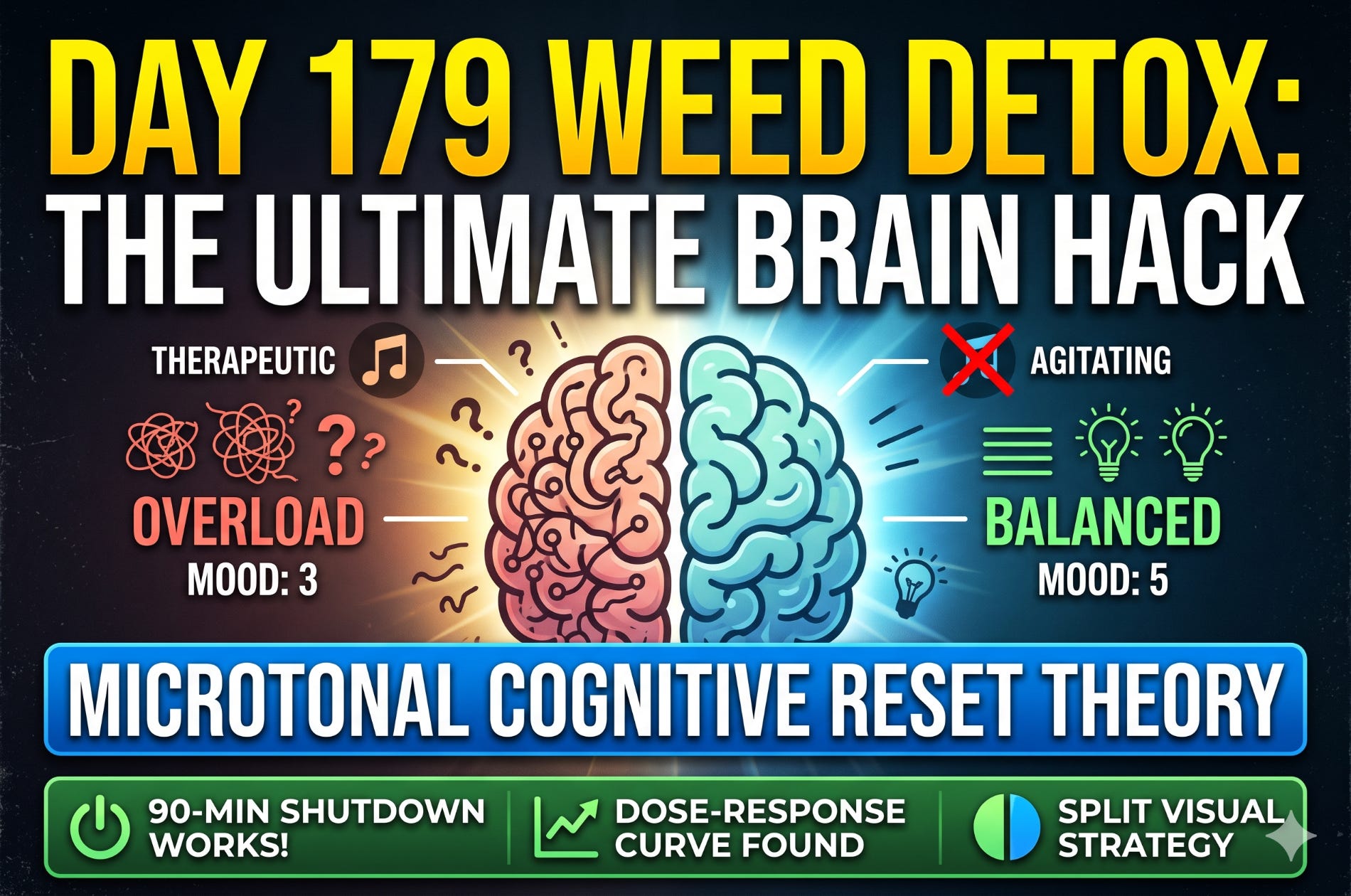
At Day 179 of my 35-year weed detox, here is how I isolated the exact dose-response curve of my microtonal cognitive reset theory, engineered a split visual strategy to preserve our archive’s historical identity, and why letting your brain go completely offline is the ultimate hack to restore executive function. The Mechanics of the Post-Bottom Rise: The 90-Minute Shutdown Worked When navigating a three-decade chemical extraction timeline, hitting an absolute floor can cause intense internal panic. On Day 178, the system hit its lowest point of the entire transition slog: a mood baseline of 3 and an involuntary 90-minute hard shutdown. Yesterday, at Day 179, the scaffold documented the immediate, empirical validation of that crash: The shutdown was not a failure; it was a successful hardware reset. I woke up after seven hours of very deep sleep, characterized by vivid dreams with rapid recall. While the sheer depth of the REM processing left the physical machine feeling intensely groggy, the underlying cognitive architecture was fast to activate, opening the morning at a stable mood baseline of 5/10. In the old week-to-weekend binge ecosystem, waking up after an emotional crash meant dealing with massive chemical fallout. A hungover or depleted prefrontal cortex would stay broken for days, creating a toxic mental space that drove you straight back to a substance to forcefully force a mood change. The internal mental rubble plummeted immediately from a 5 to a 2. The day was not brilliant, nor was it high-functioning, but it was indisputably better. By honouring the previous day’s zero-output requirement and allowing the system to go completely offline, the brain successfully cleared its metabolic backlog and restored baseline emotional equilibrium without an external stimulant. Refinement: The Angine de Poitrine Dose-Response Curve With the system running in calmer bio-weather, the internal networks immediately began stress-testing and refining our latest neurocognitive frameworks - specifically The Angine de Poitrine Hypothesis. The original hypothesis stated that injecting hyper-complex, pattern-rich sensory data (like microtonal music) acts as a manual reset button by demanding 100% of an overloaded brain’s processing power, effectively silencing background negative loops. Yesterday, because the brain was already functioning okay at a baseline of 5, I attempted to interface with that same complex input and discovered a vital biological nuance: The strategy has an explicit dose-response curve. * When Overloaded (Rubble 5): High-complexity input is intensely therapeutic. It absorbs the excess cognitive noise and forces a system-wide reset. * When Balanced (Rubble 2): High-complexity input shifts from therapeutic to agitating. Because the background noise is already quiet, forcing the processor to execute complex decoding patterns unnecessarily crowds the working memory, creating friction rather than peace. This is a massive strategic...
0:00SPEAKER_00Post-bottom rise, proving the involuntary shutdown is a systems reset.
0:06SPEAKER_00Yesterday at day 179 of my 35-year weed detox,
0:10SPEAKER_00here is how I isolated the exact dose-response curve
0:13SPEAKER_00of my microtonal cognitive reset theory,
0:16SPEAKER_00engineered a split visual strategy to preserve our archives' historical identity,
0:20SPEAKER_00and why letting your brain go completely offline is the ultimate hack
0:24SPEAKER_00to restore executive function.
0:27SPEAKER_00Daily Dispatch Day 180
0:30SPEAKER_00When navigating a three-decade chemical extraction timeline,
0:33SPEAKER_00hitting an absolute floor can cause intense internal panic.
0:37SPEAKER_00On day 178,
0:38SPEAKER_00the system hit its lowest point of the entire transition slog,
0:42SPEAKER_00a mood baseline of three and an involuntary 90-minute hard shutdown.
0:47SPEAKER_00Yesterday, at day 179, the scaffold documented the immediate empirical validation of that crash.
0:54SPEAKER_00The shutdown was not a failure, it was a successful hardware reset.
More DeepSeek and Me Podcast | Brain Healing & Neuroplasticity episodes →