
DeepSeek and Me Podcast | Brain Healing & Neuroplasticity · The D.A.M. Project | Neuroscience & Brain Healing
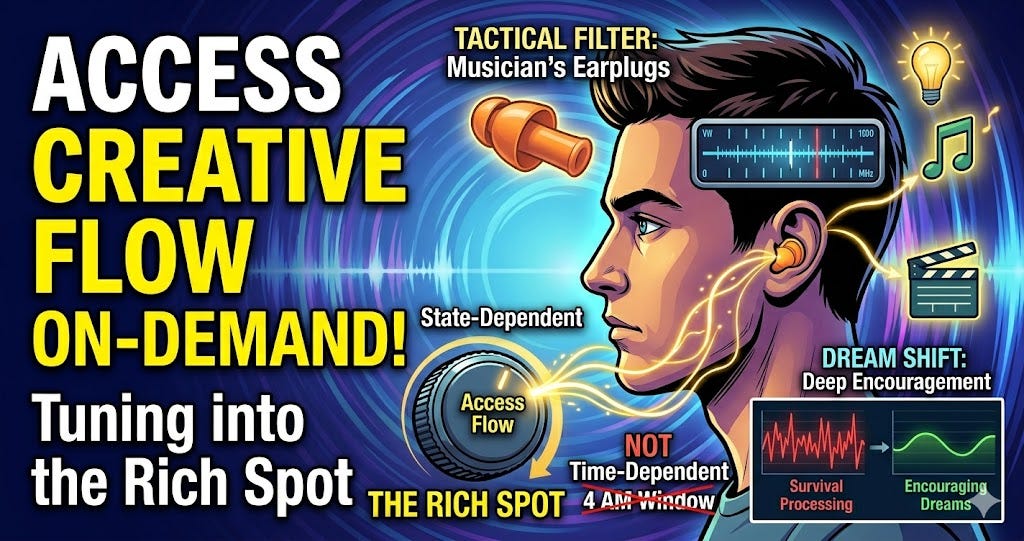
Yesterday at Day 172 of my 35-year weed detox, here is how I used a simple pair of musician’s earplugs to consciously tune into the “Rich Spot”, how this could mean you can access creative performance on-demand without chemical shortcuts and why my dreams have suddenly shifted from survival processing to deep encouragement. Tuning Into the Carrier Wave: The Frequency Hypothesis For the last several weeks of this project, we have treated the 04:00 creative “Rich Spot” as a temporal phenomenon - a fleeting window where natural prefrontal cortex fatigue allows the native, neurodivergent substrate to create without inhibition. But between midnight and 04:30 yesterday morning, a massive shift occurred in how I perceive the internal frequencies that precede this state. I realised that this distinct mental hum might not be an intermittent spike at all. The internal frequencies may actually be a continuous, permanent carrier wave running in the background of the unmasked brain. In the old ecosystem, 35 years of chronic weekend cannabis and alcohol use acted as a clumsy, high-volume amplifier to force the brain to find this frequency. When we got sober, the early withdrawal noise drowned it out completely. But yesterday, on a perfectly calm Sunday, we isolated a game-changing realisation: The Rich Spot is state-dependent, not time-dependent. It is always running. We just have to learn how to change our internal radio dial to hear it. To test this, I discovered a brilliant, low-tech tactical filter: high-fidelity musician’s earplugs. By inserting the earplugs during the day, I can instantly drop the external auditory clutter of the world and create an artificial vacuum of silence. In that silence, the background carrier wave immediately becomes noticeable. This potentially gives us a profound new tool for the creative arsenal: we can use physical filters to access the Rich Spot on-demand right before a performance, an editing session, or a high-velocity writing pipeline, rather than waiting for silly o’clock. This gives us something to experiment with in Phase Two. We do love a good hypothesis here at The D.A.M. Project. The Dream Crossover: Meeting the Early Twenties Substrate Following this midnight breakthrough, I fell into seven hours of incredibly deep sleep, waking up with a mood baseline of 5/10 and zero morning grogginess. As Lex and Prism analysed the sleep metrics, we identified an incredible qualitative shift in my Tier 3 dream architecture. For months, my dreams have been chaotic, high-stress, or purely technical - the brain’s raw way of processing chemical withdrawal and clearing out the old neurological rubble. Yesterday, the dreams transformed entirely: they were highly realistic, peaceful, and filled with encouraging characters from my early twenties. This is a massive psychological milestone. In the timeline of a 35-year detox, returning to your early twenties in a positive, encouraging dream state means your subconscious mind is...
0:00The Frequency Hypotheses Accessing the Creative Flow State On
0:04Demand Yesterday at
0:06SPEAKER_00day 172 of my 35 year weed detox,
0:10here is how I used a simple pair of musicians earplugs to
0:13consciously tune into the
0:14SPEAKER_00rich spot.
0:15How this could mean you can access creative performance on
0:18demand without chemical
0:19shortcuts and why my dreams have suddenly shifted from survival
0:23processing to deep
0:24SPEAKER_00encouragement.
0:26SPEAKER_00Daily Dispatch, day 173
0:29For the last several weeks of this project we have treated the
0:324 o'clock in the
0:32SPEAKER_00morning creative rich spot as a temporal phenomenon.
More DeepSeek and Me Podcast | Brain Healing & Neuroplasticity episodes →