
Deep Learning With The Wolf · Diana Wolf Torres
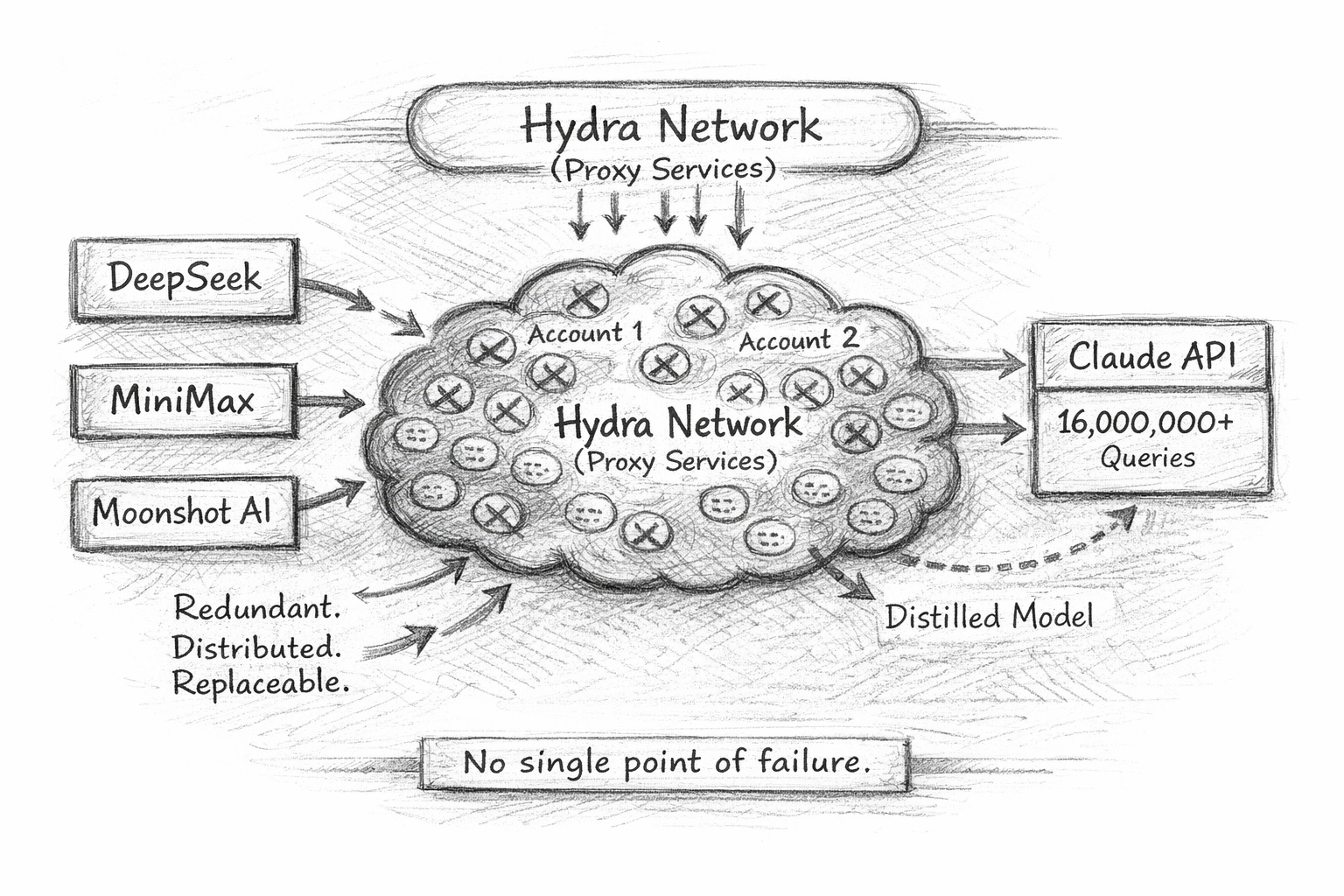
On February 23, 2026, Anthropic published a report titled “Detecting and Preventing Distillation Attacks.” In it, the company disclosed that it had identified coordinated, industrial-scale efforts to extract capabilities from its Claude models. According to the announcement, roughly 24,000 fraudulent accounts generated more than 16 million interactions in patterns consistent with systematic model distillation, using Claude’s outputs to train separate systems designed to approximate its behavior. No model weights were reported stolen. No source code was leaked. Instead, the activity relied on scale. Large volumes of prompts were issued, responses were collected, and those responses were used as training data elsewhere. Anthropic framed the incident not simply as a violation of terms of service, but as a security and strategic risk. Frontier AI systems are expensive to train and heavily engineered for safety. When their outputs are harvested at industrial volume, the resulting replicas may inherit capability without necessarily inheriting safeguards. The episode highlights a structural feature of modern AI systems. If intelligence can be observed through interaction, it can be measured. And if it can be measured at scale, it can be approximated. What Is Distillation? The concept of knowledge distillation was formalized by Geoffrey Hinton and colleagues in 2015 in their landmark paper, Distilling the Knowledge in a Neural Network. The idea is elegant: * A large model (teacher) produces probability distributions. * A smaller model (student) learns to match those outputs. * The student inherits much of the teacher’s performance. In its original form, distillation assumes access to internal model signals, specifically logits. Logits are the raw probability scores a model produces before selecting a final answer. They reveal more than just what the model chose. They show how strongly the model considered other possibilities. Training on those signals allows a smaller model to mimic much of the larger model’s performance, often with fewer parameters and lower computational cost. Large language models deployed through APIs change that setup. External users do not see logits. They see text. But text is still informative. Every prompt and response pair reflects how the model behaves. At small scale, those interactions are just conversations. At large scale, they become data. This is where distillation overlaps with what researchers call model extraction. Instead of learning from internal probabilities, a student model learns from observed behavior. Inputs are recorded. Outputs are collected. A new model is trained to reproduce that mapping. At its core, a neural network represents a mathematical function. If you can gather enough examples of inputs and outputs, you can train another network to approximate that function. Alignment Does Not Transfer Cleanly Modern LLMs undergo layers of safety training: * Supervised fine-tuning * Reinforcement Learning...
0:00SPEAKER_0116 million illicit exchanges,
0:0224,000 fraudulent accounts and a massive industrial scale
0:08operation involving three
0:10SPEAKER_01of the absolute biggest AI laboratories in China.
0:13It really sounds like the plot of a,
0:15you know,
0:16a cyberpunk thriller,
0:17doesn't it?
0:18SPEAKER_00You've got corporate espionage, shadow networks, digital heists.
0:22SPEAKER_00But this is the actual reality of the AI landscape as of yesterday.
0:27SPEAKER_01Exactly.
0:27We are looking at the breaking news that just dropped
0:29yesterday,
0:29Monday,
0:30February 23rd,