
Deep Learning With The Wolf · Diana Wolf Torres
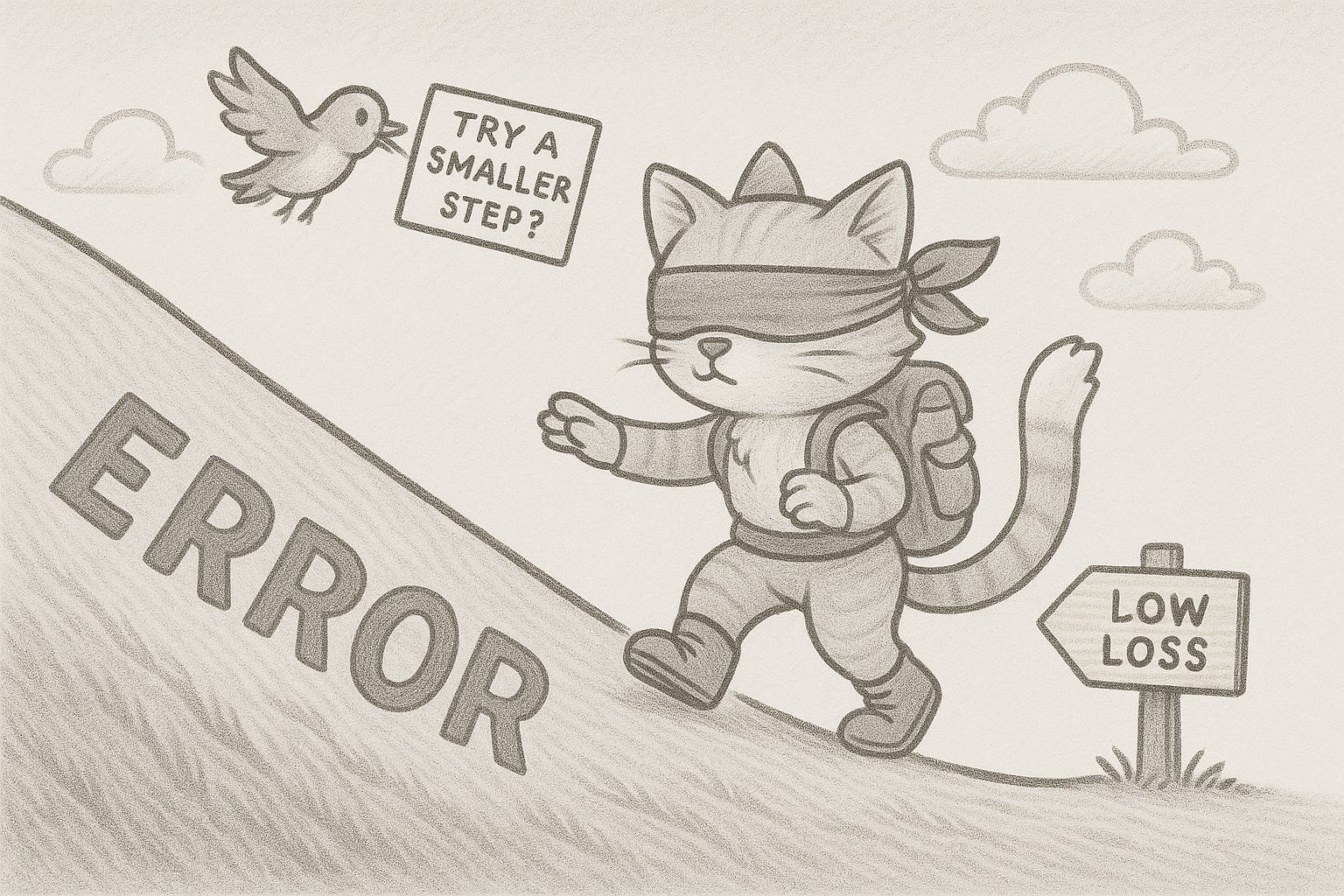
A friend said to me recently: “You don’t realize how much you know about this AI stuff. You should start breaking it down for people.” Fair point. Yesterday, I began by defining the term "deep learning." Put simply, we said: it’s how machines learn from data, layer by layer—like a brain made of math. But today? I’m going with a much less obvious choice. Why? Because I want to make a point: Even the most intimidating terms in AI can be made understandable—if you slow down, break them apart, and explain them like you would to your favorite aunt. Today’s term? Stochastic. Gradient. Descent. It sounds like a lion. But we’re going to break it down into kitten-sized steps. (I blame the cat metaphors on all the Sora2 cat-playing-fiddle videos flooding my feed.) But no more catting around. Let’s get into it. 🐾 The Hiker Kitten on the Hill Imagine a blindfolded kitten trying to tiptoe down a hill labeled “Error.” At the bottom? A little wooden sign that reads Low Loss. The kitten doesn’t have a map. It doesn’t see the full terrain. But it takes small steps, feels which way the ground is sloping, and tries to move downward. That’s gradient descent—the heart of how AI models learn. Step by step, they adjust in the direction that reduces error. It’s how I walk down a hill, too. Don’t judge. 🎴 The Flashcard Learner Now let’s add the “stochastic” part. “Stochastic” just means random. Instead of studying every flashcard in the deck before making a move, the kitten picks a few at random. It learns from small samples—just a mini-batch—not the entire dataset. Wrong answers get tossed in the bin marked Loss Function. Right ones? Reinforced. That’s how the model learns. Not by memorizing everything, but by trying, adjusting, and trying again. That coffee cup way too close to the edge? Totally bothering my OCD. 🪜 The Escalator of Errors Now picture our kitten on an escalator made of training epochs—steps that represent each pass through the data. But here’s the twist: some steps are missing. Some are uneven. The kitten has to guess where to land next. That randomness doesn’t confuse the model. It helps. It prevents the model from getting stuck in local patterns and nudges it toward broader understanding. I felt this once on the Great Wall of China. The steps were wildly inconsistent—a deliberate defensive design to slow down invaders. Varying heights and unexpected changes forced enemies to look down, making them off-balance and vulnerable. And that’s exactly what happened to me. Except I had more time than someone expecting an ambush. After navigating these steps for a while, something shifted. The irregularity forced me to stay alert, to feel each step instead of zoning out. I couldn’t fall into autopilot. That’s exactly what randomness does for SGD. It prevents the model from getting stuck in comfortable patterns. The unevenness—the stochasticity—nudges it toward broader understanding instead of memorizing one predictable path. The randomness doesn’t confuse...
0:00You ever hear a term in machine learning that sounds just
0:02impossibly complicated?
0:04SPEAKER_00Stochastic gradient descent.
0:06It's definitely one of those phrases that can make your eyes
0:09just glaze right over.
0:10SPEAKER_00But what if I told you that behind that beast of a name is something,
0:14SPEAKER_00well,
0:15SPEAKER_00something much,
0:16SPEAKER_00much simpler.
0:18SPEAKER_00Yeah, you heard me.
0:19The core idea behind one of the most powerful algorithms in AI
0:22today isn't some scary lion.
0:24It's a kitten,
0:25a blindfolded kitten to be exact,
0:27on a very,