
David A. Hughes · Resisting the Global Technocratic Coup One Person at a Time
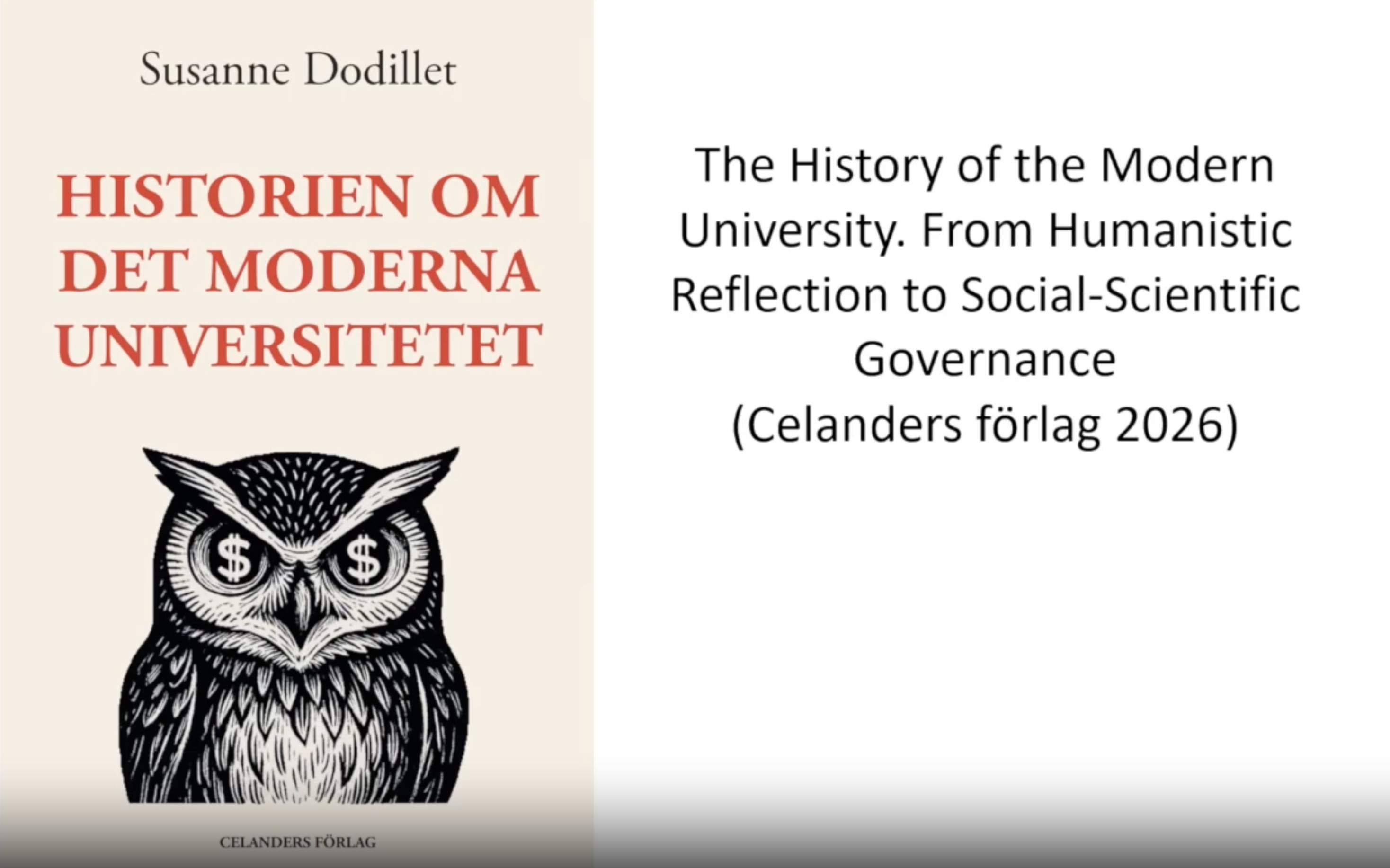
Abstract The university is usually pictured as a free sphere, a place of disinterested inquiry, critical thinking and individual responsibility, insulated from politics and the market. Even its critics tend to treat whatever falls short of this ideal as an unfortunate aberration rather than an expression of the institution itself. This talk takes a more sober starting point. My claim is not that particular studies are biased or particular fields compromised, but that the modern university as a whole operates as a propaganda instrument: not an autonomous sphere but both an object and an instrument of governance, and the keystone of the technocratic expert society we inhabit. Working from the Swedish case, I trace how the university was remade over the twentieth century from a site of humanist reflection into an apparatus of social-scientific governance. The decisive impulse came from American research philanthropy, whose large-scale investments built up an empirical social science designed to make society measurable and steerable: an instrument of social control. Once social questions were recast as objects of measurement, the social ceased to be a moral and political matter and became a technical one, and those who paid for the mapping also defined the problems to be mapped and the direction in which they were to be solved. A welfare state grew up around these structures that cared for people while quietly disarming their capacity to resist the concentration of power that built it. What made this possible was not any single discipline but the institution as a whole: nothing conceals an apparatus of governance better than the good name of free, truth-seeking science. This is what makes the modern university corrupt in a structural rather than an anecdotal sense: it is not the quality of thought but the interests of its funders that decide which questions are asked and which answers gain authority. Today the expansion of steerability takes new forms: information-gathering intensified through digitalization and ever denser surveillance, with the university still serving as the developer that realizes it, as newly endowed research centres present new technologies as science and public benefit that everyone is expected to welcome. This talk draws on my book Historien om det moderna universitetet. Från humanistisk reflektion till samhällsvetenskaplig styrning (Celanders, 2026). Downloadable Materials The transcript for this presentation can be downloaded below. Support Our Work The time, expertise, and effort required to produce these presentations is considerable, and we put them out for free. If you are able to support our work financially, please consider making a donation at https://opencollective.com/omniwar. This is a public episode. If you would like to discuss this with other subscribers or get access to bonus episodes, visit dhughes.substack.com
0:03SPEAKER_00Hi again, and thank you so much to Jakob for his presentation.
0:08SPEAKER_00Just as a reminder,
0:09SPEAKER_00if you miss anything or want to go back and view any of the presentations,
0:13SPEAKER_00they will all be archived on the site omniwar.org and also at davidhughes.net.
0:20SPEAKER_00So the next presentation is by Suzanne Dodier, who is coming to us from Sweden.
0:27SPEAKER_00And this is this presentation is a perfect continuation of
0:32SPEAKER_00the conversation that's actually happening through these presentations.
0:36SPEAKER_00I just wanted to sort of take you through the thinking
0:41SPEAKER_00on how these presentations are sequenced,
0:43SPEAKER_00because I think it presents a very comprehensive and interesting overview of all
0:51SPEAKER_00the many aspects of academia that have been captured By the technocratic agenda.
0:56SPEAKER_00So we started out with the military intelligence capture of
1:00SPEAKER_00the entire scientific pursuit of academia.
1:04SPEAKER_00Then we look at a very specific scientific topic, which is climate change.
1:09SPEAKER_00And now we're moving into the social sciences and Suzanne's Talk is entitled