
Daily Mass Readings with Homily and Saint of the Day · Fr. Gabriel Maria
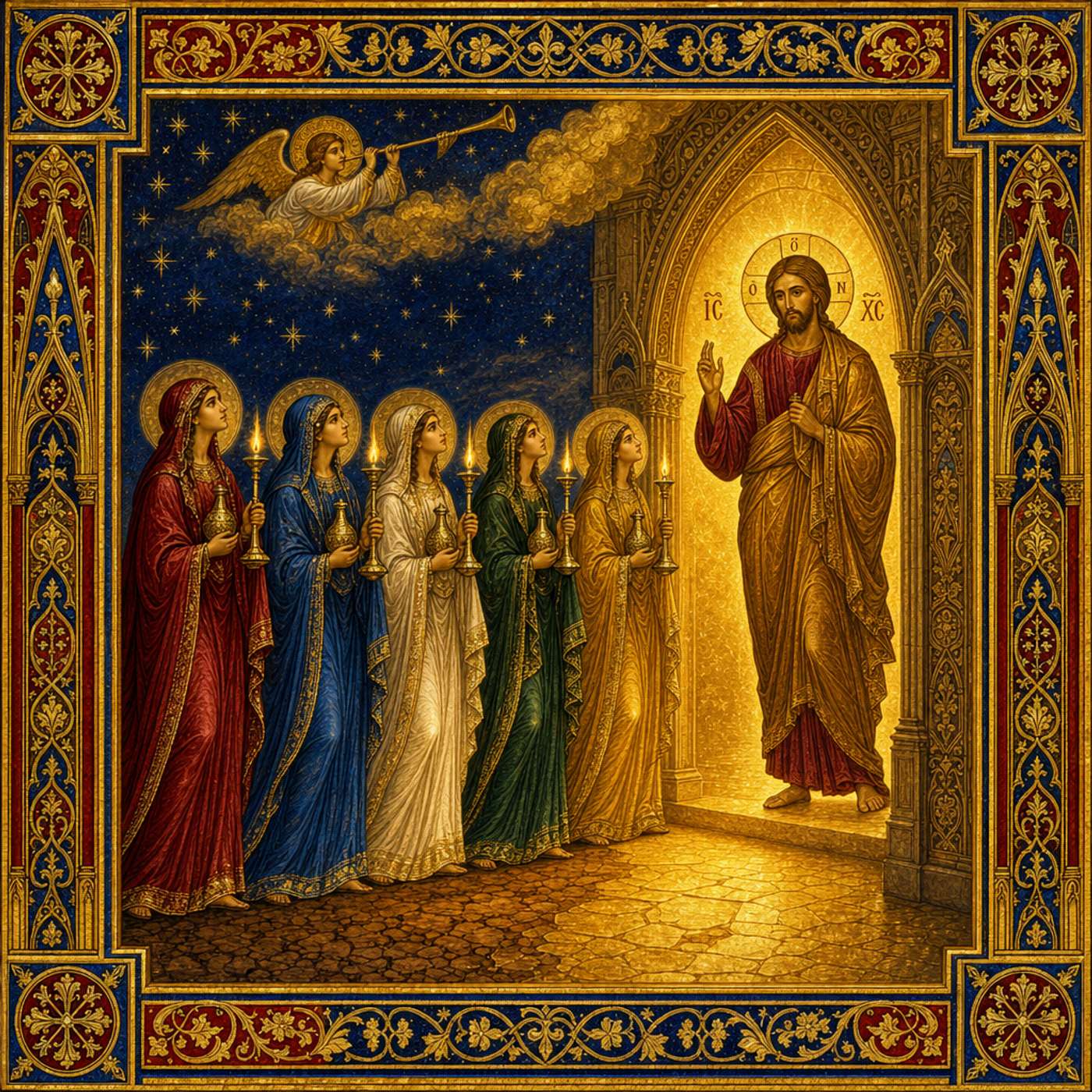
In the name of the Father, and of the Son, and of the Holy Spirit. Amen. Today is November the eighth, the Thirty-second Sunday in Ordinary Time. O Christ, Bridegroom of souls, You delay in mercy and come in glory. Keep us watchful in the night, fill our lamps with charity, and bring us, awake and unashamed, into Your wedding feast, who live and reign forever. Amen. A reading from the Book of Wisdom. Resplendent and unfading is wisdom, and she is readily perceived by those who love her, and found by those who seek her. She hastens to make herself known in anticipation of their desire. Whoever watches for her at dawn shall not be disappointed, for he shall find her sitting by his gate. For taking thought of wisdom is the perfection of prudence, and whoever for her sake keeps vigil shall quickly be free from care; because she makes her own rounds, seeking those worthy of her, and graciously appears to them in the ways, and meets them with all solicitude. The word of the Lord. Responsorial Psalm. Psalm sixty-three. My soul is thirsting for you, O Lord my God. O God, you are my God whom I seek; for you my flesh pines and my soul thirsts like the earth, parched, lifeless and without water. My soul is thirsting for you, O Lord my God. Thus have I gazed toward you in the sanctuary to see your power and your glory, for your kindness is a greater good than life; my lips shall glorify you. My soul is thirsting for you, O Lord my God. Thus will I bless you while I live; lifting up my hands, I will call upon your name. As with the riches of a banquet shall my soul be satisfied, and with exultant lips my mouth shall praise you. My soul is thirsting for you, O Lord my God. I will remember you upon my couch, and through the night-watches I will meditate on you: You are my help, and in the shadow of your wings I shout for joy. My soul is thirsting for you, O Lord my God. A reading from the first Letter of Saint Paul to the Thessalonians. We do not want you to be unaware, brothers and sisters, about those who have fallen asleep, so that you may not grieve like the rest, who have no hope. For if we believe that Jesus died and rose, so too will God, through Jesus, bring with him those who have fallen asleep. Indeed, we tell you this, on the word of the Lord, that we who are alive, who are left until the coming of the Lord, will surely not precede those who have fallen asleep. For the Lord himself, with a word of command, with the voice of an archangel and with the trumpet of God, will come down from heaven, and the dead in Christ will rise first. Then we who are alive, who are left, will be caught up together with them in the clouds to meet the Lord in the air. Thus we shall always be with the Lord. Therefore, console one another with these words. The word of the Lord. Alleluia, alleluia. Stay awake and be ready! For you do not know on what day your Lord will come. Alleluia, alleluia. A reading from the holy Gospel according to Matthew. Jesus told his disciples this parable: "The kingdom of heaven will be like ten virgins who took their lamps and went out to meet the bridegroom. Five of them were foolish and five were wise. The foolish ones, when taking their lamps, brought no oil with them, but the wise brought flasks of oil with their lamps. Since the bridegroom was long delayed, they all became drowsy and fell asleep. At midnight, there was a cry, 'Behold, the bridegroom! Come out to meet him!' Then all those virgins got up and trimmed their lamps. The foolish ones said to the wise, 'Give us some of your oil, for our lamps are going out.' But the wise ones replied, 'No, for there may not be enough for us and you. Go instead to the merchants and buy some for yourselves.' While they went off to buy it, the bridegroom came and those who were ready went into the wedding feast with him. Then the door was locked. Afterwards the other virgins came and said, 'Lord, Lord, open the door for us!' But he said in reply, 'Amen, I say to you, I do not know you.' Therefore, stay awake, for you know neither the day nor the hour." The Gospel of the Lord. Wisdom sits at the gate. The soul that rises at dawn finds her already waiting. That is the promise of the first reading, and it is the whole rebuke of the Gospel: the Bridegroom is faithful to come, and the only question is whether the lamp is burning when He does. The scene is literal and exact. In a village wedding, the bride's companions go out by night with lamps to escort the groom to the feast. All ten are virgins. All ten carry lamps. All ten grow drowsy, and all ten hear the same cry at midnight. Nothing visible divides them. The difference is hidden in a flask. St. Augustine teaches that the lamps are good works and the oil is charity. Fasting, almsgiving, even virginity itself may shine before men. Without love they burn on borrowed fuel and soon fail. St. Gregory the Great presses the wound deeper. The oil is the witness of a hidden conscience, and the foolish are those who light their lamps for the praise of others. The merchants to whom they are sent are the flatterers, who sell applause. A lamp kindled for applause goes dark when the applause stops, and midnight is the hour when no one is watching. St. John Chrysostom hears in the oil the voice of mercy. They were virgins, yet unmerciful, and so the door was shut. Purity without charity is a lamp without light. The wise do not refuse from avarice. Charity cannot be lent at the last hour. Each soul stands before the Judge with the grace it has made its own, and no saint can pour his holiness into another's lamp. The time for buying is now, in the marketplace of daily fidelity: the confessional, the Mass, the hidden kindness, the cross carried without complaint. The Bridegroom is Christ, and the Church is His Bride. The delay is the long age between the Ascension and His return. Here the Apostle completes the parable. The sleep of the virgins is the sleep of death, of which Paul says that the faithful have "fallen asleep." St. Thomas Aquinas teaches that sorrow for the dead is not forbidden, only sorrow without hope. The midnight cry is the voice of the archangel and the trumpet of God. Notice that all ten sleep, the wise as well as the foolish. Sleep is not the danger. To sleep without oil is. The wise sleep in peace because the lamp is ready, and this is the freedom from care that Wisdom promises to those who keep vigil. Vigil is not anxiety. It is love, ordered and prepared. Then comes the terrible sentence: "I do not know you." Cornelius a Lapide notes that this is not the ignorance of one who has never heard of them. It is the withholding of the knowledge of love, which Christ gives to His own sheep, whom He knows by name. The locked door is no whim. It is the fixing of a will that spent its whole life refusing to be filled. The psalmist shows the remedy. "My soul is thirsting for you." That thirst is the wick, and grace is the oil that feeds it. He remembers God on his couch and meditates through the night-watches, and so his lamp is lit before midnight comes. The banquet he longs for is the wedding feast of the Lamb, which every Mass anticipates. At this altar the Bridegroom already comes in the night of faith, and here the flask is filled. So the Church asks one thing of us today: do not wait for midnight to find oil. Fill the lamp now, with love hidden from every eye but God's. Before you sleep tonight, make a brief examination of conscience and an act of contrition. Then choose one hidden act of mercy for tomorrow, done for no one's praise, and offer it for the faithful departed. Let charity be the oil, and let the lamp be lit. May Almighty God bless you, the Father, and the Son, and the Holy Spirit. Amen. Praised be Jesus Christ, now and forever. Amen. EPISODE_TITLE: Oil for the Lamps Before Midnight IMAGE_PROMPT: Five wise virgins holding bright burning oil lamps and flasks at a darkened doorway beneath a starry midnight sky, while Christ the Bridegroom approaches in radiant golden light, in the style of a reverent classical Catholic icon painting.
More Daily Mass Readings with Homily and Saint of the Day episodes →