
Daily Mass Readings with Homily and Saint of the Day · Fr. Gabriel Maria
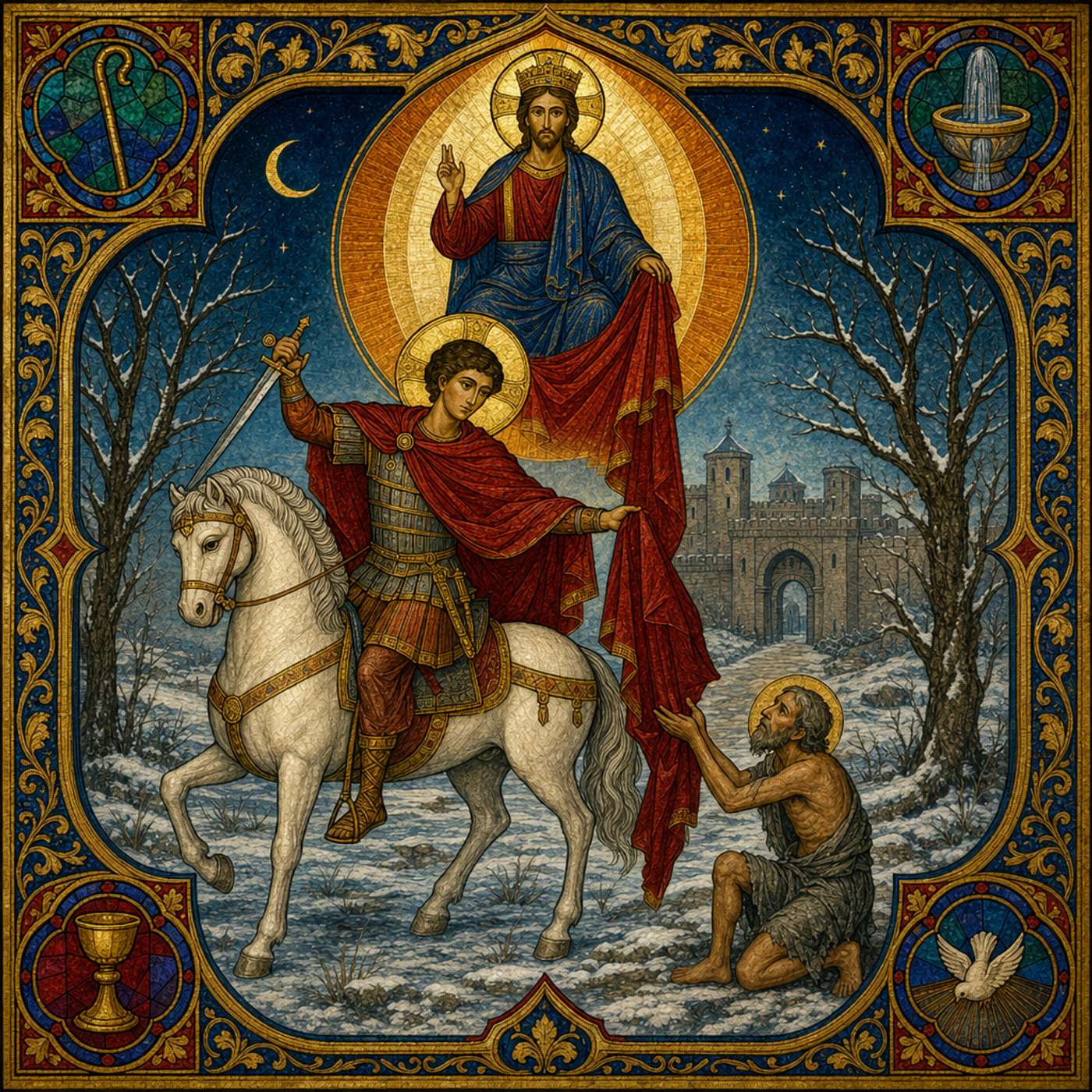
In the name of the Father, and of the Son, and of the Holy Spirit. Amen. Today is November the eleventh, the Memorial of Saint Martin of Tours, bishop. O God, who clothe the naked and cleanse the leper, grant that we who have received mercy without merit may return to Your feet in thanksgiving, and make of our lives a cloak for the poor. Through Christ our Lord. Amen. A reading from the Letter of Saint Paul to Titus. Beloved: Remind them to be under the control of magistrates and authorities, to be obedient, to be open to every good enterprise. They are to slander no one, to be peaceable, considerate, exercising all graciousness toward everyone. For we ourselves were once foolish, disobedient, deluded, slaves to various desires and pleasures, living in malice and envy, hateful ourselves and hating one another. But when the kindness and generous love of God our savior appeared, not because of any righteous deeds we had done but because of his mercy, he saved us through the bath of rebirth and renewal by the Holy Spirit, whom he richly poured out on us through Jesus Christ our savior, so that we might be justified by his grace and become heirs in hope of eternal life. The Responsorial Psalm, Psalm 23. The Lord is my shepherd; there is nothing I shall want. The Lord is my shepherd; I shall not want. In verdant pastures he gives me repose; beside restful waters he leads me; he refreshes my soul. The Lord is my shepherd; there is nothing I shall want. He guides me in right paths for his name's sake. Even though I walk in the dark valley I fear no evil; for you are at my side, with your rod and your staff that give me courage. The Lord is my shepherd; there is nothing I shall want. You spread the table before me in the sight of my foes; you anoint my head with oil; my cup overflows. The Lord is my shepherd; there is nothing I shall want. Only goodness and kindness follow me all the days of my life; and I shall dwell in the house of the Lord for years to come. The Lord is my shepherd; there is nothing I shall want. Alleluia, alleluia. In all circumstances, give thanks, for this is the will of God for you in Christ Jesus. Alleluia, alleluia. A reading from the holy Gospel according to Luke. As Jesus continued his journey to Jerusalem, he traveled through Samaria and Galilee. As he was entering a village, ten lepers met him. They stood at a distance from him and raised their voice, saying, "Jesus, Master! Have pity on us!" And when he saw them, he said, "Go show yourselves to the priests." As they were going they were cleansed. And one of them, realizing he had been healed, returned, glorifying God in a loud voice; and he fell at the feet of Jesus and thanked him. He was a Samaritan. Jesus said in reply, "Ten were cleansed, were they not? Where are the other nine? Has none but this foreigner returned to give thanks to God?" Then he said to him, "Stand up and go; your faith has saved you." Paul commands gentleness toward everyone, and he gives one reason: "we ourselves were once foolish." St. John Chrysostom teaches that remembering our former wretchedness is what makes us meek toward others. The man who recalls the pit from which he was drawn cannot sneer at the one still in it. Meekness is memory, and gratitude is memory made articulate. Then comes the turn on which the whole Epistle hangs: "the kindness and generous love of God our savior appeared." Salvation is an epiphany, a gift that arrives unbidden. St. Thomas Aquinas teaches that grace is not the reward of our works but their root. Mercy precedes merit. The bath of rebirth is the font, where the flesh of the sinner is made new, as the leper's flesh was made new on the road. Ten lepers stand at a distance, as the Law required. Cornelius a Lapide reads leprosy as the image of sin. It corrodes the body slowly, numbs it to its own decay, and cuts the sufferer off from the people and from the Temple. They cry out, "Have pity on us!" Christ does not touch them. He does not even say, "Be clean." He says only, "Go show yourselves to the priests." They are cleansed "as they were going." Obedience comes before evidence, and faith walks before it sees. All ten obey, and all ten are cleansed. Only one returns. St. Ambrose observes that the nine received healing of the body, but only the one who returned heard, "Your faith has saved you." Cleansing is a gift. Salvation is communion with the Giver. The nine went on to the priests of the Law, and the Samaritan, a foreigner and a schismatic, recognized the true Priest already standing before him. He does not go to the Temple. He falls at the feet of Jesus, because the Temple is now a Person. The Evangelist's Greek says he "gave thanks," *eucharistōn*. The Samaritan's return is the first Eucharist, and the Church has been returning to that same pair of feet ever since. St. Augustine asks what better thing we can carry in our hearts, utter with our mouths, and write with our pens than "Thanks be to God." Aquinas places gratitude under justice. It is not a pleasant feeling but a debt, and the heart that will not pay it grows hard. This is why Paul writes, "In all circumstances, give thanks." Gratitude is not a mood that depends on circumstance. It is the posture of a creature who knows what he has been given. The Psalm gives the final horizon. The Shepherd spreads the table, the cup overflows, and we dwell in the house of the Lord for years to come. The leper's return anticipates the return of every redeemed creature to the feet of Christ, where thanksgiving is no longer one duty among many but the whole of heaven. We are the ten. We have been washed in the font and absolved in the confessional. The question is whether, having been healed, we go on to our own affairs, or turn back and fall down in adoration. Every Mass is that turning back, and the one who comes to it with a grateful heart hears again, "Stand up and go; your faith has saved you." Martin was born about the year 316 in Pannonia and raised in Pavia, the son of a pagan soldier. He was enrolled in the Roman army as a boy and, while still a catechumen, rode through the gates of Amiens one bitter winter. There he met a beggar, half-naked and shivering. Martin drew his sword, cut his military cloak in two, and gave half to the poor man. That night Christ appeared to him, wearing the half-cloak, and said to the angels around Him, "Martin, still a catechumen, has clothed me." The kindness of God had appeared to him, and Martin answered it with a charity that was no mere feeling. He was baptized, and he laid down his arms, saying, "I am a soldier of Christ; I am not permitted to fight." He became a disciple of St. Hilary of Poitiers and founded Ligugé, the first monastery in Gaul. In the year 371 the people of Tours seized him and made him their bishop against his will. He lived as a monk in a bishop's chair, evangelized the pagan countryside, and cared for the poor and the sick. Dying at Candes in 397, he prayed, "Lord, if your people still need me, I do not refuse the labor. Your will be done." He was buried on this day. Martin never grew tired of giving, because he never forgot what he had received. Before sleep tonight, name three gifts you received today, and thank God for each aloud, as the Samaritan did. Then give away one thing you own to someone who lacks it, as Martin gave half his cloak. May Almighty God bless you, the Father, and the Son, and the Holy Spirit. Amen. Praised be Jesus Christ, now and forever. Amen. EPISODE_TITLE: Saint Martin and the Grateful Samaritan IMAGE_PROMPT: Saint Martin of Tours as a Roman soldier on horseback in a wintry landscape, cutting his red cloak with his sword to clothe a shivering beggar, while Christ appears in a golden glow above holding the half-cloak, in the style of a classical Catholic sacred painting.
More Daily Mass Readings with Homily and Saint of the Day episodes →