
Daily Mass Readings with Homily and Saint of the Day · Fr. Gabriel Maria
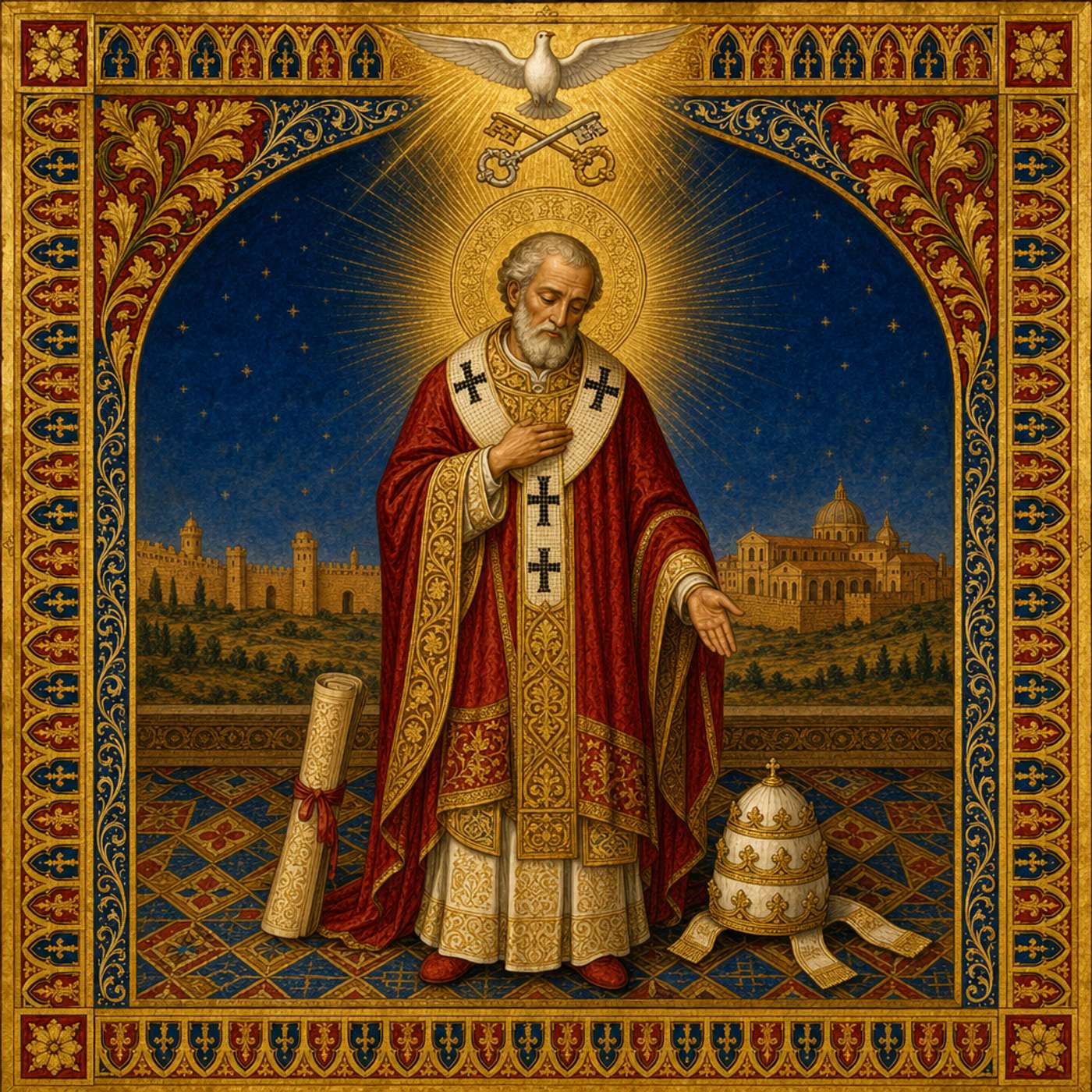
In the name of the Father, and of the Son, and of the Holy Spirit. Amen. Today is November the tenth. O God, who gave your Church the rock of Peter and made Saint Leo its faithful guardian, grant that we may hold the sound doctrine we have received. May your grace train us to renounce worldly desires. And when we have done all that is commanded, may we kneel as servants who owe everything to you. Through Christ our Lord. Amen. A reading from the Letter of Saint Paul to Titus, chapter two. Beloved: You must say what is consistent with sound doctrine, namely, that older men should be temperate, dignified, self-controlled, sound in faith, love, and endurance. Similarly, older women should be reverent in their behavior, not slanderers, not addicted to drink, teaching what is good, so that they may train younger women to love their husbands and children, to be self-controlled, chaste, good homemakers, under the control of their husbands, so that the word of God may not be discredited. Urge the younger men, similarly, to control themselves, showing yourself as a model of good deeds in every respect, with integrity in your teaching, dignity, and sound speech that cannot be criticized, so that the opponent will be put to shame without anything bad to say about us. For the grace of God has appeared, saving all and training us to reject godless ways and worldly desires and to live temperately, justly, and devoutly in this age, as we await the blessed hope, the appearance of the glory of the great God and of our savior Jesus Christ, who gave himself for us to deliver us from all lawlessness and to cleanse for himself a people as his own, eager to do what is good. The word of the Lord. The Responsorial Psalm, Psalm thirty-seven. The salvation of the just comes from the Lord. Trust in the Lord and do good, that you may dwell in the land and be fed in security. Take delight in the Lord, and he will grant you your heart's requests. The salvation of the just comes from the Lord. The Lord watches over the lives of the wholehearted; their inheritance lasts forever. By the Lord are the steps of a man made firm, and he approves his way. The salvation of the just comes from the Lord. Turn from evil and do good, that you may abide forever; the just shall possess the land and dwell in it forever. The salvation of the just comes from the Lord. Alleluia, alleluia. Whoever loves me will keep my word, and my Father will love him, and we will come to him. Alleluia, alleluia. A reading from the holy Gospel according to Luke, chapter seventeen. Jesus said to the Apostles: "Who among you would say to your servant who has just come in from plowing or tending sheep in the field, 'Come here immediately and take your place at table'? Would he not rather say to him, 'Prepare something for me to eat. Put on your apron and wait on me while I eat and drink. You may eat and drink when I am finished'? Is he grateful to that servant because he did what was commanded? So should it be with you. When you have done all you have been commanded, say, 'We are unprofitable servants; we have done what we were obliged to do.'" The Gospel of the Lord. Grace appeared, and grace teaches. Paul's word for training is the word for the education of a child, and the Church receives it as the discipline of a mother. Grace does not merely pardon. It forms. It instructs old men in temperance, old women in reverence, and young men in self-mastery. The household of Crete becomes a school of the Cross. St. John Chrysostom reads this passage with a pastor's alarm. The pagan watches the Christian, and a scandalous life blasphemes the word of God more loudly than any heretic could. Doctrine is sound only when it is lived soundly. Paul binds the two together: sound doctrine, and a people eager to do what is good. The Church's whole hope rests on one clause: "The grace of God has appeared." Cornelius a Lapide reads this appearing as the Incarnation itself. The eternal God shines upon the world in flesh, and he gives himself in order to cleanse "a people as his own." The people is the Church, purchased and purified, set apart as a bride is set apart. Her chastity, her sobriety, and her justice are the fruit of his blood. Then comes the Gospel, which strips away every vanity. A servant returns from the field and still must prepare the table. The master owes him no thanks. St. Augustine hears in this the confession of the psalmist: "I have said to the Lord, You are my God, for you have no need of my goods." God gains nothing from our obedience. The gain is ours. St. Thomas Aquinas teaches that our works merit eternal life only because grace first raised them above nature. What we offer, he has already given. We are unprofitable not because our works are worthless, but because they are gifts returned to the Giver. This is the freedom of the saints. The proud man counts his services and presents the bill. The humble man works, and says only, "I did what I was obliged to do." The first is a hireling. The second is a son, and sons are not paid. They inherit. Yet the Lord does not leave the servant in the field. Elsewhere he promises that the master will gird himself and serve his watchful servants at table. "You may eat and drink when I am finished" is not the final word. The Church's blessed hope is the banquet where he who commands us to serve will himself wait upon us. Every hidden duty and every unthanked sacrifice is a furrow plowed toward that feast. St. Leo speaks to every Christian in his sermon for the Nativity: "Acknowledge, O Christian, your dignity. Having become a sharer in the divine nature, do not return to your former baseness by a life unworthy of it." This is Titus compressed into a sentence. Grace has appeared and made us sharers in the divine nature. We therefore reject godless ways, and we do so as a debt of love, not for reward. And if we fall short, the Church gives us the same prayer: we are unprofitable servants, and mercy alone is our boast. Leo was born in Tuscany and rose through the Roman diaconate under Celestine and Sixtus. He was so trusted that he was sent to Gaul to reconcile two quarreling generals, and while he was away the Roman clergy elected him Pope in the year 440. He governed the Church for twenty-one years, when the Empire was collapsing. In 449 he wrote his Tome to Flavian of Constantinople, a clear statement of the faith: one Person, Christ, in two natures, truly God and truly man. At Chalcedon in 451 the bishops read it and cried out, "Peter has spoken through Leo." That is sound doctrine, defended in its entirety. In 452 he went out unarmed to meet Attila at the Mincio, and the scourge of God withdrew from Italy. In 455, when the Vandals under Genseric approached, he could not turn them back, but he obtained from them a promise that Rome would not be burned and its people not slaughtered. He then spent his strength rebuilding churches and comforting the afflicted. He preached constantly, and his sermons are among the finest the Roman Church possesses. Yet he never wrote like a man claiming a reward. He called himself an unworthy heir of Peter. He is the servant who comes in from the field and still girds himself to serve. He died in 461, and in 1754 he was declared a Doctor of the Church. Today, perform one hidden duty faithfully, without mentioning it to anyone. At day's end, kneel and say quietly, "Lord, I am an unprofitable servant; I have done what I was obliged to do." Then pray the Glory Be in thanksgiving for the grace that made it possible. May Almighty God bless you, the Father, and the Son, and the Holy Spirit. Amen. Praised be Jesus Christ, now and forever. Amen. EPISODE_TITLE: Unprofitable Servants and Sound Doctrine IMAGE_PROMPT: Saint Leo the Great in papal vestments and pallium stands before the ancient walls of Rome with a raised hand, a scroll of his Tome beside him, and the keys of Peter and a radiant dove of the Holy Spirit above.
More Daily Mass Readings with Homily and Saint of the Day episodes →