
Daily Mass Readings with Homily and Saint of the Day · Fr. Gabriel Maria
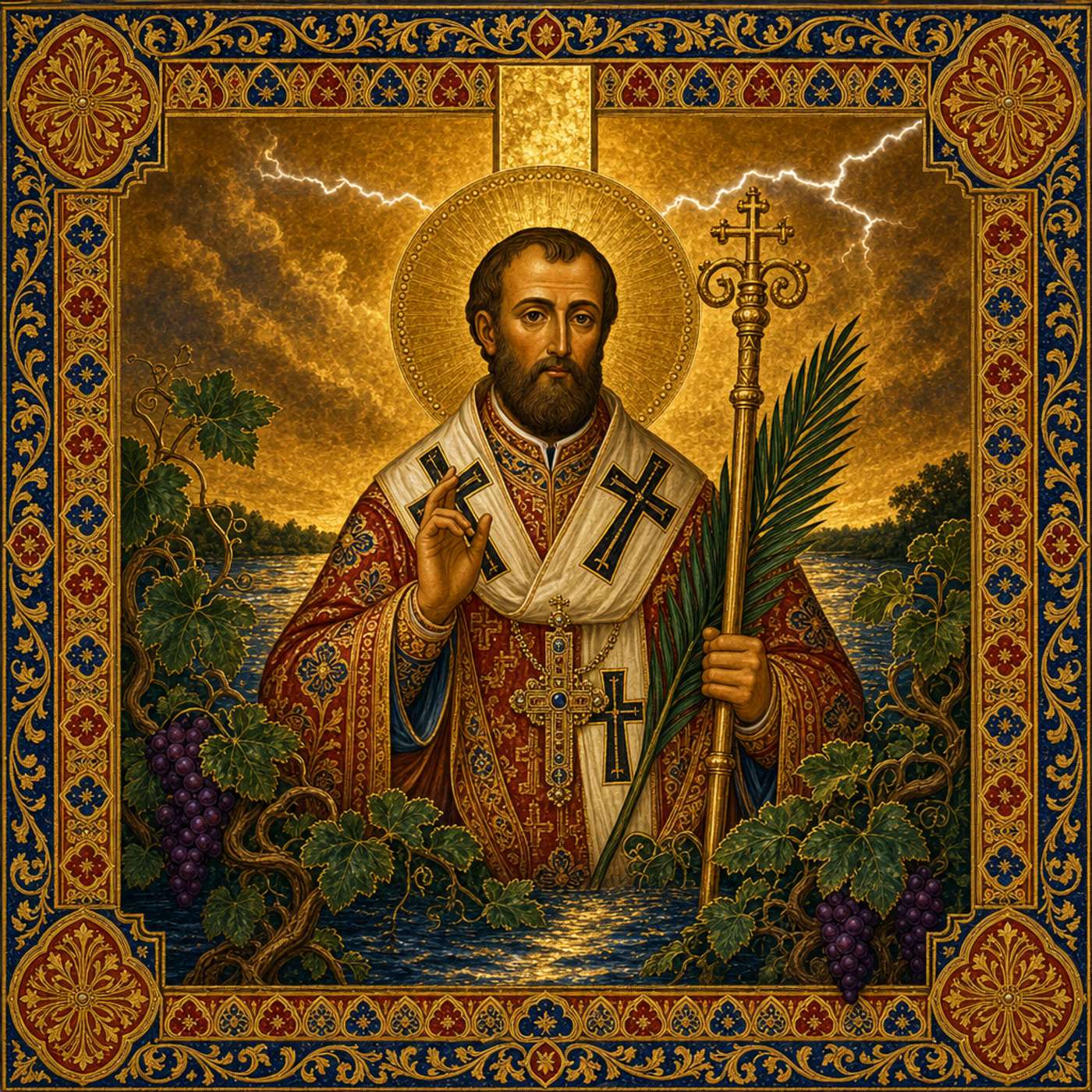
In the name of the Father, and of the Son, and of the Holy Spirit. Amen. Today is November the twelfth, the Memorial of Saint Josaphat, Bishop and Martyr. O God, who made Thy servant Josaphat a shepherd laid down for the unity of Thy flock, grant that we may love the Church's peace more than our own comfort, and forgive as we have been forgiven, through Christ our Lord. Amen. A reading from the Letter of Saint Paul to Philemon. Beloved: I have experienced much joy and encouragement from your love, because the hearts of the holy ones have been refreshed by you, brother. Therefore, although I have the full right in Christ to order you to do what is proper, I rather urge you out of love, being as I am, Paul, an old man, and now also a prisoner for Christ Jesus. I urge you on behalf of my child Onesimus, whose father I have become in my imprisonment, who was once useless to you but is now useful to both you and me. I am sending him, that is, my own heart, back to you. I should have liked to retain him for myself, so that he might serve me on your behalf in my imprisonment for the Gospel, but I did not want to do anything without your consent, so that the good you do might not be forced but voluntary. Perhaps this is why he was away from you for a while, that you might have him back forever, no longer as a slave but more than a slave, a brother, beloved especially to me, but even more so to you, as a man and in the Lord. So if you regard me as a partner, welcome him as you would me. And if he has done you any injustice or owes you anything, charge it to me. I, Paul, write this in my own hand: I will pay. May I not tell you that you owe me your very self. Yes, brother, may I profit from you in the Lord. Refresh my heart in Christ. The word of the Lord. Responsorial Psalm, Psalm 146. Blessed is he whose help is the God of Jacob. The Lord secures justice for the oppressed, gives food to the hungry. The Lord sets captives free. Blessed is he whose help is the God of Jacob. The Lord gives sight to the blind. The Lord raises up those who were bowed down; the Lord loves the just. The Lord protects strangers. Blessed is he whose help is the God of Jacob. The fatherless and the widow he sustains, but the way of the wicked he thwarts. The Lord shall reign forever; your God, O Zion, through all generations. Alleluia. Blessed is he whose help is the God of Jacob. Alleluia, alleluia. I am the vine, you are the branches, says the Lord: whoever remains in me and I in him will bear much fruit. Alleluia, alleluia. A reading from the holy Gospel according to Luke. Asked by the Pharisees when the Kingdom of God would come, Jesus said in reply, "The coming of the Kingdom of God cannot be observed, and no one will announce, 'Look, here it is,' or, 'There it is.' For behold, the Kingdom of God is among you." Then he said to his disciples, "The days will come when you will long to see one of the days of the Son of Man, but you will not see it. There will be those who will say to you, 'Look, there he is,' or 'Look, here he is.' Do not go off, do not run in pursuit. For just as lightning flashes and lights up the sky from one side to the other, so will the Son of Man be in his day. But first he must suffer greatly and be rejected by this generation." The Gospel of the Lord. Paul holds apostolic authority and lays it down. St. John Chrysostom marvels that he reaches for age and chains instead, so that weakness pleads where power could command. Love does not extort what it longs to win. Paul wants Philemon's pardon to be a gift, because only a freely given pardon is a true one. St. Jerome notices the wordplay hidden in the Greek. Onesimus means "useful," and the runaway who was useless is made useful by grace. The prison becomes a womb: "whose father I have become in my imprisonment." Baptism does this to every fugitive. It takes a life wasted in flight and makes it fruitful in the household of God. Onesimus is every sinner. He fled the master's house, carrying stolen years. Paul stands between him and the offended man and says, "Charge it to me. I will pay." He writes this in his own hand, and the Apostle's hand points beyond itself to the hand that was nailed. Christ has cancelled the bond against us, nailing it to the Cross. Paul sends back "my own heart," and the Church does likewise. She sends the reconciled sinner home, no longer a slave but a brother. The logic of mastery dissolves in the logic of the Blood. The Gospel answers the question the Pharisees ask wrongly. They look for a spectacle, but the Kingdom is not observed. Pope Benedict XVI teaches that the Kingdom stands before them in the person of the King himself. Where Christ is received, the Kingdom has come. St. Augustine confesses the same truth from the other side: "You were within me, and I was outside." We run after signs on the horizon while the Lord waits in the interior place we have not entered. The Kingdom hides in small things. It is in a prisoner's letter, in a slave's return, and in a master's forgiveness. Wherever one man receives another as Christ, the Kingdom is among us. Pardon is its quiet sovereignty. Yet the Lord promises a day that will not be hidden. Lightning crosses the sky from one horizon to the other, and no rumor can improve upon it. Until then the Church is a people of longing. "The days will come when you will long to see one of the days of the Son of Man." That longing is a mark of fidelity, because the soul that has tasted the hidden Kingdom hungers for it unveiled. So the warning stands: "Do not go off, do not run in pursuit." False messiahs always promise glory without the Cross, but the Lord states the order plainly: "First he must suffer greatly and be rejected." The same order governs every disciple. Paul's chain, Onesimus's debt, and the martyr's blood are the road by which the Kingdom comes. Our Lord's own word in the Alleluia keeps us on it: "Whoever remains in me and I in him will bear much fruit." Fruit comes from remaining, not from running. The Lord who frees captives, protects strangers, and raises the bowed down does this through members who remain in him and forgive as he forgave. Josaphat Kuntsevych was born about 1580 in Volhynia, in the Ruthenian lands of the old Polish-Lithuanian Commonwealth. As a young man he was drawn to the Divine Liturgy and to the Eastern monastic life, and he entered the Basilian monastery at Vilnius. There he fasted and prayed in secret, and he was loved for his gentleness. The Church in his homeland was torn by division, and the Union of Brest in 1596 had restored communion with Peter's successor, yet many resisted it bitterly. Josaphat was made Archbishop of Polotsk. He gave himself wholly to unity, and he did not use force. He preached, reformed his clergy, catechized his people, and prayed without ceasing that all might be one, as Christ prayed. Like Paul, he asked for reconciliation and would not command it. His enemies called him a "soul-snatcher." He answered that he would gladly give his life for the unity of the Church. On November 12, 1623, a mob in Vitebsk attacked his residence. Josaphat came out to meet them and offered himself in place of his servants, as Paul offered himself for Onesimus. He was struck down with an axe, shot, and thrown into the river Dvina. His body was later recovered. Pope Pius IX canonized him in 1867. He knew that the Kingdom does not come with display. It comes through the Cross, where division is healed in the Blood of the Lamb. Today, reach out to one person from whom you are estranged, whether by an old wound or a debt of the heart. Offer pardon, or take one concrete step toward peace. Then pray one decade of the Rosary for the unity of all Christians, through the intercession of Saint Josaphat. May Almighty God bless you, the Father, and the Son, and the Holy Spirit. Amen. Praised be Jesus Christ, now and forever. Amen. EPISODE_TITLE: Saint Josaphat and the Hidden Kingdom IMAGE_PROMPT: Saint Josaphat in Eastern Catholic episcopal vestments with the martyr's palm and a bishop's omophorion, standing on the banks of a river beneath a golden icon-style sky, a radiant cross rising behind him and a vine of grapes winding around his hands.
More Daily Mass Readings with Homily and Saint of the Day episodes →