
Daily Mass Readings with Homily and Saint of the Day · Fr. Gabriel Maria
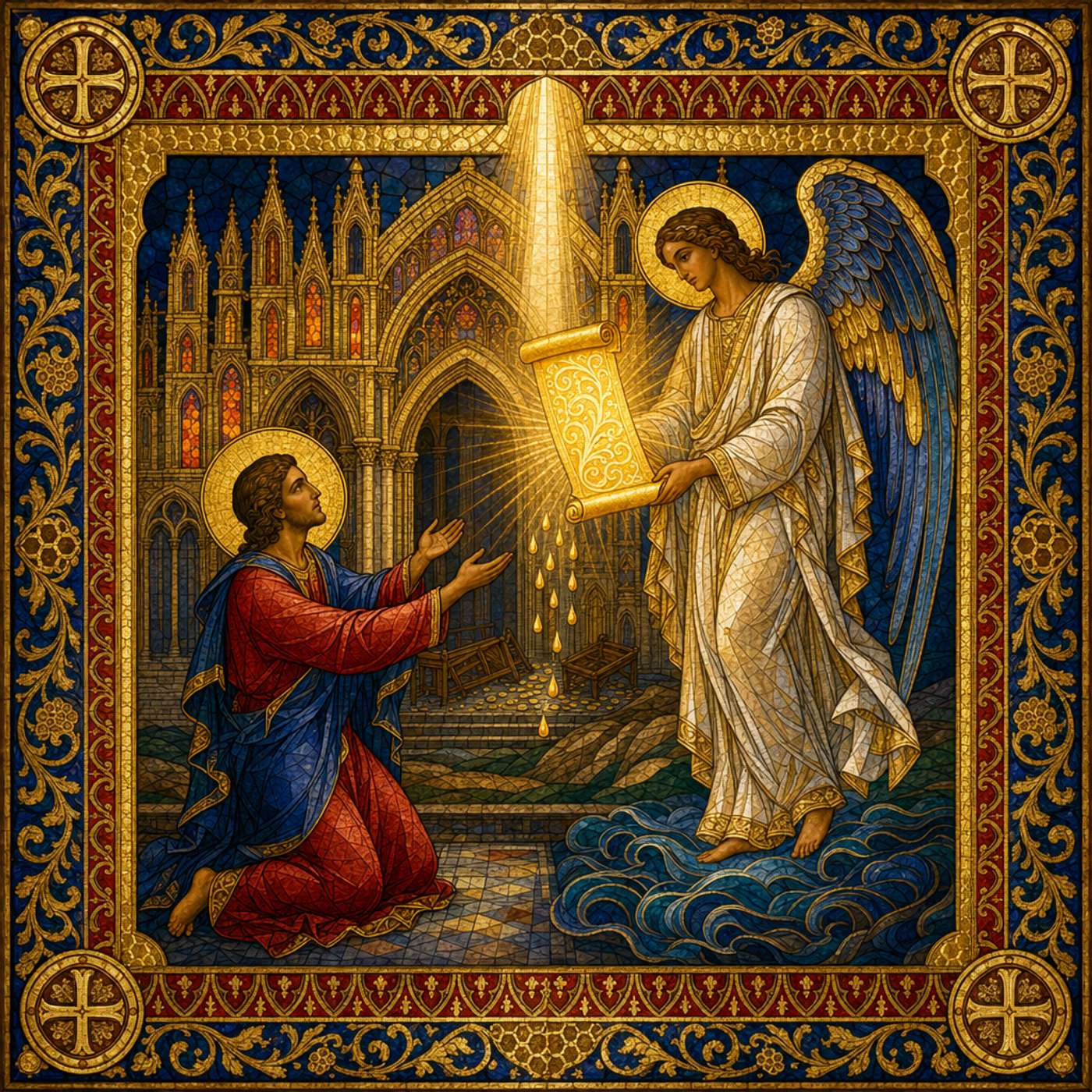
In the name of the Father, and of the Son, and of the Holy Spirit. Amen. Today is Friday, the twentieth of November. O God, whose Word is sweeter than honey and whose house is a house of prayer, cleanse the temple of our hearts, and grant that what we receive in sweetness we may faithfully proclaim, even through bitterness, until we taste the fullness of Your promise in glory. Through Christ our Lord. Amen. A reading from the Book of Revelation. I, John, heard a voice from heaven speak to me. Then the voice spoke to me and said: "Go, take the scroll that lies open in the hand of the angel who is standing on the sea and on the land." So I went up to the angel and told him to give me the small scroll. He said to me, "Take and swallow it. It will turn your stomach sour, but in your mouth it will taste as sweet as honey." I took the small scroll from the angel's hand and swallowed it. In my mouth it was like sweet honey, but when I had eaten it, my stomach turned sour. Then someone said to me, "You must prophesy again about many peoples, nations, tongues, and kings." The word of the Lord. Responsorial Psalm. Psalm 119. How sweet to my taste is your promise! In the way of your decrees I rejoice, as much as in all riches. How sweet to my taste is your promise! Yes, your decrees are my delight; they are my counselors. How sweet to my taste is your promise! The law of your mouth is to me more precious than thousands of gold and silver pieces. How sweet to my taste is your promise! How sweet to my palate are your promises, sweeter than honey to my mouth! How sweet to my taste is your promise! Your decrees are my inheritance forever; the joy of my heart they are. How sweet to my taste is your promise! I gasp with open mouth in my yearning for your commands. How sweet to my taste is your promise! Alleluia, alleluia. My sheep hear my voice, says the Lord; I know them, and they follow me. Alleluia, alleluia. A reading from the holy Gospel according to Luke. Jesus entered the temple area and proceeded to drive out those who were selling things, saying to them, "It is written, My house shall be a house of prayer, but you have made it a den of thieves." And every day he was teaching in the temple area. The chief priests, the scribes, and the leaders of the people, meanwhile, were seeking to put him to death, but they could find no way to accomplish their purpose because all the people were hanging on his words. The Gospel of the Lord. The scroll is sweet in the mouth and bitter in the belly. John does not read it; he eats it. The Word of God is not held at a distance for inspection. It must be swallowed, digested, and made flesh in the one who bears it. St. Gregory the Great teaches that whoever is to preach must first consume what he is to say, feeding upon the Word within before he feeds others from without. The Word enters as honey because it is Truth, and the soul was made to hunger for Truth. St. Augustine says it plainly: give me one who loves, and he will feel what I say. Sweetness is the knowledge of the lover. The psalmist knew it: sweeter than honey to my mouth, more precious than thousands of gold and silver pieces. Yet the same scroll sours the stomach. Cornelius a Lapide notes that the sweetness is the consolation of contemplating divine mysteries, and the bitterness is the labor, sorrow, and persecution that follow the one who proclaims them. The Word cannot be kept as a private delicacy. It sends. "You must prophesy again." Every Christian who has tasted Christ and then witnessed the world's refusal of Him knows both flavors. The sweetness is the pledge, and the bitterness is the cost. A Gospel that never turns the stomach has probably not been swallowed whole. The scroll prefigures Christ Himself, the Word made flesh. He was sweet beyond measure to the Father, and He was made bitter for us in the garden and on the Cross. The Church eats this same Word in Scripture, and more profoundly still in the Eucharist, where the Word is given as true food. What is sweet on the tongue of faith becomes, in the one who follows Him, a share in His Passion. The Gospel shows what such a Word does when it enters a defiled place. Christ enters the temple and drives out the sellers. This is not a burst of temper. It is the zeal prophesied by the psalm, "Zeal for your house will consume me." Benedict XVI observes that the cleansing points beyond the stones of Jerusalem to the end of the old Temple and the rise of a new one, the very Body of the Lord, raised in three days. The den of thieves gives way to a house of prayer whose altar is the Cross. St. Gregory the Great reads the dove-sellers as those who traffic in sacred things, who would sell the gifts of the Holy Spirit. The warning reaches every baptized soul. St. Paul says, "You are God's temple." Christ comes daily to the temple of the heart and finds stalls erected there: vanity, ambition, calculation, the bargaining spirit that treats prayer as a transaction and God as a vendor. He does not enter to condemn but to cleanse. Augustine urges us not to do in ourselves what He drove out of the temple. The whip is mercy, and the overturned tables are grace. And "every day he was teaching in the temple." Once the house is cleared, the Word is preached. The people hang on His words because the sheep know the voice of the Shepherd, as the Alleluia proclaims. The leaders, whose hearts are full of merchandise, cannot hear. Only an emptied house can receive the Word. This is the order of the interior life: purification, then illumination, then mission. We are cleansed so that we may hear, and we hear so that we may be sent. At the end of all things, the Temple needs no sun, for the Lamb is its lamp. There the sweetness will be undiluted and the bitterness gone, and the saints will feast forever on the Word they once swallowed in tears. Ask Him today to enter your heart as He entered the temple, and do not hide the tables. Read today's Gospel once more, slowly, and choose a single phrase of it to carry through the day. Repeat it in silence at every pause, and let it cleanse the house of your heart and prepare it for prayer. May Almighty God bless you, the Father, and the Son, and the Holy Spirit. Amen. Praised be Jesus Christ, now and forever. Amen. EPISODE_TITLE: Sweeter Than Honey, A House of Prayer IMAGE_PROMPT: A radiant angel offering an open scroll glowing like honey to a kneeling Saint John, while in the background Christ stands in the gold-lit Temple of Jerusalem with overturned tables and fleeing merchants, rendered in the style of traditional Catholic sacred art.
More Daily Mass Readings with Homily and Saint of the Day episodes →