
Clarity Connections with Julia Tucker-Lloyd · Julia Tucker-Lloyd
The conversation delves into the importance of understanding political terms and ideologies for informed citizenship. It explores the tension between progressivism and conservatism, the dangers of communism and fascism, the impact of democratic socialism, the flaws of socialism and capitalism, the threat to democracy, the nature of conservatism and progressivism, and the nature of democracy and republic. Takeaways Understanding the meaning of political terms is crucial for informed citizenship. The tension between progressivism and conservatism is a healthy part of the American political system.
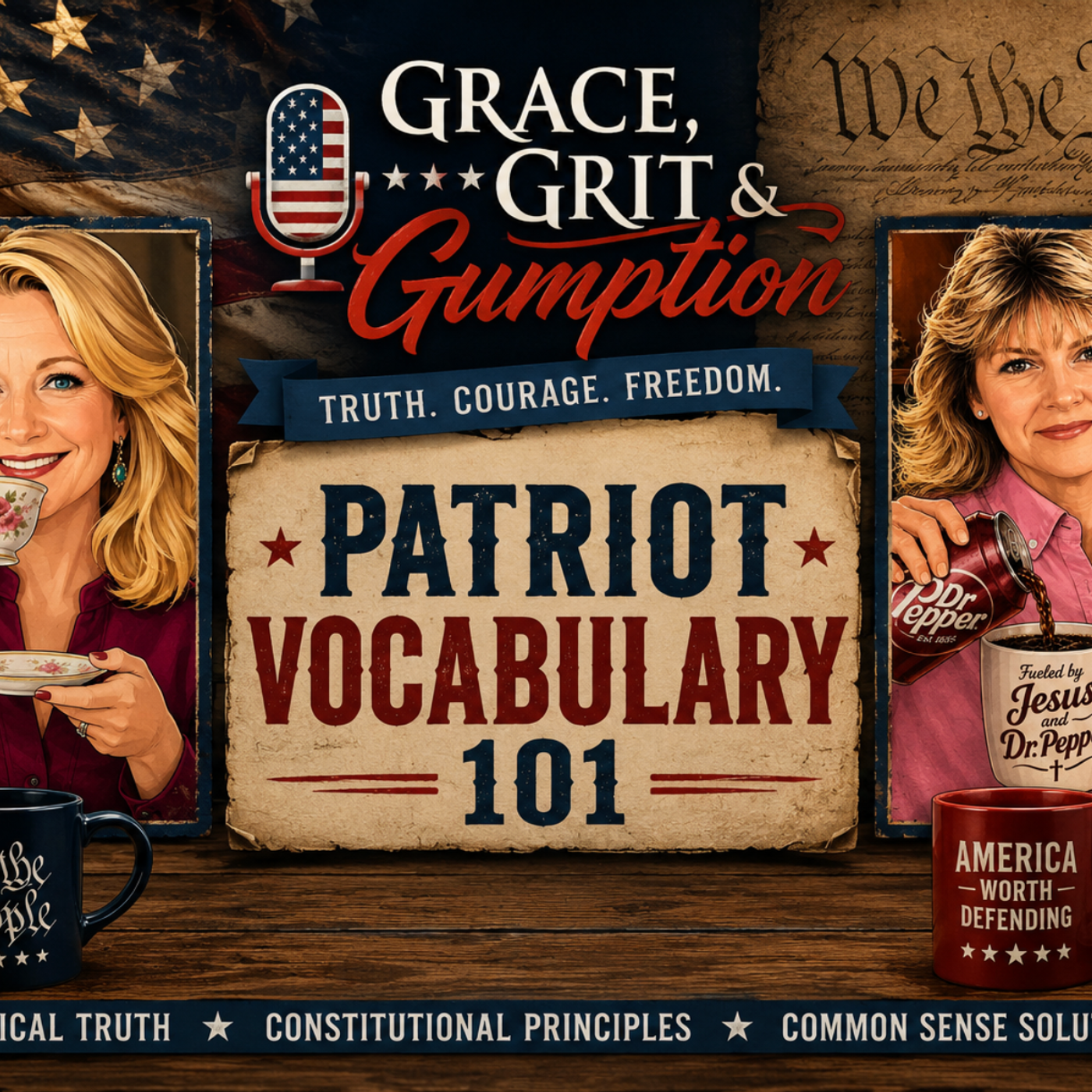
Cindy Mac: What happens in Richmond doesn't stay in Richmond. Welcome to Grace, Grit, and Gumption. I'm Cindy Mack. Julie Tucker: And I'm Julie Tecker. Cindy Mac: And together we are guarding our values with grace, defending them with grit, and moving forward with a whole lot of gumption. So let's get to it. So today, Julie and I are, well, we're going back to school. This has got to be one of my worst nightmares. But at least there's no algebra. there may, however, be a vocabulary test because there are certain words Americans throw around constantly and they have. No idea what they mean. Words like communist, socialist, fascist, conservative, progressive, democracy, and republic. We hear them on TV, we use them in political speeches, we use them on social media, and we use them to describe politicians and occasionally our neighbors. But here's the problem. Most people don't even know what these words mean. And you know words aren't just labels. They carry ideas. They shape governments and governments shape laws and laws eventually shape people's lives. So today we're enrolling everybody in a class we're calling Patriotic Vocabulary 101. So Julie, have you got your number two pencil sharpened? Ha ha. Julie Tucker: So I'm ready, but I want to establish one rule before this class begins. We are not defining these words according to who we like or don't like politically. We're going to ask questions about each one. Where did the idea come from? What does it actually mean? And what happened when people tried it? Because one of the best defenses against political manipulation. It's just simply knowing what words mean. One of the questions I liked for my students to ask me, believe it or not, was why do we need to know this? Is this going to be on the test? You need to know these seven vocabulary words, especially as we use them towards the democratic socialists of America, because there's this growing movement in the United States. With over a hundred thousand members. And chapters in all 50 states, the Democratic Socialists of America are putting us to a test. And it sounds great when they say ordinary working people should have more control over government, workplace, housing, health care, and major economic decisions. But if you look at what might they might actually deliver through the lens of history and current events, there's some sobering thoughts. So Cindy, let's think about what Stalin, Lenin, Mao Zi Tang, Ho Chi Minh, and Kim Il-sung have in common. So that's Russian, Chinese, Vietnamese, and Korean leaders. What do they have in common? They all advocated some version of communist or Marxist Leninist government, and it was A revolutionary one-party state claiming to resent, not resent, represent workers and peasants usually involves centralized political authority, state direction of the economy, and suppression of rival political parties that may be echoing with people's perception of today's politics. So estimates vary a lot depending on what is actually counted. Do you count the executions? Do you count the prison labor deaths? Do you count the forced collectivization? Do you count famine? Do you count civil war? What about the broader war deaths? Historians generally place the death tolls under just those communist leaders and regimes in the millions to tens of millions. If you count only direct executions and prison camp deaths, the numbers are lower. If you include famines caused or worsened by state policy, forced labor and deportations, and war related death, the tolls rise dramatically. That's why estimates differ so much across historians and sources. Nerd alert. We have to look at what happened when quote. Democratic socialism was applied historically, and the millions of deaths matter. And so a lot of people say, well, where's Hitler and Nazi Germany in this lineup? So technically, you could put the Nazi Party in fascist totalitarian dictatorship. But do you know what they called themselves in 1933 when they started? The democratic socialist movement. Cindy Mac: Democrat socialists. Julie Tucker: So bottom line. Whether it is fascist totalitarian dictatorship, communism or socialism, there is a relationship to the suppression of opposition and the concentration of power. So Cindy Mac: So let me ask you a question real quick. When s when someone tells me that democratic socialism just means free school lunches and affordable health care, you mean that's not true? Julie Tucker: So let's look right at what the Democratic Socialists of America on DSA.org has to say. So Not every Democrat is a Democratic socialist, but this is an incredibly strong theme that's emerging within the party and splitting the party. DSA is America's largest explicitly socialist organization. And so what does it actually mean? And the answer's pretty, direct. exhibit A. Capitalism isn't something they simply want to reform. This is a quote from their website DSA dot org. Capitalism is a system designed by the owning class to exploit the rest of us for their own profit. And then comes the important part. We must replace it with democratic socialism. DSA says under its vision. Society would collectively own key economic sectors such as energy and transportation. Okay, Cindy, just want to hear your thoughts on that one. Cindy Mac: I'm already expecting my high stress alert to go off on my watch. Okay. I am unapologetically pro-capitalism. Is is it perfect? No, of course not, because people aren't perfect. Any economic system that's operated by humans is gonna be flawed. Absolutely. And I just this just popped in my head. You know, scripture warns us that the love, people always say it wrong, it's not money is the root of all evil, it's the love of money is the root of all evil, and you can find that in First Timothy. notice it doesn't say money itself is evil, it warns about the love of money, greed and you know the Corruption and the power that they seek, that they just lust for. Those are all problems of the human heart. And when we see the consequences, we can see that every day. But socialism doesn't cure the human heart. And so the promise that we can create this society making everything equal sounds very appealing until you ask the question. Well who gets to decide what to decide what equal means? Who gets to decide that? Who gets who gets the control? Who gets to control the resources? Those people are flawed human beings too. So greed doesn't just automatically disappear when the government takes over everything. Neither does the corruption or the desire for power. And I think you know, capitalism at its best recognizes it recognizes private property and it rewards work and innovation and it allows people to bus build businesses and create jobs and give individuals the freedom to make economic choices for themselves. So can it be abused? Absolutely. But so can governmental power. So that's why I don't think the answer to the imperfection of capitalism is handing even more Economic power to the government in pursuit of this utopia that simply doesn't exist. I mean, you can't, you can't create a perfect economic system out of imperfect people. So I don't think capitalism's obviously not the problem. It's the human heart. And just kind of let me say this too. Scripture addressed that a long time ago. this utopia that people are looking for, whether they realize it or not. It's heaven. That's what they're looking for. It's the only place where everything's going to be truly perfect because we will be in the presence of the perfect and holy God. So no political system, no economic system or government is ever going to create heaven on earth because every one of them is made up of flawed and sinful human beings. So and I feel led to say this too. My sincere prayer is that they come to understand that and they come to know Jesus Christ before they die because without him, the eternity that awaits them is going to be very far from the utopia that they're searching for now. Julie Tucker: Yeah, and and exhibit B is all about public ownership of major corporations. So we don't trust we don't trust individuals to own corporations. We're gonna hand them Cindy Mac: Right. Julie Tucker: over in the interest of economic democracy. And again, I am quoting from the website. I'm not making this up whole cloth. I am sharing the words from the platform for the Democratic Socialists of America. Here's one of the proposals. Establish public ownership of the largest corporations and essential industries. That means AI. That means energy. That means transportation. I'm pretty sure they'll take Elon's toy or Elon's toys as soon as they can. We're not talking about taxing corporations. We're not even talking about requiring corporations to adhere to certain regulations. We're talking about government ownership. And what this is about is changing who owns what. So, in other words, there is a loss of private property, there's a loss of entrepreneurship, and there is a loss in investments. So my notes say Tell Cindy to just share her thoughts on loss Cindy Mac: Yeah. Julie Tucker: of private property, loss of entrepreneurship, and investments. Cindy Mac: the thought of the government deciding that a privately built corporation is just too big or too important to remain privately owned, that fundamentally changes the meaning of owning a private owning private property. Private property becomes conditional on what the government decides it should control. my gosh, why then would anybody bother to take why would you start a business? Why would you invest your savings and work a hundred hours a week and hire employees and and grow a company if the government can just take it away from you? That's absolutely insane. Nobody's gonna do that. Nobody's gonna work to to build a business. They don't just happen out of thin air. People invest their retirement accounts and their pensions and their savings. They put capital in these companies with the expectation that they're actually going to own a share of that business. They're going to own it. They're going to be able to maybe you know, retire and let the company work for it, for them. I mean, so if major corporations are transferred to public ownership, then what's gonna happen to the incentive to to do anything, to invest in a company, to start a company? So the answer to concentrated corporate power isn't concentrated government power. That's just ridiculous. Julie Tucker: is actually hostile to the Constitution, which leads us to Exhibit C. Cindy Mac: Imagine that. Julie Tucker: DSA's current program goes really far. It says, quote, complete victory will require building a new society from the ground up. It describes the goal as creating a democratic Socialist Republic. Which by the way was the same thing Hitler said was a good idea. I'm just saying. Part of the project, DSA's program says its movement should draft a new constitution. Trash the Constitution entirely. Start over. Okay, this is the part that I thought would be the most fun to hear from you about. Go. Cindy Mac: Definitely need something stronger than Dr. All right. So this obviously really concerns me because now we're no longer talking about just changing an economic policy or passing the new law. Now we're talking about trashing our country. I mean, is our constitution perfect? No, I think it's as close as you're gonna get with imperfect people because the people that wrote it weren't perfect. But that's precisely why it. contains processes to amend it and we've used that process throughout history. We correct injustices, we've expanded rights and I'm trying to think what else, but we've we've done all that without throwing the entire frame the framework away. So there's an enormous difference between saying this provision needs to change and saying we need to build a new society from the ground up and and draft a new constitution and start over with what? A a democratic Julie Tucker: Well, I mean it's a it's Cindy Mac: socialist republic? Julie Tucker: I mean, it's like, okay, it took us until nineteen nineteen for you and I get to get the right to vote. I'm not particularly proud of that, but we got there because there were checks and balances in the constitution and the form of government and the ability to amend it through prescribed practices. And now we're just gonna scrap it and start over. And here are some of the major features. You might want to take a deep breath in through your nose, out through your mouth. Cindy Mac: I need a drink. Julie Tucker: Exhibit D. We're gonna abolish the Electoral College. Now, we already know Governor Abnigel Spamberger wants to do that anyway. She wants the popular vote to to take care of everything without really considering what the Electoral College was supposed to do. Originally, it was supposed to get keep. larger populated states from completely overrunning Vermont, which is very small and cold, and they produce some really good syrup. So abolish the Electoral College, but wait for it, we're gonna abolish the United States Senate while we're at it. So the Electoral College is designed to give population representation and then the Senate Is designed to give equal representation and we're going to abolish them. So the Senate is not some accidental feature of the Constitution. It represents the states as states. We get two senators, Wyoming gets two senators, California gets two senators, the House represents population. And the Senate gives equal representation along with the population representation. Which is where the Electoral College comes from. So you can certainly argue that this agreement is undemocratic because citizens in smaller states have greater representation per capita in the Senate. But that's essentially a socialist perspective. The constitutional argument on the other side is that America was not designed as one giant national direct democracy. It was created as a federal Constitutional republic composed of states. It was the best thing they could do to give everybody a vo voice without too much power in one place. And so, should we abolish the Electoral College or work around it the way Spanberger's trying to do with this whole compact agreement? Little side dig there, or abolish the United States Senate I wrote Cindy reacts however she wants. This'll be fun. Cindy Mac: Either. How about we don't do either? If you eliminate both, you aren't tweaking a couple of outdated institutions. You're fundamentally changing the structure of the United States. So the House, as you said, the House already represents us based on population. And the Senate was intentionally designed differently because the states themselves matter in our federal system. So, like you said, you know, Virginia gets two senators and so does California and so does Wyoming. But without that balance, the most populous parts of our country would have considerably more influence over the federal government, while smaller states would lose one of their primary protections within our constitutional structure. And again, I come back to the same question. Why are we dismantling every safeguard instead of recognizing why those safeguards were put there in the first place? The founders knew what they were doing. They knew how dangerous unchecked power was. Whether that power belongs to one person or a branch of government or even a political majority. That's why they divided the powers between the federal government and the states and the the three branches of government it it just it just doesn't make sense. And you can call the system imperfect but abolishing the Senate and abolishing the electoral college replacing private ownership of major industries and drafting an entirely new constitution, those aren't isolated reforms anymore. Altogether you're talking about you're talking about fundamentally restructuring the entire United States of America. Julie Tucker: So again, take a sip of Dr. Pepper. You might need you might need another bottle. Cindy Mac: I'm not gonna make it. Julie Tucker: So again, I am pulling from the Democratic Socialists of America website. We're not making this up. We're not quoting someone who quoted somebody. Go to the website, read it. So exhibit F. Restructure the presidency and the Supreme Court. So here's the part that many Americans have never heard. Democratic Socialists of America, by the way. Talib Rashid, AOC, Bernie Sanders, and there's more, Jasmine Crockett, and there's more, even people who actually got nominations out of the Democratic primaries. This is what their platform is. We want to re quote replace the president and Supreme Court with an executive. And judiciary chosen by and subordinate to Congress. So we're gonna get rid of the Electoral College, we're gonna get rid of the US Senate. I don't know what Congress is at that point. But whoever they are, the president and the Supreme Court are chosen by whoever those people are. Okay, go ahead. Cindy Mac: This should alarm every American. I don't care what party you belong to. Our government was deliberately divided into three separate branches of government because concentrating power in one place is dangerous. The president's not supposed to be subordinate to Congress. The Supreme Court is not supposed to be subordinate to Congress. Each branch has its own constitutional authority and it provides the checks and balances on the others. So if if Congress chooses the executive and judiciary branch, and those branches are then subordinate to Congress, well, where's the meaningful check on that power? And that's the issue for me. Today, you may love the people controlling Congress and trust them completely, but what happens on the other side when the other side takes control? Our constitutional protections aren't supposed to depend on whether we like people currently holding office. And again, look at all these proposals together. You look at the Electoral College, you look at abolishing the Senate, replace the President and the Supreme Court with institutions. subordinate to Congress, establish public ownership of major corporations and draft a new constitution. At some point, you don't call that reform. This is a proposal to fundamentally restructure the American system of government. The separation of powers can be trusted and can be frustrating, not trusted. They can be frustrated and inefficient. But I think that's intentional. Because government isn't supposed to have an easy path to unchecked power. The checks and balances are a feature, not a flaw. Julie Tucker: Brilliant feature not a flaw. Gonna definitely underscore that in our show notes. One of the problems is this is a move towards streamlining control. And the premise will be that well, we're just trying to give direct control back to the people. Are you? Because look at what the Constitution did. The founders deliberately separated government power legislative, executive, judicial. Why? 'Cause they distrusted concentrated power 'cause they had watched the Magna Carta not do what it was supposed to do. So the Democratic Socialists of America are proposing a fundamentally different arrangement in which the executive and judiciary could be support subordinate to the legislator. So if the le if the if the legislator decided, well, we want to gerrymander in Virginia. Supreme Court could do nothing about it. This is a really important debate. And Americans need to know what's happening because this isn't about better health care. This isn't about better lunches. This is about something we've seen. And exhibit G ought to scare the crap out of people. Police abolition. This is literally on the website. Go to DSA.org. I've already told you this. You've heard the phrase defund the police. Sometimes defenders say that doesn't literally mean eliminating police departments. In DSA's national abolition abolition working group, however, the stated goal is very clear. It calls for rejecting the expansion of police budgets while cutting budgets annually towards zero. It also calls for freedom for all incarcerated people. Marilyn Manson not Marilyn Manson. Charles Manson. Welcome back. Cindy Mac: Thankfully he's dead. Julie Tucker: Yeah, well he is dead, so there's we got that going for us. But I'm just I'm just saying freedom for all incarcerated people, as if our judiciary system meant nothing, and protecting the health and well-being of our society was just overreaction. So it's not ambiguous defund, abolish, Create something else. And so here's the other thing. All of this is buried in the idea of class struggle. DSA's language repeatedly divides society into economic classes, just like Karl Marx did, just like Stalin did, just like Lennon, just like Mousy Tongue, etc, etc. It says that America's class structure creates a basic conflict of interest between between people possessing enormous economic power and then the rest of us. it says this is the ideal. The democratic socialists of America say we fight for a world without classes, and the working class is the only social force capable of carrying out this fight. Now, this should sound really familiar if anybody knows anything about history, because Karl Marx said the same thing. also, there's gonna be some people, Cindy, that says, well, democratic socialism just means what health care is, like they have in Scandinavia. And that's not the whole story. Not according to DSA. And this is why our vocabulary matters. There is a difference between a welfare program. which we have plenty of, and a welfare state, a social democracy and democratic socialism and communism. They're on the same continuum. So, excuse me, look at Scandinavia, which is always held up as the ideal by the Democrat Democratic Socialists of America. What they say is, all right, here's what we want. It's a compromise. You keep capitalism, you keep private businesses, you keep private investment, you keep private property, you keep markets, but we're gonna renovate it. We're gonna have higher taxes, universal health care. Generous social programs, strong unions, and a lot of regulation. Look at the cost of living to live in Scandinavia. And then if you look at that compared to true democratic socialism, you don't just renovate the capitalist house and keep private markets. You say ownership itself creates inequality and undemocratic po democratic power. And for those of you who'll say, Well, that can never happen in America, look at who Zoran Mandami appointed to be his housing secretary. She says nobody no owns anything. And he doxxed anybody in New York who he thought owned a property, which is not that hard. I mean, New York's expensive, anything over a couple million dollars, he put their names and addresses available publicly. basically saying we're gonna go after the people that own more than we think they should. So it's a it's about changing who owns and controls major parts of the company of the coun economy. So the vision for America that DSA has slips into communism. And we don't like to say that. We like to say, well, socialism is broad, great, good, make sure we take everybody, it take care of everybody. But in order to do that, we slip into communism, which says, and the government will control everything. So I don't think well We all think we understand communism, but basically communism envisions a classless society which says everything is held communally rather than privately and economic classes ultimately disappear. Cindy Mac: Yeah. Julie Tucker: So here's an example. In the Russian Revolution of nineteen seventeen, which brought Lenin and then the Bolsheviks to power, the Soviet system dramatically expanded state control over the economy and political life. Free grocery stores. Under Stalin, he forced collectivization, political purges, imprisonment, censorship, and And state terror became the defining characteristic of the regime because people started reacting to hold on, this state control is not working. Yes, it is. Stop talking. And so the Soviet Union became one of the two dominant global powers after World War II, before it collapsed in 1991. And like that's not enough. You look at China and Maoist China, Mao Zedong. Who established the People's Republic of China in 1949 says this is the great leap forward. And communism wasn't simply the idea that the government should help poor people. It said we are going to take property differently, economic class and social organization differently, and we're going to change all the political and economic power in the state and the ruling party. So this is what people get confused. Why do you think people confuse socialist and communist? They're not actually interchangeable. Cindy Mac: Yeah, I mean I think it does confuse people. and th they're not interchangeable. I I don't I don't really understand why. Julie Tucker: So I had to really dig deep on this because I wanted to not be the academic egghead who couldn't explain it. Nerd alert. Socialism is the grand idea that we can make a utopian society. Communism is the vehicle through which we do it, and it doesn't work. Because socialism, when you implement it, says it's public ownership and control of all the economic resources or industries. And there's no private ownership and markets. There's no check or balance. There's concentrated power. So socialism says we've got this grand philosophical idea that everybody's going to have enough. And in order to do that, we're going to concentrate power. And so Britain tried to do this. The Labour government that was elected in nineteen forty five created Britain's National Health Service and nationalized major intro industries, including coal and railways. It didn't abolish abolish private property. It didn't become communist, but it became a mixed economy. So government programs didn't automatically equal communism. Welfare state didn't automatically equal socialism. Socialism didn't automatically equal communism, but it allowed for this huge influx of immigrants across the borders and the provision of those at governed expense to the detriment of the private citizen. So th there was this it's sort of like my dad used to say, Don't you be writing a check that your butt can't cash. And that's sort of what you know, it's it sounds beautiful and wonderful and fabulous. But the second question should be, and how are you gonna pay for that? And built into the American system for good or bad is a check and balance that says, And how are you gonna pay for that? And how are you gonna pay for that? And we have waste, fraud, and abuse in the country that we need to say, How did you think you could pay for that? Separate episode. But Cindy Mac: Yeah. Julie Tucker: What do you think, Cindy, is the most abused political word in America today? Cindy Mac: Gotta be fascism. Gotta be. Julie Tucker: Yep. So today you say someone's fascist because it means that's the person on the internet who made me angry. But it actually means something very specific. And we've seen in the No Kings march the charge that that Trump is fascist and and fascism this and fascism that and I'm like, come on, let's just look at what it means. So Benito Mussolini In nineteen nineteen in Italy. The whole word fascisms comes from a group or a bundle evoking the ancient Roman word faces or a bundle of rods symbolizing authority. Fascism is basically authoritarian, intensely nationalist political ideal ideology that subordinates individual interests or f to the nation or state. rejects liberal democratic constraints and typically concentrates authority around a powerful leader and a centralized political movement. So Trump's always being accused of being a fascist. But the Supreme Court doesn't consistently rule in his favor. Amy Barrett Comey's gotten in trouble several times for not necessarily voting what would be considered a party line in her role. It means the suppression of opposition, political violence, the militarism, and intense nationalism. So that's not to be confused with intense patriotism. You can be very patriotic and not mean you're gonna like do what it takes to make sure that you're in charge or you're in power. but we have seen suppression of the media. We've seen suppression of of you know lots of lots of information mismanagement in the few years that we've been watching, and it probably one of the most interesting conversations lately is what happened during COVID. What information was suppressed, and why is Fauci at the heart of this of this debate? Like, who's the fascist? And this is what you gotta watch for in fascism. Do you dismantle democratic opposition? well you do if you decide that there's only well there's no more Senate and there's no more presidency and we're just gonna have one party that decides what everybody does. If you censor the press, if you suppress political opponents, And if you get to one party rule, that's how you know fascism. and every authoritarian government isn't automatically fascist, but we throw that word around every time we don't like who's in authority without really understanding what it means. Where do you think you see as you read social media, Cindy? And I'm throwing you curveball because I didn't write the question down. Where do you see the most abuse of that word? Cindy Mac: Gosh, I mean I see it on both sides, but I think I see it far more on the left because everybody wants to call on the left wants to call Trump a fascist. Julie Tucker: Part of the reason that people in a hurry to call Trump a fascist is bec and this gets to one of our other incredibly important patriotic vocabulary words, there is a fundamental misunderstanding of what conservatism is. So conservatism says, hey, we want to preserve institutions and traditions and social arrangements. If they're valuable while approaching sweep sweeping political and social change cautiously. In other words, don't throw the baby out with the bathwater. You know, don't throw out the electoral college until you look and see what it means. Don't work around it with this social contract agreement that Spamberger signed up for without saying, well, what was the purpose of it? What was the point? What is what is of value in this? And so this is different than European conservatism because American conservatism said, Hey, we are rooting this around constitutional government, individual liberty, property rights, federalism, and limited government. European conservative did not have that anchor. So when you look at people who are part of the conservative movement in England in particular, they don't have those anchors. We've got those touch points. And I'm just gonna go there. I'm going with Reagan. In the twentieth century, Ronald Reagan's election into the nineteen eighties said we need to lower taxes, we need to have free enterprise, we need to have a strong national defense, anti communism, traditional social institutions, and limits on federal power. That's all he said. To protect the intent of the Constitution. And we've evolved since then, and we have factions in conservatism, but conservatism doesn't mean nothing should ever change. It says before we tear this down, do we understand why it was built in the first place? You know, Reagan's famously known for Gorbachev, tear down this wall. But he didn't apply it liberally to everything. He didn't say tear everything down and let's see what we got. He's like, let's look at why it's here and then figure out what's valuable about it. And so how how do you think progressivism is a reaction to that? Cindy Mac: It's a reform tradition and it seeks social and political or economic improvement through deliberate change and frequently including the expanded role for government in addressing perceived injustices or social problems. But I think there's another vocabulary warning there. You want to expand on that? Julie Tucker: Yeah, so there's a friction between conservativism and progressivism that is not a bad thing. Conservatism says is, wait, don't tear that down yet. What's actually working? And progressiv progressivism says, no wait, we must tear it down and rebuild something better. So the friction is good. But there's something to understand. The progressivism that began in nineteen five under Teddy Roosevelt is not what we're looking at now. They they are not the same thing. So Theodore Roosevelt, he became one of the era's most famous progressive reformers. And he said, you know, we got to regulate corporations and food and drug and have conservation efforts and have direct election of senators and reforms intended to reduce political corruption. Both sides of the aisle would agree with that. And Then there's some stuff we wouldn't like, maybe. we the progressives under Teddy Roosevelt suppress they they loved eugenics and other so coercive social policies. I mean, this is why we have Planned Parenthood. So, you know, institutions can and sometimes should be deliberately changed to improve society, but the qu conservatives say, well, what counts as progress? And what happens when reform creates unintended consequences? And so the tension between progressivism and conservatism is much like the check and balance that's in the American Constitution. If you get rid of one and and suppress the other, you don't have that same movement forward because there's no check and balance. So Let's talk about our democracy. just guess, Cindy, how many times in the last thirty days have you heard the phrase, but we must preserve our democracy? This is a threat to our democracy. Cindy Mac: I am so sick of hearing that. It drives me crazy. We are not a democracy. We are a constitutional republic. If you can't get anything else right, for the love of Pete, get that right. Drives me nuts. I don't know how many times I've heard it. I tuned it out. Julie Tucker: Well, saying America's a democracy isn't really and then saying it's also a republic, they're not contradictory statements, but they are a clear explanation of our identity. So we are a political system in which legitimate government authority ultimately derives from the people expressed through voting and political participation. By the way, that means we have to participate. But we're not a direct democracy. We do get the opportunity this election to vote directly on some constitutional changes. And we'll talk about in a subsequent episode why the no, no, no still goes. but we elect representatives who make government decisions on our behalf, and we take them out when they stop acting on our behalf, which is another episode about Senate. But the American system, like it a expanded democratic participation through all the constitutional amendments and political reforms. So voting rights expanded way beyond what they said it would in 1789. You know, women got the right to vote, slaves got the right to vote. the majority can't just do anything at once because American democracy operates within a constitution. And that's gonna bring us to our final vocabulary word before we do that. If American democracy operates within a constitution. Am I being a drama queen when I say the democratic socialists of America are actually the biggest threat to our democracy? Cindy Mac: No. Next question. Julie Tucker: Well and well that's true. And I'll have a bunch of hate mail on this episode. But if you want to remove it, you want to remove the Constitution and totally start over, that's the biggest threat to our democracy. So Republic. Roman Republic was history's most influential example of Republican government. And then centuries later the Enlightenment comes along, nerd alert. And the founding fat fathers knew that history well. A republic is just a political system in which government is considered a public matter rather than private possession of a monarch. Pl public authority is exercised under its laws and institutions. So looking at Rome. In five nine, Rome placed its monarchy within a republican political order containing the alleged elected magistrates and the senates and assemblies. And so it wasn't democratic by today's standards, but it offered some checks and balances. Here's where we benefited. The United States Constitution begins with we the people. That's democratic legitimacy. But the people established a constitutional republic. Instead of every citizen voting on every federal law, citizens choose representatives. Choose wisely sidebar. And then power's divided between the House and the Senate and the President, the courts, and the federal government and the states. And then there's this other boundary, the Bill of Rights. Freedom of speech isn't supposed to disappear because fifty one percent of your neighbors don't like what you're saying. All right, I'm ready for my final exam, Cindy. Cindy Mac: All right, Professor Tucker, the final exam. I'm gonna give you one word and then I want you to give me the shortest definition possible. Julie Tucker: All right, hit me. Cindy Mac: Com ready? Communism. Julie Tucker: A classless economic and social ideal based on common ownership through extensive state control. Cindy Mac: Socialism. Julie Tucker: Social or public ownership or control of significant parts of economic life democratic socialism among them. Cindy Mac: Fascism. Julie Tucker: Authoritating authoritarian ultranationalism that subordinates individual liberty and political opposition to one powerful state, one movement, one leader. Cindy Mac: Conservatism. Julie Tucker: Preserve what's valuable, change cautiously. Cindy Mac: progressivism. Julie Tucker: Use reform, including government action, to change institutions in pursuit of social improvement. Cindy Mac: Democracy. Julie Tucker: Political authority ultimately comes from the people. Cindy Mac: Mm. Republic. Julie Tucker: The people govern through laws and institutions, not personal rule of a monarch, and in America's case through elective representatives operating under a constitution. Cindy Mac: Yeah, and for the millionth time, America is a constitutional republic, not a democracy. Julie Tucker: Yeah, America is a constitutional republic with representative democ democratic institutions. Those aren't competing descriptions. They're describing different features of the same system described in the Constitution. And it just says where does legitimate political authority originate? The people. And Republican constitutionalism says something else. How will authority be exercised and restrained? Through representation, laws, divided powers, constitutional limits. It requires restraints on power. And Cindy, this is a sidebar, but it's an important one. The democratic social agenda for Americans, it takes all of this away. And it's worth fighting for. Cindy Mac: Absolutely, absolutely. All right, well, maybe Patriot Vocabulary 101 isn't really about vocabulary after all. It sounds like to me it's more about citizenship. Because free people have a responsibility to understand the ideas that are governed governing them. So before we call somebody a communist, You might want to know what that means. And before you call somebody a fascist, you might want to know what that means. So understand what you're saying. And before we dismiss the word as an the word republic as an antique, understand why the founders constructed one. Human beings possess rights, and human beings entrusted with power need limits. So here's your homework. Learn the words. Read the Constitution. Know your history. Question political labels. And the next time someone throws around a communist, socialist, or fascist, or democracy, or republic, ask a simple question. What exactly do you mean by that? Because chances are they don't even know. You might be surprised how quickly the conversation changes, because informed citizens. Are considerably harder to manipulate. And boy, do we need informed citizens. Class dismissed. And that's all the time we have for today. Thank you for joining us. Be sure to follow us on Facebook at Grace Grit Gumption. You can email us at podcast at GraceGritGumption.us, listen on Spotify and Apple Podcasts, or watch us on YouTube, Grace Grit and Gumption. We don't promise easy answers, but we do promise honest conversation. Until next time, be sure to lead with grace, stand with grit, and move forward with a whole lot of gumption.