
Circularity.fm · Patrick Hypscher
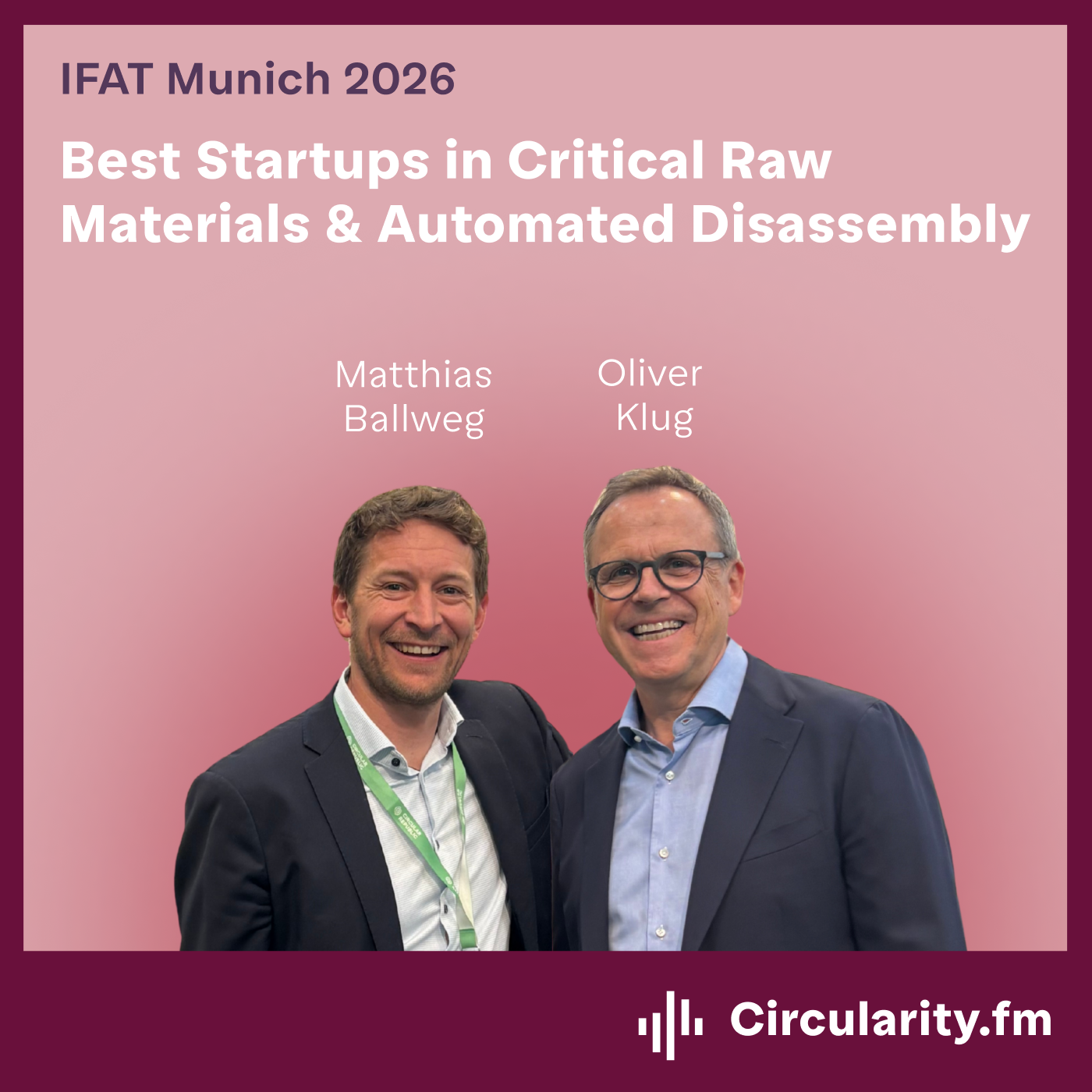
Which startups are solving Europe’s two key circular economy challenges: automated disassembly and critical raw materials recovery? This episode covers the Circular Technology Award, launched by Circular Republic and Knorr-Bremse, to back startups working in both fields. Matthias Ballweg, co-founder of Circular Republic, and Oliver Klug, Chief Strategy and Transformation Officer at Knorr-Bremse, explain why they created the award, what they learned from the applicants, and why they paired prize money with proof-of-concept partnerships instead of funding alone. What you’ll hear in this episode: • Why automated disassembly is finally viable, and what the robots can now do that they couldn’t five years ago. • How two very different approaches recover critical raw materials in Europe: hydrogen to reclaim rare earth magnets, and low-temperature salts to pull metals from electronic scrap. • What corporates like Knorr-Bremse look for before adopting a startup’s technology. The four winning startups then present what they’ve built: Xavier Kohll from R3 Robotics and Tomaso Manca from Hiro Robotics winners in automated disassembly, Carlo Burkhardt from HyProMag and Fred White from DEScycle winners in critical raw materials recovery. This is the final episode of the IFAT Munich 2026 series, recorded live at the fair.
0:00Matthias Ballweg: Automated disassembly is basically physical AI. It's the AI use case for Europe.
0:12Patrick Hypscher: My name is Patrick Hypscher, and this is Circularity.fm, the podcast about understanding, building and managing circular business models. You're listening to the final episode in our IFAT series. The IFAT is the world's leading trade fair in environmental technologies. In the previous episodes, we talked about sovereignty, we talked about the economic potential of circularity and the startup landscape. Today, we will bring all of this together and present to you the winners from the Circular Technology Award. Before we get to know the four winners from the award, Matthias Ballweg, co-founder of Circular Republic, and Oliver Klug, Chief Strategy and Transformation Officer from Knorr-Bremse, will provide us with some background information about the award and the motivation to launch it. Let's start with Matthias.
1:22Patrick Hypscher: Matthias, you co-founded Circular Republic almost four years ago. Now, this year, you launched the Tech Award. Why did you start that?
1:30Matthias Ballweg: The Tech Award was a joint idea with Knorr-Bremse. Knorr-Bremse is a classic German Mittelstand SME company, a rather large one, to be honest, that is really looking to build future-proof business. I think that's why we started talking. So we started to look into that space where are promising fields for international industry players based in Germany to innovate. Where does circularity offer innovation potential?
2:03Patrick Hypscher: Okay. And I guess you evaluated a couple of options. Why did you ultimately choose on these two fields?
2:11Matthias Ballweg: So we thought, we've chosen automated disassembly and critical raw material recycling. And it feels like the perfect point in time for both. So first, we are heading in a geopolitical time where obviously resource scarcity, especially around critical raw materials, is becoming hugely important. And that is building a market, that is building a business opportunity. And that's from the market pull side. And then on the other hand, there is now technology available that wasn't available five or ten years ago. Robotics technology, really the S-curve is now tipping up. AI, similar. And automated disassembly is basically physical AI, if you will. It's the AI use case for Europe. So we might not be the global champions in every AI use case in Europe, but for automated disassembly, we are. And it wasn't available five years ago even. Now it is. In Europe, you can have a robot arm disassembling products, even deciding whether screws are rusted or not, and acting accordingly. That is completely new tech, while at the same time, this market pull, the need for securing sovereignty for those materials is coming together. And then we said, now that's the opportunity to build a business. And it's still a bet, right? But that's how innovation and entrepreneurship always works, right? You do bet on a certain risk and bet on a certain trend. I believe this is the right trend. Sustainability together with geopolitical uncertainty are both not going to go away. The technology is now there. So let's catch the opportunity.
3:56Patrick Hypscher: Okay, wonderful. Before we hear Oliver's perspective from Knorr-Bremse, let me get some idea about the startups. You've got many applicants. I can assume many solutions. So what have been your observations? Is there any pattern or any white spot?
4:11Matthias Ballweg: I mean, we will have a different episode on the startup landscape.
4:15Patrick Hypscher: Yes, but with the focus of the award, what stood out for you?
4:19Matthias Ballweg: So we realized while it's a hot topic, there are not that many startups yet. We think, yes, we've got a lot of applications, and we feel like we've got the full market of circularity startups in the set of applications. But it's not that there are hundreds of startups that are building robot arms to disassemble stuff and then have new recycling. It's not that there's a lot of new technology. And that's maybe one finding. And the second one is you need a lot of complementary technologies. Quite a bunch of startups that are focusing on visioning, detecting what kind of material is it actually, that, this example, detecting the screw and deciding is it rusted, that's completely different also technology and skill sets than steering the subsequent robot arm, than doing any kind of hydrological, thermic or chemical or even mechanical recycling process in the end. And you need in any case to, like a chain, right? Put a couple of startups next to each other to enable circularity in any kind of electronic or critical raw material value chain. It's not that there is one player doing everything.
5:35Patrick Hypscher: Okay, Matthias, thanks for setting this up. I think it's again a huge contribution to the circular economy in Germany and Europe. And let's hope it will spark some additional innovation.
5:45Matthias Ballweg: Thank you.
5:46Patrick Hypscher: Thank you. And thank you for making the story so cool.
5:52Patrick Hypscher: Oliver, we just learned from Matthias about the Tech Award. And Knorr-Bremse is the partner of this award. You're the Chief Strategy and Transformation Officer. Before we look at the award, can you say a few words about Knorr-Bremse?
6:07Oliver Klug: Yes, of course. So Knorr-Bremse is one of the leading technology and market leaders for braking systems for the truck and rail industry. We are in 100 locations in 30 countries. Last year, we made a revenue of 7.8 billion euro and a profit of 11.6% EBIT. So it's a pretty strong market leader with a lot of technology, a lot of good engineers and a lot of innovation in the truck and rail industry, yes.