
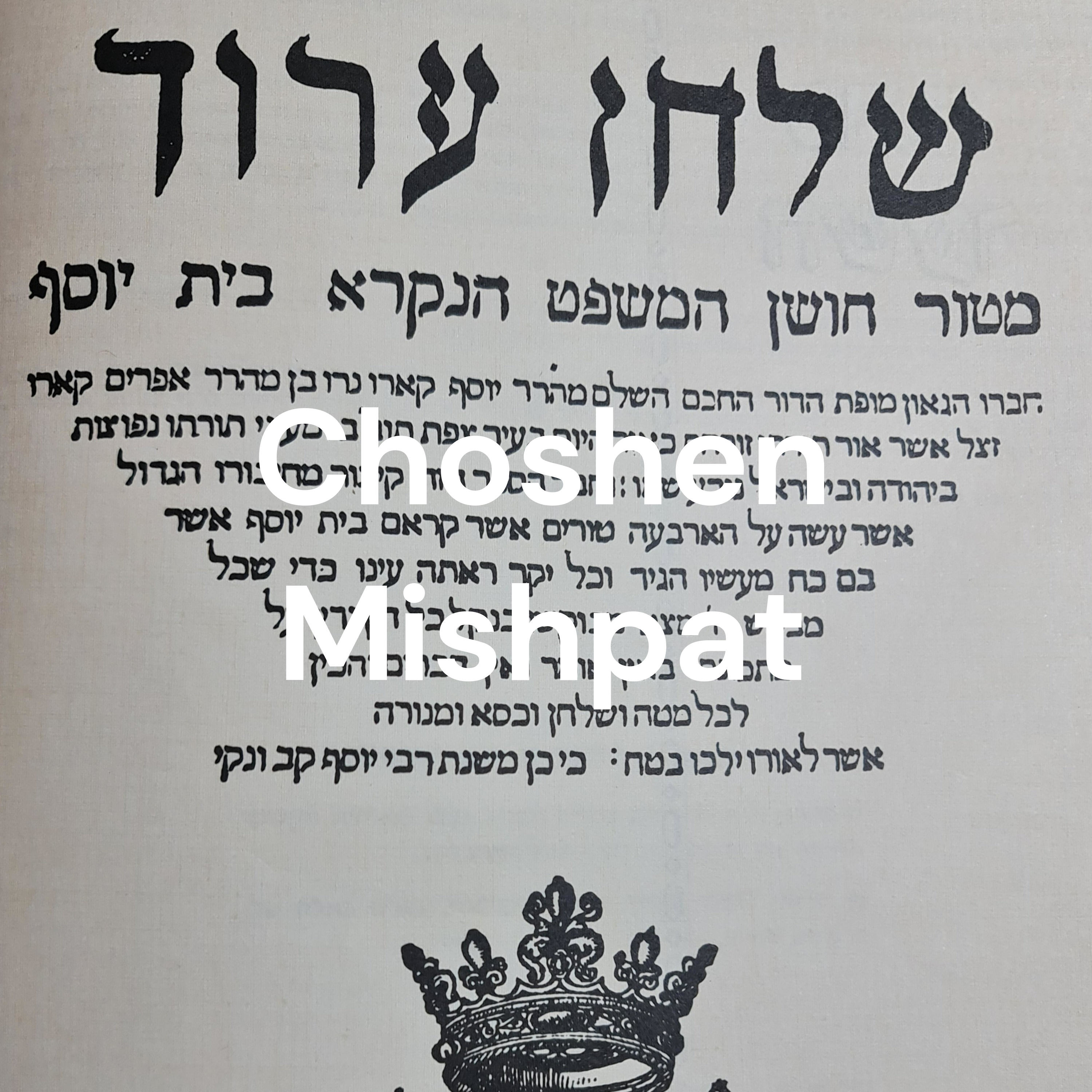
Choshen Mishpat is the section of Shulchan Aruch, the code of Jewish Law, that deals with monetary mattes. In this podcast we will study Choshen Mishpat in order. The first section of Choshen Mishpat deals with the laws of Dayanim, rabbinical judges. The podcast consists of brief recordings, each approximately 4-5 minutes long.
The קצות החושן agrees with the סמ״ע that even a mistaken underclaim may bind the claimant because מחילה בטעות הוי מחילה, while the נתיבות המשפט sharply...
The commentators debate whether a דיין may award more than the claimant requested: the סמ״ע understands the רמ״א broadly and limits the award to the amount...
The רמ״א rules that a דיין should not award a claimant more than he actually demanded, even if the דיין believes that the claimant is halachically entitled...
If a litigant makes an incorrect halachic assertion in front of the בית דין on a matter other than the dispute presently being adjudicated, the דיין should...
The שולחן ערוך rules that a דיין may not favor the poor, the prominent, or the apparently righteous, must judge both litigants with equal caution, should...
The Rambam gathers several prohibitions that require complete judicial impartiality: no misplaced compassion, no favoritism toward rich or poor, no bias...
The Rambam teaches that a דיין may not favor the rich, prominent, or righteous, nor disadvantage a wicked litigant because of his character; judgment must be...
The Rambam teaches that compassion cannot override דין: a בית דין may not spare a murderer, waive a קנס, or favor a poor litigant simply because of his...
In סעיפים ח׳–ט׳, the שולחן ערוך brings both major interpretations of שלא יעשה דיין סניגורין לדבריו: a דיין must not defend his own mistaken ruling, nor may...
Although a דיין may not ordinarily formulate claims for a litigant, the Yerushalmi and Rambam recognize an exception under פתח פיך לאלם — “open your mouth...
The Gemara teaches that a דיין must not become an advocate for a particular position; רש״י understands this as a warning not to defend one’s own mistaken...
The שולחן ערוך requires the דיין to repeat the litigants’ claims before deliberation; the מפרשים explain that this confirms the דיין’s understanding,...
The ירושלמי learns from שלמה המלך that a דיין should repeat the litigants’ claims before ruling; the מפרשים debate whether this repetition is primarily to...
The שולחן ערוך requires the דיין to understand the litigants directly, but the מפרשים discuss several possible solutions when this is not possible, including...
The טור quotes the Rambam’s rule that a דיין should hear the litigants directly, while the ב״ח distinguishes between capital and monetary cases and allows a...
The Gemara and Rambam establish that a דיין should hear the litigants and witnesses directly rather than through a תורגמן — translator; however, if the דיין...
Although the רמ״א warns against giving even a theoretical halachic opinion after hearing only one side, the later פוסקים recognize situations in which a חכם...
The ש״ך distinguishes between a דיין who merely heard one side, who may still be able to judge the case, and a דיין who has already issued a written ruling,...
The שולחן ערוך prohibits a דיין from hearing one litigant without the other present, while the רמ״א limits this to a case where the דיין expects to...
The רמב״ם treats hearing one litigant without the other as a Torah prohibition derived from לא תשא שמע שוא, applying both to the דיין who listens and to the...
Showing the latest 20 of 325. Every episode is in the API: GET /v1/podcasts/pod_375gmz3sf7ancs2qbax99ezx9h/episodes