
CDFAM Computational Design Symposium · Duann Scott
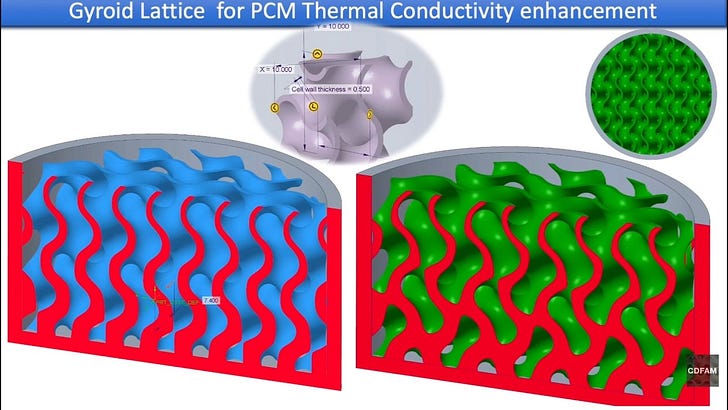
CDFAM Computational Design Symposium — DC 2026 Andreas Vlahinos · Advanced Engineering Solutions PCMs provide cooling without requiring an extra power source, unlike fans or active liquid cooling systems. They absorb peak energy loads during operation and release that heat when the ambient temperature drops, acting as a buffer against rapid temperature changes. This allows for more compact thermal management systems. Because most PCMs have inherently low thermal conductivity, they often fail to absorb or release heat quickly enough for high-demand applications. Designers can significantly improve the thermal performance of Phase Change Materials (PCM) by embedding lattice structures. Embedding a highly conductive lattice, such as aluminum or copper, forms a “thermal skeleton” that functions as a heat highway, dissipating heat more quickly and evenly through the PCM. Adding a 3D-printed metal lattice can increase the effective thermal conductivity of a PCM system by an order of magnitude compared to pure PCM. The internal structure provides a continuous path for heat conduction, which can double the melting speed. Beyond thermal benefits, the lattice provides mechanical support to the PCM, preventing leakage and helping it maintain its shape during the liquid phase. Simulating PCMs’ thermal behavior is difficult due to the highly nonlinear nature of latent heat release, the shifting phase-change boundaries, and the significant differences in physical properties between the solid and liquid states. This presentation demonstrates simulation techniques and showcases the process of optimal lattice selection. Links Talk page with full transcript Watch the talk on YouTube Search this talk's transcript Cite this talk This is a public episode. If you would like to discuss this with other subscribers or get access to bonus episodes, visit www.designforam.com
0:03SPEAKER_01Hello.
0:06SPEAKER_01My name is Andreas.
0:09SPEAKER_01I just solve new unique and difficult problems for defense and aerospace.
0:17SPEAKER_01And then I train the teams how to do that.
0:23SPEAKER_01I feel a little bit out of place to be in an AI conference and talk about design
0:29SPEAKER_01for additive manufacturing.
0:31SPEAKER_01But bear with me.
0:40SPEAKER_01That's the second part, training the team
0:47SPEAKER_01we solve the problem with.
0:49SPEAKER_00These are the recordings from the CDFAM Computational Design Symposium held
0:53SPEAKER_00in Washington, D.C., July 2026.
0:59SPEAKER_00For more information about CDFAM,
1:01SPEAKER_00archives of previous recordings,
1:03SPEAKER_00and details of future events around the world, visit CDFAM.com.
1:12SPEAKER_01I think you saw that slice on an earlier presentation, the three-phase of matter, okay?