
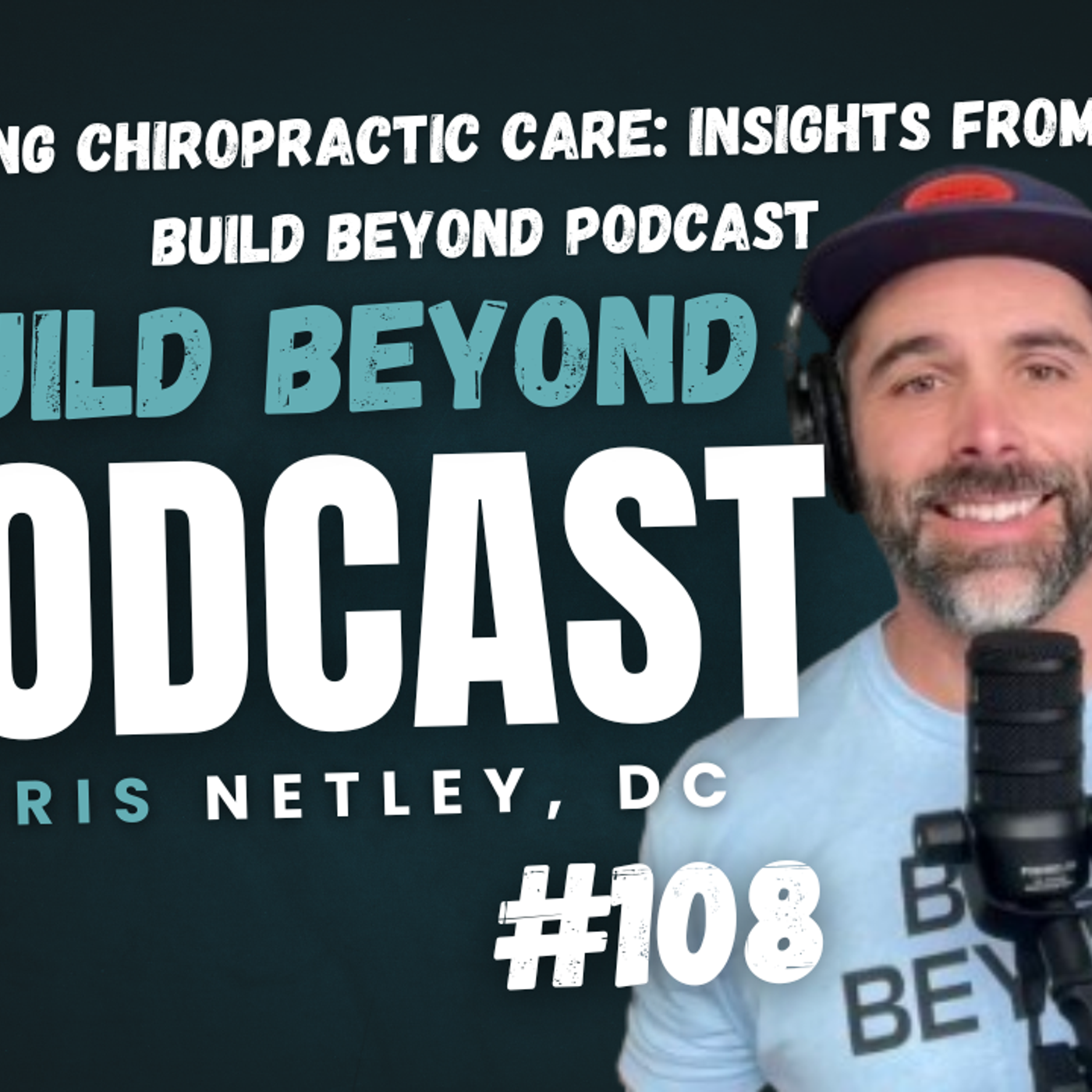
Build Beyond Podcast · christopher.netley
What if chiropractic adjustments aren’t as important as you’ve been led to believe? In this episode, Chris gets candid about chiropractic care, the profession he chose, and why his own beliefs about adjustments have changed dramatically over the years. After growing up receiving chiropractic care and eventually becoming a chiropractor himself, Chris began questioning many of the claims surrounding routine adjustments. Are they necessary when you’re not in pain? Do they actually prevent future problems? And if you feel fine before an adjustment, how do you know it worked? Chris shares a recent patient conversation that brought these questions to the surface and explains why he believes adjustments can be useful—but should be viewed as a tool rather than the foundation of care. He also breaks down why his approach now focuses primarily on exercise, physical activity, strength, mobility, confidence, and helping people get back to the things they actually want to do. In this episode, you’ll hear: Why Chris changed his mind about chiropractic adjustments When hands-on care may actually be useful Why routine adjustments may not be necessary for everyone The importance of measuring whether treatment is actually helping Why exercise and physical activity play such a major role in long-term health and pain management How to make more informed decisions about your own care Whether you get adjusted every week, haven’t seen a chiropractor in years, or actively avoid chiropractic care, this episode will give you a different perspective on what chiropractic care can look like. Chapters 00:00 Introduction and episode overview 01:52 The value of chiropractic adjustments 03:48 Personal journey into chiropractic care 05:48 Patient case studies and treatment options 09:52 Questioning the evidence for chiropractic techniques 14:59 Guidelines from the American Chiropractic Association 20:00 The importance of active lifestyle for health 25:54 Conclusion and final thoughts Where to find Chris Netley: BuildBeyondHealth.com Instagram: @chrisnetleydc | @BuildBeyondHealth | @podcastbuildbeyond YouTube: @chrisnetleyDC X (formerly Twitter): @chrisnetleyDC Facebook: Build Beyond Podcast Music licensed through Soundstripe. Code: 5OXSTWNWC0YVWPMC
Chris: Before we jump into today's episode, if you enjoy the podcast and you want to support the show, please do me a quick favor, hit the like button and then make sure you're following or subscribed. That way you'll know whenever a new episode comes out and it really helps more people find the show. All right, let's get into it. Welcome back the Build Beyond Podcast. This episode, I'm going to get candid with you about chiropractic, about the chiropractic profession and about chiropractic care in general. I'm going to share some very their personal opinions, their professional opinions, they're my opinions. They will be, depending on who you are, quite controversial. if you If this if whatever I say upsets you, I think w what I would recommend is that you pause and you ask yourself why it upsets you. Because if I strike a nerve, usually what that means is that there's some truth to it. This is not geared towards chiropractors in specifically, although you're definitely more than welcome to listen. This is more geared towards patients because their There are a lot of misconceptions, there are a lot of misunderstandings, there are a lot of concerns out there when I talk to patients, and I feel like I have this conversation a lot. And I just had this conversation two days ago. And I'm actually going to tell you a story based on that conversation to help illustrate my point. So I'm going to just say this point blank. I don't think chiropractic adjustments so back cracking or any variation of it, whether it's with your hands or with a tool, I don't think they're extremely valuable. They're not useless by any means. And I do use them. I do use hands on care. I actually did a decent amount of soft tissue therapy yesterday on a patient because we wanted to do an experiment. We wanted to see if I spent 10 minutes working on her. Did she get changes with her overhead squat? And we did. So then once we knew we could affect change with what I did, I showed her how to replicate it with a with a lacrosse ball and with a foam roller. So I used it as a test retest. And had we not gotten the results, we could have just, you know, not used it anymore. But we did get a positive result, at least for a short term. And she was okay with that. Because she wants to be able to keep overhead squatting and practicing that movement while she's working through some shoulder issues. And and so she wants it it it's it's goal-oriented. So it's chiropractic care, hands-on therapy would be a means to an end. Now I didn't adjust her, I could have. It probably would have been the next step. So I use what I would consider to be an escalation of force. You know, I ideally I would want to see if we could stretch. or mobilize the patient could do that on their own, so they don't need me at all. We we kind of worked through that. She had been trying it, it hadn't really been working. So the next step for me was to go in with my hands and do some soft tissue therapy. Had that not worked and had she wanted to, we could have talked about chiropractic adjustments. and that's still on the table. Again, I use them from time to time, but I so Why then you might be asking why I became a chiropractor. I saw something on social media not too long ago, and I believe this guy was a chiropractor, and he said, you know, you've got two basically two kinds of chiropractors. You've got chiropractors who are actual chiropractors, so backcracking, manipulation, heavy, and then you've got people who just basically want to be physical therapists and went a different route. I think that those two exist, but there's at least one more category, and I fit into that category. I'm someone who grew up as a chiropractic patient. All I'd ever been told about chiropractic care is that it prevents pain, it reduces your risk for injury, it improves your overall health. I bought in hook, line, and sinker, to these theories that originate from the late 1800s and early 1900s. I went through my whole childhood and adult young adult life. Seeking chiropractic care because that's all I had ever been told in by doctors of chiropractic. I believed it so much that when it was time for me to make a career change when I was getting out of the Marines, I actually chose out of everything else to become a chiropractor. So when I say these things, I'm talking about something that I have changed my life or my mind on, and has changed my life because I bought into this idea. of the of this this elevated vision of the chiropractic adjustment. I bought into it so much that I chose it as a career. So when I say these things I don't say them lightly and I don't want to make people feel silly. Because if what I'm saying opens up your eyes and you feel silly or dumb for having gotten routine chiropractic care, I chose it as a profession. So I'm not judging you. I really bought in. And obviously I don't believe that now. And I'm gonna tell you a story right now. This illustrates a conversation that I have not infrequently because right before I had this conversation, like two days before that, I had a similar conversation. So a young man came to see me and you know I he fell out of his health histories. normal. I mean no there's nothing really wrong with him. And he said he didn't have any pain. So I like I normally do, I kinda got to know him. I asked him, Well, how are you hoping that I can help you? And he said, Well I really think I want to get an adjustment. And I said, Okay. Is there anything else that you want? Well and he wanted to talk about exercise and some other things. And I said, Okay, well what's your priority? I want to make sure that we c ideally we'll get to everything because I set aside an hour. with patients. So I I'm usually I can get to everything, but I want to focus on the high value stuff that's important to them. So he said, okay, that I think the most important thing that we want is an adjustment. And I said, okay, what's wrong? And he said, nothing's wrong. And I said, okay, so you're not in any pain. No. Ha have you been in any pain recently? No. Do you have any numbs or tingling anywhere? No. Are you tight? Are you have any restricted movement? No. Is there anything that you can't do now? Or you don't enjoy doing because of pain or tension that you want to be able to do that you're hoping the adjustment can provide you. No. Why are you here? Because I want an adjustment. So we're okay. So I I kind of get an idea where this is going. Because he because obviously he's had chiropractic care before. And he's been adjusted. And I said, okay, well, ta tell me about your previous chiropractic experience. So I want to understand. So, well, he had he had. been manipulated by two professions by DOs, osteopaths. So OMT is it's very similar to chiropractic care. There there are some distinct differences, but some people think. I think it's very similar. I think it works about the same. but it's done by essentially a medical physician. Not essentially literally a medical physician. A DO and MD are the same thing license wise. So He had also been adjusted routinely by a chiropractor. And I said, Okay, well when you go into your chiropractor, because that was the profession that had adjusted him had manipulated him the most, I said and I mean physical manipulation, not like not like they're tricking him. That would be well, I don't know. Hopefully they weren't, but that's what he was talking about. So he had been adjusted and and had hands on care from chiropractors more than from osteopaths, is what I'm trying to say. And he said, Well, I'll go in, I'll feel fine. They would typically use this thing. He described it, I forget the name of the neuro kilometer, or there's another newer name for it. But essentially you you there's it's a handheld thing. It's either an it's an individual unit or it's hooked up to a machine, some of the newer ones, and you run they run it up and down your spine and it detects heat on one side versus the other, and then it gives you this little heat map, and then theoretically you adjust where the heat is. I'm just gonna throw it out there. I don't there's no evidence that that works. So if you're going to a chiropractor and they're using something like that. I'd get another opinion. and if you are listening to this right now and I just made you upset and you think that there is evidence, please send it to me. I would love to see it. And honestly, if if someone sends me some research on the little heat map thing that a lot of chiropractors still use, and I'm wrong, and there is really good qu and there's some quality evidence to support it, I will come on this podcast and apologize. Now, if you send me something And it's not good quality, I'm gonna read it on on the podcast as well. So come at me with some confidence and I'm willing to admit that I'm wrong. I'm actually willing to have you on if you feel strongly about this, to and I will be quiet and listen and let you present. I I'm gonna have a rebuttal for sure, but I'm open to changing my mind because I've changed my mind on this already. So it I am I am someone who's willing to think about things differently. So anyway, back to my patient. He had had this thing, they look at heat map, he would get adjusted. And I was like, okay, well, when you went in with pain, when you went in without pain and then you got adjusted, like, how do you know it worked? And he paused and he didn't really have an answer. I was 'cause I can't do better than zero pain or zero stiffness. So how do we and I can't measure if it makes you healthier. in any noticeable way. And so he again he didn't really have an answer. And I'm not trying to stump him, but I'm trying to get to a point because, and I think this is what made it click. If you walked into a medical doctor's office and you said, Hey, I want treatment, medical treatment, the doctor would say, What for? And if you said, Well, there's nothing wrong with me, I don't have no symptoms. I just want medical treatment. And the doctor would say, Well, what kind of treatment? What are you looking for? And maybe you say, Well, I want this or I want that. You just name something. The the doctor's probably not going to offer treatment if there's no signs or symptoms of dysfunction. Now, if there's some type something preventative, maybe. But if you just go to a doctor and you say, look, I want medical care, but I don't have anything wrong with me, how are they gonna what would they I can't imagine that they would provide care if there's no diagnosis or no symptoms or there's nothing measurable to improve. Now what a lot of people will say, a lot of people in my profession and similar professions will they'll throw accusations at doctors and say, Well, doctors don't care about prevention. That's a stereotype. They they the stereotype is the doctors don't care about prevention, they only want to treat and once p someone's injured or a sick. I don't know any doctors who think that way, to be fair. Maybe I just have a select group of physicians around me who are good. I don't know. I think the system might be set up that way. So physicians will do the best they can within the system that they have, and sometimes there are barriers to providing preventative care. And based on time limits and what's presented to them, they they only sometimes have the option to be reactive. But I don't think that stereotype is is accurate. So getting back to this, it's like I told this patient, look, you you're not in any pain, you don't have any stiffness, you don't have any tension. I can't do better than zero. So I could crack your back and crack your neck right now. And the best I can hope for is no change. Now there's always the possibility that I create pain or stiffness. So I'll do it. I'm we'll we'll do a full history and exam and make sure it's safe. But I'm I'm just going to be Adjusting you, crossing my fingers, hoping that I don't make you worse than I cause I can't do better than no pain. And he was like, yeah, that makes sense. So I'm not denying him the treatment. I just don't know why I would be providing it. And if I'm gonna do it, I want him I really want him to understand what he's asking. So we ended up just talking about exercise and physical activity and coming up with a plan for him because he's not lifting weights, he's not doing a lot of cardio, he wants to get back to sports, but he's got a little knee thing. He loves basketball. but his knee's kinda bugging him, so we kinda went over that and it ended up being a very productive use of our time. Quick favor before we keep going. If you're enjoying this episode, please hit the like button and make sure you're following or subscribed. It's a really simple way to support the podcast and help more people find the show. All right, back at it. Now, this conversation represents a problem with our profession. I had a had I had another conversation previous to this, maybe a day or two before, where a person had been going to chiropractic care routinely and we it was kind of the same thing. Like you're not getting better, why you keep doing it? I don't know. The chiropractor just keeps telling me I need to keep keep coming back. It's probably improving my health. I had another patient who I'm working with recently. Same thing, like a decade of chiropractic care with no changes. But so why are we doing this? Why do we keep doing the same thing over and over again if we're not getting a better result? Now, the the philosophy and the thought process behind this, and the reason why I became a chiropractor is that there's this belief that cracking people's backs, manipulating the spine, has second and third order benefits. So there's downstream effects. So theoretically If you manipulate the spine, you can affect the central nervous system, which goes out and affects the peripheral nervous system, which affects organ function and muscle function, therefore, better. Now that is not illogical. It just doesn't work. The body doesn't work that way. And there's no evidence, there's no good quality evidence to support it. And I've actually looked for it. So I keep in mind I went to chiropractic school. We had science classes going over. all of the research. It's not impressive. I just it's not. And since I've been in practice, I have looked for it. There are a couple people who are considered to be, you know, our top researchers for for chiropractors. I've read a lot of their papers. I've taken courses from them. It's not impressive. So I can't sit here and say there's no evidence. It's just poor quality. And it's not getting any better. And I think one thing that really troubles me is that one of the these chiropractors who is well very well known for research, she made a comment on one of her in one of her courses that, you know, that we are really trying, we're doing everything we can to prove the validity of what we do as chiropractors and support it. And it I it was an off-the-wall comment, but it It illustrates the one of the problems with this is that you you sh good quality research, you don't go in trying to prove something you believe. You try and disprove it, if anything. But you the the research should be you shouldn't be tied to the outcome. The outcome is the outcome. And then you have to replicate those outcomes. And we can test these things. They have been tested. So I'm not sitting here saying that chiropractic adjustments are bad or that we shouldn't use them. They're it's a tool. And they can be helpful. And they can be more helpful for some people than others. But my problem with this is that if people are going in seeking chiropractic care, especially when they have no symptoms, because they believe, because they've been told that there's a preventative benefit to it and that there is a a health benefit to it, we don't have any good evidence to support that. It just doesn't exist. Good quality evidence, it's not there. And again, if you're listening to this and I'm and I'm upsetting you and you you I have the evidence. Send it to me. My contact info is it's out there. shoot me a message. Let me send me the the PMID or whatever you got for the research. I'll go over it. And then we'll set up a time for a podcast, either virtual or in person if we can, and we'll and we'll go through it. I'd be happy to do that. And if I'm wrong, I'll be happy to admit that I'm wrong. because I'm just aspiring to be less wrong. And it's hard. It's hard to go through grad school and get a doctorate in something and then realize that it's not all it's cracked up to be. So what what could we do then? What should we do? We can look to the American Chiropractic Association. So that's our version of like the American Medical Association. So it's not like a governing body, it's an association. But it's probably the biggest, most credible organization that we have, I would say, one of them. So they have guidelines, they have recommendations. I'm on their website right now, I'm looking at my iPad. And anyone can find this. I'm looking at back pain. It says tips to prevent back pain. And they have a number of bullet points. And I'm gonna spoiler alert, chiropractic adjustments are not on these bullet points. Let me read them to you. There are several simple strategies that can help to prevent the onset of back pain, among them. Maintain a healthy diet and weight. Remain active under the supervision of your chiropractor. I gotta throw that in. I don't you could be under the supervision of any or no supervision, in my opinion. But okay, under supervision. So be active. Avoid prolonged inactivity or bed rest. Warm up or stretch before exercising or physical activities, such as gardening. Maintain proper posture, wear comfortable low heeled shoes. Sleep on a mattress of medium firmness to minimize any curve in your spine. When lifting an object, lift with your knees, keep the object close to your body and do not twist. Quit smoking. Smoking impairs blood flow, resulting in oxygen and nutrient deprivation in spinal tissues, and work with your chiropractor to ensure that your workstation is ergonomically correct. That's it. That's their list. Now I have a big problem with a lot of these bullets. Maybe that's a topic for another episode. Because I think there's a lot of misleading stuff in here. But you gotta look l think about this. This is the American Chiropractic Association. They don't just throw stuff up on their website. This is n this is easy to find. This is like under the the the section for patients where you can get so out of all the meetings that they had and all the different chiropractors that were sitting around these tables and they were Going over these bullet points, why did they not throw in chiropractic adjustments specifically? Doesn't make any sense, other than the fact that they know that the research for them is not it's poor. It's poor quality evidence. Now, you might be sitting there saying, I get adjusted every week and it makes me feel great. If it works for you, I think you should keep doing it. Don't listen to me. You're probably not still not listening to this podcast. But if you're someone out there who there are people out there who actively avoid chiropractors because of stuff like this, because they think once I start going, I'm gonna have to go forever. So they actually avoid care that could help them because of these the things that we say. And there are people who keep going even though it's not working for them, because they feel like there's benefit to it. So whatever choice you make as an individual, I support that. I just want to make sure that you have the information and at least you've heard the other side of it. And even then, if you're like, well, I just I still like going, great, do that. I I'm all for your choice, but it informed decision making requires that you have information and that you at least hear a counter argument. And you have so hopefully, if nothing else, I can provide that. Now I I'm s just scrolling through the website right now of the American Chiropractic Association, and I was looking for guidelines. And here's some interesting ones. So practice guidelines. So they they reference a an article. That's I'm looking in PubMed right now. This was published in 2017. Non-invasive treatments for acute, subacute, and chronic low back pain. A clinical practice guideline from the American College of Physicians. So this is actually referenced on the website. I'm not going to go through the whole paper, but they've kind of broken it down into distilled it down into three recommendations. Recommendation number one: given that most patients with acute or subacute low back pain, no, by acute or subacute, that's like it just happened. It's it's pretty new. Those people can improve over time regardless of treatment. So clinicians and patients should select non-pharmacological treatment, so non-drug, with superficial heat. It says there's moder moderate quality evidence for superficial heat, massage, acupuncture, or spinal manipulation. So that's chiropractic adjustments. And it says that there is low quality evidence for these. So there is evidence, but they they're acknowledging that it's low quality. Recommendation number two. For patients with chronic low back pain, clinicians and patients should initially select non-pharmacological treatment. So again, avoiding drugs, with exercise, multidisciplinary rehab, acupuncture, mindfulness-based stress reduction. It says there's moderate quality evidence for these. Tai Chi, Yoga, motor control exercise, progressive relaxation. Electromyography biofeedback, low-level laser therapy, cognitive, behavioral therapy, or spinal manipulation. Again, low quality evidence. Recommendation number three. And patients with chronic low back pain who have had an inadequate response to pharmacological or non-pharmacological therapy, clinicians and patients should consider. pharmacological treatment with non-steroidal anti-inflammatory drugs. I'm not gonna go through all that. And aga again, this is not me rec making that recommendation. That's I can't with my scope of practice. I'm I'm reading off of a paper. and if you're looking for it, shoot me a message. It's I can send you the How to find it. But Again, this is and this is all free information that's out there if you want to go through it. So I don't want to beat a dead horse. If you like getting chiropractic care and you like treating it like I don't know, like a routine massage where you just go in on a frequent basis to get your back cracked because you think that that's the best decision for you and you like it and you can afford it and you don't mind the time and you have a good relationship with your chiropractor and it just makes your life better, you feel that, then that's great. You should keep doing that. I'm not here to tell you that you shouldn't. But if you're someone who's avoiding chiropractors because you're afraid of that, you need to understand that we're not all like that. So there could be some benefit out there. And if you're someone who's been going to a chiropractor routinely for years and you haven't noticed any noticeable change, you really need to hear this because there's something else out there that can work for you. Now, what is that? That's kind of where I specialize. So I, as I said, I use chiropractic adjustments as a tool. It's pretty rare. I do soft tissue therapy more than I adjust people, but even then it's pretty rare. Most of my stuff is lifestyle-based, exercise based. getting people back to activity as quickly as possible. I would say that my whole practice revolves around either keeping people active or getting people active again as quickly as possible because I think there's ample research to show that routine physical activity has a wide range of health benefits. Routine physical activity is great for pain management. It's great for improving your health. So decreasing your risk for things like Alzheimer's, decreasing your risk for dementia, heart disease, cancer, type 2 diabetes, strokes. You can improve, you can affect your immune system. So you can speed up your recovery from illnesses. you might be able to lessen the symptoms when you do get sick. You might be able to reduce your risk for the viral infection or a bacterical infection in general. You could improve your mood, you can improve your sleep, you can improve your energy levels. There are so many benefits to routine physical activity, and pain and injury or fear of pain and injury can be a barrier to being root active routinely. So I fill that niche. Right. So people are they've either got a pain or injury or they're scared of pain or injury, and then there's a bear, and that's the barrier preventing them from living the active lifestyle that they want and accessing their full potential with physical activity. And to remove those barriers, if using my hands is useful for an individual person, I will do that. But it's usually not. So we do a good exam, we do a great history, I cross off as many possible diagnoses as we possibly can. We narrow it down to a list that usually doesn't freak people out. So we build some confidence. And then we find what creative ways to get them moving or doing the activities that they want to do as quickly as possible. Initially we try and make them as comfortable as possible, but as quickly as we can, we actually start pushing them into discomfort to show them your body's not fragile, you can do this. And we start to build strength, we build mobility, we build flexibility, we build confidence, we build skills. And we build strength and muscular endurance and cardio and improve VO2 max. And we have fun doing it. And people get better. Sometimes they don't even get out of pain. They're like, this is great. Sometimes they do get out of pain. A lot of times pain is just gonna keep coming back and back, and we can't solve that riddle, unfortunately. But we can decrease it and we can manage it and we can get people living the life they want to live in spite of pain. It's very doable. So that's really all I have for this episode. I hope that this is helpful. If I rubbed you the wrong way, I'm not trying to Antagonize people. I created my own company and I created this podcast because I have opinions and I want to talk about them and I want to help people the way I want to help people. If you don't vibe with that or like you're not I'm not the kind of doctor for you, or then do you just don't don't listen to my podcast and don't contact me for help. But if you're curious and you think that I might be able to offer something different, keep listening. Listen to the podcast. Because it it's not just me. I have other people who come on. I try and get as many guests on as I can who think like me, but I am very excited someday to be able to get guests on who don't think like me, who we can have a back and forth. I don't think I'm a very good podcast host. So I don't think a lot of people really want to come on my podcast, to be fair. but as it grows, I would love to. I would love to have some more controversial conversations with people who don't agree with me. So if you're that person or you know that person, you want to be the first, let's do it. Hit me up. I can be professional. But if I'm gonna come into something with an open mind, I would I would ask that someone else comes into it with an open mind as well. We don't have to agree in the end, we just have to be open to new ideas. So my my my thought process and my mind is constantly changing. Change my opinion as as often as I can. As I learn more. All right. That's it. If you're still listening, I appreciate you. Follow the podcast, send it to someone who needs to hear this. All right. I'll talk to you guys later. Thanks for listening. If you enjoyed this episode and you want to support the podcast, please hit the like button and make sure you're following or subscribed. You'll get updates whenever a new episode comes out and it really does help the show continue to grow. Thanks again for listening and I'll see you on the next episode.