
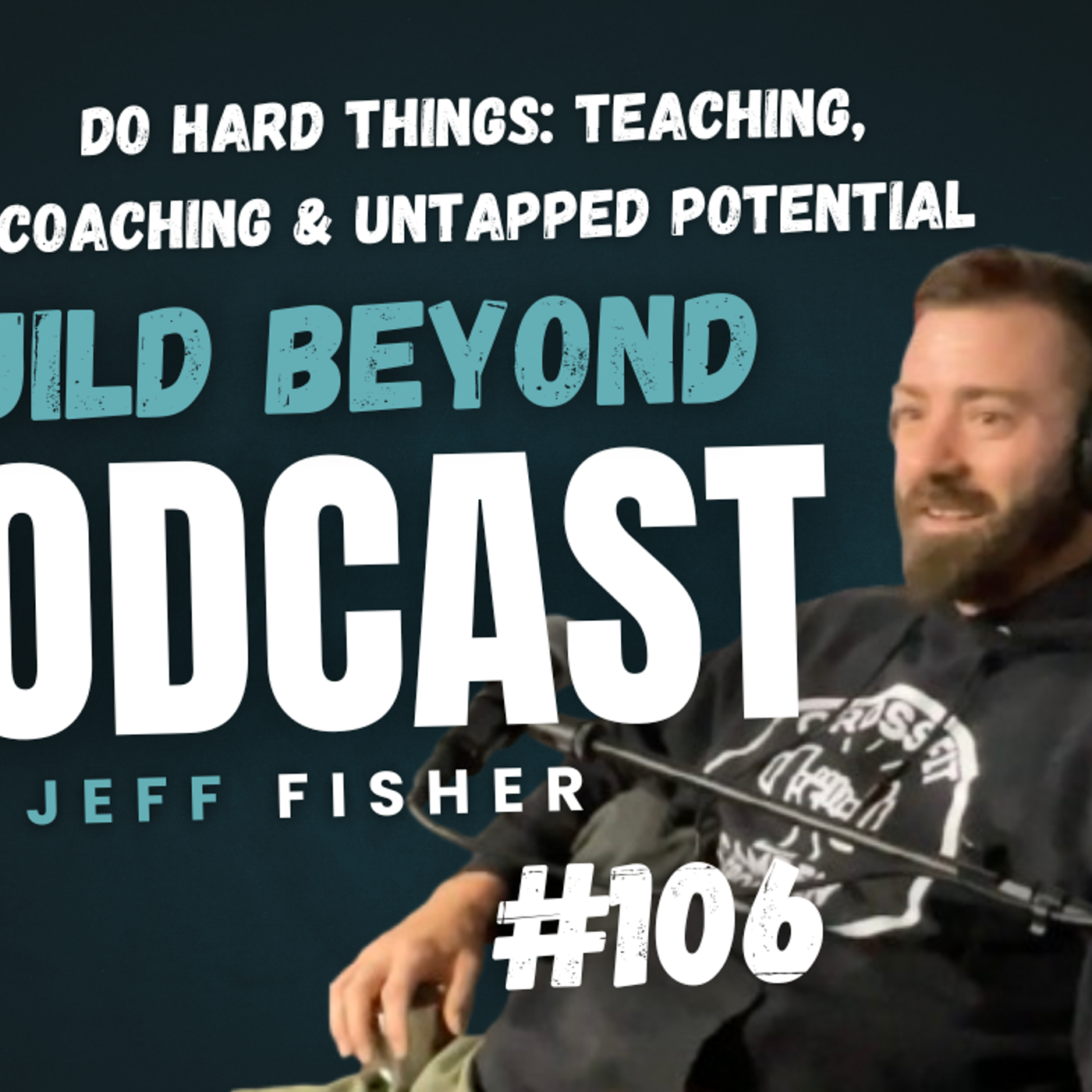
Build Beyond Podcast · christopher.netley
What does it take to help someone realize they’re capable of more? In this episode, Chris sits down with Jeff Fisher—a high school teacher, CrossFit Level 3 coach, father, and the founder of CrossFit Camden Frontier, a nonprofit CrossFit affiliate at Camden-Frontier High School. Jeff shares the experiences that led him into teaching, his own unlikely introduction to CrossFit, and how a small summer fitness program eventually grew into a fully equipped CrossFit affiliate for students. But this conversation goes far beyond workouts. Chris and Jeff talk about the connection between teaching and coaching, why people need opportunities to experience success, the importance of community, and what happens when we become afraid of doing difficult things. They also explore one of Jeff’s biggest frustrations: seeing untapped potential in people who don’t yet recognize what they’re capable of. From the classroom to the gym to parenting, this episode is ultimately about challenging people, supporting them through failure, and helping them discover what might be waiting on the other side of doing something hard. If you’re a parent, teacher, coach, athlete—or simply someone who wonders if you have more potential than you’re currently using—this conversation is for you. Chapters 00:00 Introduction and overview of teaching and coaching journey 01:49 Early influences: teachers who inspired goals and resilience 04:11 Travel and storytelling: opening eyes to the world 06:06 Balancing enthusiasm and professionalism in teaching 08:04 The legacy of teaching and the importance of making connections 10:01 Engaging students with history and making it relevant 11:55 The impact of storytelling and real-world experiences 14:02 Building a CrossFit gym from scratch with community support 16:00 The evolution of coaching and the importance of communication 17:57 Encouraging hard work and overcoming fear in fitness 20:08 The significance of community in sustaining motivation 22:10 Balancing teaching, coaching, and personal life 24:08 The importance of persistence and purpose in long-term impact 26:04 Reflections on legacy, potential, and continuous growth 28:00 Advice for aspiring teachers and coaches 29:59 Closing thoughts: the power of resilience and community Where to find Jeff Fisher: Instagram: @crossfitcamdenfrontier Where to find Chris Netley: BuildBeyondHealth.com Instagram: @BuildBeyondHealth YouTube: @chrisnetleyDC X (formerly Twitter): @chrisnetleyDC Facebook: Build Beyond Health, PLLC Music licensed through Soundstripe. Code: QRFZHSIAK9FFSH7X
Chris: No, I'm it's all good for me, man. Okay. What do you teach? What classes? So I teach high school, nine through twelve mostly. a US history class, it's mostly freshmen. I have a world history class, it's mostly sophomores, and then a government economics class. juniors, seniors. This year I'm also teaching a history through film class, where we start colonization all the way to present day and I try to find movies that kind of take that timeline. they offer that class probably every other year, just for another class for kids to take. So it's a good one, it's fun. Yeah. What made you want to be a teacher? man, that's a good question. So growing up, school was hard for me, especially reading, which is funny because now I'm a bookworm and I can't stop putting a book down. but I had just had people along the way that made me set goals. And I think the first teacher was her name was Mrs. Four. And at the beginning of year we had to get we had an envelope and a piece of paper and we had to write goals down. And my goal was to make the honor roll. And you know, I I could always do good in other classes, but reading was always a struggle. And so we would get these assigned readings, take home, do the reading. I remember clear as day, a few different times sitting in the bed with my mom or on the couch and and reading books, going in the next day, taking the test and doing mediocre at best. And she was really cool in the sense that we could write our phone number on our tests and she would call us that night and tell us how we did. And I'd get these phone calls and I don't know the scores, D's, Cs, low Bs or something. And just always being frustrated. I do remember one specific time our bathroom was attached to our living room at our house in Pittsford and I just got out of the shower. I had my clothes in my hand and my towel wrapped around my waist and While I was in the shower, Mrs. Ford called. And I got out and mom said, Hey, Ms. Four called. And I was expecting the worst, like always. And she's like, You gotta A on the test. And I remember taking my clothes and I threw them up in the air, you know. One of them actually hit the lamp and knocked the lamp over. But I was so excited. So the idea that someone made me set goals, and eventually I did make the honor roll. And then I had other teachers that kind of just opened my eyes to the world going forward into high school. I had a teacher, his name was Mr. Lovell. he actually was in the the Peace Corps for a long period of time after college. And he traveled to all these places, you know, almost I think almost every continent except for Antarctica. And he took pictures of everywhere he went. So it wasn't like what he was telling us, he was just telling us, but he was legitimately showing us. You know, so we talked about the Roman Empire. He had pictures of the Forum and the the the Parthenon and the Coliseum and it was just cool to to see those things and it just opened my eyes to more of life outside of Pittsford, you know, outside of the tri state area. My family didn't travel a lot when we were younger, so the ability to see things in the world was just was amazing. another high school teacher. he was a math teacher. He was actually a family friend of mine, growing up. But math was another subject that I was really interested in. And he was just a hard nose, like, we're gonna get in here, we're gonna work and you're gonna learn. And just because we were friends, like, didn't mean that like he was gonna accept anything but the best. So kind of a hard work drive person. get into college, I was originally going to do Spanish and math because I had an excellent Spanish teacher who really allowed us to move in class. we would have some vocab words and we would come up with different movements to remember them or hand gestures or move motions like that. We would act out skits and plays in front of the class. So originally I obviously Spanish and math because of two previous teachers. And then I got to college, I went to Jackson at first. And then went to Sienna and I had a history peop professor, her name was Sister Jean Lefabe. man, she had to have been seventy some years old. But she was just just amazing. the the way that she taught. Again, we'd have like certain five or six words up on the board. And you know, our job was to not just learn the definition of the word, but put it in the context of time and history. And I had her first class, and I remember after class, I'm like, hey, I'm gonna switch my major. I'm gonna switch it to history. And then from there on out. So I think just having these important people in my life that not only made me set goals, made me work hard, opened my eyes up to the world, and then also taught in a way that was maybe unorthodox from different people I've had before. And so now today, like, you know, as a teacher. Like I want I wanna teach my kids those things. I wanna open their eyes to the world. I wanna teach them hard work. I wanna I wanna teach in a way that I wanna be taught. Like I want I wanna have fun. I wanna get up, I wanna move, I wanna laugh, but at the same time we're still gonna learn content. So, you know, just having important people in your life, I think was was crucial. Yeah. So gotta bring it with enthusiasm every day. Yeah, yeah. It's hard. You know, it's hard. You got a hundred kids a day looking at you, you know. I teach at Camden, a lot of our kids aren't taken care of. Education's not important, you know, survival's important. And to try to get them to at least appreciate history, which a lot of kids don't. We don't appreciate 'til we're older, which is a pretty common theme that we hear. I when I talk with parents and kids. But I generally say after having kids for three years, I think I think they learn, I think they respect it a little bit more, I think they understand, which is obviously the key of education. So you were inspired as a student when people went out of their way to challenge you. Hundred percent. Yeah. Absolutely. How rewarding is that as a teacher when you go out of your way and someone responds and and then they s they you can s actually see that you've made an impact. Yeah, I mean, kinda g getting some goosebumps right now, but that's that's the important part. And I and I think, you know, having kids learn like rote memorization is cool, but seeing them make connections is also cool. And I just had a an example from this last week where this s you know, we're we're we have some I almost like a sister gene vibe. I have five words. that we're gonna try to understand or documents or concepts that we're gonna learn. And after we do the lesson at the end, they have to tell me about the five words. It's almost like an exit ticket. So what did you learn? And her ability to connect all five words together was was crazy. And her ability to connect five words to like the previous lesson as well. I mean that's that's it. That's it in a nutshell. It's interesting because, you know, you you teach history so you really think about like the legacy of the things that you teach because they're either old ruins or old cultures and things like that. So they're they live beyond their the time they should have. People are still talking about them. You're still talking about teachers in that way that you've had. There's some type of legacy there. Yeah. It's kind of a interesting thing to think about, you know, in fifty years. One of your students may be on a podcast. Yeah. I think Mr. Fisher was, you what I Like you you're almost creating your own, it's like a a legacy where it lives on beyond you. And I also think it's like with history, especially world history in the US as well, like I like to figure out how did we get where we're at? Like what things led up to us, me being here right now on this podcast, or how did we as a nation get here? And that's a hard concept for kids to grasp because, you know, it's so long ago, you know, the Roman Empire fell and this led to this, that this, to this, to this, to this. And that's why we are, you know, the United States of America, because of this trickle effect. And the same thing happens, you know, in my personal life with school. You know, I it's just so weird. You know, I I did some I did a PD session for a guy at the ISD. He hooked me up with the superintendent at Camden. I became a teacher there. I met my wife, you know, I met the gym, and then now like I am because of just doing a s a simple PD session for somebody. And that's the same thing with history, right? If these little tiki tacky things didn't happen along the line, then how would life, as we know it, be much different? And to me, that's really a mystery. You know, it's amazing. How often do you see kids light up when you talk about stuff like this? I feel like I would not have been interested. Yeah, I I think I think the idea of like this event that happened two thousand years ago is why we are today. It's hard for kids to grasp. but I don't know. Like when I when we do certain activities, I don't know if I see like the light the light up I got it, but the fun they're having that's what I see. That's what I notice. When they're talking to each other, when they present, like some my kids are doing some some skits right now and I c I kinda challenged them because I did this skit before a couple of years on feudalism and European society. And they wrote the skits in the past year were subpar. They weren't good. So I kinda challenged them. I'm like, look, in the last two years, these have been really bad. Now I kinda changed how I approached it little bit, but the last day and a half or so they've been working on and I can see them collaborating and talking and trying to have fun and you know that's that's it. You have to have fun in learning. You have to you have to make it enjoyable because otherwise they don't care. They can't just get up there and ramble for fifty minutes straight. It's boring. You gotta make it entertaining. Yeah, I I think back to high school and I remember teachers who were like that. Where they it was like, well, this person is just punching the clock. Mm-hmm. But then other teachers, I can still remember I had a world cultures teacher, Mr. Frost, who was like that, who had traveled a bunch. So when he would talk about things, he had seen it. You know what I mean? He but went and hung out with the Bedouin tribe once. And he was an old sixties hippie too. So he had a lot of adventures that I'm sure he wasn't able to share. And that kind of came through that he was filtering certain things. Sure. When he was younger, but you could see his eyes light up. And he had no pictures. He was I he was funny about it because because we always asked, and he said, If I'm looking through a camera, I'm not experiencing it. No. So I didn't take any pictures. They're all in my head. But he was such a good storyteller that you felt like you were there. So I feel like I was into that class, not because I cared about world cultures or history, but it was like, Well, what story is he gonna tell us today? You know? But Here I am talking about him, you know, he's probably not even alive anymore. So it's it's one of those things where I think it's you it's interesting because you have you can say certain things and maybe you don't even realize it. You're just excited, but it connects in a way where people don't forget. Yeah. I had a high school English teacher who was like that too, a Vietnam vet who could recite poetry and and books like verbatim. And we had asked him about it and he was like, Well, I got drafted and spent a year in Vietnam and he's like, you know, I would carry poems or books with me 'cause I like to read and he was like, I don't know, something about like being afraid and reading things over and over again 'cause you could only ha I could only carry one thing at a time. He's like, I don't know, some things are just burned into my memory. Probably have a lot of boredom. Yeah. So he was like but he would he he was one of those guys who could almost get up and and And it recite a chapter of a book, word for word. And you'd be sitting there looking at the book and he's lecturing, and you're like, How is he how does he know where all the pauses and all the commas are? But, you know, things like that, I feel like when someone's really interested and really invested, man, it really whether you like the subject or not, and he was a big Hemingway fan, and I I don't I don't like earnings Hemingway books, but Old Man in the Sea, it's a it's a good one. I don't know. It's a good message. I felt like I remember reading all those books and being like, not not for me, but I think and like let's gotta not get it twisted. I don't bring that hardcore enthusiasm as every day. Like I think it's impossible. Yeah. Even here at the gym, you know, you work out, like you can't bring it all every day. But quite honestly, sometimes you gotta fake it till you make it, right? You know, if you can at least show some enthusiasm, then you know, maybe that helps. Yeah, there's a strength and conditioning coach. I was with TCU when they won the national championship. couple years ago. I don't know if he's still there. I can't remember the guy's name. But he was a former NFL player and I heard him on a podcast. And he he's super intense. But he had that kind of mentality where if I don't have the energy in the gym with these this group of guys, they're not gonna get a good workout. And he was like, it's my responsibility, even though these are grown men, they're somebody's kids and I'm here to like do a job. Mm. So if I'm not willing to come and bring a hundred percent, if I can't get into that right mindset, then I need to get out of this profession. And he's and he was like, I get the same intensity from my assistants and I demand that because I I show it, you know, I model that for the athlete. So if I can come in and give that intensity, I need it out of you guys. And I was like he said it way better than that, but I I feel like that's coaching, teaching, it's It's the same thing. Yeah. You know, you're you're trying to inspire someone to improve themselves. And oftentimes they're you're trying to make them do something or encourage them to do something that maybe is against their nature. It's uncomfortable. Whether it's uncomfortable because they have to learn something new or push their muscles or or whatever it is. And that that's a hard thing to do because you've got to be inspiring. Sure. I guess is a good word. W who do you look for who do you look to as an example of someone or who's inspiring? Do you model anyone? Boy. I mean, I obviously you look at some of the teachers who inspired you and you kind of replicate that. Is there anyone else out there where you're like, man, if I could if I could be like that person or take that essence from them? There's no one really that that comes to mind. I think just previous teachers would be the biggest thing. I mean, I've had I've had other bosses. I th that that would be the first thing that would pop into my head. Yeah. I had a my first boss at at Camden, you know, he drove from Toledo every single day. Wow. Never made excuses, worked hard, cared, protected us as as teachers. I had another boss at a grocery store that I worked at. You know, just just hard working people that showed up every single day and They they got the job done. So I guess just previous employers would be one of the biggest things. I think also my parents, you know, my my dad was a a factory worker for almost thirty years and tough job, you know, hard work. my mom was a a banker for forty two years. So I think also my parents have showed me hard work and dedication pays off. So I think just parents and and previous employers would be my biggest inspiration, I suppose. Yeah. So as a parent, you're trying to set that same example. Yeah, man. Yeah. And this is this is something that I talk about just talked about my brother in law. Like teaching kids to do hard things, I think is one of the biggest things that we are we're missing as a society. spoon feeding them, helping them out every single second of the day. Like I think I think that's the one of the biggest things, besides the basics, right? Besides like reading, for example. things get tough. You gotta suck it up and you gotta try to overcome it. You gotta try, at least. Yeah. That's a that's a big part of I think parenting right now. Yeah. It's gotta be hard too as a teacher because I'm assuming you spend so much time with your kids that you probably start to feel like a parent. a hundred percent. You are a parent. These kids don't have parents. Some of them. Yeah. You know? They're living with grandparents, they're single parent, they're not being taken care of. Like you gotta love I I mean yeah, but you know, sometimes the The schoolwork, the lesson, the activity comes second. You at least gotta be there and show some love, take care of Just basic things like, How we doing? How was your weekend? They don't hear that, you know? And I remember w one kid wrote me a a letter or he gave a speech, I don't remember what it was, but always asking kids how their day was, how their weekend was. You know, and that seems pretty basic to me. That's what you do as a person. Like to show that you you care for them. Yeah. And you know, they need to hear that. They want to talk about that. Cause no one else asks them, which is sad, but tis education. Yeah. Well, how'd you end up at Camden then? Yeah, so there was a guy who was the I think he was the superintendent of the ISD at the time. I was doing s my student teaching at Hillsdale for Paul Oskintowski was his name. And this is gonna sound really funny, but this would be 2009. I was I was bringing technology to the classroom. That's what my master's is, is educational technology. And it was really basic stuff for you and I, you know, like including hyperlinks to YouTube videos and pictures and using like a a a a trackpad that I can use as a mouse up on my projector screen and you know I was using Facebook groups as a way to communicate with my students and parents. So I gave a PD session at Hillsdale. It caught word at the ISD and then that that summer of two thousand and nine, but 2010 I guess. I was applying for jobs. I applied for couple of positions, Clinton and Napoleon, whose interviews I thought I I kill them. Like I'm like I walked out of there, I'm like, I'm getting this job for sure. I didn't get both of those jobs. So anyways, the guy that I did the P D four at the I S D eventually, caught word that Camden was looking for a a high school history teacher and I went to do the interview and it was the worst interview I have ever had. I felt like he was asking the same question over and over. And I just kept saying I'm sorry, but I'm gonna keep responding like this. And I eventually got the job. I think in the end I think I was the only applicant. So So he called me that night and he's like, Usually I have to sit twenty four hours and think about if I'm gonna hire somebody, but he's like, I think this is a this is a must. So do you want the job? And I'm like, Well, sure, sweet. Okay. The rest is history. Yeah, it's just weird how again, it's just weird how little things just add up in the long run. Do you remember the question? It was some it was something about like how how would you handle like a around the sorts of like how would you handle a disruptive student in your classroom or how do you how do you make sure you reach all students in your classroom? Yeah. And I just kept saying like, I think if you were to watch me teach and how passionate and excited I am and the variety of activities I would have, like I don't really have any issues with students. Like I don't have problems. I don't have to send kids to the hallway or to the office or whatever else because I think it like kids are so engaged and they're having so much fun that they're not worried about being disruptive. There's no time to be disruptive. Yeah. So I say like I answered that question like three times in a row. And he's a pretty intimidating dude. He's like bald and he's like jacked and ripped and yeah. I think he was wearing a lime green shirt. I'm like, Jesus, this guy's kind of scaring me. If you're watching this Scott Well then what was the evolution of bringing CrossFit into Camden? Yeah, so pretty early on in at teaching at Camden, I wanted to I I kind of got suckered into coaching. And I'm glad I did. I started off with middle school basketball and we had a group of girls coming through that were a a very good class. They were very athletic. And some parents had coached them along the way. And I think they just wanted to become parents and and watch from the stands. And so the job opened up and eventually I got I got talked into doing it. So I coached middle school girls and boys basketball for a while. I coached varsity track, which by the way, I had I should not have ever coached track because I know nothing about track. But as long as there was somebody there who was passionate and gave a damn, like, you know, I think they were they were happy with that. And we had a couple kids go to state, but eventually, especially with I gave up track because it's just not it's not my vibe. It's not my it's not my speed. It's funny, not to be cliche, but it's not my it's not my not my thing. It's too slow. Basketball is more of my thing. But I eventually got with basketball and I just be I remembered coming home frustrated a lot. Not frustrated with with how I was coaching, and my planning for games and practices. I was becoming increasingly frustrated with going back to what we just talked about, like kids having a hard time doing hard things, being told no or being told what to do. And not in a angry mean fashion, like you know, parents contradicting what I'm what I'm saying or reprimanding a student for not showing up to practice. Like saying, Okay, if you're gonna mispractice, you need to like you have to contact me. You're not contacting the office or your buddy. This is like a job. So if you're not going to show up to work one day, you need to let your boss know. And just a just a lot of hassles. Yeah. So I eventually gave up basketball, unfortunately. And I think our our I feel like our sp our sports program and still today, and I'm sorry I'm going say this, but like our sports programs are are they're just not doing well. You know, you'll have one or two teams that that this that does pretty good, but but overall, like We're we're we're not a good athletic school. And I'm not one to just sit and make excuses in sit in the sidelines and and bitch and complain. Like that's not my thing. Like I always try to I wanna do something to help out and I wanna I wanna do something to have a solution to that poor at athletic progress or success that we're having. Yeah. So, you know, I'd probably been here at the gym for ten years now. And so going into the summer, it probably was like right around right before COVID, right around COVID. Actually be right during COVID. I'm like, well, I'm I'm gonna try to offer a a fitness program over this the summer. And we called it Camden Frontier Fitness at the time. And I had a big meeting with with students before we went to summer break. And the the turnout was was really good. we would have, you know, five to fifteen kids every single day. And after that it just slowly evolved into CrossFit Camden Frontier. There's a lot more little odds and ends there, but I don't know how much you want to hear. Where did all the equipment come from? How'd you get all that? So this is one thing I'm I'm I'm very proud of is the the evolution or the transformation of our of our gym. You know, looking back when I hired in at in two thousand and ten gym it was good. It was a nice gym. It's a it's a portable room, so it's a detached room from the school. And you know, we had the basic necessities. we had barbells and places to bench and we had some dumbbells, but everything was really just worn down, you know. Stuff that my CrossFit kids' parents used when they're in school in the eighties and nineties, you know. So stuff had been there for a while, it's deteriorating and Coincidentally, right when we're starting the, you know, CF Fitness, all of this COVID money became available for health and wellness. And our PE teacher currently, Corey Dunn, who comes to the gym now, he had asked the superintendent, since all this money was available, if he could get a rig, so I could pull up rig. And like he didn't even bat an eye. It was I don't even know how much the rig cost, probably ten thousand dollars. You know, we got probably six or so pull up bars there. And so eventually that that summer, that'd probably been the year before we started. That summer, the custodians had built a built a wall to brace the the pull up rig. And I thought to myself, well, if they're not even gonna bat an eye at this this rig, I'm gonna try to put together a itemized list of different of equipment that we need. So I put together probably like fifteen thousand dollars of stuff, anything from Bikes to rowers to barbells, all sizes of barbells, trainer bars, thirty five, forty five, dumbbells, wall balls, and he took it to the board and the board approved it right away. So I went to that meeting and the superintendent's like, Well, this is that health and wellness money that the federal government, state is providing. He's like, This is goes right hand in hand with each other and the board, I think, unanimously approved the the fifteen thousand dollars. So from from there, we still had a few odds and ends to do. There were some coaches' office is in the corner that were taking up a lot of space. So the custodians removed all those coaches' office. So it really cleared up about a quarter of the room. two two, three years ago, we also install installed horse stall mats or stall mats on the floor. So every inch of the floor is now covered with mats. So, you know, what really turned into a rusty, dusty ragtag gym has now turned into that. I'd say it would compete with some of the CrossFit gyms across the United States. That's awesome. so yeah, I mean we we have we have everything we need to re run a CrossFit gym. Also, you know, kind of a little shout out here, the the community foundation here in Hillsdale also would apply for different grants through them and they've been great for us to always approve just little odds and ends we need. we also applied There's a grant through the CrossFit through through CrossFit called the CrossFit Foundation, where the money is only earmarked for nonprofit organizations and that's up to ten thousand dollars. So we applied for that. So I think in total through different fundraisers, donations and grants, I think we're around like fifty thousand dollars, sixty thousand dollars. So a lot of a lot of donations, a lot of scholarships kind of things. That have helped build the program and it's been pretty amazing. And CrossFit allows nonprofits to affiliate for free, right? Yeah, that's that's true. So what happened was we were doing the open and my kids wanted to do it. it's just hard for them to get here on a Friday night to do it with the gym. And so we went to do the workout and I wanted my kid to get I wanted to get this get the score. I wanted to see where they ranked amongst all the CrossFitters and their in their age group. But when we did that you you you couldn't you couldn't upload the score unless you were affiliate or unless you videoed it and then like submitted it. And that that's just too much for us. And so eventually through some communication, I wrote CrossFit and I said, you know, what's what's the solution here? Like what can I do? And they're like, well we do offer a free I think they call it non commercial affiliation, but it's pretty much a non profit affiliation. So we applied applied for the affiliate. this I think this is year this will g be year four of being an affiliate. I think in March. And we applied for that. So we officially became a CrossFit Camden Frontier. That's cool. Yeah, pretty neat Yeah. That all worked out. That's a f super official. Yeah, yeah, exactly. Are there any benefits other than being able to use the name and do the open? There's really n well when you got access to the money. The the programming was one. Yeah. I don't even think we had to be An if I don't even think we had to be an affiliate to get the money. well. Yeah, that was pretty cool. Yeah. But we had already had an established workout program. So it was pretty easy to say, like, we're already doing this. We just need some help. And they were like, yeah, no big deal. Other than that, we get the programming that we use here at the gym as well. It's a free program that's provided. you get the the CrossFit toolbox, which has all the the advertising and workouts and stretches and yada yada. Other than that, we just really get the name. Yeah. Yeah. But but still it's professional and makes it authentic. Well, at this point, I mean it's recognizable. Yes. So it's it's not just a from the outside looking in a ragtag bunch of PE teachers. There's a there's programming and and thought put into it. Yep. What's your CrossFit origin story like as an individual? Yeah, cool. So I think as a kid Always active, right? Always outside, always playing sports. getting into high school. Yeah, I'd work out in the the P class or the weightlifting class, whatever. And backtrack. I remember being younger, had a babysitter and she was really big in the softball and they would have summer softball workouts and so when her workouts were during the day I'd go up there with her and I just enjoyed like playing with the machines, you know, like the lat pull down machine. Like I couldn't get enough of it. So I always had this like drive to be active, drive to work out. Get to college and just doing more of like just basic bodybuilding stuff, curls, bench, maybe squat once in a while. so I always stayed active and then as I started teaching, I got, you know, j Just got busy and I really let myself fall apart. And I remember my aha moment was I had to have a lipoma, fatty mass removed from my back. And I remember going to the doctor's office, I was in my teaching clothes, I went to checker records ahead of time. You know, I got this big large latte full of all sorts of junk, you know. I step up on the eventually go to the doctor's office. I step up on the scale with all my stuff, my latte, my clothes. And I think the scale read like two thirty. And I've always been a skinny dude. Like if you look at me in high school, I was always really small and and tiny. and that was my moment. I'm like, holy crap. Ask college for about five years, I really let myself fall apart. And I've always been like 180, 185. And now I'm like 50 pounds heavier. I'm like, I gotta do something. So I'm like, what what can I do? And and I actually reached out to Matt. Matt's been a friend of mine probably since I've been a freshman in high school. So I've known him for a long time. So I eventually reached out to Matt and I'm like, I gotta start the gym. So this is when they were in Jonesville. And I started going there. But it was funny because I was friends with Matt on Facebook. And I'd s I'd see these pictures or videos that he would post. And I remember this one and it was his profile picture. Matt, this is funny by the way. He was on a pull-up rig and he was about halfway up the pull-up rig. And I remember looking at his back, just shredded. You know, probably more shredded than he is now. Mm-hmm. And I'm like, how did he get that shredded? Just doing basic bodybuilding stuff. Well I I also remember Googling CrossFit. And the first video that I looked at And I don't know if it was a parody or if it was real, but this guy was going around asking gym members, like, What what do you do if you have to pee during a workout? And I don't know if these people were answering authentically or not, but they were like, Yeah, well, sometimes I just pee my pants during the middle of the workout. So I see Matt being absolutely ripped. And this is probably about the time he went to the games, I'm gonna guess. So he was in prime form. Then I also see this video about this freak cult of people who pee during workouts. And I'm so I'm like having a dilemma, right? So eventually I decide to to suck it up and I tell Matt, hey, I need to do something. And so I sh I showed up, I think the next morning. That would have been like in the December. December of twenty twenty s twenty seventeen, I think. December of twenty seventeen. And so I went and did my first workout. Still remember it. Five rounds for time. Ten burpees, ten power cleans. And it sucked. I was the last one to finish. I used 95 pounds. I think it was 135 was prescribed. But it it was fun. Like like the group was yeah, fun and so side story, but this is great. I still remember this. I go to put my barbell away. And at the time our barbells were on the wall. So they were stacked on top of each other with like kind of J hooks to keep them all in place. So I go to put my barbell. on the J hooks on the wall. I get one side on, but the other side I did not, but I let go. And when it the one side then dropped, the other side went higher and it was a chain reaction. I knocked off two, three, four different barbells. And so all of a sudden they all come crashing down. And Matt later goes after you know some time had passed, that dude's never coming back again, you know? He got last in the workout. He destroyed all the barbells that were on the wall. But there was something about it that like I d I just couldn't get enough of. Yeah. Yeah. It's great. What made you want to be a CrossFit coach then? I don't know. Like there's a part of me I feel like I I'm a pretty good leader. I'm a teacher. Yeah. And I think loving f eventually loving fitness. Loving teaching, love being a leader and helping people out inspired me to to eventually take the level one. Yeah. So I remember talking to Matt. This is when we moved to Hillsdale. I'm like, Hey, I I'm kind of interested in paying the level one and he said he would help me out pay for some of it. And so eventually I I I took the level one and I started this is when we I think first introduced Thursday morning classes 'cause there was no Thursday morning initially. And so I started teaching some Thursday morning classes and it's funny. I look at my s like I look at I can still see some of the workouts I was coaching back when I first started to where I am now and it's amazing how much progress I've made and the my the ability to to see such little things that people do during a workout. When you first start it's the grand scheme. Okay. Can I get through this in an hour? Is everyone safe and no one's dying? And now it's really like microscopically looking at the fine details. Yeah. Yeah. Do you have any aspirations to go on and keep moving up? 'Cause you're level two now, right? Level three. You're level three. Yeah, okay. So I took my level three maybe three years ago, this upcoming July. wow. 'Cause my cer I I think my certificate's up, unfortunately. Yeah, I don't know. I I I always said I was never gonna take my level three. I didn't think there was a point. It's just a test. It's an exam. And it I don't I don't I didn't I didn't really think taking a test really indicates or dictates that you're a good coach. But after doing it and after all the preparation, like I think it really proves you know everything CrossFit. And it's not just movements, it's not just working out, it's not hero rods or, you know, benchmark workouts. It's like the human body as well, right? Muscles. How would you scale someone down appropriately? You got this pregnant woman, you have an 85-year-old in your gym. Like, what are the things that you need to do? Now I'm still not great at that. Like, I still, if I had those situations, I would have to do some planning. But I feel like it it proves that you have been invested into this and you know your stuff. Yeah. And it was very difficult for me. When I took it, I'm like, I failed this. I failed this test. There's no way I passed this. The first question was in a In an isometric bot squat hold in the in the bottom of your squat hold, which muscles are engaged. And they were all s Latin names. And I'm like, if this is how this test is gonna start, I am s I'm lore I'm screwed. There's no way I'm gonna pass this. So we I get done with the test and they immediately print out the results. It's on a single piece of paper. Lady double checks my name, yep, Jeff Fisher, and she hands me the paper and I flip it over and the first word is congratulations. I'm like What? You don't get a percent. You don't get, you know, you're strong in this and weak in this. It's just like pass fail. And so I I passed it. So as far as level the level four, I don't know. I'm kinda getting some inspiration from Matt and and and seeing what like he's doing and the nerves that he's doing to do this. And and by the way, that you know, th that dude, in my opinion, is a level four coach. He's he's great. He's a leader, he's motivating. He walks the walkie talks the talk kind of vibe. Like I don't think he's gonna have a single problem with this. Will it be something I do soon? I I don't know. I don't know. I never was gonna do level three and it it but it would be cool to reach the pinnacle of the CrossFit world. I mean, that would be that'd be an inspiration, right? That'd be what you would wanna do, I would hope, is if you're a coach, that would eventually be where you would wanna get. I went through the I did the level one course like two years ago. And something that blew me away with the coaches there was communication. I would it just I don't know why that was such a maybe I just had really good staff there coaching, but their ability to communicate, manage a crowd, but still give individual instruction. while not taking their eye off of somebody else and then to like dynamically change cues if something didn't work. Mm-hmm. Just almost like a reflex. Because not every cue works with everybody. So you could have a circle of people trying to learn a med ball clean. And you've got to have eighty cues in your back pocket because there's so many but you're having them all do it. Mm hmm ten, twenty people. I remember sitting there, like almost wanting to make mistakes just to see how many cues I could pull out of them. But I don't know that to me, when I think about level four, that's what I think about. I think about amazing communicators, amazing motivators, and they have all that knowledge, but they can pull it out and filter it. Because it's one thing to be able to take a written test. A lot of people can do that, you know. Like I could probably go take. the anatomy portion right now and pass it. But doesn't make me a level four coach. Right. And that was something I think with like I have my CSCS through the NSCA. It's just a it's a written exam, you know. So it it favors test takers, it but it makes you eligible to be like a collegiate strength and conditioning coach, but you don't have there's no portion of it that develops or assesses your ability To actually do the job. Now, I to be a collegiate strength condition coach, you obviously have to work your way up. No one's you know, Michigan isn't just gonna hire you because you have a certificate. But I think that's a really interesting and unique thing about the way CrossFit does it, is that if you wanna go to the top, yeah, you've gotta pass written exams, but you also have to be able to pull that knowledge out of your back pocket like that, mm-hmm with a smile on your face. When someone is frustrating you and not getting it until you see that improvement, but at the same time keep track of everything else. Right. I've just never seen anything like it. And I feel like to your point, in a strength and conditioning environment, there's potentially dangerous things going on behind you. yeah. So you have to be able to focus, be efficient, correct. But then your head has to be on a swivel because you cannot ignore other people. And just blows me away when I see level four is work because it's it's almost like a it's almost like watching a performance, but they're not performing. They're literally improvising. You know, like an amazing stand-up comedian who's interacting with the crowd and you're just thinking like how is this has gotta be scripted. I don't know. That's where I feel like when you're preparing or you're thinking about that. How do you is it just practice in the gym? Or are there other things that you have to start to think about and work on to develop that? Well, I think like even before you get to the gym, like so when I go to my morning class, usually the night before the morning of, like I look at the workout and I'm I'm literally plotting in my head where is everything going? For safety, number one. You know, where are the barbells going to be at? Where are the rowers? Where are they going to run? Can the barbells be next to the pull-up bar? Do they need to be way like so? You're always scheming and plotting. Like, what what do you think is going to be the best for these athletes to get the workout in and also to be safe? And I think a another part is you have to rely on the other coaches at the gym. What's what worked for this workout? What did not? I'll give you a good example. The few weeks ago we used wattage on the bikes. You had to maintain a certain wattage. And I was nervous about that because we never use wattage. So the uncertainty of doing a new workout and not really knowing what to expect. So all of us coaches are in a text group and we just sit there and brainstorm, you know, how do you how do how should this look? How should it feel? what worked in your classes, what did not. So not only doing your your self planning. you're as you're plotting this out in your head. But then also you gotta rely on others. You know, you gotta ask for help if you need to. And I think that's important. and when the workout starts to go, you're right. I think that's when the years of practice come into play. Now you got it in your head. You know what's gonna look like, but now it's like head on a swivel, right? Check checking to make sure that everyone is doing what they're supposed to be doing, though like you said. Sometimes it can be very frustrating when you explain things and people still don't necessarily do that. So it's it's a combination of you putting the work ahead of time, how's it gonna look, getting help if you need it, because we're not all experts in this. And then eventually the years of practice just kind of make it glue and come together. Is it you get that same kind of feeling though as connecting with a student though? Like when you see someone's clean go from pretty ugly to like, well, that's that was it. You know, and maybe they only got one rep yeah out of the five hundred that they practiced that day, but one of them looked amazing. Sure. I think one of the best examples of like just in a a sixteen minute class period is someone's overhead squat. Mm-hmm. Like in the beginning of an overhead squat, you know we're all kind of tight, hips are tight, shoulders are tight. But if you're if you could work with somebody For a 60 minute class period and get them to eventually feel what the rep should feel like. Like that's that's success. Yeah. You know, that that's great. That's a super tough, demanding work or movement. Right. And I remember working with a my mother in law, she came to my gym once, you know, and at first with that that PVC pipe up overhead, you know, half squattish. Okay, let's squat to a ball. And then by the end we removed the ball and she was pretty doing a a pretty decent overhead squat. So to see that progress in a sixty minute period. Now couple that with weeks and months and years of practice, you know, it's just amazing what people have the ability to do but they don't know they can do it. Yeah, I remember Greg Glassman came to talk at the college four or five years ago now. Did you go to that? Yes. He said something in that talk because there was a ton there were a ton of cross I did not I didn't expect that many CrossFit affiliates to show up. But for a college event, I would say it was probably close to at least fifty percent just random affiliates. He's the godfather, man. Yeah. And he so he started talking to them. It's funny because it was about broken science. And there's a bunch of science professors, PhDs there. And he just ends up talking to the CrossFit coaches for most of it. He said something, and I don't remember the exact words he used or the exact percentage, but he said, you know, there's a certain percentage of people who come into a CrossFit gym once and they never come back because they realize it's just hard work. That's the secret. And I remember that very specifically because the the the 20% or whatever that don't come back. You have to think that there's a huge percentage who people who never came in. So there are so many people out there who would benefit from the training and the community. And I think a lot of people from outside will look at the community and be like, it's kind of a cult. Or, you know, there's a bunch of jokes about it. But one of the easiest ways to be successful at anything, especially if you're trying to make fitness or health changes, is to be around other people who are. trying to do the same thing and struggling with the same things and overcoming the same things because that community becomes essential in a way. You know, it's it's really it's like the goodwill hunting scenario. How many of your students can just go get a library card and are going to go sit down and read books and retain that knowledge? It's just, it's rare. It's rare that I feel like someone's going to be able to just build a home gym, look at things on the internet, and then stick with a an intense program long enough and then learn the skills on their own. It's just, it does happen, but it's it is quite rare. Yep. And so when Glassman was talking about that, I was thinking, okay, well, what about that 20% that never come back? Or what about the people who are who are afraid to come in? And then I think about the when I am in class and I see a new person come in, and you wonder, What's this? Are they going to drop a barbell and never come back? Or is there going to be some kind of thing? And then you see someone like you or Matt up there engaging with them, coaching them, but there's that fine line. You don't want to overcoach, but you don't want to undercoach. So when you've got that new person who comes in who maybe was part of that group of people who said, I'm never going there, you know, and for years. And then they f they become part of that. Small percentage where if anything rubs them the wrong way or they get embarrassed or they feel i anything they don't like, they might turn away. And it might be ruined for them. As a coach on their first day when you have those new people, like how do you approach that? Do you teach do you treat any different? Or is there What's the thought process there? Because you won't necessarily know coming in as you're thinking about where the barbell is gonna go, what's the safety stuff? Like you're not necessarily gonna know that someone's gonna show up and it's gonna be their first time in a CrossFit gym. And they've been thinking about it for five years and they're terrified, but they're here. Like how how do you approach someone like that? I think it's the same thing as a like a kid, a kid who's learning a skill or you're trying to introduce them to a a new hobby. Yeah. Like I think you have to show like success. Like if you're gonna take your kid fishing, which can be, as you know, ultimately boring, like you, if you take a kid fishing, you want to make sure they catch a fish. If they catch a fish, they will want to do it again. Right. And I think the same thing happens here at the gym. Like you have to get new members to feel like they are they were successful in something. Whether that be okay, I learned a new movement. And it actually felt pretty good. And I understand what the guy's saying. I feel my body moving in new ways that I've never felt before. Or they finish the workout. Like they have to take away something from the gym and and not be leave the gym and be like, well, I'm frustrated, I'm never coming back again. Yeah. Yep. So if we can get them to move in a new way that they've never experienced, kind of enjoy it, finish the workout with the rest of the group, get a high five from somebody. Like I think that creates that intrinsic motivation to be like, wow, I I did something new, I learned I liked it. Yeah. Right. And so you know, it's the same thing with with kids. If you want to do have them do something, like they have to try to be successful at it, right? You know, give them a little glimmer of it. Now it's not gonna be perfect, but I think that's part of it. And I think also that, you know, besides learning something new and being successful, I think the community is Is the other big thing, right? So many people have the concept that all eyes on me. I'm a new person. There's 50 people in the gym. They're all watching me. I'm not very good at this. But then like once you start to do it, like, wow, no one's shooting whatsoever. And this is kind of me, but with a bunch of other people. And I can keep coming here because no one's gonna judge me. You know, I'm new, I'm learning. So I think just giving them be successful. Congratulating them. Hey, nice job. Like you did it very well on that. I'm I'm really proud of you. And then the community support before after that. I think that helps a new person try to come back. I feel like I mean besides other options, you know, like scale options and things like that, which I'm sure a lot of people are aware of, but I think success is crucial. I think new people there's a fear from a lot of people, not everyone, about being the worst or the last person to finish. And it's interesting because someone was talking to me about that the other day, about this fear that they have, a member here about being the last person. And I was like, what are you talking? What what? The last person's usually the most badass. You know what I mean? Because if you're the last person, you're doing every rep. Sure. You're you're probably looking through a paper towel tube. You know, you might be modifying, but to you, it's the CrossFit games. You know what I mean? Like you're going for it. You're not slacking off. You're really pushing yourself. And everybody else is genuinely sitting there thinking, like, this is cool. You know what I mean? Like I've never I've never seen a scenario where there's the last person and everyone's like, ugh. Right. It's almost the exact opposite. 100% of the time, where people you'll see some of the more, I would say, elite people in the gym, the fitter people who who really do this a lot and go to competitions, they're they're gonna finish first all the time. But they're almost the biggest cheerleaders, you know? Everyone's really invested in what this person's doing. And I feel like as people start to realize that, there's no shame in modifying, being last, lifting the least amount of weight, a lot of that, I don't know, anxiety maybe goes away and it just becomes fun. You know, or the or you channel the an that anxiety into excitement. Yeah, but but like how do we change that? You n you and I both know that happens all the time. Yeah. But I had to XYZ, had to scale. I you know, and that's a really tough thing. And you can you can tell till you're blue in the face that y you showed up, you got a workout in, you're now fitter than ninety nine percent of the world population. That's a really hard thing to get people to understand. You showed up, man. Yeah. Some people will never shed that anxiety, but if they keep coming back, that means they're but to you your point earlier, doing hard things. Right. So maybe you're never gonna get over that. It's just that it's just something that that's just your hang up. But you know what? If you put on your shoes and you show up and you just keep training and you you succeed in spite of that, that's just some people have different things that they have to deal with. Yeah, I think like you know, obviously my mind never stops. You probably know that. But I was trying to think coming into this, like w what's the biggest what would be the biggest takeaway that I would want my parents, my staff, my kids, the people at the gym. I always think of the what ifs. And this kind of goes back to what we're talking about, all these things that led up to where we're at today. human beings have so much potential that is just literally untapped. You know good example. I don't want to live in the glory days, but I was ver I was pretty good in baseball, right? I didn't do anything really outside of playing baseball to get better. Well what if I would have went to some baseball training? What if I would have done a CrossFit regimen on top of playing baseball? What if I would have started CrossFit back in two thousand and ten when I saw Matt shredded on the pull-up bar? That that bothers me. You know, it bothers me in the sense that me as a human being, I could be ten, twenty percent better than what I am now, not only as a person, but also as an athlete. And that's the same thing that drives me absolutely bonkers with my kids at school, is athlete or not. so much unpotent so much untapped potential with students. And I'm not just talking athletically, but I'm also talking about like again, your ability to do hard things. You know, one girl I just talked to, well, I was gonna go into the nursing program at the tech center, but people told me it's too hard, so I decided to not do it. Well, you have no idea. Like you you didn't even you didn't even try. Like Things are not just gonna be handed to you like you that we got we gotta work our asses off to get where we're at. Yeah. And I see all of these I'm gonna now I guess talk about athletes. Like our our athlete athletic program is not good. I'm not saying CrossFit is the the the cure where we're in s win state championships if all kids come up, but what about just your overall potential as a as a person? If you can like if you can come to the gym Three, four times a week. Like your potential as an athlete, and also we can we know ac academics are impacted by by athletic performance or by working out, right? There's a there's a quit there's a relationship between the both. Like, if you can as an athlete come to the gym and not necessarily beat the crap out of yourself for now, you don't have to do that, right? Just come in and get a good workout in. You have now taught yourself That whenever something very difficult comes up in your life, that you can overcome it. And I apply it to just doing basic how housework. Like, I don't want to unload the dishes. I don't want to mow the yard. I don't want to, you know, shovel the the mulch off of the front porch or around our patio. But it's like if I can do Murph, if I can do Fran, I can shovel this damn mulch. Right. And the same thing with my kids who are athletes, kids who are watching. If you can show up to the gym and now play a game, and when it hits after half, third quarter, fourth quarter, like you have taught yourself, I've done this. Now I just have to do it in the game. And that that it just it blows my mind how many people won't even give it a try, won't even give it a shot. Yeah. To to to see what their potential is. Yeah. And it's unfortunate that that like you and I, as we get older, we realize that. Well, I should have done. But what if you learn that when you were a teenager? Like, I can show up for sixty minutes, work out, and this is one hundred percent applicable to anything you do in your life. Any type of task you do, in the back of your mind, there's like, okay, I just rode five thousand meters, shoveling the mulch is a piece of cake. Right? And I I don't know how to get that through to people. Right. The program that I offer is legitimate. Like you go to some cities in the United States, it's a two hundred dollar a month program. Here it's what, a hundred dollars a month program. I'm offering it for free to better your life mentally and physically. And it's just getting hard, harder and harder to get people to realize that. Now I have success stories. Don't don't get me wrong. I don't want to be negative Nancy here. I got some great success stories, but the ability to reach the majority of people. And this is probably worldwide, right? That you can do this and it gives you benefits for life. Yeah. And that's that that's the one thing that kills me. Blows my mind. Do you think it's because people are afraid of doing hard things, or they just don't feel like they can't see the potential outcome on the other side of hard things? I think I no, I I don't I think the I'm maybe going on a branch here. I think life today in 2026, I think life is so easy. Everything we do is easy, right? Get on your phone and literally do whatever you want, right? Take a pill, take an injection to save your life. So we have all of these safety blankets that keep us content, that keep life easy. And so We would rather take the easy road than do something to fix those problems. I that's what it comes on. I think so. And I I'll just use my my parents as an example and I would tell this to their face, but it's like they have worked, you know, thirty years in a factory, third shift, first shift, second, you know, throughout his entire life. You've now retired, you got two grandkids, and it's like This is the moment of your life to live. You have worked your ass off to be at this point. And you have no debt, right? Because you're able to make a good money, begin a factory work, right? You've worked 42 years as a banker, and now you have the chance to live, but yet we are content with the easy way, right? Sitting around taking pills, medications, injections, whatever that may be. And that that hurts, right? That's it may it makes me emotional in the sense that you have life to live. You have untapped potential still. It's not over. And but yet you sorry, you still wanna bitch and complain about insurance companies and going to the doctor and da da da. Again, CrossFit is not necessarily the cure all, but doing something is better than doing nothing. Well, I mean, it can it I don't want to say it's gonna cure anything, but the the potential benefit of increasing physical activity, just anything, walking, gardening, that's huge. You know, if you if you could if you could bottle it up and make it a pill, you'd be a you'd be the wealthiest person in the world. It's it's what would you call that? Life. Yeah, it's just it's just like the magic of just actively being human. And I think what you're talking about with all of these things that make things too convenient, it's almost taking away the essence of what makes us uniquely human. Challenge, overcome challenge, growth, new challenge. You know what I mean? There's that that idea that you actually get better as you get older. Where I think in our society we start to think, I've reached a certain age, it only it's only I'm only going to get worse. Right. Where for the bulk of human history, if you didn't keep getting better, you became a burden and then that that can only be sustained for so long. But even then you would still have knowledge and wisdom, you know, you would still interact and be of some great use, even if your physical body is can't do what it used to be able to do, but To a certain extent, you had to be useful. And now you can retire. And the idea is to not be useful by a lot of people. And I think that to your point, that's a sad thing because it's like the potential, what you could do. You know, if you come in at the the Legends class, I think is really funny. I'm I'm always in here getting ready for work when they're finishing up. And it's Jam-packed. I always have to park in the back because there's so many people that come to Legends. I can hear the music from the street. It's like a nightclub playing classic rock, of course. And there are some people who go to Legends that I don't think can lift much more than a PVC pipe, but they come every class, smiles on their faces, doing what they can, reaching it's their potent like they're trying to reach their full potential. And it's Different. You know, there's some people who are in the legends class who are legit. You know, they can come in and and work out with younger people and and and almost go RX on a lot of stuff. And there are some other people who are just they're just working for another good year of mobility. They're just lucky to be or happy to be alive. Yeah. It's one of those things. It's like, well, how how many more good years can I squeeze out of this life? Yeah. And when you see that, it's really inspiring. And then you see. people who are exponentially younger who have this gift, you know, they're not using it. It's like Yeah. But you can't really get through to them because you you know, if you if you try and tell someone what to do, they're just gonna be like, you know, who's this person trying to trying to tell me how I live my life or and I I think that communication piece, trying to help people see the potential, that's hard. I don't even have I don't have a solution to it. I mean it's just that's teaching, that's coaching, that's healthcare. Because in healthcare, if you go around and you talk to I I guarantee if you go to the hospital waiting room and you just go around and start interviewing people, they know what's wrong, they know how to fix it. Yeah. They're not taking the active steps to do it. Most of them, many people. It's not a lack of knowledge or a lack of access. It's just I don't know. There's there's some kind of gap there where it's easier to do this and not fix the problem and just keep putting a band-aid on it. Or I think for a lot of people it's a lack of confidence. They just don't feel like they're the type of person they understand the solution. They understand what it would take. And they just don't feel like I'm not that type of person. That's not me. Mm-hmm. And I feel like that's why a lot of people don't come to gyms. You're not gonna come to CrossFit and get a membership. You're not just gonna walk into Prime and start You know, slamming around weights. You're not gonna go to yoga. Cause you don't feel like you're part of that or you're that type of person. But I think what a lot of those people don't realize is that that's growth though. Right. Maybe you're right. But you could become that. It would just take time. You've got to integrate in the community and you've got to learn skills. You've got to be challenged. You've got to fail. You've got to be okay with failure. And then you're going to grow from that and get stronger and then more humble and more skillful. And more mobile and stronger and all these things and that the person that you want to become that you don't think you are right now is on the other h side of all of that hard stuff. But I don't know that I don't know how to help people see what's on the other side of that mountain. Yeah. But as a teacher and as a coach, for those who are willing, I guess, or or ready to try. You know, you can challenge them and guide them 'cause you can still hold their hand, but they've got to walk themselves. So it seems like that's in all of the roles that you're playing, parent, teacher, CrossFit coach, you know, you're you're challenging people, you're guiding people, you're s you're you're modeling the behavior for them. I do the same stuff. So that you can get them to at least see what their full potential could be if they keep going. Mm-hmm. I don't know. Is that Is that what keeps you going each day? Because you're it's a what you do challenge. What you do like the challenge. As a par being a parent of little kids is a thankless job. Mm-hmm. You know. Other than when they're they're in a good mood, then it's nice. Yeah. being a husband can be a thankless job. No offense, but it can be. being a teacher, a high school teacher, it's gotta be a thankless job a lot of the time. Yeah. You know. I just for you What what's the key to your you've gotta be thinking about longevity because you're not that old. You know, how are you gonna sustain this type of enthusiasm for the next couple decades? That's a good question. And that's a that's a dilemma I'm having right now, you know, especially at my gym. My the attendance hasn't been great. So all of my core group of athletes are now in high school and they're in varsity sports. And so I get it. Y you get home f late from a game, you play football, you get crap beat out of you. You don't wanna get up at five thirty and hit the gym at six. Like that's tough. Though we know that working out during the season is a very good thing. So attendance has been very bad and you know, I've been there's been and it's just like all the aspects of life. There are times where I wanna close the gym down. I wanna shut it because like i I'm it's just becoming increasingly frustrated the amount of people who are not utilizing or taking advantage of such a amazing beautiful program that can literally save your life. however I know deep down inside, like if one person still shows up, I am still impacting one person. As far as burnout, I don't know. I don't burn out I just keep going, I keep roll keep rolling. And it's it's not just the gym. Like sometimes I don't wanna go home and and deal with kids. I don't wanna go home and deal with my wife. I mean I'm just saying that I love my wife and I I love my kids, but there are a lot of times in life you just wanna give up and quit, right? But I just know that so many people in my community and in my household and here like depend on me. And and and that that creates this like I gotta do it. Like it's it's it's something I gotta do. And I'll give you another example, like just sometimes it's hard getting here on Wednesday, you know, to run class. It's super hard and I feel bad for Matt because he hears a lot of my complaints and he was like, Y it's okay to take a couple Wednesdays off and I'm like, you know, I I can't. I can't. I feel like people I feel like most people in enjoy when I come here It's somebody new once a week, right? Might do something different, have a little bit more fun than others. I don't I don't know. So there's like I have a job to do and so I'm going to do it. Even though I tell myself I'm gonna shut my gym down, like I'm probably not gonna do it 'cause I'm gonna keep showing up if one person is there. So I think it's just a it's a duty and responsibility. I've put myself in this position for up where others depend on me. So therefore I've got to do it. Even though I might bitch and complain the entire way, like I'm still gonna roll. I'm still gonna do it. Stubborn. I'm very stubborn. I don't know. I don't know if this is an admirable trait or this is like you're gonna have a you're gonna die in that gym. Driven. We're gonna walk in one day and we're gonna you're gonna be on the floor in the gym then they're like, he died where he wanted to be. Have you seen the there's a I think they make a bunch of funny videos on Instagram about this, but it's like if you walk into a gym and someone's dead and there's a barbell, before you call nine one one you put more plates on. Yeah. Please. Please if that ever happens to me. Just put a two thirty snatch on the barbell and I will die happy. Yeah. Yeah. Write right PR on the board. Yeah, yeah, yeah. Like, that's that's legit. I don't know, man. That's just it's just how I am. And it you know, it's like it's just like Matt here. Like this is his baby. This is what he's built for the last whatever twenty ish less than twenty years. Like the gym is my baby, right? And it's hard to just give up on all the money we've raised and lives we've tried to change and Yeah. Same thing with teaching. Like there's last year for sure, like I wanted to try to find a new profession. Just hard kids that I was dealing with. But it's like that's my baby. That's what I've made. I've been in the same room for seventeen years. Like I just even though I wanna give up, but Yeah, 'cause you gotta think that some of those teachers that you idolized, they may have had the same feeling the year before they made impact on you. And what if they had walked away You know, and all more power to It would have been probably a good decision for them, but they didn't for whatever reason. They stuck with it. And then they were there long enough to impact your life. And they showed up with fake enthusiasm, stubbornness maybe, just to 'cause that's what they were supposed to do and it ended up now you're here, you know, you're teaching, you're doing that. So even if even if it is a thankless job right now, you know, you're You might what if? Yeah. You might in in in thirty years you might be sitting around thinking, Well that was a waste of time and then you get a letter in the mail and you're like, nope, it wasn't. Yeah. You know. And that happens often, especially with with teaching. Yeah. Getting letters from kids, kids coming back, you know, saying thank you or they remember something, you know, it's that helps. It helps a lot. I think it'll be a cool thing One day if you ever have the children of a former student, you know, where they're like, my dad said you were awesome. Yeah. That'd be that'd be kind of a good Hasn't happened yet. I'm not that old. I know. It's coming though, that I can see him coming up the pipeline. Or you'll someone's gonna come in and be like, I heard about you. Yeah. You give my dad an F. Yeah. Well those are the kids that usually deserve it. That's All right. I think that's a good spot to end it. Okay. I appreciate it. Thanks for coming in. Yeah, dude, that's awesome. Makes me actually feel you know, again as I question myself, talking about the things that I've accomplished. We live so much in the the now. Yeah. Versus what I've done over the last seventeen years or s five years at my gym, ten years at this gym. It's kinda cool to to reminisce and think about how blessed I am to be in this position. So thanks. Yeah, thanks.