
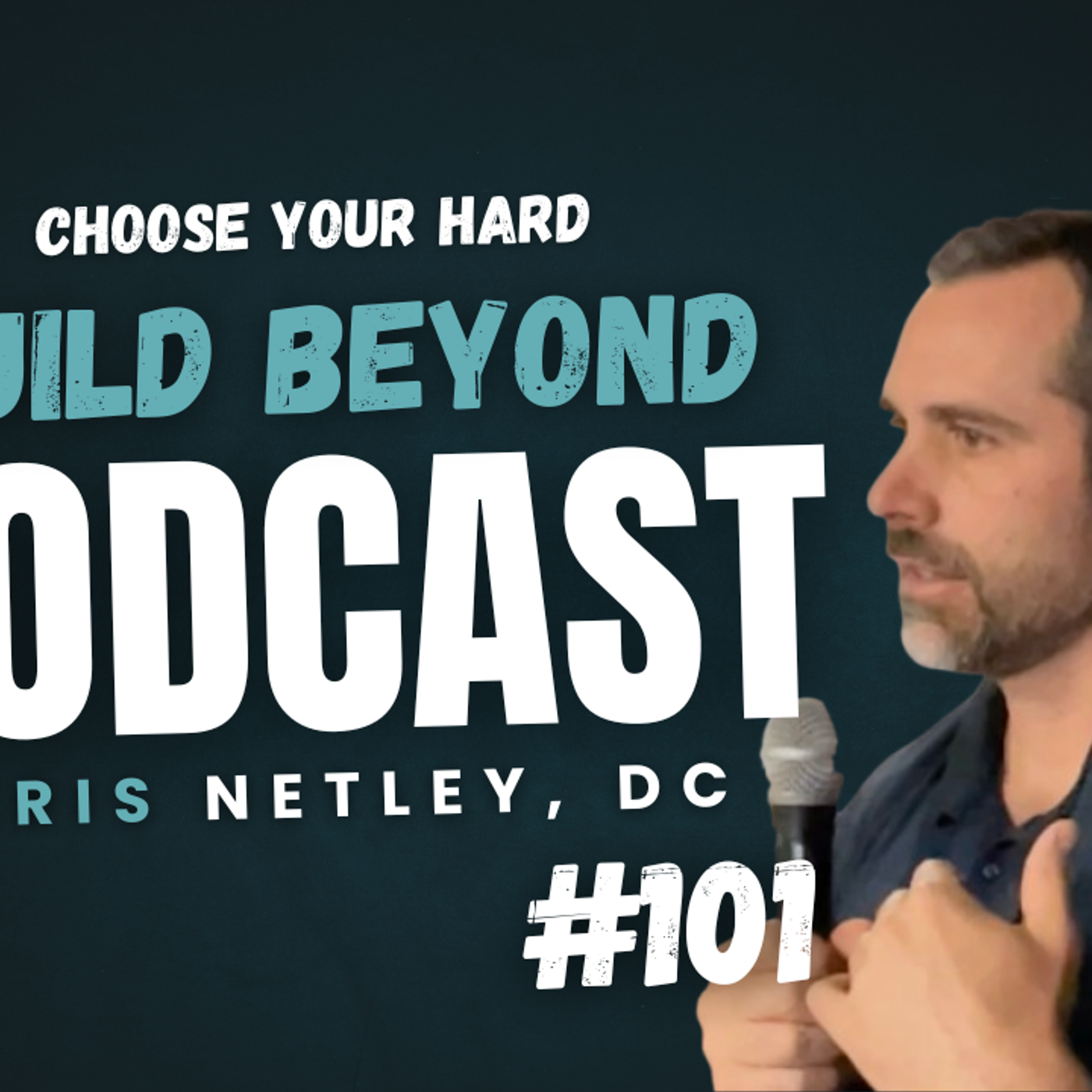
Build Beyond Podcast · christopher.netley
In this episode of the Build Beyond Podcast, Chris explores a simple but powerful truth: you don't get to choose between hard and easy—you only get to choose your hard. Whether you're recovering from an injury, trying to lose weight, improving your fitness, or building healthier habits, every worthwhile goal requires consistent effort. Avoiding today's challenges doesn't eliminate hardship—it often creates even greater challenges down the road. Chris explains how small, intentional choices can create powerful ripple effects across your health. Improving one area—like walking more, sleeping better, or eating more nutritious foods—often leads to better energy, improved recovery, enhanced mental well-being, and greater motivation to keep moving forward. If you've ever struggled to stay consistent with your rehab plan, fitness goals, or healthy habits, this episode will help you reframe the way you think about difficult choices and inspire you to choose the hard that leads to the life you truly want. Chapters 00:00 Introduction: Why Hard Things Matter 02:10 The Hard Truth About Health and Lifestyle 03:08 The Consequences of Avoiding Hard Choices 04:39 Choosing Hard to Prevent Greater Hardships 06:21 The Role of Consistency and Learning from Failure 09:16 Making Better Choices for a Resilient Life 11:37 Budgeting as a Hard but Necessary Choice 12:35 Encouragement to Embrace the Hard Path Where to find Chris Netley: BuildBeyondHealth.com Instagram: @BuildBeyondHealth YouTube: @chrisnetleyDC X (formerly Twitter): @chrisnetleyDC Facebook: Build Beyond Health, PLLC Music licensed through Soundstripe. Code: L17N8BDXCWT8XSLU
Chris: Welcome back to the Build Beyond Podcast. This episode has to do with something. This is a conversation that I have with patients weekly, sometimes multiple times per week. This is not something that I invented. I have heard many people talk about this subject. And probably definitely better at it than what I'm going to do. But I want to deliver it in my own unique way because this is this is so common. This is about choosing hard things. Because here, here's the truth. If you want if you've got chronic pain or you're trying to make some big changes to your health, you're going to have to do hard things. And you're going to have to do hard things. consistently for a long period of time, long enough to get what you want. And then when you get what you want, generally you still have to keep doing those hard things over and over again to maintain the results that you've worked so hard to achieve. For a lot of people, that hard, all the things that add up that stack up to the to the hard road that you have to follow to get what you want. It seems like Mount Everest. You can't see the top. So some people start on the journey, many people don't finish. Many people don't start anyway because it just seems so daunting. I will submit to you though that if you don't choose the hard path The results that you get through failing to choose the hard path are also hard. It's just a different circumstance. Let me give you a specific example. Eating Eating healthy food can be hard if done consistently. It can be boring and it can be challenging. It's usually not as challenging as what people think from a financial perspective, but eating oatmeal, eating fruits and vegetables, eating lean meats, avoiding sugar, all of these things can be hard over a long period of time. Exercising routinely can be hard. If you don't like cardio, getting out there and getting your heart rate up is hard. If you don't like strength training, strength training is hard. If you don't like walking, that can be hard. All of these things are hard, and I'm not going to argue that they're not hard, because that would be a lie. But you know what is also hard? Diabetes and heart disease. And I'm not saying that in the absence of all of these things, you will inevitably have diabetes and heart disease. I'm not trying to scare you or fear monger in that way, but Just think about it for the the s for the purposes of this podcast. If you're still listening, you must be interested in this topic. So Diet and exercise, lifestyle changes, that is all hard. True. You will get results if you can do that stuff consistently over a long period of time and you can keep up that those habits. Having diabetes and heart disease is hard. Recovering from open heart surgery is hard. I watched my dad do it. I would imagine having a foot amputated because of diabetes, that's probably pretty hard. Waking up every day and not having energy, that's hard. Waking up every day and not liking the way your body feels or the way your body performs, that's hard. Waking up every day and being afraid that if you fall down, you not might not be able to get up, or being afraid to pick something up because you might throw your back out. That's all of that, that fear, that's hard. So if if hard is the standard, life is hard, you're going to deal with situations that are hard regardless. You kind of don't have a choice. Things are just going to be hard. Where you do have a choice is selecting the hard that you want. Because if you select lifestyle changes, diet and exercise. And all of these things that we would consider to be healthy choices, your risk for things like heart disease, type two diabetes, cancer, Alzheimer's, dementia, viral infections, bacterial infections, all these things, your risk for all of these, from death from all causes, goes down. So you do hard things and you choose hard things ideally so that you don't have to experience other hard things. And if you do experience those other hard things, because I can't promise you you won't have a heart a heart attack, you will go through those hard things in a much healthier state. More lean muscle mass, less body fat, lower inflammation, just e everything, all you'll have so many boxes checked off that when you actually do go through some of these hard things that you're trying to avoid, it'll be much easier to bounce back. COVID is a good example. There were a lot of people who went into the pandemic not in the best shape. They they were in higher risk demographics. And there wasn't a lot they could do in that point other than try and avoid the virus. After the initial fear had worn down, I can tell you that I me being physically active and relatively healthy, not a lot of comorbidities, I wasn't too worried. And I've had COVID like many people multiple times and it's uncomfortable. But at no point, even when I knew I had COVID, was I fearful for my life. And I'm thankful for that. 'Cause a lot of people didn't have that. So if you're stronger, if you're healthier, if you've got a better VO2 max, if you've got you know you've got a healthy diet, you're harder to kill. You're harder to take down because you chose hard things. And because you chose those hard things and you did them consistently and you've done it over a long period of time and it's become a lifestyle. So you might be someone who's struggling to go through a an effective rehab plan. You might be someone who's struggling with chronic pain. You might be someone who's struggling with other diseases. You might be someone who's struggling with mental health struggles. You might be someone who's struggling it doesn't really matter what you're struggling with. And I want to stay in my lane. So if you have a mental health problem, I can't really comment on that. But from what I deal with, pain management, rehab, nutrition, lifestyle modifications, I can one hundred percent guarantee you that if you pick hard things That'll move you in the direction of what you want and you stick with those hard things long enough, you will make progress. Sometimes it makes things worse. Sometimes we don't make progress. But if we do something consistently for long enough and we don't get the results that we want, it's not a waste because we learn from that and we cross that off the list. So by doing hard things and not getting what we want, we narrow down our focus, which can be really valuable. So I mean the secret to success is that consistency and then learning from failures. You're in a way you're overwhelming your problem with an excellent solution and you're doing it over and over and over again. That's the overwhelming part. And even if you're wrong, even if it's not an excellent solution, so you overwhelm your problem with a the wrong solution, you pivot. You learn, you cross something off the list and you move on. Usually you ha sometimes you have to fail multiple times in order to get what you want. That's a basic principle of innovation, engineering in any capacity. You're you're never gonna hit the nail on the head the first try and you already know that. That's why they do research and trials and you have prototypes and you work through things. You want to see things fail because you know that you have to fail a certain percentage or a certain number of times in order to find the right path, in order to learn what you need to learn in order to succeed. So that is my message for you. You have hard is the standard. Life is hard, but you do have the option to choose your own hard. And if we can choose things that statistically we know reduce our risk for things like Alzheimer's, dementia, type 2 diabetes, heart disease, some kinds of cancer, we can choose things that boost our immune system. So it lowers our risk for infection. It can speed up the symptoms once if we get an infection. Yeah, it can lessen the symptoms during the infection. If we can choose things that boost our energy levels, that improve our sleep, that affect our mood. I mean, who doesn't want all of that? Well, they're they're hard, right? That's strength training, that's aerobic activity, cardio, working on your VO2 max, that's step count, that's moving throughout the day. That's eating things that are boring sometimes. You know, that's making better. better choices. And by better choices, I'm talking about not talking about necessarily like certified organic or you know, gluten free or glyphosate free. And I'm not saying that stuff's bad or silly. But I'm just talking about it's the difference sometimes between saying I'm not gonna get soda and Oreos and bring those into my house. Instead I'm going to buy apples and fruit juice. You know, I'm just not gonna I'm gonna remove that temptation. And sometimes that's saying, Well, I'm a you know, after a certain time I'm not going to be scrolling on my phone, instead I'm gonna go for a walk. It might be making the the choice to put a sticky note next to your toothbrush that says do ten push-ups and every time you brush your teeth you do ten push-ups and you do that for a year. It might be just buying every time you go to the you go to a grocery store, say you go once a week. And you buy seven apples and you set them on your counter. You don't put them in the fridge and the CRISPR or hide them somewhere. You put them right front and center. And you know that when you come in, you're gonna eat seven apples that week, one per day. That might be it. And you might be and that might be the dietary change that you make. I don't know. It doesn't really matter. You have to pick something that is challenging that you think you can do consistently over a long period of time. And then you test it to see if it makes a difference. And I will submit to you that it doesn't really matter. If you do something challenging long enough, you're either gonna get better results or you're gonna learn from the experience and you're gonna be able to pivot. But you have to choose your hard and your failure to choose to do hard things will oftentimes eventually lead to you experiencing hard things that you don't want to experience. Right. And w and let's take it out of the healthcare realm into something that we've all experienced, budgeting. If you don't pay attention to your credit card spending and and how you're spending your money, in the short term you are not choosing hard things. You're failing to choose a budget which is hard. And in the long term, you get to experience hard things. Right. So I don't think that this concept is very foreign. As I said before, many people before me have said it and they've said it better. They will continue to say it better. But this is a conversation that I have with people all the time, especially when there's When they're looking at everything they need to do or possibly that they'll need to accomplish in order to get their chronic pain in check or to get back to sports. And it just seems like Mount Everest and it seems hard. And I and I have to agree with you. I'm not gonna sugarcoat it. Yes, this is going to be hard. I'll help walk you through it and simplify it for you, but yeah, it's going to be really hard. But that's okay. Because what you want, the results that you want are on the other side of all these hard things, and it's very doable. Especially with coach and some help. And if you fail to make this choice, that's fine too. But you're you're not escaping hard. You're just gonna have a layer of hard that you don't want. You know, you're gonna you're you're not gonna accomplish the goals that you want, and then you're gonna have to live with the hard ramifications of of a subpar outcome. So choose your hard and if you need help. Just ask. There's no shame. All right. I hope this is helpful. Thanks for listening.