
Build a Vibrant Culture Podcast · Nicole Greer
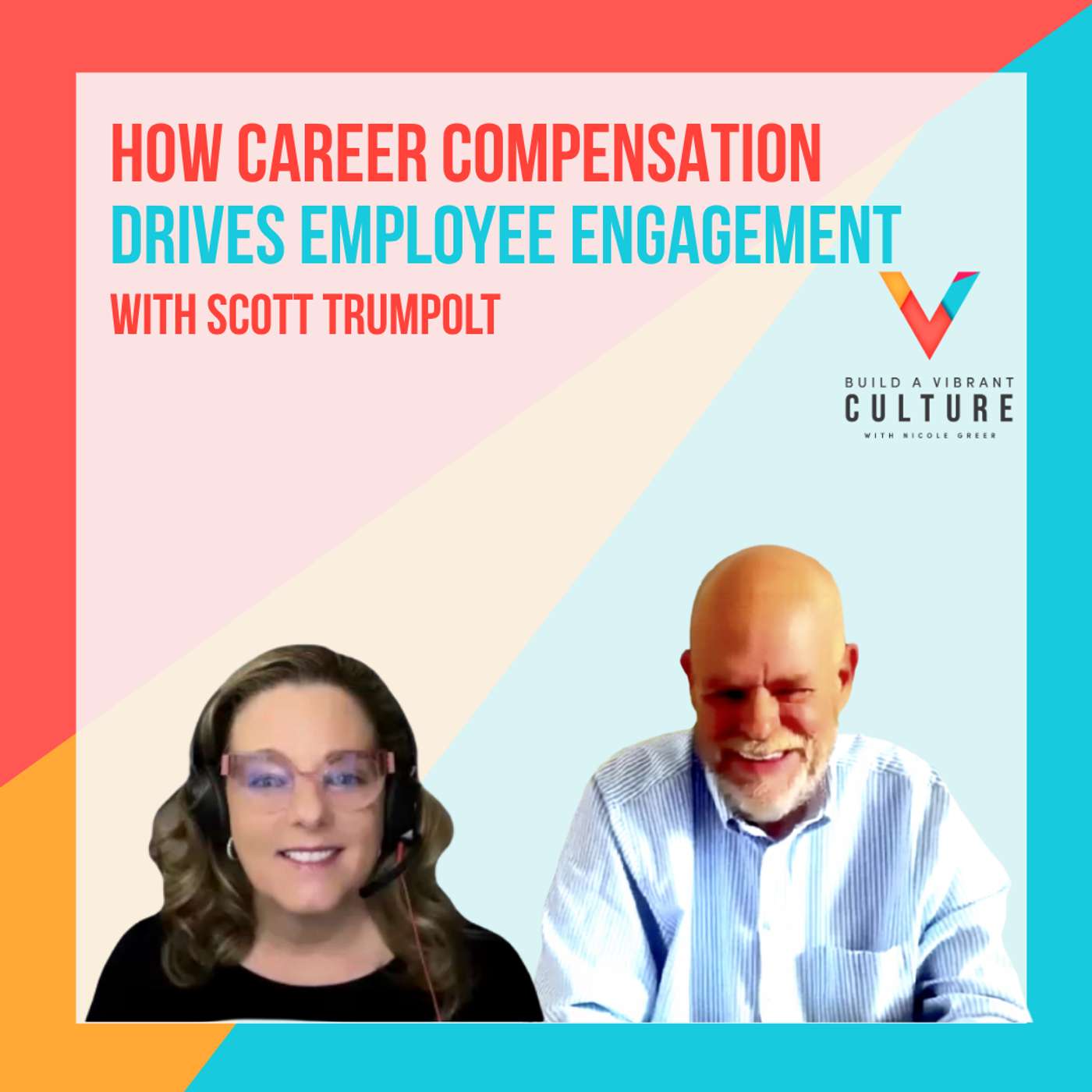
(Disclosure: As an Amazon Associate, Build a Vibrant Culture earns from qualifying purchases. Some links on this page are affiliate links, which means we may earn a small commission if you buy through them, at no extra cost to you.) Scott's book, The Transparency of Compensation: The Employee Engagement Response, is available here: https://amzn.to/4iny9rY (paid link) Why do so many pay conversations end in frustration? Many focus on the job someone is doing today. Career compensation changes the conversation by linking pay to growth. When leaders connect compensation to a clear career path, employees engage and gain confidence. In this episode of the Build a Vibrant Culture Podcast, Nicole Greer speaks with returning guest Scott Trumpolt, compensation consultant and author of The Transparency of Compensation: The Employee Engagement Response, to explore how pay transparency and career compensation build a work culture where people want to stay and grow. This conversation covers why organizations still avoid talking about pay, the difference between tactical and strategic compensation, what pay secrecy costs in trust, how managers can turn a dead-end merit conversation into a career conversation, and how career architecture gives employees a clear path to grow their pay. In this episode, you'll learn: Why leaders treat compensation tactically and how to shift to a strategic, career-based approach What pay secrecy costs your organizational culture in employee engagement and trust How to explain a 2% merit increase so it opens a growth conversation instead of ending one What "above market" pay means and why a pay range isn't infinite How competencies and career architecture create clear career paths Why the money follows skills, and how managers and HR can partner on pay conversations Scott's rapid-fire take on salary posting, counteroffers, merit increases, unlimited PTO, bonuses, and inflated job titles This episode is for leaders, managers, HR professionals, and business owners who want to use compensation as a tool for employee engagement and build a stronger work culture. CONNECT WITH SCOTT TRUMPOLT Website: https://hrcompensationconsulting.com/ LinkedIn: https://www.linkedin.com/in/scott-trumpolt-m-a-g-r-p-257a6b317/ Scott's book, The Transparency of Compensation: The Employee Engagement Response, is available here: https://amzn.to/4iny9rY (paid link) The Build a Vibrant Culture Podcast helps leaders improve work culture, communication, and business performance through real-world leadership strategies and practical insights. Click here to view the episode transcript. Learn more about training, coaching, and courses at https://vibrantculture.com Connect on LinkedIn: https://www.linkedin.com/in/build-a-vibrant-culture-nicole-greer/ For speaking inquiries: https://vibrantculture.com/speaker-kit-request/ Download our training catalog: https://vibrantculture.com/catalog-request/ Want to be a guest? Send your request to...
[00:00:00] Nicole Greer: Welcome everybody to the Build a Vibrant Culture Podcast. My name is Nicole Greer and they call me The Vibrant Coach, and I am here with Scott again, Scott Trumpolt I'm so excited that you're here. We are gonna have a fabulous time. He's been on the show before, and he is a guru of all things compensation, everybody. [00:00:18] Nicole Greer: And just take a look at this. This is his new book. Can you see it? I gotta put it directly in front of my face so that you can see it. The Transparency of Compensation: The Employee Engagement Response. So today we're actually going to cover two things in, in, in one thing. Okay? So it's a two for one, so it's like BOGO, buy one, get one free. [00:00:38] Nicole Greer: Okay? And so here's the thing. We're gonna talk about compensation, and then we're also gonna talk about this, this hot and heavy thing of just like, how do we get employee engagement? So he's kinda put those two things into one, and I'm super excited to talk to you, Scott. Welcome to the show. [00:00:52] Scott Trumpolt: Thank you so much, Nicole, for having me back. [00:00:54] Scott Trumpolt: It's really a pleasure to address your listeners and your viewers. [00:00:58] Nicole Greer: Oh, that's so great. Well, I'm so glad you're here. And I'm gonna read from his book to get us started because I think that he nails it in the preface, right? So let's preface with the preface, everybody. It says, "Historically speaking, the very idea of providing any real transparency to the general workplace population about the concepts of compensation has long been a detached and almost alien one." [00:01:22] Nicole Greer: I couldn't agree more. "In terms of providing a detailed rationale behind how and why each individual employee is paid for their services, and in relation to their pay of others doing similar or different work has never been viewed as a top business priority." He goes on to say, "In fact it has not even been regarded in the past even as an aspirational goal to be achieved over time. [00:01:46] Nicole Greer: Indeed, the transparency of employee compensation in all of its derivatives..." You can tell he's really smart, he uses big SAT words. "... is most often discouraged from happening. When it is discussed at all, it is only done quietly by those who need to know," all right on a need to know basis. Most certainly an individual can obtain a handful of reference books on the subject of compensation and learn at their own speed and leisure about how this concept of compensation is done or should be done. [00:02:16] Nicole Greer: However, even in the same resources to be found, it is still abstract in terms of how it impacts the individual employee. So I just- Mm-hmm ... thought that was a great tee up, right? So the preface is a great preface, and so you're gonna kinda help us out with how we look at compensation. So first of all, how did you get into this whole compensation thing in the first place? [00:02:36] Nicole Greer: How'd you find your way into this expertise? [00:02:39] Scott Trumpolt: Well, that was about 30 years ago. Yeah. And I had gotten my master's degree in human resources and I was working in a company, and I switched over to HR, and they tried me out in a lot of different areas of human resources, whether it was recruiting or benefits, different areas. [00:02:58] Scott Trumpolt: And I was mentored by two gentlemen- Who really had a wealth of knowledge that they freely shared with me. And they saw I had an aptitude for it, and I just kind of went with it. And so compensation became my thing, and it has still been my thing, lo and behold, 30 years later. [00:03:19] Nicole Greer: Yeah. Well, I think that is probably 90% of us who found ourselves in HR, we kind of fell into it and we, and somebody said, "Here, try doing this," and then, we found it. [00:03:29] Nicole Greer: So I think that's great. Yeah. That's a great story. Yeah. Yeah. So let's start with the elephant in the room, money, okay? Why are organizations still so uncomfortable talking openly about compensation? Let's just do that piece, and then I got a follow on for you. So why do- why are we so uncomfortable with this whole thing? [00:03:48] Scott Trumpolt: Well, it has a historical perspective, certainly, and I talk about that in the book. But I think what it really comes down to is at the top leadership, when you think about top, top leadership, they are always thinking about most issues strategically But when it comes to compensation, which is part of human resources, human resources is often thought by them at that level from a tactical perspective. [00:04:16] Scott Trumpolt: And so they are thinking in their minds, "Oh my gosh, this means that we have to post pay ranges. Do we want to be really out there and share what everybody's making in their different jobs?" And that's really not what it's all about, but that's, I think, the thought that comes across. And so managers who are dealing directly with the employee, who are the real drivers of employee engagement, this is something that we found, are oftentimes not armed with the proper tools, and they're thinking very tactically as well. [00:04:53] Scott Trumpolt: "I've got to get through this merit process. I have to discuss the employee's performance and then give them a pay range how much they're going to be getting paid. Increase, not a range, but how they're gonna get paid an increase." [00:05:05] Nicole Greer: Mm-hmm. [00:05:06] Scott Trumpolt: And that's about it, and they're only comfortable with doing that, and that results in a certain kind of stilted conversation. [00:05:15] Scott Trumpolt: And I know we're gonna get into this, but now with some of the new pay transparency laws, the one good thing about them is it's forcing a lot of these issues out into the open so they can be confronted in a positive way. That's the big takeaway from the book. It's not just that this is something that we need to do because it's being imposed upon us by some legislation. [00:05:43] Scott Trumpolt: It's actually a good thing because now we can use compensation as a tool for employee engagement when it's done right. So there's got to be a shift from thinking tactically to strategically, and there's a lot of different partners involved in that. [00:05:58] Nicole Greer: Yeah, absolutely, yeah. Let's just tease it out for just a quick second. [00:06:01] Nicole Greer: This just popped in my brain. If somebody's sitting there thinking tactically and strategically, can you tell me the difference between those two so that we're clear- [00:06:09] Scott Trumpolt: Yeah ... [00:06:10] Nicole Greer: on what those mean? [00:06:10] Scott Trumpolt: Yeah. [00:06:10] Nicole Greer: Yeah, what does that mean? [00:06:11] Scott Trumpolt: T- to me it's, it's, tactical is very day to day. It's, it's, it's very set. [00:06:17] Scott Trumpolt: This is not a, a forward thinking, which when we talk about career compensation we will get into. But tactical is very day-to-day thinking- not a long-term perspective, not taking us from just the what right now, but what can be- [00:06:38] Nicole Greer: Yeah, yeah, yeah [00:06:39] Scott Trumpolt: ... as we go down the pathway, and I think that's really what's missing, and that's what's kept in the background. [00:06:45] Scott Trumpolt: And, this, this is not meant to be in any way negative, because there are a lot of great things going on behind the scenes in the area of compensation. There's a lot of companies doing a lot of great things, but it's not visible to the employee in a way that can be beneficial, hence the problem, hence the lack of trust. [00:07:05] Scott Trumpolt: So the real difference is, a- again, it- it's thinking, we love to say living in the moment, and, and compensation is very much in the moment, but those moments are too rare, and they're too limited and restricted in terms of the information that's shared. People will accept something a lot more, even if they don't fully agree with it, if they at least understand the process. [00:07:28] Nicole Greer: Yeah. [00:07:29] Scott Trumpolt: That's what's [00:07:30] Scott Trumpolt: missing. [00:07:30] Nicole Greer: Yeah. I've got a story, and I want you to double-check me, Scott. I was working with a, a company here in North Carolina, and they do welding, and it is very challenging to find a welder. [00:07:41] Scott Trumpolt: Mm-hmm. [00:07:42] Nicole Greer: Okay? So this is a very interesting thing to do, is to do fabrication and try to hire a welder. [00:07:47] Nicole Greer: We put together a program that was, I think, strategic, but do double-check me, and you can tell me I'm wrong on my own podcast. It's fine. But what we did is we said, "You could come in here with no skill, zero, zero welding skill, but you might have a good attitude and some eagerness and some willingness and some enthusiasm, and we'll pay you X to start to learn to weld." [00:08:12] Scott Trumpolt: Mm-hmm. " [00:08:12] Nicole Greer: Once you learn to do this kind of welding," a zig and a tig and all the welding terminology "you, you are become really proficient at it, we'll pay you X." Because we want you to get there. That's our strategy is to get you to this next level. Then- once you are able to do that and you can each one teaches one, now you're sitting there welding, but you're also helping the guy or gal next to you learn to weld. [00:08:38] Nicole Greer: We're gonna pay you another fee com- compensate you at a different level, a higher level- [00:08:43] Scott Trumpolt: Yes [00:08:43] Nicole Greer: ... because you're contributing at a much higher level to the organization. And we had a lot of people who were super-duper, as he's saying, engaged because, okay, I get in here, I put my head down, I learn how to do this thing. [00:08:58] Nicole Greer: I become masterful at it, and then boom, I'm helping other people do it. And so it was strategic to get more people trained and through so we could make these air conditioning units. So is that... Do I have my... Is that good? [00:09:12] Scott Trumpolt: Absolutely. [00:09:13] Nicole Greer: Okay. [00:09:14] Scott Trumpolt: That's fantastic. [00:09:14] Nicole Greer: Okay. [00:09:14] Scott Trumpolt: And that's the road you wanna go down. [00:09:16] Scott Trumpolt: Think of it this way. A job, a job that you're doing at any moment in time, that's tactical. [00:09:23] Nicole Greer: Yeah. [00:09:24] Nicole Greer: Right. I'm [00:09:24] Nicole Greer: welding this thing. [00:09:26] Scott Trumpolt: Strategic, strategic is a career Okay? Which gets into the idea of career compensation. Where do you go? As you said, the first thing that they're learning is competencies. [00:09:41] Scott Trumpolt: There... These are things that you learn about how you do the job, not just what you do in the job, but how you do the job, and that's a great place to start. But a career is more strategic, and f- this book is m- written primarily for the corporate world and for non-profit organizations. But in the type of work you're describing, even in the type of work you're describing, if you can develop a pathway, this is what we're talking about strategic. [00:10:10] Scott Trumpolt: And you said one other thing that was very important in there. You talked about increasing value to the business. [00:10:18] Nicole Greer: That's right. [00:10:19] Scott Trumpolt: And this is crucial. I talk a lot about, in the book about this. You need to align these pieces with the business need. Now, that may sound to some person, "Oh, well, it's just about the business. [00:10:31] Scott Trumpolt: It's about the business, not about the person." But that's not really what we're getting at here. What we're, what we're trying to say is to the employee is that if you can align your skillsets to the business need, you can continue to grow in that organization. Because every business has a different need, a different philosophy, but if you can align your skillsets to that business, you can grow within that business. [00:10:56] Scott Trumpolt: You don't need to go somewhere else. You can continue on a pathway, and that's really the essence of career compensation. [00:11:04] Nicole Greer: Yeah. That's so good. And you know what we began to see is there was a young man that worked at this organization, his name was Matt, and, ... so he learns to weld. He each one teaches one. [00:11:16] Nicole Greer: Then turns out the guy is quite a lovely leader. He's got the soft skills everybody that are really hard. And he, ends up becoming this... We invent a position for the guy. He's the- ... he's the trainer. Yeah. He's running the program, right? [00:11:30] Nicole Greer: And so- Yeah, [00:11:30] Scott Trumpolt: he's [00:11:30] Scott Trumpolt: a keeper. He's a [00:11:31] Scott Trumpolt: keeper. [00:11:32] Nicole Greer: Yeah, yeah. And and how fun is that- for us HR people to see that happen. We're like, "Yes!" Yeah. Somebody's... Yeah, so good. So good. [00:11:37] Scott Trumpolt: Well, [00:11:37] Scott Trumpolt: you [00:11:38] Scott Trumpolt: bring, you bring up another important point, too. It's like some people do not wanna go down a people leadership path, but others may very well want to do that. [00:11:47] Scott Trumpolt: But a great way to start is let's get good at your job right now, and then certain things will become m- apparent. [00:11:54] Nicole Greer: That's right. Certain things- They'll unfold, yeah ... [00:11:56] Scott Trumpolt: certain things can be encouraged when they're spotted. I mean, you mentioned at the beginning of the call you asked me in the podcast about how I got my start. [00:12:04] Nicole Greer: Yeah. [00:12:05] Scott Trumpolt: And that's exactly what happened. All I had was some theoretical knowledge. But they tried me out in different things. [00:12:10] Nicole Greer: I read a book. Yeah. [00:12:11] Scott Trumpolt: And, and they d- and they tried, and they tried me out in some areas, and then they saw I had a certain aptitude, so they encouraged it. I happened to like it. [00:12:20] Scott Trumpolt: And so that is what makes a career. But again, at the time I'm thinking, "Okay, I also have to understand how does this fit into the business need?" Maybe I wasn't thinking about that right away, but if we can get to a point where our managers are having conversations with employees, and let's face it, the manager is not going to be a compensation expert, but they should have a pretty good idea about what the next business need is going to be within their department, certainly. [00:12:48] Nicole Greer: 100%, yes. [00:12:49] Scott Trumpolt: And that's how you can guide them in this area that we're talking about. That's very important. The business need, it's not being sh- selfish about just what the business needs. It's a way to get the employee engaged to the point where they want to stay at that company, and that's where engagement starts to take hold. [00:13:08] Scott Trumpolt: Again, your whole podcast is about building a culture. [00:13:11] Nicole Greer: That's right. [00:13:12] Scott Trumpolt: And there's got to be several entry points into that culture. It can't just be a program. And we can talk a little bit about that, but there's got to be more than one opportunity during the year, like a merit pay review to accomplish to pull this off. [00:13:27] Nicole Greer: Yeah. Yeah. Okay, we, we talked about the money part needs to be strategic, not tactical. And then, this, this whole secrecy thing, in fact, in the way back I was often told, "Don't tell anybody what you make." Like this is top secret information, right? You know- Yeah ... and did we all talk? [00:13:46] Nicole Greer: Everybody say yes, we all talk. But so what is secrecy costing a business in terms of engagement and trust, the secrecy? What, what's the big cost? Why the push for transparency? [00:13:58] Scott Trumpolt: Well, to put it in simple terms, the way I look at it is if something is done in secret, there's usually something to hide. [00:14:06] Nicole Greer: Yeah. [00:14:06] Scott Trumpolt: And I don't think- ... I don't think, though, that there's some devious pl- I worked in corporate for many years, so- ... I, I don't want to make out that there's this bad guy in there keeping things for, for certain reasons. It's not really like that. It's, it's more that everybody's working very busy in, in their day-to-day jobs, and they don't want to promote the idea of people talking about their salaries, even though there's legally nothing against it. [00:14:39] Scott Trumpolt: I mean, employees do talk. [00:14:41] Nicole Greer: Absolutely. [00:14:42] Scott Trumpolt: Ab- ab- absolutely. [00:14:43] Nicole Greer: Mm-hmm. [00:14:44] Scott Trumpolt: But they don't want to encourage that kind of atmosphere either because let, let's think about this for a minute. Compensation, human resources in general tou- touches the lives of individual employees by the programs that they develop and that they put out there, and certainly compensation, let's face it, it affects people's personal as well as their professional livelihoods based on what they, they get paid. [00:15:11] Scott Trumpolt: So it is a sensitive topic. [00:15:13] Nicole Greer: Oh, 100%. [00:15:14] Scott Trumpolt: And I don't think it's something that historically we've wanted to be talking so openly about because it, it doesn't lead- Anywhere. It, it's more of just a preventative measure. It's not something sinister, it's just preventative. They want people to focus on their jobs and, and people understand, or they don't understand, this is part of the problem, is that everybody comes at the, at... [00:15:41] Scott Trumpolt: They might, you might have five people in the same job, but they come into that job with different levels of experience- [00:15:48] Nicole Greer: Yes, yes ... [00:15:49] Scott Trumpolt: different levels of background. Their ability to start on day one and be a, a top contributor versus someone that's gonna take a learning curve, like you talked about with the welder gentleman- [00:16:01] Scott Trumpolt: Who had a good mind to start and a good attitude, but he wasn't necessarily someone that was doing the job at that moment on a competitive basis. So you wanted to grow him over time. But every company comes into it a little bit at, at a different learning curve in their processes to where they are, and companies understand that. [00:16:22] Scott Trumpolt: So to try and line up everyone and say they're... You wanna treat everyone fairly, but also keep in mind that everybody brings different criteria, brings different skills to the table, and that's something that they want. What's missing from it is the ability to connect the dots for employees and to see how they can grow their compensation over time. [00:16:46] Scott Trumpolt: It's very limited to, "Here's your job. Here's what you get paid," and then maybe down the road we will talk about if a possibility arises. We all need to be more proactive in this regard when it comes to transparency of understanding the process. So it's not about suddenly posting everything, all the information about every employee that's going to do the trick. [00:17:09] Scott Trumpolt: That's not what this book is about. This is about getting employees to understand the process, and most importantly, through their manager in different ways. And human resources plays a vital role in this regard to help them have better conversations with their employees about this awkward stilted conversation that they may have only once a year. [00:17:34] Scott Trumpolt: There are actually opportunities throughout the year to talk about this. Think about it. Managers will certainly talk about an employee's performance more than once a year, so why can't we talk about career development linked to pay at different times, strategic times during the year? Not all the time, everybody's busy, but make it more of a strategic experience than a tactical one. [00:17:57] Nicole Greer: Yeah. Well, two things popped in my mind when you were, were talking about this. And so one is don't miss what Scott said about you might have two, three, four, five people in the same job, meaning their job description in the HR office is, is job description 49712, whatever, okay? Whatever their, whatever their role is. [00:18:19] Nicole Greer: But like he's saying is each one of those humans in that job description brings a unique set of skills, a unique set of experiences. One is stronger at this and one is stronger at that. And I worked for a company for many, many years, about eight years. It was called Summit Properties, and we ran beautiful apartment communities. [00:18:38] Nicole Greer: And once I became a manager, I, I could run an apartment community. I, I, I had, I had those skills down, down. I could run it. I could make it sing. The P&L would sing. I would clean it up. I would get it going the right direction, all that stuff. Well, the leader inside of our organiz- organization said to, said to me, "Here's what I'm gonna do. [00:18:57] Nicole Greer: I'm gonna position you to run your apartment community. You'll still be the community manager, but I want you to go out and do marketing for all of Charlotte, North Carolina." [00:19:06] Scott Trumpolt: Mm-hmm. [00:19:06] Nicole Greer: And I was so excited, and I went home and told my husband. I said, "David, guess what I'm gonna do. I'm gonna do marketing." [00:19:12] Nicole Greer: And, what's the first thing he asked me, Scott? "How much money are they gonna pay you to do that?" And I was like, "Oh I [00:19:19] Nicole Greer: I didn't even think about it. I, I was just excited I was gonna have this opportunity to grow myself, but they positioned me that way with the thought that, "We're getting you ready to leave the apartment manager job and get you going this direction." [00:19:34] Nicole Greer: Now, they probably should've given me a little something something. But here's the thing- ... is that, m- one of my co- one of the people in my cohort, another apartment community manager, she was being positioned for training. Turns out I got the training role and she got the marketing role, so we did a switcheroo. [00:19:49] Nicole Greer: But positioning your people strategically, as Scott is saying, is so important. And so we even had a piece of paper that said job description, and there was a big circle around it, and it said position description. ... so I thought that that was absolutely genius. Now I forgot what the other thing I was gonna say, but it'll come back to me. [00:20:06] Nicole Greer: But I think that's something- . to think about with these competencies. It's a whole- . it's one thing to run an apartment community. It's a whole nother thing to go out and shake the bushes and do marketing. [00:20:16] Scott Trumpolt: Yes, absolutely, and they were preparing you in your own way. You were becoming more valuable to the organization. [00:20:22] Nicole Greer: Yes, yes, [00:20:22] Nicole Greer: yes. [00:20:23] Scott Trumpolt: You had not yet demonstrated those skills, but what you were being given is an opportunity. And- Sometimes I think it's, it, it's a timing issue and it, it's also a generational issue in terms of what the expectations are. But one thing that I have seen time and time again in organizations, and th- this doesn't happen to every single individual. [00:20:47] Scott Trumpolt: I realize people are taking on a lot more responsibilities and not necessarily getting paid for more. But what I have seen over my 30-year career, I've been doing my own thing for about 14 years now, but I was in corporate for a number of years. And I still work with corporations, so I see what's going on in there. [00:21:08] Scott Trumpolt: And the money follows is the point I'm trying to make. [00:21:11] Nicole Greer: That's right. That's [00:21:12] Nicole Greer: right. [00:21:12] Scott Trumpolt: As you get the, the additional skills going, if not in your own job, other opportunities come up and you may have been cross-trained, as you talked about in the marketing, and you can move into another, another organization and that's an ideal opportunity because you've added more skills and experiences to bump up that pay. [00:21:34] Scott Trumpolt: And so it's taking a longer term perspective. I don't want to group any individuals i- in, in a certain category. Everyone is, of course, different. I don't wanna generalize here. But I think it's important to take a longer term view and think of, again, compensation in the career perspective and not the job, immediate job perspective. [00:21:59] Scott Trumpolt: And there are a lot of tools that I talk about in the book to help make that a reality. Some companies are using them uno- unofficially. Some are using them in a very structured way. What I happen to see, and I think it's important to mention here, is you'll see companies that, that they have a little notation or certification certify one of the best companies to work for. [00:22:23] Scott Trumpolt: The reason they get those is they go through a process where they're looking at employee engagement levels in the organization. They do a lot of survey and testing of their employees, and so they get this designation partially because of the employee engage. So is, is everybody doing that? No. But those that develop a culture As opposed to a set of programs that intersect with one another. [00:22:52] Scott Trumpolt: I don't want to get too theoretical here because it actually is just this whole idea about introducing compensation more into the culture. Then it becomes more comfortable, and that's where you get engagement. And some of the best companies to work for, this is what they've done. [00:23:09] Nicole Greer: Yeah. Yeah. So we just want to follow suit. [00:23:11] Nicole Greer: And you want to get Scott's book. It's The Transparency of Compensation: The Employee Engagement Response and get the tools and everything that he's talking about. So don't delay, all right? I've remembered the other thing I wanted to say is I have this- .. I have this, I have this class that I teach. [00:23:26] Nicole Greer: Usually when I'm getting i- I'm introducing myself to an organization, and we're gonna do a culture project inside that organization, I teach this thing called the Vibrant Culture Toolbox. Before we even get st- started, you leaders, you managers need a toolbox that you're using- [00:23:42] Nicole Greer: as we begin to build a vibrant culture, right? 'Cause don't miss that Scott keeps saying, I don't want to get theor- theoretical, theoretical," 'cause w- I don't know how it is for you, Scott, but I get people like, "I don't need any more theory. I need applicable stuff and things to say- ... and do that really help me." [00:23:57] Nicole Greer: And so that's what the toolbox is. But one of the things that I say in there is, here's this company. It has needs. It's, it has changes that are coming down the pike. It has results that are required. How do you get those things? They don't get there on their own. And I know this is so simple, but it's all done through people. [00:24:15] Nicole Greer: So scale the people, meaning develop the people, scale the organization. Yeah. That's the only way it works. [00:24:23] Scott Trumpolt: Yeah. Well, [00:24:24] Scott Trumpolt: you know- [00:24:24] Nicole Greer: That's how it works, people [00:24:26] Scott Trumpolt: It- it's inter- the type of work you're doing is exactly how to make those kind of things happen. My next step in the evolution of this book is not... [00:24:35] Scott Trumpolt: Yes, it's out on Amazon, and, I'm encouraging people- [00:24:38] Nicole Greer: Yeah, get it, [00:24:38] Nicole Greer: people ... [00:24:39] Scott Trumpolt: I'm encouraging people to, to read it, but the next step of what I really want to do, I've already done this, I just need to fine-tune it, but I've actually taken the book and put it into a summarized presentation because I want to go to places and companies and to talk about the essence of the book and say, "Look, you will learn about all the different, as a primer, basic Comp 101, the different programs." [00:25:08] Scott Trumpolt: But what's a lot more important, because there are other books that talk about compensation, how to build a pay structure, how to create an incentive plan. There's plenty of books out there. But what I'm doing is taking all of those processes and re-imagining them and redefining them- for the idea of employee engagement, which requires a different kind of conversation. [00:25:32] Scott Trumpolt: So how do you do that? So my next step is really to convert this book into a, a summarize, not hundreds of slides, maybe 20 slides, so there's plenty of time for questions and slowdowns. But it talks about how to... It, it's not creating new compensation plans, it so much as it is redefining them To have the right stakeholders involved and to approach it differently in terms of that all-important one-on-one conversation between- [00:26:04] Scott Trumpolt: the manager. I mean, I don't blame managers. Managers will often say, "Go see HR about this. Go see HR," and I, I understand why, because they're, they're lacking some of the tools. So I'm not trying to transfer HR's responsibility to the managers. It may sound like that. What I'm trying to actually do, and the book talks about this too, is enhance HR's role as a strategic partner. [00:26:28] Nicole Greer: Oh yeah, here we go. [00:26:29] Scott Trumpolt: By, by allowing them to proactively provide different tools and communication methods around compensation to managers so that they can do... It is gonna go over much... Let's face it, some employees are afraid to even go into human resources. Maybe if they say something wrong- [00:26:48] Nicole Greer: Yeah, it's [00:26:48] Nicole Greer: sad [00:26:49] Nicole Greer: they're terminated. They think it's the principal's office. [00:26:51] Scott Trumpolt: Ah. Yeah. Yeah, so let's have them work more in the background, but in a different way- [00:26:57] Nicole Greer: Mm ... [00:26:57] Scott Trumpolt: to be more strategic again. Yeah. So sorry, I got off the subject a little bit, but- [00:27:02] Nicole Greer: You're good. You're good ... we . No, we're, we're cooking. [00:27:04] Nicole Greer: Yeah, absolutely. Yeah, and and, and the thing is, is like sometimes managers will ask me questions. They're like, "This guy came to me," and he's "He told me he wanted a raise. What do I say?" [00:27:15] Scott Trumpolt: Mm-hmm. [00:27:16] Nicole Greer: And I, I said, "Here's what you say. You say, 'I would love to give you a raise. I would absolutely adore that opportunity. [00:27:25] Nicole Greer: Here's what you need to do.'" See, that's, in that moment, here's what you need to do in order to be compensated higher, which is the employee performance management piece, which, we can talk about that a little bit. But here's the competencies you have today, here's the competencies you need for the next level, right? [00:27:42] Nicole Greer: And, and Scott said this earlier, the career path that people are on. I- if people are clear then we can, we can begin to put people on that path, and then they can move along. I think it's the, back to the question, what is the secrecy? Well, they don't know how I could get a raise, right? [00:28:01] Nicole Greer: They don't know- ... what they need to do, and so we need- ... to tell them what they need to do. So for example, I'll just go back to my own experience. I was a leasing agent first, and then they said, "To be an assistant manager, you got to know how to do this stuff." So I learned- Yeah ... how to do that stuff. [00:28:14] Nicole Greer: And then to be a manager, you got to learn to do that stuff, and so I learned to do that stuff. Now, it's not a guarantee that you're gonna get the raise, get the promotion because we have to have places to put you But at least when that place comes open, you're ready, and then you get that, that raise, and you know you're ready for it, right? [00:28:32] Nicole Greer: So- .. there's a lot going on there. Now you use a term called career compensation, right? So everybody write that down, career compensation. What does that mean, and how is that different from the traditional conversation, "Here's your raise. See you next year"? [00:28:48] Scott Trumpolt: Yeah. Well, let's use that example of, "Here's your raise. [00:28:51] Scott Trumpolt: See you next year." [00:28:52] Nicole Greer: Okay. [00:28:53] Scott Trumpolt: That, that often comes up in the performance review process. Yeah. And one of the things that often happens is that maybe the employee is aware that there is a 3% merit budget in general. They hear- ... they heard this, and that's usually shared somehow. The company might say, "Yes, we're gonna have a merit process." [00:29:14] Scott Trumpolt: They may or m- may not tell them the budget, but th- they might say... They might get wind of the fact there's a 3% merit budget. So they go in there expecting a 3% budget. And the manager says, "Well, sorry, I can only give you 2%." And they'll go, "Well, why is that?" And they'll say, "Well, that's what the budget says I can do." [00:29:36] Scott Trumpolt: "Well, I, I heard it was 3%. I mean, why am I getting 2%?" Well, that's what I, I have in my budget to do." It's a dead-end conversation- [00:29:46] Nicole Greer: Yeah ... [00:29:46] Scott Trumpolt: that can be changed in a moment right then and there. The reason that manager is giving them 2%, in this case, let's say, I know I'm making up examples, and not e- every example fits every individual employee. [00:30:01] Nicole Greer: Of [00:30:01] Nicole Greer: course not. [00:30:02] Scott Trumpolt: But oftentimes when that happens, that's all that they say. That's all they feel comfortable to say, so it's an awkward and stilted conversation. But what they c- really, if they had the tools, they would say, "Well, the reason they told me I can give you a 2% is, you know what? You are well past the market. [00:30:20] Scott Trumpolt: You've been here five years with the company. You're a terrific performer at what you do, but you're now in a position where you should be ready for the next step in your development." [00:30:32] Nicole Greer: Yep. " [00:30:33] Scott Trumpolt: Here's where you need to go," a little bit along the lines of what, what you said, and hopefully there's been some conversations before this because a merit, a pay range is not infinite for a job. [00:30:46] Scott Trumpolt: But even employees are stuck in the mindset of job compensation. They're thinking of their job. "I'm doing great at my job. Why aren't I getting more increase?" "Well, you've been at the j- in that same job for five years. You should be good at that job, and guess what?" "Y- guess what? You're being paid above the market, and our merit budget says 3%. [00:31:09] Scott Trumpolt: You know what? If you are paid really low in your range right now for whatever reason and you're a great performer, you might get 6%. 3% is just the average budget. But in your case," in this individual, so the idea is we wanna give more me- merit pay to the people that happen to be lower in their market value who are performing well. [00:31:31] Scott Trumpolt: We all know employees that within a year are really hitting it out of the park, and other employees that are more comfortable just doing, showing up and doing the standard work. In this case, the, the employee that I'm getting back to was actually really a great performer. Well, they're paid above, so if we can give them some insight- [00:31:50] Nicole Greer: Yeah, above market. [00:31:51] Nicole Greer: Explain above market in case somebody's like- [00:31:53] Scott Trumpolt: Yeah ... [00:31:53] Nicole Greer: "What's [00:31:53] Nicole Greer: that mean?" Explain [00:31:54] Scott Trumpolt: above. Yeah. Well, most companies have pay structures based on and this comes up a lot, they, they call it a market-based pay structure, and what that means is that they have a pay range assigned for your job, and what they do is they look at the 50th percentile Of the market. [00:32:14] Scott Trumpolt: So there's 50% below getting paid that amount for that job, and 50% getting paid above that job, and they use that as the midpoint for your job. And so say the midpoint is $80,000, okay? And because that's the market value of your job, and you've been in the job five years, and you're a really good performer, and you're making $90,000. [00:32:40] Scott Trumpolt: Well, you're above the market value, the competitive market value by $10,000. And that's great, and you should be, but what that is indicating to the company is that it's a signal, w- how do we get you? It opens up a conversation. How do we get you to the next level? Yep. Because that is how you're gonna continue to grow your pay. [00:33:04] Nicole Greer: That's [00:33:04] Nicole Greer: right. That's right. [00:33:04] Scott Trumpolt: Stop thinking about compensation in terms of your job. It's not infinite. You get paid a certain amount based on the competitive, what the market will pay this job in similar organizations. And it just so happens you've been here five years, you've been getting your merit increases. [00:33:21] Scott Trumpolt: Maybe last year you got a 4% increase. But the employee is still thinking, "I'm doing just as good of a job as I did last year, maybe even better. Why am I getting this 2% increase?" The company has a limited budget, but instead of putting it in terms like, "Well, that's all we can afford," and ... Or even saying that even [00:33:40] Scott Trumpolt: You could even say to them, "Well, you're, you're, you're paid near the maximum of your pay range." That still doesn't create engagement. That creates a negative feeling coming, coming out of the door. B- but if the conversation is, you're a great performer. You've been here five years, and you're ready-" We got to, we got to figure out, we got to have a plan. [00:34:00] Scott Trumpolt: We got to move [00:34:00] Nicole Greer: That's right. [00:34:00] Nicole Greer: We got to position you differently. [00:34:02] Nicole Greer: Yeah ... [00:34:03] Scott Trumpolt: position you differently. Yeah Look at other opportunities in the organization that can learn. And if you haven't learned these competencies and these skills, that's part of the performance review process. It's not, shouldn't just be about how you did this year as a performer. [00:34:16] Scott Trumpolt: Where do you need to go here to continue- [00:34:18] Nicole Greer: Yes, yes, yes [00:34:18] Scott Trumpolt: ... to grow, to grow your pay? And that's the, a different type, and that's a more engaging conversation- .. Because that provides pathway down the future, hence the word career compensation. Not job compensation, career compensation, and that's a very important difference. [00:34:35] Nicole Greer: Yeah, yeah. So I'm gonna, I'm gonna share an example. Real life stuff that I'm doing, y'all. I work with a CPA firm, and we are teaching everybody to coach. We're having a coaching program, okay? And then we're gonna do employee performance management. Fantastic stuff. Great leaders at this organization. [00:34:51] Nicole Greer: And so I was talking with the partners and I'm like, "Okay, I need you to think about the people that you're coaching. What do you see for their future?" Because, they're in there, they're doing the accounting, the audit, they're doing the tax, they're doing all the stuff. [00:35:05] Nicole Greer: But it's like, okay, this person needs to ta- needs to get better at talking with clients Right? Whiz-bang tax person, but like this person needs to get better at, at talking with clients. Okay, so there's a whole set of competencies in there, right? And that's what the coaching is gonna be about. [00:35:23] Nicole Greer: And again instead of the job, if you want to become a partner, you got to talk to clients. [00:35:30] Scott Trumpolt: Mm-hmm. [00:35:30] Nicole Greer: Once you're able to do that, you've built your confidence, you've, called on people, you're doing some sales. Don't miss that. "What? I'm in sales? I'm an accountant" No, you are a CPA who wants to be a partner, and so you have to learn sales, right? [00:35:45] Nicole Greer: You got to go out and go to networking events and pull in some business for the CPA firm. So it's, it's helping people get the awareness. Right now you are whiz-bang tax guy or gal, but here's next level for you, right? ... If that's the career you want, that's the stuff you got to learn, and we'll pay you, we'll pay you once you learn it, right? [00:36:03] Nicole Greer: . So I think that's so huge. Okay. All right. So I talk a lot about, and you've, you've alluded to it and thank you for creating a vibrant culture. And so let me, let me just define that for everybody. That means that people are lit from within, right? So I always kid and I say, "Do you guys want to get lit?" [00:36:18] Nicole Greer: And everybody's like, "Yes, absolutely. Absolutely." And so- [00:36:21] Scott Trumpolt: I [00:36:21] Scott Trumpolt: got to write that one down. I love it. [00:36:22] Nicole Greer: Yeah. It's- [00:36:23] Scott Trumpolt: Lit from within [00:36:24] Nicole Greer: ... yeah, yeah. And, and here's the thing. I guess, again, out of my own experience, which is, my... probably the greatest teacher in my life, my own experience, is that if somebody's leading me with clarity, that's the L in lit, saying, they ask me, "Nicole, what do you really want to do with your career?" [00:36:42] Nicole Greer: I tell them, but then I also have somebody who's further along in their career and they say, "Well, here are some other things you could think about." So sometimes the employee has blind spots, they don't know what's possible, right? Because they just don't have the experience, right? [00:36:57] Nicole Greer: The I stands for integrate integrity. Th- is this a person of character? Does this person have good habits? Does this person set goals? Do they manage their keep KPIs? Do they deliver results? So am I whole? Am I a big contributor? So that's the I. Mm-hmm. And then T is, is in my area of responsibility, am I transforming the ordinary into something better, ac- something extraordinary? [00:37:19] Nicole Greer: So getting lit. Okay? So the employ- And that's employee engagement in a nutshell right there. You talk about or, and I... we both talk about creating a vibrant culture, but one of the biggest ingredients is trust, okay? So can you really have a high-trust culture if employees don't understand how compensation decisions are made? [00:37:38] Nicole Greer: What do you think? [00:37:41] Scott Trumpolt: Well, the, the whole thing is, is that there are all these different pieces that contribute to a vibrant culture. Every different functional area plays its part. Without a better understanding Of something that is so fundamental, compensation, as we talked about earlier. I don't wanna be ominous here, okay? [00:38:09] Scott Trumpolt: I don't wanna, be negative or anything like that, because there's no place for this. [00:38:13] Nicole Greer: No, we're just- But- ... fierce with reality around here. [00:38:16] Scott Trumpolt: But, but, but, but it, it, it's very important to understand, since compensation is directly... That's why compensation is in human resources, okay? It's, people would think, "Well, isn't it like accounting you, you're dealing with numbers?" [00:38:30] Scott Trumpolt: Yes, but it's a different language. It's still, the reason it's in human resources is because it's impacting the employee's work life, and their personal life, and their, their professional life. It's compensation. Yeah. And until we figure out a better system to motivate, attract, and retain em- employees, pay is a big part of that. [00:38:52] Scott Trumpolt: So to answer your question, is if you take a certain piece out of the equation, like compensation, it makes it much more difficult to have a truly trusting culture, because a piece is missing. You may be able to obtain trust in other areas of the company, but if there's not more of an understanding, and again, it's not about sharing other people's salaries in order to earn that trust. [00:39:22] Scott Trumpolt: It's not about posting pay ranges. And believe it or not, n- as, as a side note, there are a small group of CEOs that would love to post all the pay ranges, not just what's required. It's just a feeling that they believe that's how you contribute to transparency. But maybe you can do that in a small startup environment, where everyone's working towards the same goals and it's a family environment. [00:39:45] Scott Trumpolt: But to your, but to your question itself, I think it leaves a hole in the, y- you're filling up the water, and there's a, there's a hole in the, in the bag, and it's seeping out. [00:39:58] Nicole Greer: Mm-hmm. [00:39:58] Scott Trumpolt: And without obtaining a new level of trust and compensation, and now it's critical, because we're living in this age of disclosure, where I just can't believe it. [00:40:10] Scott Trumpolt: I mean, I'm dating myself a little bit here, but I see employees- [00:40:14] Nicole Greer: It's okay. It's [00:40:14] Nicole Greer: good to [00:40:14] Nicole Greer: be our [00:40:15] Nicole Greer: age ... , [00:40:16] Scott Trumpolt: Yeah, but I've seen employees out on YouTube sites telling how much they make, how much they got for their last pay increase, and just sh- sharing it out there. I, I don't know exactly what their objective is in this regard, but we have this age of disclosure, and from a legal standpoint some state laws are requiring certain types of pay ranges that get posted for employees, and sometimes it affects internal employees. [00:40:44] Scott Trumpolt: And again, the problem with that is, is that it poses more questions- Than it does answers, 'cause a person sees this range and says, "Oh, where's the top part? Why am I not at that?" And that's all it does. But, but these pay transparency laws in various states, not every state has them yet, but it's growing [00:41:03] Nicole Greer: It'll [00:41:04] Nicole Greer: come [00:41:04] Scott Trumpolt: it does provide an impetus for companies to get more organized internally. 'Cause the next question we might be getting to is, "Well, it's all well and fine, Scott, to talk about compensation transparency and doing all the things you talked about. Well, what if our internal pay systems are all in a mess?" [00:41:25] Nicole Greer: Yeah. [00:41:25] Nicole Greer: Which is, which is, which is a thing. [00:41:28] Scott Trumpolt: Yeah. Well- Yeah ... well, one of the great things about that is that there is a method to the madness. There is a process for a lot of companies, but for those who made decisions in isolation, these types of legislative initiatives are really forcing companies to look closely at their pay situations and get their house in better order. [00:41:50] Nicole Greer: That's right. [00:41:51] Scott Trumpolt: So if I was tasked with going, let's just say someone hired me, "All right, create pay transparency in the organization." Well, before I even started on conversations with managers about how to train them to handle these type of questions and to give their employees transparency to the how and the why instead of just the what I would be looking at their, their internal structures, see where there are some internal equity issues how far is their, their pay structure away from what their philosophy is. [00:42:25] Scott Trumpolt: Do they wanna pay market? All of these things do, need to be looked at. That's what I do, and I'm not the only one. As an independent consultant, I work with companies that don't have the time or the expertise internally to do that. [00:42:38] Nicole Greer: You need to get somebody g- get you going in the right direction. [00:42:41] Nicole Greer: Yeah. [00:42:41] Scott Trumpolt: Yeah. And a lot of companies ha- have been doing that, and some... And, and these new laws are and the fact that there's such a thirst out there for employees for more information about compensation, that this is, th- this is why companies are getting their act together more and more if they do have some internal issues. [00:43:02] Nicole Greer: Yeah. Well, I can't believe it, but we are, like, almost 12 minutes before the top of the hour, and we've just, had a great talk so far. I wanna talk about two things quickly. They deserve more attention, so please go get Scott's book. I'm putting it right in front of my face right here, everybody. [00:43:18] Nicole Greer: The Transparency of Compensation: The Employee Engagement Response. Okay, the first thing is I love your idea in the book career architecture. And we've been dancing- ... kind of all around it, but explain what career architecture is. W- that's what we need to be doing. [00:43:32] Scott Trumpolt: Yeah. Career architecture is not something that I invented, but it's something that I came across in my career. [00:43:40] Scott Trumpolt: It's been around for a while. People may call it something different. But- [00:43:46] Nicole Greer: Career pathing ... [00:43:48] Scott Trumpolt: take, take the, take the word career, and the, the one element to understand, to take away from career architecture is the fact that there is no such thing as a financial analyst in and of itself. That's a job. But when you look at the market, you will find that there is a financialist one, two, three, four, five. [00:44:13] Scott Trumpolt: There's an intermediate, a senior, an expert. And a lot of people, and again, this is miscommunication, feel that, "Oh, when I work here for two years, that means I now become a financial analyst two." No, this is not a government type of pay structure program. Each one of those levels of the same job represents a career. [00:44:36] Scott Trumpolt: So if you want to stay in a path of being a financial analyst, as an example, or a software developer or a human resources generalist, whatever it is, there is no such thing as just that title. Different levels within the the, the actual job exist. They have different levels of scope and complexity over time, and they pay higher and higher. [00:45:02] Nicole Greer: Yes. [00:45:03] Scott Trumpolt: And there needs to be a business need linked to it. For example, some companies may only, based on their organo- organizational structure, let's be honest here, have need at one time for an intermediate level financial analyst. That's all they may need. But over time they may, the business need may change, and they may need people at the senior level, and even... [00:45:26] Scott Trumpolt: or, or expert level or a specialist level. And again, the idea of career architecture is evaluating those different, with different criteria. The same basic job, but as you- think about it, as you become more experienced, your manager is not gonna look over your shoulder as much. [00:45:45] Nicole Greer: That's right. [00:45:45] Scott Trumpolt: They're gonna expect you to take initiative. [00:45:48] Scott Trumpolt: These are all things you learn as you grow. So career architecture is a way of classifying jobs- Against the market, but with greater precision, not just talking about the job itself, but what level of scope and complexity are you in that job? So it's using the a market-based approach, that market data concept, the value of your job, and then breaking it out into different components of ever greater scope and complexity, and paying you appropriately for which one of those you're doing for your organization. [00:46:23] Scott Trumpolt: So today, you're a financial analyst at the, the intermediate level. How do you get, and there are guidelines to how do you get to become a senior, and it's not based on years of experience. The idea is as you work longer in an organization, the idea is you should be gaining all the time, growing yourself, growing yourself, making yourself more valuable to the company, 'cause that's where compensation grows. [00:46:49] Scott Trumpolt: Hopefully that helps. [00:46:50] Nicole Greer: Yeah. I- that's just an amen right there. You need a growth mindset, okay? That's just, get Carol Dweck's book. It's an oldie but a goodie. Read chapter eight. That's the only chapter you need to read. Okay. All right. So good. All right. So Scott, I just wanna say that I had many other questions for you, but get the book, everybody. [00:47:08] Nicole Greer: I want you to go in the book and read about inflated job titles, and I want you to go in there and look at his ideas on artificial intelligence. The book is robust. The chapters are... I mean, there's 34 chapters, but they're short. They teach you a point. They bring something home, something you need to apply to what you're doing. [00:47:28] Nicole Greer: So I just really celebrate this. So let's finish up with our kind of compensation speed round. So no consultant answers, Scott. First thing that comes to mind salary posted in every job ad [00:47:42] Scott Trumpolt: Only as required by law. [00:47:45] Nicole Greer: Okay. Employees discussing salaries with each other, healthy or headache? [00:47:50] Scott Trumpolt: Headache. [00:47:52] Nicole Greer: Counteroffer- [00:47:53] Scott Trumpolt: They're gonna do it. They're gonna do it, but I don't think it's gonna lead anywhere. [00:47:55] Nicole Greer: Yeah, I agree. Just angst. All right. Counteroffers, smart strategy or dangerous habit? [00:48:02] Scott Trumpolt: Dangerous habit. [00:48:03] Nicole Greer: Okay. Annual merit increases, keep them or kill them? [00:48:08] Scott Trumpolt: Keep them, but enhance them. [00:48:10] Nicole Greer: Ah. Unlimited PTO, benefit or branding? [00:48:16] Scott Trumpolt: With one, one quest- the, the, the issue with- I'm sorry, but I have to stop us just for a moment here, because with that one, I would have to say that that can be a trap- Yeah ... because oftentimes they say you have 30 days of PTO, but the reality is, is that you can't use hardly any of them, and so it becomes a branding thing, I guess I, I could say. [00:48:40] Nicole Greer: Okay. [00:48:41] Scott Trumpolt: All right. And it can be a, a dissuader of engagement. [00:48:44] Nicole Greer: Ok- okay, don't miss that, everybody, so examine that. Inflated job titles, harmless or hab- hazardous? [00:48:50] Scott Trumpolt: Hazardous. [00:48:52] Nicole Greer: So you're gonna have to get the book to get the download on that. Okay. Let's see. Bonuses, motivating or overrated? [00:49:02] Scott Trumpolt: Can be can be, can be motivated if done in a transparent way, and I talk about that in the book, about how to make bonus plans transparent. Okay. Can be motivating. [00:49:14] Nicole Greer: Yeah, it always was for me. I was gonna get it, come heck or high water. All right, so finish this sentence. Last one. If you want employees to trust your compensation system, you have to [00:49:28] Scott Trumpolt: Make it part of your culture. [00:49:30] Nicole Greer: Yeah. Look at that. What way to tie it in a bow, Scott. That was amazing. All right. So if somebody wants to get ahold of you, they need your help, they're like, "Oh, my God, Scott, get in here and do that very thing you told us about five paragraphs ago. Help us clean up our house and get our compensation and our situation going in the right direction," how do they find you? [00:49:50] Scott Trumpolt: Well, I'm on LinkedIn. That's a great place to find me. [00:49:53] Nicole Greer: Yeah. [00:49:53] Scott Trumpolt: Hopefully if there are notes for this podcast, you could post that in there. Yeah. I have my website, too. Yeah. hrcompensationconsulting.com. That's a great place because I put all my media out there. And my books are out there. They link to Human Resource. [00:50:09] Scott Trumpolt: So I have two, but this is the one we're talking about now. [00:50:13] Nicole Greer: Yeah. [00:50:14] Scott Trumpolt: And but this has been fantastic. I- [00:50:16] Nicole Greer: Yeah. We have a good time when we hang out. We, we could just chit-chat it up all day, couldn't we? [00:50:22] Scott Trumpolt: Yeah. Yeah. Well, we, we have, we have a lot, we have a lot in common, and there are many other folks out there, and this is, this is just what I want to, to, to focus in right now with compensation. [00:50:36] Scott Trumpolt: It's not just a bunch of numbers. It's, it's misunderstood if it's understood at all, and there just needs to be greater... I see opportunities for transparency that I didn't see 10 or 15 years ago- [00:50:47] Nicole Greer: Yeah, of course ... [00:50:48] Scott Trumpolt: through var- through various means, like we talked about. Not just state laws that only provide a starting point, but just living in this age of disclosure, so w- but we have to do it right. [00:51:01] Nicole Greer: 100%. [00:51:02] Scott Trumpolt: We have to do it right. [00:51:03] Nicole Greer: Yeah. That's [00:51:04] Nicole Greer: right. [00:51:04] Scott Trumpolt: Or the opposite can happen and, and things g- can wor- get worse. [00:51:09] Nicole Greer: Yeah. I couldn't agree more. All right, everybody, it's been another episode of the Build a Vibrant Culture podcast, and so here's what I want you to do. I want you to go down to wherever you're listening on the YouTube or on the, on the Spotify, on the Apple podcast, and give us a like. [00:51:24] Nicole Greer: If you would just do that for a quick hot second, we'd appreciate it, and leave a love note for Scott. That would be fantastic. And come back next Wednesday, and we'll have another episode with another guest who's gonna bring you the strategies, the systems and smarts to help you build a vibrant culture. [00:51:40] Nicole Greer: Thanks, Scott. [00:51:41] Scott Trumpolt: Thank you, Nicole