
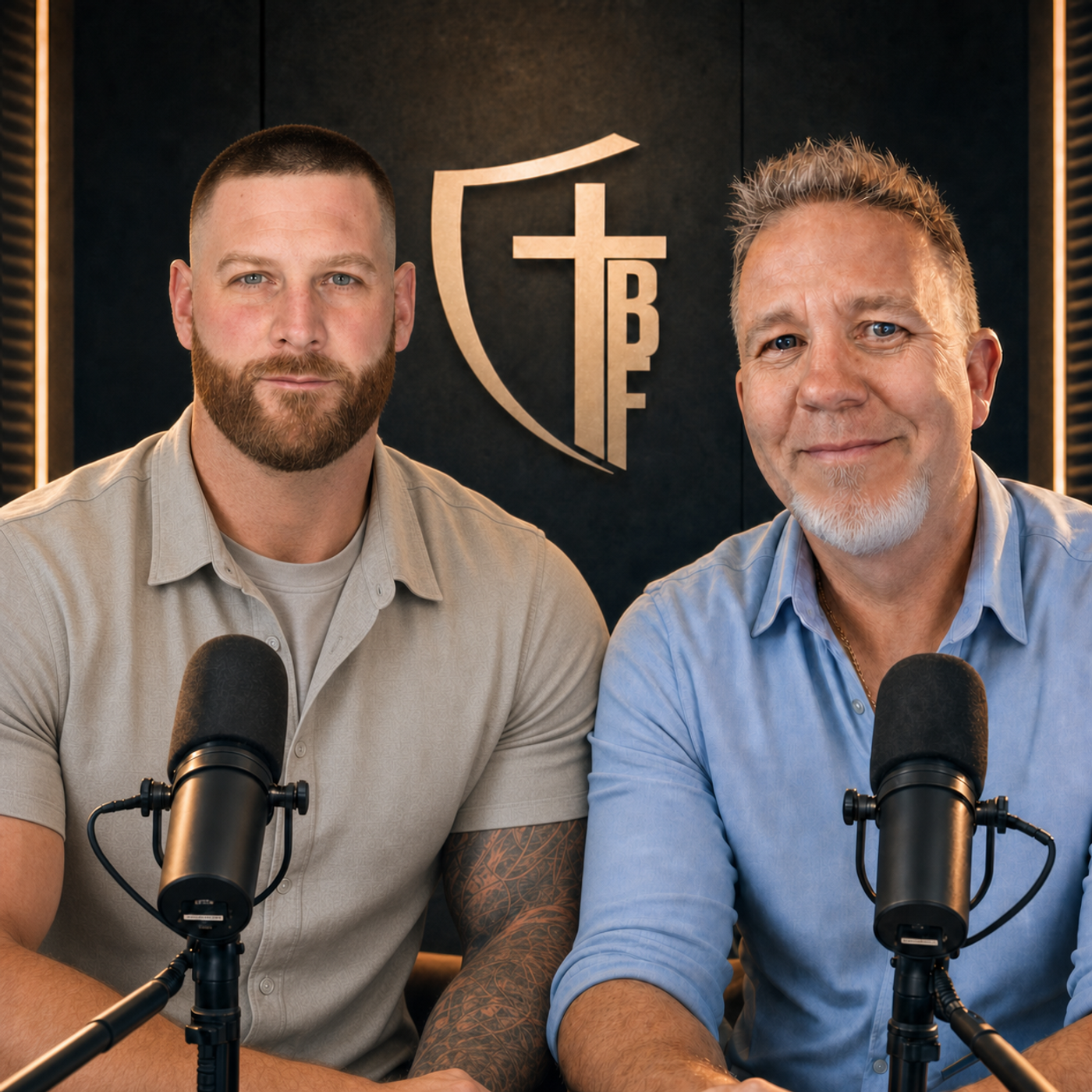
Brotherhood Forged | Christian Men's Community & Podcast · Joey Koontz and Paul Bengel
Brotherhood Forged is a Christian men's podcast helping men grow in faith, discipline, and leadership. Episode [EP#]: Joey and Paul sit down with Mick Naples. He's an author, a podcaster, a fellow Ohioan, and the son of a stubborn old Italian guy who "fixed lawnmowers for a living." Mick wrote Walking with Grizzlies after losing his dad and facing a regret he'll carry for life. On the day his father died, a nurse asked if he wanted to talk to him. Mick said, "No, I'll talk to him later." There was no later. This conversation is about honoring your parents while you still can. It's about seeing your father as a real man with real battles, and becoming the dad your kids know will always show up. Huge thank you to Mick Naples for his honesty and his time. Grab the book, get the free Resolution, and share your own Grizzly Letter: Website: https://walkingwithgrizzlies.com Book: https://www.amazon.com/dp/1734595094 Instagram and YouTube: @walkingwithgrizzlies Podcast: The Walking with Grizzlies Podcast Topics covered: "If you're gonna be a bear, be a grizzly" and whatever your hand finds to do The night his dad asked, "Why do you have to talk like that?" Three days in Hollywood and how God started working on his heart Idolize, demonize, humanize: how sons see their fathers "There's no pain like regret" and what it really costs Luther: our parents' shortcomings don't cancel the honor we owe them When's the last time you said thank you to your mom or dad? Forgiveness, grace, and seeing God as a Father who isn't a hard man The one lesson Mick's dad taught him about fatherhood: just be there Scripture referenced: Ecclesiastes 9:10, Proverbs 19:21, Exodus 20:12, Matthew 5:23 to 24, Genesis 4:7, Proverbs 12:25, Matthew 25:14 to 30, Psalm 51:12, Luke 16:31, James 1:22 Books mentioned: Walking with Grizzlies by Mick Naples, Enjoying God by Tim Chester, Luther's Catechism Timestamps: 0:00 Welcome, Mick Naples 1:18 "If you're gonna be a bear, be a grizzly" 3:05 The prank calls and "Why do you have to talk like that?" 7:38 His biggest regret: not sharing the gospel with his dad 10:45 Three days in Hollywood and a 36 hour drive home 15:04 Idolize, demonize, humanize your parents 20:49 "There's no pain like regret" 29:15 Honoring his mom after his parents split 33:23 When's the last time you said thank you? 38:20 "No, I'll talk to him later" 40:35 Forgiveness, grace, and enjoying God 45:41 Could his dad have done anything different? 51:14 Keep chipping away and know your heritage 55:23 Fondest memory and greatest lesson from his dad 1:00:18 Where to find Mick 🔥 Brotherhood Forged: Built for Men Who Refuse to Stay Stuck This isn't just another group chat. It's a coaching driven community for men ready to lead with strength, faith, and integrity. You get weekly group coaching calls, daily challenges, real accountability, workouts, and a brotherhood of men who actually show up. You don't have to figure it out alone. Join us at bro4ged.com/land Forge your identity....
Joey: Guys and gals, welcome to Brotherhood Forge. Today, tonight, we have a very special guest. We have Mick Naples. Mick is an author. He's a podcaster. He's a fellow Ohioan, just below Paul, up there in Michigan. He lives with his wife, Madeline, and their two children. And he is an author two times, I believe. And his most recent book is Walking with Grizzlies after losing his dad, who was a stubborn old Italian guy who fixed lawnmowers. There's lots more to tell, but that's where I'm gonna leave it for now. Welcome, Mick. Mick: Thank you, Joey and Paul. It's good to be here with you guys. Joey: Was that accurate in that introduction? Was that fair? Mick: Yeah, I mean that's everything was fair. I mean you you painted a nice picture of me and an accurate picture of my old man. So it's that that was him. That was the legend. the stubborn Joey: Mm. Mick: old Italian guy who fixed lawnmowers for a living. And he he would he would always tell people that. He'd he'd say, his thing was, yeah, I fix lawnmowers for a living. Now no, I won't tell you that these lawnmowers I'm working on cost eighty thousand dollars a piece, but I I fix lawnmowers for a living. So that's Joey: That's good. Mick: that's accurate. Joey: I bet he PB: Well Joey: was a humble man. Go ahead, Paul. before I just you go ahead. PB: No, you're good, man. Everything about him sounds humbling. I I wanted to paint the picture of the motto, man, because there's there's two models that really took that I took away from this book. And one was the the story of being a grizzly. So can you kind of just kick everyone off with that? Because I think that's pretty epic. Mick: Sure. He and and you know, I do not know where he got this from. It's just something he would always say. And I again I don't want to steal the exact language from the book, but honestly, he really would growl this. You know, he'd say if you're gonna be a bear, be a grizzly. And you Joey: Yeah. Mick: know, it's like I mean, he never even sat down and explained where that came from, what it meant, but I don't think it needs a lot of explaining. It was just like If you're gonna do something, just just do it. Just dive in, just go after it and just live. I I mean I don't I don't know how else to to really elaborate upon it. It's one of those things you hear and you really don't need a whole lot of explanation. You just you just knew Joey: Yeah. Mick: what he meant. You you just know what it means. But yeah, you know, and I I likened it to, you know, if we want to tie this to scripture, like in Ecclesiastes nine, ten. If you know, whatever your hand finds to doing, do with all your might. And Joey: Yeah. Mick: Just what a what a great I I like it, you know, and it it became the basis for for the book. And I mean it it kinda helped the theme a little bit that my dad sort of looked like a grizzly bear, big big old beard and you know, catcher's myths, his his hands. They were all callused up and stoved up and and all kinds of stuff. So yeah, all of the above. Joey: Yeah, yeah. You one thing that I I just really wanted to ask you real quick and it was when you talked about in the book when your dad answered the phone. Let's talk a little bit more about that. Mick: I I I you know, you'll have to be more specific. I can't even share everything Joey: Okay. Mick: that the guy used to say. It it wouldn't be appropriate for your audience. Joey: Well, let's go when when your friends would call the house and they'd call just to speak to your dad. I did I get that right? Mick: Yeah. So and you know what? This this kind of morphed. and not to say that these things didn't happen simultaneously because they I'm sure they did, but when this all first started off, you know, back when we were in high school, you know, my phone number would circulate through the student body as you you gotta Joey: Yeah. Mick: you gotta prank phone call this guy, you gotta call this guy and just just mess with him. I mean i i you know, and he he was the and you know I I've been on the other end of those phone calls, listening to the stuff that he's saying. Is you know, we're we're all sitting there. Some sometimes I I think I I don't think I'm stretching the truth here. What we we would do it from my basement. You know, we'd we'd call him from the basement. And I mean he was just you you never had to wonder what Mike Naples was thinking. And chances are when you were calling his house in the early hours of the morning, you were gonna get exactly what he was Joey: Exactly. Mick: thinking. And you know it was probably gonna elicit at least a a few chuckles to say the least but that changed to my buddies would call and just just just talk with them, you know, shoot the breeze Joey: Mm. Mick: with them. They'd they'd talk sports, they'd talk they'd talk whatever. I mean a lot of sports, I think part of that was probably because I I never really took a a deep interest in sports and my dad was a big sports Joey: Yeah. Mick: guy. And I attribute that to the fact that he was such a big sports guy growing up and and he said this multiple times, that my mom made him promise not to not to over push us as kids into Joey: Mm-hmm. Mick: sports and things. And, you know, I I think he was he was true to that. And I just I just never got into the whole sports ball thing. And, you know, looking back, part of me is thankful for that because I I see I see how seriously some people take it. Joey: Mm-hmm. yeah. Mick: And you know, I'll throw out the I word, you know, idol. even you know, all these sports ball exhibitions for for kids that take place on Sundays. And it's just like, you know, I I know Joey: Yeah. Mick: where I'm going to be on Sunday and it's not gonna be at a at a sports ball field. Maybe maybe if it's in the afternoon or something, but just the fact that that's even up for grabs is interesting. But Yeah, I just never I d that's something that we didn't share. Looking back, Joey: Mm. Mick: I I wish that we would have. you know, I I think back, it's like, man, I I have a degree of athletic aptitude. I probably could've wandered anywhere and you know, we could have shared that together. And and who doesn't like you know, good competition? I'm I'm not totally Joey: Right, right. Mick: against all these things. But, you know, I did play soccer. and you know, he was he was at all my games. He got kicked out of a number of my games for PB: Yeah. Mick: You know, getting into it with the referees. And I mean, it was just, Joey: That was me. Mick: it was fantastic. And you know, here's the thing about my dad too. It's like, you know, he, I told you some of the stuff he said wasn't, you know, wouldn't be appropriate to share with your audience. And and that's true. And I'm not going to tell you I didn't laugh at it because it didn't change the fact that it was hilarious. but Joey: Yeah. Mick: I would I would also say my dad knew how to conduct himself. You know, he was the type of guy who, you know, man to man, he might be sitting there. using this language and all this stuff, but he's the kind of guy that would tune you up if you were talking like that in front of you know, some women and some children and stuff like that. So, you know, that was actually a really sobering time for me. I wasn't a Christian quite yet. And I remember Joey: Okay. Mick: my dad looking at me and I'm sitting there, you know, dropping F bombs and stuff in front of him. That's that's r one thing really the Lord cleaned up in my life is is my mouth. And Joey: Yeah. Mick: He looked at me and and I'm telling you, he's he was who he was. He said, Why do have to talk like that? And I think even as a non Christian, Joey: I think even if Mick: I'm like, wow, like the fact that my dad's saying that to me is, you know, probably not a good thing. That was a Joey: Yeah. Mick: really long answer to your question. we we're we're already going all all over here, but I I Joey: good. Mick: I don't even remember what the question was, but that was the grizzly and that that was my old man. Yeah. Joey: Yeah, yeah. Grizzly then we went to the phone call. But you you segued it nicely. You segued Mick: The phone call. Yeah, that's right. Okay. Joey: it nicely. You're fine. I'm gonna go to Paul before I hit my next one. PB: was it was a beautiful segue, man. I you said a couple of things there that I wanted to highlight. The first was you said that you wish you had shared that with him and I was curious what other things you've gone through life and wished as well. I I don't know the answer to one of them. But then you brought up at the time you were non Christian. So d did your dad play a role in that at some point or is this something that you wish you could have shared that with him as well? Mick: No, it's a really good question. And actually I would say that not not sharing more of that with him is is one of, if not my my principal regret. My dad would have sat there and you know, before we we started recording here, Joey was telling me, Hey, our our goal with the podcast is just to get the gospel out to people. It's it's just to share this truth with people. My my dad was every preacher's dream, because he was To me anyway, he was a captive audience. He would have sat there and listened to me talk about the I don't know, the the dumbest, most obscure thing you could possibly imagine. He'd be interested in it if I was interested in it. And Joey: Mm-hmm. Mick: you know, the Lord saved me back in twenty ten. And I w I won't I wonder, you know, one day I I hope I can ask him, Joey: Like an app. Mick: you know, what the heck he was thinking. Because the the change in me was drastic. Not not that I was necessarily living a particularly lascivious life. The Lord spared me from a lot of things. Joey: Yeah. Mick: but I I was different, man. Like I I was different. It j it was like flipping a switch. You know, you went from just kinda, you know, the quiet guy to the guy who's just you know, hellfire and brimps I mean I I went through the cage stage just like a you know, a lot of people do where, you know, I just won't shut up about stuff and You know, I'm pushing the envelope for the sake of pushing the envelope. And, you know, Joey: Mm-hmm. Mick: looking back on those things, I I don't regret anything I said, but I I certainly regret the way I I came off. and regret the way, Joey: Yeah. Mick: and you know, this ties some of our themes really into your podcast is, you know, just considering the whole principle of honoring one's parents, right? The fifth commandment. And I I Joey: Yeah. Mick: wish I would have been more d you know, I I I didn't hesitate to tell somebody. that they were on their way to hell, but I I sure didn't respect my parents a lot. So it's it's just that I I wish I would have shared the gospel with him more for sure. w without Joey: Mm-hmm. Mick: question. Joey: Yeah. Yeah. Mick: But he no, he didn't. So I'm I'm the first Christian in my family. I was raised I was nominally Roman Catholic. we my parents joined the Catholic Church just so they could send us to a Catholic school, just to send us to a private school and you know, to to get a decent education. And then we moved when I was in sixth grade and we went to public school and that was that was pretty much the end of Catholicism. you know, Joey: Mm. Mick: in any strict sense in in my family. Joey: So question for you. Twenty ten, salvation. Was that also your surrender moment? Or was that like most people, it takes a while to where you're like, I really am surrendering to Christ. Just curious. And then I can follow up with that. Mick: Sure. I think I think that somewhere in between here. I'm just an enigma trying to break all the all the paradigms here, I guess. I so Joey: Yeah. Mick: I was definitely different. I was definitely changed, but I would say the Lord started working in my interests, like for for whatever reason. And and without going into crazy detail here, I was I was in California at the time. I had this crazy kid dream to go out to Hollywood and be an actor. I found a place to live on Craigslist. I packed up my car. I drove out there. I was signed up for film school. Like the whole deal. And it's it's funny. You're welcome to laugh, but I didn't even get to the funniest part. So the funniest part of this story is I was out there for two days, three days before I turned in my car and and drove home. you know, it was just it was just the Lord crushing me. Like I I end up in this this house in North Hollywood, again that I found on Craigslist. And there's like a dozen people living in this house. Like two sets of bunk beds in a bedroom, and I'm just like, okay, you know, my you know, the the spoiled little suburb boy isn't exactly at home here. And you know, I just Joey: Yeah. Mick: honestly like I just remember I I don't consider myself a particularly emotional person, but I was driving around Hollywood just crying. Like, what am I doing right now? And a fri my my best friend at the time was at the Master's College in Santa Clarita. And for whatever reason, a a non-believer says, I'm gonna drive to see my friend at this Christian college and ask him to pray for me. I have no idea, but that's what I did. He he prayed for me and I packed up I I was already packed up and I I got my oil changed at a Walmart in Valencia, California, and I drove home. I drove 13 hours straight to Santa Rosa, New Mexico. I stopped and then I drove 23 hours straight home. Like I was I was just done. And looking back on it, it's not the way that I would advise anybody to handle adversity or even wondering if you're doing the right thing. It's like, dude, you you gotta give this a chance. Like you drove out there. But I I definitely have consistently looked at that as the start of the wor Lord working in my heart. And some other little things happened when I got back home. some things didn't work out with you know, some different girls and just other things I wanted to work out and they didn't work out. And it just showed me again and again that everything I thought to be good and right wasn't. for a long time, Joey: Mm. Mick: Proverbs 1921 was my life verse. Many are the Plans in the mind of a man, but it is the counsel of the Lord that will stand. And so all I can say is, for whatever reason, I I started picking up some Billy Graham books, reading through those. I was plugged Joey: Yeah. Mick: into three Bible studies throughout the week shortly thereafter. I requested, I was working Sunday mornings in the produce department at the time and like I gotta request off. I gotta go, I gotta go find a church. And I visited a church of a mentor of mine, one of the guys leading the Bible studies. Joey: Mm. Mick: and then the following week I checked out a different church and that was the church I I stayed in for the better part of a decade. and those guys, those pastors poured into me and and that's where I that's where I grew up in the faith. So somewhere in between, I I really couldn't tell you when I I had this recognition and realization that I needed Christ, that I was a sinner and and all this other stuff, but I was just different. I was memorizing Joey: Yeah. Yeah. Mick: scripture. I was reading my Bible. It was I was different. I don't know how else to say it. Joey: Yeah. It was a slow process for me too. And I can't pinpoint the day or the hour. Some people can. It's okay. It's okay if we can't. Mick: Sure, sure. Joey: It's sanctification is a process anyways. So it's all good. Mick: Yeah, amen. Joey: Yeah. PB: You you brought up honoring your parents, man. This takes me to the next segment or the next statement that I really love that you said is how we idolize I'm sorry, yeah, idolize, demonize, humanize our parents. And that's something that you I I I'm pretty sure that's in the book, but at least in the podcast interview you brought up. Can you walk us through that process, man? 'Cause I think so Mick: Sure. PB: many people get caught in one of those or not maybe two of those stages before they finally realize that third stage. Mick: Definitely. And that's definitely not original to me. I don't believe it made it into the book. but I did bring it up in the in a podcast. You're right. I heard that and I was just, I mean, it just hit home for me. You know, you idolize every kid, every person's, you know, my my dad can beat your dad up. You know, we just look Joey: My dad. Mick: to our dads and they're these just indomitable figures that can just fix any problem. I mean, I remember I in It was either third or fifth grade. It's crazy that I can't remember this. Now I think it was fifth grade. I I broke my arm the first day of summer vacation. And you know, I I remember being in the hospital, basically looking at these doctors. Obviously, he was a very young boy, just looking at them and saying, You're not touching me until my dad gets here. Like I I distinctly remember that. And that's that's how that's how kids are supposed to view their dad, right? We We idolize them. And then you go through this stage and it's not hard to pick this out of the book where you demonize your dad. It's like in Joey: Mm. Mick: the book I talk a little bit about, you know, my mom at times saying, you know, you're you're just like your father. And there there was a time when when that really got under my skin. just I I I didn't necessarily like the man. Joey: Mm. Mick: I I don't know. we we had a lot of different ways of viewing things. And I was just what can I say? I was just a selfish punk. Kid that that just didn't see what was in front of him. That's that's the thrust of the book, but I I went through that stage. And then now, unfortunately, on the other side Joey: The on the Mick: of his death, absolutely humanize him. And not just his death, but since his death, me becoming a family man, having children Joey: Mm. Mick: of my own, having a wife of my own, it's like your your mind is just blown with. some of the things that he must have been dealing with as he was trying to lead our family and take care of us. I just I I don't even have a compartment for it. It's just so staggering. PB: Mm-hmm. Joey: Hmm. Yeah, you may PB: We had talked briefly, man, about how there's certain things that you don't really realize until you become a parent. And actually when you said that, we we were having a conversation at one of our community calls on Monday. And one of the men was talking about how there's just not a very good relationship with his son yet. And he kind of like pushes him away. He's kind of in that demonizing phase. And I was like, dude, I really think there's a full circle moment where and and it's unfortunate, but we all get to a point where we understand and realize the sacrifices and the things that our parents do, you almost have to look through it like, They're doing the best they can with what they got. And that's on us then to take that ne to the next step as parents ourselves. But like it it really sucks that we have to get to that point to realize it and that we can't realize that humanization piece earlier. 'Cause it gets like like your whole concept, that can d drastically change your relationship, but we get in our own way so much. Mick: Amen. And you know, you talked about sharing things with my dad. If there's one thing that I w I mean outside of the gospel, if there's one thing that I really wish I could have shared with him, it would be fatherhood. I just, Joey: Yeah. Mick: you know, being able to now know what it's like to have a son of my own. I mean, it's sometimes it, you know, sometimes it breaks my heart because I I know my disposition towards my own son. Like I I mean, there's not a thing in the world I wouldn't do for that kid, you know, right right now. And I just, you know, I I think I knew that about my dad, but I in a way that I really can't explain. I I feel that now. And, you know, I don't want to set up this this this false paradigm wherein, you know, you you automatic you have to experience ever everything to be able to to relate to somebody. I mean, you know, we we have scripture and scripture's sufficient for all things pertaining to life and godliness. And but at the same time. I I just it it just changes you like nothing else like nothing else changes you. And I was actually thinking through this with a friend of mine as well. I his dad passed away probably within the last month or so now and I was sitting there at the funeral and he read this you know, he did his dad's eulogy and it was just incredible. I I asked him for a copy, but a couple things struck me about it. One is that, you know, his dad and my dad in many ways were cut from the same cloth. These old school guys about the same age. And Really, you could have read that eulogy at my dad's funeral. And but what was different was just how he had already come to all of these realizations that I didn't come to until, I mean, at least a little bit of time after he died. I'm like, why is that? Why does why do some people see these things and some people don't? And he threw something at me and I I'm still chewing on it, but I I think it's probably true. And I I think it's what you were just alluding to, Paul, that. the the family dynamic really changes things. You know, I got married late in life. I had kids late in life, which so did my dad. but I didn't I wasn't changed by all of these things when he was still here. And my friend was. Like, you know, my my dad never got to see his grandkids. my dad didn't even see me get married. So I mean it all of these things, they just, they just change you. I there there's no other way to to explain it. Joey: Yeah. It and there was a point where I don't know if in the book I I have this written somewhere. You said there's no pain like regret. When did you realize first that regret? What did it cost you and what did it teach you? Mick: Well, I would say I probably came to full terms with it when I was writing the book and Joey: Yeah. Mick: and forcing myself to to kind of pour out all of these things and and think through all of these things. I I don't know, everybody processes grief differently. I I was at work the next day. Like I I don't know how to explain that I just wasn't like I mean it was it was an intense moment. The night that he died. I mean, don't don't get me wrong. you know, I I walked into you know, a hospital room where my dad was laying in a bed and you know, nobody had told me he was he had passed. Like I I walked in and there was just my dad and he was gone. And, you know, my my sister, who was living, you know, forty-ish minutes away at the time, was driving in. And all she knew at the time was, you know, dad wasn't doing well, that the hospital called and dad wasn't doing well. And it's like She's blowing up my phone. I'm not going to tell her on the phone that that dad had passed while she's driving there. it it was you know, it was an intense night, but I just I don't think I ever really stopped and and had this this this processing of it. You Joey: This is. Mick: know, I just I just kept going. And it it hits in intermittent times. and I reflect on this in the book a little bit, but it's like Yeah, I didn't I didn't have this mourning period, but you know what? Sometimes I just tear up walking into a grocery store. Or when a a certain song comes on that I'm listening to. And again, I I'm telling you what, I I don't consider myself an emotional person. I I I just don't. But I would say that's when I started to really think about the regret and putting something on paper and finishing the book, that was that really crystallized everything. What did it cost me? the cost is incalculable. You know, you think back to all those credit card commercials. I don't know if it was Visa or MasterCard, whatever it was, and the the tagline was priceless. you can't Joey: Yeah. Mick: put a price on it because you can never get it back. that that's the nature of regret, and that's why it's so heavy. No, no matter what, you ever you ever make a decision, do something, not do something, even if it was something now you look back and and it was like kind of frivolous, but in the moment. you're you're sick over it. I mean, you could honestly be sick because you're you're being hammered by the reality of of something you did that you cannot change. And and Joey: Mm-hmm. Mick: that's that's regret. I mean there's just there's just no going back. He's he's never coming back. And that's that's what I would encourage people to really think through. so so it cost everything. PB: Th this isn't a question, man, but I I do wanna and I don't even know if a plot is the right way, but like you're right, you you can't go back and you can't change it, but you can do something about it. And and that's exactly what you're doing with this book. You're getting messages out there to guys to say, like, look, man, I messed this up and and learn from me that you so you don't have to type of thing. And you you get to essentially in a way share that fatherhood experience with your dad because Now you're able to pass pass on some of the best stuff from your father to your sons and it's just I think that's again one of those things that we don't realise until we get to the point of life where we can realize it to be like, man, you know, my mom said I was just like my dad. That's that's not just a bad thing after all. Mick: Yeah, I appreciate you saying that, Paul. It's one of those things where it it really has become a big part of me. It it really has made me who I am, in s in in a way. not just the events, but also being deliberate to reflect upon those events as well. So I appreciate you saying that. And, you know, it's as men also you know, you really don't have a choice. I mean, you when when looking at something like this or or any number of things, because I here's the other thing I I don't want to come across, and I I say this in the introduction to the book, if I recall, like this isn't a sob story. Like I'm I'm not a dramatic person. And when I look at my life, I recognize very clearly that the Lord has been so incredibly gracious to me. I have a comparatively easy life. I mean Just the things that people, the people go through, the things that people deal with that I that again, in God's kindness, I don't. Right. Joey: Mm-hmm. Mick: you know, at the same time, it doesn't negate anything. I I hope that you're right. I I hope that this gets out there. I hope that people are helped. I hope that it drives people to to an awareness of of everything that I'm saying, because Joey: Of everything that I'm Mick: you know what, it might not be as bad as as some other people have it, but it, you know, it still kind of stinks. You know. But you know, I I got sidetracked there. My I think as men, when something like this happens, you really only have one of two position one of two options here. You can you can assume the fetal position and crawl into a corner, or you can Joey: Yeah. Mick: get on with life. I mean it's it's it's not optional for us, right? PB: Right. Mick: We've got responsibilities, we've got things that are resting on our sh shoulders, families, legacy, society. that's that's the way God's ordered things. So the alternative really wasn't an option. PB: Yeah. Just it it still takes courage though, but you're absolutely right, man. I do I do love the stance of the book and at the the message behind that too. Cause there you're as far as I know, and I've read a lot of books and listened to lot of podcasts, there is not one geared toward kids or sons to say, Hey, look, take advantage of the opportunity while you got it. But I also hope that this challenges us as fathers and us our generation as fathers to say, you know, maybe there is something differently that I can do too, because yes, our our kids should honor our we should honor our parents, but like I do think there's a there's a group of people out there that they've tried everything they could to have that relationship with their dad and there's still something Joey: Mm-hmm. PB: that needs to be changed in their dad's heart to soften their heart to have that relationship. So I don't want anybody to think like, Well, okay, I I just gotta keep going, I gotta do I gotta do more, it's always on me. Like 'cause as as fathers, we should take that step. But I love the encouraging piece to sons of like, dude, make that first step could make take the first step. Cause Joby Martin talks, but there's a side of his dad that he can't even talk to, like He's so closed off because that's who he is, that that he has to take an initial an extra an extra step to get there. But I I love the emphasis on the sons, but also us as men, us as fathers. Don't let that go to waste either. Mick: Yeah. Amen. I mean there's there's definitely a dynamic between children and and their their dads. And you know, I'm I'm still in in in a lot of ways thinking through the intricacies of of that dynamic. But you know, I think and I think we see this paradigm in scripture, the the onus, the responsibility is always on the person who who brings it to mind. Right. whether whether you realize Joey: Hmm. Yeah. Mick: that you've offended your brother or your brother has offended you, it's your responsibility to go to him. And it's of such importance that you want to leave your gift at the altar and go take care of things, go be reconciled. And you know what, I I tend to agree with you, Paul. Even as a dad now, it's like we the responsibility is is on us, right? as the one steering this ship, leading this family. but you know what? Every single relationship I think in some measure is a two way street. And when PB: Absolutely. Mick: when children get old enough to start coming to realize some of these things, I mean I Joey: Some of these things and Mick: I'd I'd like to think that the you know that the book has appeal to to a younger person, son, daughter, whoever, you know, maybe maybe more middle aged people like like like us. I I don't know. I I'd like to think that it's it's pretty widespread application there, because these these principles of relationships are Are the principles for a reason. PB: Absolutely, man. Well said. Joey: Mick, is your mother still alive? Okay. Mick: She is. she is. And you know what? We have a really good relationship. she's she's so good to my sons. And you know, she she lives about an hour or so away up near Cleveland. Joey: So away. Mick: But you know, I I love seeing her. And you know, this I think this brings our conversation a little bit back to you know, script and and I really love where where our conversation is right now and and what we've talked about. But You know, in my head, I was kind of thinking, I'm like, okay, you know, these these guys, these they run this staunchly biblical theological podcast. I'm I'm kind of, you know, I wonder where this conversation's gonna go. And, you know, I I talk about you know, honoring your parents, the fifth commandment, and all of those things. And I would say, you know, definitely drop the ball in some areas with that with my dad. But in coming to some of those realizations, Paul, kind of going back to what you were saying about. still living in light of those things, I I had some chances and and still have chances to rightly apply those things, with with the relationship PB: Mm. Mick: I have with my mom. So, Joey: Mm-hmm. Mick: when my dad died, my mom and I weren't in the greatest place. So, Joey: It is placed. So Mick: my parents split up shortly before my dad died, after thirty years of marriage. And I I just was an angry guy. you know, I I really can't even I can't even begin to think about what children go through when their parents split up and and go through all of these things because I know how it affected me as a grown man. Like I I was I was an angry guy, angrier than normal. I mean, I'm I'm short, I'm Italian, you know, this this this didn't help PB: Yeah. Joey: Yeah, just Mick: things much. So and you know, I I had a lot of animosity towards my mom and I I don't know all of this wasn't crystallized in my head yet, but I did get to the point where I sat down with her and I just said, Look, whatever happened between you and dad, however I might feel about it, whatever feelings I might have towards you, I I wanna move on. Like you're my mom and Joey: Mm-hmm. Mick: I I wanna move on. And it wasn't until much later that now and I I didn't put this in the book either because I I didn't know about it, but I I was reading through Luther's Catechism and he said something in there that has stuck with me. I've I've mentioned it in podcasts and I I talk about all the time because it just it just nails me to a wall. He said that our parents' shortcomings do not negate the honor that we owe to them. And I Joey: Mm. Mick: It was just an astounding axiom to read. And just like, he's so right. It doesn't matter how I'm feeling towards my mom. It doesn't even matter if I'm right. She's my mom. Like I and I need to honor her. Now, listen, somebody could listen to this and they could break this down all sorts of different ways. Like obviously, you know, I I'm painting in broad strokes here. First of all, I'm I'm painting the picture of my own life, and as I seek to apply those things. we're painting with very broad strokes. You know, sometimes there people aren't gonna have a good relationship with their parents. I it's just just the way it's probably gonna be for some people. But those aren't necessarily the people I'm talking to either, right? But that was Joey: Yeah. Mick: that was a big moment for me. that was Luther's words have have stuck with me and they continue to. Joey: Yeah. You pretty much answered my next part of that question was, Yes, your mother's still alive. And I was gonna say, how did your your dad's not only hit his did his death impact your relationship with your mother, as you wrote the book, did that improve or as your mind shifted and you learned to really like, my gosh, I missed all these moments with dad because I didn't see him. Did that have a big impact on your relationship with your mom? You kind of answered it there, but Maybe if you could expand a little bit more. Mick: Sure. Yeah, I don't I don't know if it's that specific. you know, because I I just think that there's this natural tendency for us to just take for granted what's in front of us no matter what, no matter how Joey: Yeah. Mick: much we rail against it. I think it's probably part of you know, life on on this side of glory and this side of the fall. But you know, I I Joey: Mm-hmm. Mick: did text my mom actually just this week as I was editing some content, some short form content, and it Whatever video I was working on, it compelled me to stop. And I just texted my mom and I just said, Hey, I just want to thank you for for raising me the way that you did. And you know, I just I just appreciate that. And she's like, Are you okay? I'm like, Man, maybe PB: Ha ha ha. Mick: I must not be doing something right here. If but but I mean, I think that'd probably be the response from any parent because again, we take those things for granted. And that that's the video I was working on. So I It it's so easy for us, and I did this with my dad, and there was a time I did it with my mom, to look at them and and list all these things that we don't like, list all these qualities that we're never going to embody. But you know what? I I think we probably all like ourselves, at least mostly. And we're we're not that way by accident. So when's the last time PB: Mm-hmm. Mick: you said thank you? And I, you know, as I'm editing this. It just kind of struck me. When was the last time you said thank you? So so I, you know, I I reached out to my mom and I I just said thank you. And those things go, Joey: Mom and I I can't. Mick: I mean, I don't even I don't even know if it's quantifiable. And again, this is a this is a broad principle as well. Like people people like being valued. They like being appreciated. Proverbs twelve twenty-five, anxiety man's heart weighs him down, but a good word makes him glad, or something to that Joey: Yeah. Mick: effect. It's like I think we just overlook some of the most basic hum humanitarian truths that, hey, if you tell somebody something nice, it's probably gonna make them feel good. Whether that's your employer, whether that's your friend, whether that's your spouse, whether that's your parent, it's like Joey: Yeah. Mick: it didn't cost me anything to send the text, but it probably meant the world to her. And you know, full circle, I just think about all the times that I didn't want to be c inconvenienced or I didn't want to call my dad or go visit my dad or whatever. It's like That would have made that guy's, you know, my son's too young to to understand some of this stuff now. obviously he's not quite two years old yet. But I'll tell you what, Joey: Yeah. Mick: when I walk through the door when I get home from work and you know, he runs in the other direction or he doesn't look up from his toys or whatever it is, it's like, it hurts me, man. And he doesn't even understand Joey: Yeah. It does. Mick: this stuff. Like, you know, to to put myself back where I was with my dad, it's like, here's me. I'm this this basically grown man. And I don't appreciate him. It's like, man, that had to tear him up inside. I just and so lots lots there to unpack. Joey: Yeah, yeah. Your book did give me a little remorse, a lot of remorse. Both my parents are gone. And I can remember many times where the phone would ring and it was my mom who we didn't have the best relationship with. And I I just didn't want to answer it. Or she would ask the same questions every time. My dad would call. Sometimes I just didn't want to talk. I'd give anything to have one of those calls back. So I felt so deeply Mick: Ain't that the truth? Joey: some of the things that you shared there. So being on the other Mick: Yeah, amen. Joey: side of that. when my son does say something, he's thirty, he sends me that text, I love you, it melts my heart. It melts my heart. So yeah, keep doing that to mom. Mick: Amen. PB: Well I and I'm in a different seat because I I am blessed. I have a very good relationship with my parents and I and I try not to fall into that taking it for granted things I think we all do and and falling into not appreciating them for what they are. But y back Joey: Yeah. PB: to what you talked about then, man, I think that we do really have to challenge ourselves because we can't we we have to be doers of the word and and not just like hears, right? We have to apply things to our life. We have to apply to soften our hearts to see what's in front of us instead of what we wish they weren't. And I think too often that's where we get to. So a a biblical challenge for all of us and and anybody listening that has parents in the life still or anybody, right? Because you said doing nice for someone can it can drastically change their day. But I think it also changes ours too, right? Because we're we're seeing a different lens. We're being we're honoring them a different way, honoring our parents in different ways, and really flipping our perspective. Whereas too often we see the worst that people have, the qualities we don't want to take on, the things that we're burdened by. And I really do think that's that's an us problem. And it and too often we do take it for granted that I'll call back later. I'll I'll I'll get back to that relationship later. But then again, we're not being doers because we're not numbering our days in a sense. Like not exactly correlated to there, but like we don't get that time back, like you said, man. There's not guaranteed for tomorrow. So why wait Joey: Yeah. PB: to do what you can do tomorrow and not just do it today? Like just do it. Mick: Amen. And I mean, Joey: Yeah. Mick: I I lived what you just said. I the day that my dad died, I called the hospital to check in on him. And you know, the nurse said, do you want to talk to him? I said, No, I'll talk to him later. PB: Yeah. Mick: And I mean there there was no later. I I mean we're we're you know, I I live that and it's it's not beyond any of us Joey: It's not beyond any Mick: to to live something like that. And I like what you said too, about You know, actually being the doers of the word, being people who who do these things, because as we do these things, we we become those things, right? And even that feeling changes, and and that's a biblical principle as well. you know, Genesis four, I think, verse seven or something, God looks at Cain and says, you know, why are you angry? Why is your countenance fallen? If you do well. Will not your countenance be lifted up? So, you know, the the feeling comes in the doing. It's like you you Joey: Yeah. Mick: never feel like getting started with any of these things. But the more you do them, the the better it's gonna feel. And whether that's going Joey: Right. Mick: to the gym, whether that's relationally, whatever it is, but it but it also, aside from the fact that those feelings come, it's it's again also who you are becoming. It's like I I was just thinking through this. I don't know. I don't know if you feel this way, guys, but you know, the more content I put out, the more I just have no compartment for where or when I talked about certain things. I just know that I talked about them. So Joey: trust me, we both feel that way. We did. PB: We just talked about that. Mick: but I I was just thinking about so you you make a bad decision and and we all make bad decisions. but if if your life is a pattern of those bad decisions, you you didn't really actually make a bad decision. That's just who you are. And the corollary of that is true as well. Make good decisions. You're you'll be a a good person. And I I mean that in a human sense. Don't nail me to the theological board here for saying that we're, you know, good. So but yeah, what you're what you're saying is is true, Paul. PB: It's it's just I think one of the biggest challenges that we all face, man, is and and it and it kind of leads into this next phase of things, like forgiveness and giving ourselves. How did you come to terms with that? Or is that something you still go through on a daily process? Cause I mean, it hit me right there when you said that. And and any one of us could be in the same situation where they're like, Hey, do you wanna you wanna pick up that phone one more time? Do want to talk to him? We're like, No, I'm good. And then something happens, right? And then you're like, my gosh, what I would give to have that back. Do you struggle with Finding forgiveness and grace for yourself throughout this process? Or has the book really kinda helped you and what you're doing the work, obviously, right? Because in a way I feel like that's very ther therapeutic ther therapeutic for you to hopefully help the next man who could be sitting in a similar seat. Mick: I hope so. I think you're maybe giving me and all my motivations a little too much credit. but PB: No, no, man. Mick: you know, I I don't have trouble forgiving myself. I don't and you know what, I'm just thinking out loud here. It's an interesting question. It's not something I've actually thought about, but I I don't think I've ever had this disposition in in really Joey: In really Mick: anything that comes to mind, even even this with my dad, where I've I've had to forgive myself for something. It's like I I sin against other people. I know that I need their forgiveness. I know that I need to confess things to them and ask for their forgiveness if I sin against them. I know that I've sinned against the Lord in everything that I do. And I know that I need his forgiveness. And in my better moments, I know that I have that forgiveness and I find joy in that forgiveness. And I I I was absent that a long time. one of the most important books I've I've read. It was by a guy named Tim Chester. It was called Enjoying God. And it made me see that even after 10 years as a Christian, I was thinking about God the wrong way. just had this kind of miserly view of him, like he was waiting to just drop the hammer of justice upon me. I was like on the treadmill of good works without even realizing it because I knew my theology was good. I knew I believed in justification by faith alone. I I I wasn't in Joey: Mm-hmm. Mick: some sacerdotal system or anything like that. But I I didn't feel it. It wasn't it wasn't assimilated. I was still peeking around theological corners, and there was just there was just a lot of lack of of joy. It's like was just talking about this as well. Matthew 25, the parable of the talents, right? The the wicked servant, Joey: The the wicked Mick: the the the foolish servant who buried what the master gave him in the ground. Master comes back, he calls calls his him into account. And what does the guy say? He says, I knew you to be a hard man. Joey: Yeah. Mick: It's like, no. The the the master's not a hard man. Like you got this thing wrong from the start. And so In my better moments, like I said, I I have that joy. It's like David says, restore unto me the joy of my salvation. you know, I'm not saying that's ubiquitous, but when I'm thinking rightly about God, I have that. So full circle back to your actual question. You know, I don't know if a lot of people can relate to this or not, you know, push back against it. Cause I think there's a lot of talk of people forgiving themselves. I've just I've never had the need. to forgive myself for something. And Joey: Yeah. Mick: as far as the the burden, the regret, I don't know if you want to kind of equate that with forgiving myself. I'll just say it this way. It's something that's never going away. It's just, Joey: Yeah. Mick: you know, I know my sins are forgiven. I don't, I don't live with the burden in that context, but I'll I'll carry the regret to some degree until I die. And I it's just not gonna go anywhere. I don't mean for Joey: Yeah. Mick: that to sound hopeless. it's just PB: Right. Joey: Yeah. Mick: it's just there. PB: Well, and I love Joey: pues. PB: I love the other part of that that you went into because I think Philip Anthony Tom Mitchell was actually talking about this today, that he too often thought that God was militant and he was a soldier for God. And like you had just said, too often I think we forget that we have two fathers. And I think that we forget the best example of what a father is and what a father should be is is our father, right? And we we not say to say we discredit our earthly father, but we minimize the impact of our godly father and we we we we put too much emphasis on we have to forgive ourselves, we have to give ourselves grace, that's already been given to us. So I love the fact that you brought that around, man, and that's how you ended it. And I I mean obviously the regret will be there, but that's what the motivation for you to keep doing the work you're doing. And dude, I I love what you're doing. So I don't want you to minimize that either. But I love that you brought up the the earth or the heavenly father there because too often I think we forget about that example when that's the best one we have. Joey: I was going to say, you're right. I don't think we can forgive ourselves. We don't have, we can't forgive. That's God's PB: Yeah. Joey: job. That's kind of what you said there. You don't, I don't hear that very often, but I totally agree with what you said there. one thing about, do you think there was something your dad could have done different to make you feel different when he was alive? For you to embrace. You know what I'm saying? Because I have some similar regrets to what you've shared. And I'm just curious what your thoughts are on that. Not that they had to, but do you think there was something different they could have done to make you think you know what I mean? Feel closer to dad or maybe to not have that animosity if that's the right way. Mick: Yeah, that's a really good question. So I think part of it was, and you know, it's I think at heart my dad was kinda timid, which is so and maybe even a little insecure, which is interesting because he he had this again indomitable persona. You know, he'd you know he'd stand up to anybody, he'd say anything to anybody, just kinda seemed shameless and fearless. But I think deep down inside he just he might have wanted that so badly that he was afraid how how he would come off. I don't know. I'm totally speculating. And one, you know, one thing comes to mind, and I can't remember if I mentioned this in the book or not, but again, my dad wasn't in the greatest shape. I remember at my sister's wedding, he he and my mom were walking down the aisle and he like whispered over to my mom, like, don't. Don't make me look dumb. Like don't don't walk too fast for me to be able to keep up with you. And it's like, you know, w was my dad actually did he actually care like really, really deeply about what people thought of him? And I I don't know. I I wonder if if sometimes maybe that didn't didn't stifle him a little bit. Joey: Yeah. Mick: I don't I don't blame him. I don't put anything back on him for I mean he was he was himself. Joey: Yeah. Mick: and he was just i brash and you know, there was a time when I just viewed us as like antipodes, just just opposites of one another. And Well, you're you're really stumping me with this question. You're gonna to do some serious editing to this segment. I'm sorry. Joey: No, that's okay. We like we like tough questions. we like them you know, thought provoking questions. Sometimes they're hard to answer. Mick: What what could he have done differently? maybe just maybe just be a l a little more honest about those things. Like one thing, I remember my mom coming up to me one time and saying, you know, your dad came up to me and he said, like doesn't Mick know that he can come and talk to me? PB: Mm. Mick: does doesn't he know I'm his friend? And and it's like looking back on that now is one thing, but I think as I'm working through this in my head, I think the answer to your question has to be there there isn't anything I could mention because and and this is this is a microcosm of of so many things, but I I was hardened against him. I was blind. And you know, Joey: Yeah. Mick: I could say, you know, maybe my dad was a little timid, maybe he was a little self-conscious, maybe he could have reached out to me. a little more deliberately and maybe all those things are true, but I I was stone cold against him. It wouldn't have made a single difference. I mean it's it's like the rich man in Lazarus in Luke chapter sixteen. It's like even if you see somebody raised from the dead, I if if you don't believe the scriptures and so like my my dad could have said anything to me, probably. I I was I was a jerk. I don't think it would have done anything. Joey: Fair, fair. Okay. Mick: So, you know, the last seven seconds of that, you know, was what you were actually asking in the last two and a half minutes of my rambling. Joey: It's fine. That's kind of what I expected because if I'm asking myself the same question, I don't think I have an answer for e either of my parents. Mick: Yeah, maybe, maybe and that's something I've gotten better at, but I still need to work on. Maybe I just should have said, I don't know. Maybe, maybe that was the actual answer. Joey: Nah. Truth is the right answer. Yeah. PB: Dude, I I liked it though because I think so many people can struggle with that. It's always like that what if scenario and unless that other person in the relationship is willing to take that step. I mean, you can't you can't just dance with two people with one person just dragging the next person, right? You gotta have two people engaged in that relationship. And Joey: Mm-hmm. PB: I I just think that's that's that's a really tough thing for us to be in because but it goes back to ownership and accountability, right? We have to say, like, like sure, like you said, like your dad could have taken that that extra step or that initiative, but The generation of men, like they weren't really taught those things. So like it's been passed down more that we need to speak more clearly. We need to speak our intentions. What are we trying to get to? We can't expect other people to know those things. But like not everyone was taught that. So like it's it's on us as like, you know, like like you said, like he was there for me, he this to my mom, but like it wouldn't have mattered. So I kinda love how you brought that back around because I think anybody that gets asked that question, like, that's a that's a tough question, man. Mick: It it was. It was. And you know, just to kind of go back on that, because maybe I maybe I can spin this into something useful for someone, saying or speculating that maybe, maybe my dad felt more deeply than he came off as, you know, and I just nothing about my aside from my dad, who was one of a kind, my my situation is not unique, right? Somewhere, someone somewhere is. gonna have the same type of dynamic. And Joey: Yeah. Mick: my encouragement in this context would be to just to just keep chipping away. to just to just insofar as you come to this realization, try, try to get through that. Don't don't give up because it's it's worth it. And also to your point, Paul, you know, I think about I I didn't know I didn't know either of my dad's parents. He always spoke of his dad with a with a reverence. Although he he died sometime before I was even born. But his mom was a his mom was a mean lady. I never heard him PB: Mm. Joey: Mm. Mick: say, you know, conversely, I never s saw him heard him say one nice thing about his mom. She was Russian Ukrainian. and you Joey: Yeah. Mick: know, he you know he broke curfew one night and she she hit him in the face with a metal broom handle. He he needed PB: wow. Mick: a hundred some stitches. And Joey: Wow. Mick: and His mom told him the blood'll be here for you to clean up. you know, they got home from the hospital. My dad's dad took him to the hospital. The blood was still on the carpet or on the floor. And his mom said, That'll be there when you get up in the morning to clean up. My dad said it's the only time in his life he ever saw his dad be harsh or stern with his mom. He said he said he looked at her and he said, an inch higher, he would have been blind, an inch lower. He'd have been dead. Clean that blood up right now. And PB: Wow. Mick: I so but you know what? And I reflect on this in the book to your point, Paul. I I never once stopped and thought. I wonder what it was like for my dad growing up. I wonder what it was PB: Well. Mick: like with his parents. Like, there's Joey: Of course not. Mick: something else I don't have a compartment for because both of my parents, even when I was being too much of a punk to realize it, were fantastic. I've never wanted for anything in my life. Joey: Mm, yeah. PB: That's that's one of the biggest problems, man, is I think we don't pull back far enough and look at that layer because I I I have one memory of my grandpa and it was not very fond. And and I know that and I'm I'm learning more about him as I as I grow, obviously in my my own journey as a dad and everything, but like I know it was much different the way my dad was raised than the way he raised me. And my mom's dad, he was beat by his dad. His dad was an alcoholic, and like he didn't bring that into in his parenthood of of raising my mom. My dad didn't bring those th things into raising me. So it's like It's continuing to know like we don't know what it was like, man, but having that open mind of like, okay, like they're doing the best they can with what they got. And I obviously not obvious your your grandma's treatment, like I would never condone that for anybody. But like that maybe that's how she was raised too though, right? We just we just don't know. We don't know the full story. We don't know the background. We don't know what what information they were given or coping skills they were given. So it's really to back to the point of like a as a son or a child, it's on us, man, to take what we got and take that to the next level. Like Don't just let it be what it is. Continue to improve and build off of that. Mick: Amen. Amen. And you know, I would I would compel people to also, within the context of this conversation, to, you know, take their heritage seriously. because your your legacy is is connected to that in some ways. I mean, I I would like to at some point in my life really take a deep dive down that. I'm not I'm not overly keen on, you know, packaging up my DNA and sending it away to some faceless company, but you know, I'm I'm sure there's you know alternate avenues there and I I would like to explore them. I yeah, I'd love to know where my family roots lie. I I mean those things are important. PB: Mm-hmm. Good point, man. Joey: Or hey, as we as we wrap up, I think it goes so fast, I hate that. I'm gonna throw you a couple softballs that you always seem to ask. Fondest memory, greatest lesson. It's Mike, right? Your dad was Mike? Mike taught you. That's what I want to hear. Mick: He was. You know what? I I was actually thinking about this earlier. I'm like, you know, I'm asking all these people these two questions. How would I answer them? And I yeah. So I I didn't know I don't you're gonna catch me on the most important lesson, but you know, fondest memories. Joey: Mm-hmm. Mick: I I think that a couple come to mind immediately. one is I already mentioned the fact that that guy did not miss a a sports thing that I was involved in. I played soccer. He was at every game. he again he got he cared enough where he got he got kicked out Joey: He Mick: of and you know what? I remember I I played indoor soccer and I Joey: Yeah. Mick: mean this was just legendary. Like, you know, my dad just had all these expressions and you know, one of them was Joey: Yeah. Mick: one of them was hammer. Like, like hammer, like like Go, you know? And like I just rem there was a probably the best soccer game I played and I I was probably above average, but I you know, I wasn't Pele or anything like that. I but I scored two Joey: Yeah. Mick: goals in this one game. And, you know, my dad I just remember, you know, from the sidelines, he's just hammer like he's he's yelling from the sidelines and cheering me on and all this stuff. And he just he wouldn't have missed that for the world. And you know what? It was Joey: Yeah. Mick: you know, it was just it was just fun. and you know what I'm I'm thinking out loud here about some stuff. So the other thing I was gonna say was in in sixth grade I won a writing contest. And I took first place in a short story contest. I remember it was about a a car who basically was taken to a scrapyard and turned into a lawnmower. And you know, I won first place and and my dad it brought my dad to tears. Like I I remember like us walking out and I I remember seeing Tears streaming down my dad's face. one one last thing I'll say, and and this literally just came to my mind just now is I remember I was probably in in sixth grade or I don't think or maybe s seventh, seventh, eighth grade, middle school, and I might have been like my first party. Like back back in the 90s, everybody was was throwing these parties. you know, Joey: Yeah. Mick: music was playing and There'd be pizza and probably looks a lot different than parties now, but that was the thing. And I mean, it was a really big deal that I that I went to, you know, these these parties, this party. And, you know, I went and like it was just overload. I was this kind of weird, kind of shy, timid kid, you know, nervous to talk to girls and and all this other stuff. And like I rem I mean, there were just all these people, all these girls at all this party and Like I was getting pressured into dancing and all this stuff. It's like, no man, I don't want to dance. Like, this ain't my thing. Like, I I don't want to be in front of all these people. And like, I remember I I basically like faked getting sick. And I called my dad and I was just like, Dad, like, I need you to just come and get me. And he was just there. Like, it was just PB: Mm. Mick: like not even a question. It was like, Yeah, like I'll I'll be right there. And that's that's how he was with anything. most important lesson I learned from him. And you know what? I'm gonna I'm thinking out loud and I'm gonna keep thinking through this, but I think I think that's the lesson. because right now at the forefront of my mind is fatherhood. And it's just that's how I wanna be for my sons. I just want I want to be the person they know will be there. PB: Mm. Mick: I I I mean, and he he always was. He always do. I Joey: Mm. Mick: mean, there, I mean, we speculated it was like a You know, was was dad in the mob or something? Like, because PB: Mm. Mick: you know, it didn't matter what I asked the guy for, he would figure out a way to make it happen. He was there if I asked him to be there. It it wasn't a question, it wasn't, let me see if I can make this work. It was just, it was just there. And if he told if you said, PB: Mm. Mick: Dad, I'd I'd really like to pursue this avenue or I'd really like to do this, he would figure out a way to make it happen. And that that's how I want to Joey: Mm. Mick: be for my boys and my family. Figure out a way. So that's that's probably the most important lesson I've learned from Joey: Mm. That's awesome. You've honored your dad PB: I suppose. Joey: well. Go ahead, Paul. PB: That's a beautiful lesson, man. And a beautiful gift to give your kids to know. I I can call you at any time and you're there. Mick: Thank you. And I I hope I hope I can I hope I can do that, Lord willing. Joey: Well, it's been an amazing conversation. Like I said, the hour goes quick. So people Mick: It does. PB: Yeah. Joey: are looking to buy your book, find you on a podcast, your Instagram, whatever socials you have, how do they find you? Mick: Sure. So we're growing and expanding on on all those fronts. easiest place to find us, because it's got all the tentacles right there in one hub, is just the website, www.walking with grizzlies dot com. Just the title of the book, walking with grizzlies.com. That'll link you to Amazon. It'll link you to the podcast. It'll link you to our socials. It'll you can go there. there's actually a page on the book in the at the end of the book called the resolution. you can you can go and and I'll send you if you punch in your email address, I'll send you a free copy of just that resolution because it really does help to just, you know, have stuff in in writing, you know, r make make a resolution to to make the most of of all of this, to live in light of what you've learned. So all that is is right there at the website. And I and I'd love that's the other thing you can do on the website is give me your stories. Give me your grisly letters. Give me your answers to those questions. I'd I'd love to hear what is your fondest memory of your dad? What is the most important lesson you learned from him? Or, you know, maybe it's just a story. Maybe you have a similar story of regret that you wanna, you know, that you wanna throw in the ring. you can submit all those things. I'd I'd love to hear them, engage them on the podcast. So that's where you can find me. Joey: Perfect. Paul, you want to wrap it up? PB: I was gonna say those are amazing questions and I'm starting to think Joey: Yeah. PB: about those as we're talking. I'm like, I gotta get I gotta get back in the conversation, man. So thank you for for bringing that to everybody, man. Mick: Yeah. Joey: Yeah. Mick: No, really guys, I enjoyed the conversation. any anytime I get the opportunity to to talk about my dad, it's it's one I'm it's one I'm taking. So thank you for the opportunity. Joey: Yeah. I'm gonna wrap us up with a real quick prayer, okay? Mick: Appreciate that, Joe. Joey: All right. Precious Heavenly Father, God, I thank you. I thank you for Mick. I thank you for his story, Lord. I thank you for the lessons that he's sharing right now, God, for the way he can honor his father, but he can be brutally honest, you know, things he could have done better, things we all could do better. God, I ask you just to use Paul, myself, and Mick to further your kingdom, Lord, to just share the gospel and to ultimately make heaven. More crowded. Jesus, we love you. It's in your name I pray. Amen. Mick: Amen. Thank you. Joey: Thanks for being here, brother. Mick: Thank you guys. Appreciate it. Keep in touch. Love like what you guys are Joey: Be blessed. Yeah. Mick: doing. PB: Likewise, man. Joey: Be blessed, y'all. PB: I'm not even going to say my tagline. I'm going to say I'm going to use Mick, man. Go out and be a grizzly. That's what I'm going to say. I love Joey: There you go. Mick: Right on. PB: that one.
More Brotherhood Forged | Christian Men's Community & Podcast episodes →