
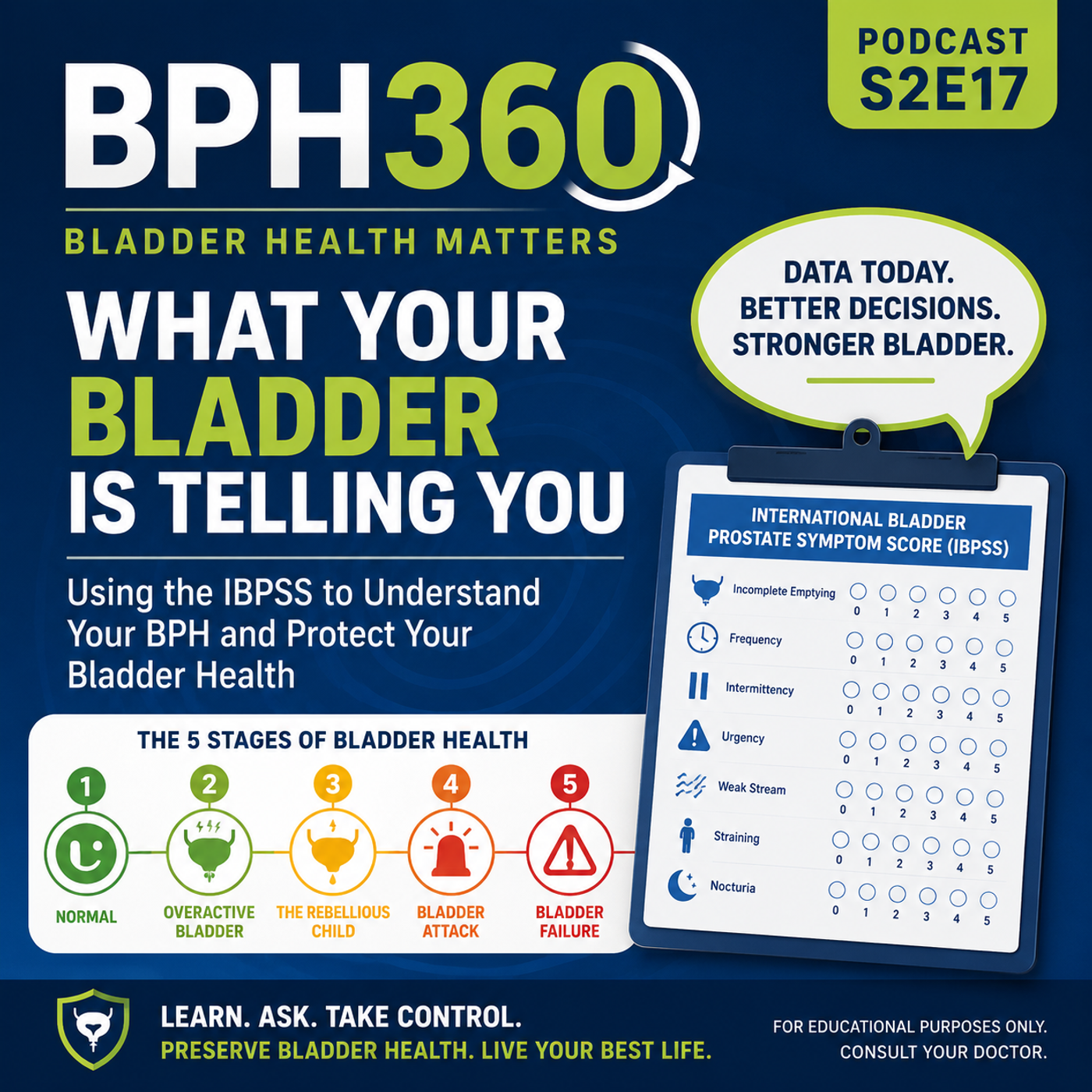
BPH360 · Man vs Prostate
In this episode of BPH360, Dr. Wayne Kuang walks you through how to take the IBPSS — the International Bladder-Prostate Symptom Score — on ManvsProstate.com. The IBPSS is designed to help you better understand your urinary symptoms, organize them by bladder health stage, and bring clearer information to your doctor. It is not a diagnosis. It is not a treatment plan. It is a communication tool to help your bladder have a voice in the conversation. You’ll learn how the IBPSS builds on the traditional IPSS by keeping the same validated symptom and quality-of-life scoring, while reorganizing the questions into a bladder-centric framework: Stage 1: Weak stream, straining, intermittency, and incomplete emptying Stage 2: Urgency, frequency, and nocturia Stage 3: Urgency urinary incontinence or leakage Stage 4: Acute urinary retention requiring a catheter Sex Span: Erection and/or ejaculation concerns that may be part of your BPH journey Dr. Kuang also explains how to read your IBPSS report, what mild, moderate, and severe scores may suggest, and why a score alone cannot tell the whole story. A symptom score cannot measure your urine flow, residual urine, prostate size, prostate shape, bladder wall changes, or bladder muscle strength. But it can help you start the right conversation earlier. The goal is simple: don’t just ask, “How do I pee better?” Ask: “What about my bladder?” >> proudP Phone App: Measure How Fast You Pee!! In this episode: 00:00 Why bladder symptoms matter 00:25 Welcome to BPH360 00:46 How to access the IBPSS 04:30 The Five Stages of Bladder Health 07:30 Stage 1: Voiding symptoms 10:00 Stage 2: Overactive bladder symptoms 11:45 Stage 3: Leakage and urgency incontinence 13:00 Stage 4: Retention and catheter risk 14:00 Quality of life and sexual health questions 15:33 proudP disclosure and urine flow data 16:46 How to read your IBPSS results 21:00 What the IBPSS can and cannot tell you 24:00 Why your bladder deserves a seat at the table Access the IBPSS and free Five Stages of Bladder Health ebook: ManvsProstate.com Educational purposes only. This video is not medical advice, diagnosis, or treatment. Always consult your doctor or qualified healthcare professional about your own symptoms and medical care. Disclosure: Man vs Prostate has partnered with proudP, a smartphone-based app that helps measure maximum urine flow rate from home. If you use referral code MVPWK, there may be a partnership benefit to the Man vs Prostate campaign. This does not affect your price or change the educational message. proudP is currently available in North America. #BPH #BladderHealth #IBPSS #ManVsProstate #BPH360 #ProstateHealth #MensHealth #UrinarySymptoms #Nocturia #OveractiveBladder
Wayne Kuang: Thanks for watching. If bladder health matters to you, watch more. Follow BPH360 to stay ahead of your symptoms. Listen on Spotify and Apple podcasts. Let's pause Man verse Prostate has with proudP a smartphone-based app that helps you measure your flow rate of urine from the comfort of your home. Welcome to BPH360, bladder health matters. I'm Wayne Kuang Cleveland Clinic trained urologist. BPH is not just prostate enlargement. It's about protecting your bladder. Learn to ask better questions, take control. For education only, not medical advice. For your care, consult your doctor. Thanks for checking out this part two to actually take the IBPSS and get your data to start having better dialogue and conversations with your doctor. If you missed part one, check out the previous episode. Now let's tackle your BPH and see what your bladder has to say about it with your IBPSS. To support the campaign, enter the referral code MVPWK. On the home page you'll see that hamburger menu sign. ⁓ And if you click there, to profile and then enter the referral code ⁓ MVPWK. ⁓ proudP is one such tool that may help you measure your flow and change the conversation with your doctor because now you're coming in empowered with data. Note, if you access proudP through Manverse Prostate, there may be a partnership benefit to this campaign. Welcome back as we now explore the IBPSS, a tool that you can use to help you better understand about what's going on with your bladder and what stage of disease you may be in with your BPH. This does not affect the price you pay, it does not change the medical education. Our message remains the same. Use data to make better bladder health decisions. proudP is available in North America. When you first arrive on the site, you will first see this disclaimer. Please remember that this information is not medical advice and that you should consult your healthcare provider. We are actively looking for similar partners to bring such screening tools to other regions of the world. This really matters. Remember there is always diagnostic uncertainty when it comes to your urination. There are so many factors, from your brain to your bladder, to your prostate to your pelvic floor. The mission is not to promote one single app. The mission is to help you get your data earlier before it is too late. While we will be talking about the IBPSS as a communication tool for you and your doctor, remember that the IBPSS is not a replacement for your doctor. It is not a diagnosis, it is not a treatment plan, it is simply a communication tool. As you see here, we can go ahead and click I agree to the disclaimer. It will now take you to the home page. When you arrive on the homepage, you'll see that you can sign up for the Man vs. Prostate Tribe. And together, let's share this message about preserving bladder health for all men so they can live the best version of their lives in continence-free and catheter-free. You also will be able to get a free copy of ⁓ ebook, Five Stages of Bladder Health, that actually started this whole campaign back in 2021-2022. Going up into the upper left hand corner, you will see the menu. If you click that, there's lots of great information here. You can see a lot of the presentations that we've made to professional societies both here and abroad, South America and Europe. You can see many interviews that we've had, more information about our podcasts, You can see the publications that we have had in peer reviewed journals and see some of the testimonials that we've been hearing about the work that we're doing together. Please note you will see that the IBPSS has now been translated in more than ten languages. As of this recording, it's actually now in fifteen languages, with the most recent being from Armenia. This is important because BPH is not just a problem only in English speaking parts of the world. It is a global problem. Men all over the world are living with slow flow urgency, getting up at night to pass their urine leakage retention in the fear that their bladder may be getting worse and may not recover if you intervene too late. Going to the upper left hand corner, you'll see that there's a menu. If you click on that, as we talked about, the very first selection is going to be bladder health screening. Go ahead and click on it now and it'll take you to this page. This is our bladder health screening page. It's important that you take the first step. Obtain good data for good decision making with your doctor. And it really starts by simply clicking right here. You'll see here, check your bladder health now. Because yes, it is important that you get the data so that you don't wait until it is too late and before there's the onset of damage or before the damage is actually permanent. So let's go ahead and join the fight to save more bladders. and click this area that says clicking here. Actually, before diving straight into the digital format for doing the IBPSS, let's remember what we're trying to do is we're trying to capture the stages, the five stages of bladder health. Where are you in this possible story of progression? Are you in stage two where things are having issues with an overactive bladder, urgency, frequency, getting up in the middle of the night? Or are you starting to get to stage three, the rebellious child, where the bladder is squeezing without your permission, causing you to leak on yourself when you can't get to the bathroom in time? Or have you now gotten to the point of stage four? Just like the heart can have a heart attack, the bladder can suddenly stop working and you show up in the emergency room needing a catheter placed up to the bladder to drain the urine. Or are you now getting to stage five, just like the heart? can go into heart failure, the bladder can go into bladder failure, and now you may need a catheter in your life for the rest of your life. And remember, unlike the heart that can be transplanted, the bladder cannot. You only get one of those, so let's take care of it. As a result, what we're trying to do is use this online website to recreate what we know on paper. Remember that now in the title, we're including the word bladder, so it's always part of the conversation with you and your doctor. Then we've taken these academically validated questions and we've simply reordered them. So now you have a sense of stage one, stage two. As you start filling this out, you're gonna get a sense of where you are because if you're scoring high. For the voiding symptoms, how well you empty, is your flow slowing down? Are you having to wait a while before you can actually start the flow? ⁓ Or is the flow starting stopping? Those are all signs that the donut hole is getting too tight ⁓ and things are slowing down. Or are you starting to high with those symptoms of an overactive bladder? Urgency, frequency, getting up at night to pass your urine. But what's new in the evolution of thinking at man versus prostate? It's let's now see if guys are entering into stage three, where you're starting to leak down your leg, whether it's drops or maybe squirts, because you can't get to the bathroom in time, stage three, or potentially even stage four, where you now have had a history where you have gone to the emergency room because you could not empty your bladder, because you could not pee or pass your urine. anymore and needed a catheter in a crisis situation. Now let's take a quick look and we'll dive in a little bit more on the online version right now. What we've done is just simply recreated the paper form of the IBPSS onto a digital format so that you can then print it out, screenshot it, and take it to your doctor. when we click ⁓ right here that page about bladder health screening, it'll now take you to the IBPSS. Let's zoom in real fast so you guys can have a better sense of that. And what we see once again, this is really about allowing your bladder to speak up about how it is doing. So here on the digital format for the IBPS, yes, it is about protecting your bladder, and that's why we put the word bladder in the title of this form. Then there's going to be some just basic information, your age, your country of origin, who's completing the form. As we talked about, it's all about the structure. This is not just a random list of urinary complaints. It is designed to help you tell your bladder story. Yes, it is subtle, but it's very powerful. It will start off with the traditional questions from the academically validated IPSS. These questions are unchanged. The symptom score is still the same, and the quality of life score is identical. But now the questions are organized so you and your doctor can start to see the patterns emerge, see those patterns more clearly, allowing you both to self-ignite by pinpointing by yourself where you might be now in the present and where you could end up in the future. You'll first see here that these are questions about your voiding subscore consistent with stage one, where the donut hole is getting too tight, things are slowing down. So, first over the past month, looking at questions of stage one. Is that prostate getting bigger? Is the donut hole constricting and getting too tight? You'll see the first question is a weak stream. For all of these questions, You'll see that the options are going to be not at all, less than one time in five, less than half the time, about half the time, more than half the time, or almost always. So for question one, a weak stream. How often have you had a weak urinary stream? The next question here is intermittency. That's the starting and stopping. How often have you found you stopped and started again several times? Then question three, straining. How often have you had to push or strain to begin urination? Then question four incomplete emptying. How often have you had the sensation of not emptying your bladder completely after you finish urinating? As you start to answer these first four questions, if you're scoring towards the right, those are all indicators that your donut hole may be getting too tight because things are slowing down. These questions all suggest that you're developing an obstruction, you're developing a blockage of the bladder. Next up are going to be questions about stage two overactive bladder. Once again you'll see the options are identical to the previous four questions, with options ranging from not at all all the way over to almost always. With question five being about urgency, how often have you found it difficult to postpone urination? Question six frequency. How often have you had to urinate again less than two hours after you finished urinating? Then question seven Nocturia How many times did you most typically get up to urinate from the time you went to bed at night until the time you got up in the morning? For those questions of stage two, overactive bladder, urgency, frequency, getting up at night to pass your urine, nocturia, these are all symptoms. For those questions of stage two, overactive bladder, urgency, frequency, getting up at night to pass your urine, nocturia, these are all symptoms. That talk about how your bladder is doing when it's trying to hold its urine. That talk about how your bladder is doing when it's trying to hold its urine. These questions are critical because they start to help you ask, is your bladder starting to struggle? Is your bladder becoming overactive? Is your bladder sending warning signals? These questions are critical because they start to help you ask, is your bladder starting to struggle? Is your bladder becoming overactive? Is your bladder sending warning signals? And now this is where the IB PSS really shines. Stage three, leaking urine. Question eight, have you ever leaked urine or wet a pad after feeling a sudden need to urinate? This question really matters because leakage can be a major tipping point, a major threshold for men to self-ignite. Where you have stopped trusting your bladder. It is so critical that we have this question out in front of everybody because too many men hide in the shadows and they're not willing to admit that they're having problems with leakage, having to wear pads, having to stuff tissue paper or Kleenex or towels into their underwear in order not to stain their pants. Too many men are too embarrassed to admit that they've stopped going out or seeing friends. Or being social because it's too embarrassing, too emasculating to admit that you're having leakage problems. Then the form takes you to stage four, acute urinary retention. That's where there's the sudden inability to pass your urine. Question nine, have you ever been unable to urinate and needed a catheter to drain your bladder? This question matters because retention is not just an inconvenience. Retention can be a moment when BPH stops being annoying and truly becomes dangerous. After the question about retention, you'll see that the academic question about the quality of life has been left intact. Question 10, if you were to spend the rest of your life with a urinary condition just the way it is now, how would you feel about that? The options here are delighted, pleased, mostly satisfied, mixed, mostly dissatisfied, unhappy, and terrible. And honestly answer this. How are your urination symptoms affecting your quality of life? With that, share that with your provider so you guys can have a honest dialogue about the data you may need to figure out what are the management strategies to help you live the best version of your life. Then it is very important that we added this question about sexual health. Too many men are being affected by their urination and it's having an impact on their sexual vitality. So question eleven right here, in the last month have you had ejaculation and or erection problems? It was important for man versus prostate to have the topic of sexual vitality out in the open. At some point in your journey with BPH, and it does not necessarily have to happen at the first visit. It can actually happen later on once you get some data in about the trifecta, prostate size, prostate shape, bladder function. And as you're starting to choose certain management strategies, you will have to factor in the impact on your sexual health. And that's why right here, question 11, we just want to get a baseline assessment, also put it out on the table in the last month. Have you had ejaculation and or erection problems? Remember, BPH is not just about protecting your bladder, preserving your bladder span, the number of years lived with optimal bladder health, but it's also about your sex span, your confidence, intimacy, and living your best life. And then at the end are just some miscellaneous questions. We just want to know are you taking any medications for your bladder and or your prostate? Have you had any surgeries for your BPH and are you taking any supplements or phytotherapy? So you now have filled out the IBPSS. And if you simply click down here at the bottom show my results, it will take you to a report page. That you can now take to your provider, your doctor, and it looks like this. So this is how I would hope that you can use this report. Do not simply fill it out and diagnose yourself. Do not fill it out and panic. Please don't assume one number tells the complete story. Fill it out and simply bring it to your clinician. As you can see here at the very top, it'll say your result. It will have tabulated your scores, added everything up, and using academically validated criteria, And giving you an assessment of your symptoms as mild, moderate, or severe. as you can see here in the sample one, I had filled it in, it gave it a score of twelve, and that is moderate. in severity and next it reports how you evaluated the impact on the quality of your life. Here it says mixed. So you can show that to your provider and they can see it as well. Then for this sample patient, they marked yes for stage three and stage four. Yes, they reported a history that they had leakage in the past, and actually they even once had to go to the emergency room because they couldn't pee at all and they needed a catheter. And you can see that here you marked yes to questions related to stage three andor stage four. These responses may reflect changes in bladder health that your doctor could find useful to know. Please share your results with your healthcare provider. Who can determine if further evaluation is needed? Yes, get your data. Better data drives better decision making. Then here, your score indicates moderate symptoms. Consider seeking medical help. You and your doctor may want a diagnostic evaluation with a bladder health baseline to understand your prostate size, prostate shape, and bladder function, the trifecta, to help you make the best decision to prevent late stage disease. Remember, regardless of the score, if symptoms are bothersome, please notify your doctor. Then at the bottom you'll see how they use the academically validated scale as an interpretation. A score of 0 to 7 mild symptoms, 8 to 19 moderate symptoms, 20 to 35 severe symptoms. And at the bottom, please print the screen or print this page and take this to your provider. And remember, this survey is not medical advice. Always seek guidance from your healthcare provider. What you will see here, which is part of the man versus prostate triangle of triage, which we will talk about in future episodes. When we just look at the IBPSS alone, for our men, when that score is eight and above, it is time to have a conversation about whether to pursue diagnostics to get an assessment of prostate size, prostate shape, and bladder health. Now that you have your IBPSS, now that you have used it to allow your bladder to give voice to its struggles and how it is doing. You can now take this to your doctor and say, Hey, this is my pattern. These are my symptoms. This is what has changed in my life. This is what I may have been under reporting. And most importantly Doc, what does this say about my bladder ? That is the whole point. The IBPSS makes the invisible visible. Your bladder now has a seat at the table of shared decision making. And now that your bladder has a voice your conversation with your doctor can get very real and can really start to change. here is a practical takeaway. Remember, please don't use the IBPSS to diagnose yourself. Use it to prepare yourself. Use it to tell a clear story with your doctor. ⁓ Use it to notice in your life in your urination. ⁓ Use it to ask questions. If your symptoms are mostly in stage one, the weak stream, straining, intermittency, and incomplete emptying, ask yourself, you know, is my bladder span already shrinking because that donut hole is getting tight and I'm developing a blockage or an obstruction of my bladder? If you are showing signs of urgency frequency getting up at night to pass your urine nocturia, ask yourself, am I now in stage two the overactive bladder? And if you have leaked urine, whether it's drops or squirt. Ask yourself, have I already arrived into stage three, urgency incontinence, the rebellious child, and does that mean my bladder is struggling more than I realized? And if you have needed a catheter because you couldn't pass your urine at all. Please ask, am I at risk for more advanced bladder damage? And if you are having erection and or ejaculation problems, recognize that there can be a link between how poorly you are urinating and its negative impact on your sexual health, your sex span. All of these are not small questions. These are questions that you can ask of your doctor to move the conversation from simply symptom management to really bladder preservation, optimizing your bladder span, the number of years lived with optimal bladder health. Yes, this is the future of BPH care. It's not just asking how do we make you pee or urinate a little better, but it's asking how do we protect your bladder for the next 10, 20, 30, 40 years. This is what the IBPSS is designed to support a better conversation, a better framework, a better pathway. The IBPSS is not perfect. No questionnaire is A symptom score cannot tell everything. It cannot measure your urine flow. It cannot measure how much urine is left behind. It cannot show the shape of your prostate. It cannot show you the condition of your bladder muscle. Remember those trabeculations and thickening. that we see over here, if you remember from previous episodes, all of those lines of a bladder that's struggling. It can also not show you if your bladder muscle is becoming weak And it cannot replace having a camera placed on the inside to see the bladder, to see its condition, and that's called a cystoscopy. And we will talk about that in future episodes. It can also not replace even more advanced testing But what the IBPSS really does is it helps you start the right conversation earlier on. And sometimes that is what changes the pathway, the trajectory that you're taking as you do a course correction to a better version of your life. Remember, when a man says I have prostate symptoms or I think my prostate's the problem, the conversation can stay too small. But when a man says, I have a weak stream urgency leakage and I once needed a catheter. I think I'm in stage four already. That conversation changes immediately. It's absolutely different. This is no longer a nuisance story. This now becomes a bladder risk story. And that is the story we all need to hear earlier. It is the story you need to share with your doctor. And it comes down to that simple question, what about my bladder? The IBPSS is not meant to replace clinical judgment. It's not meant to replace testing. It's not meant to replace your urologist or your primary care provider. It is meant to help you and your docs speak the same language. Because BPH is not just a prostate disease, it is a prostate bladder pathway, a story about a victim and a villain, a story of your life now and your life in the future. And when you ignore your bladder, men can drift silently from obstruction to urgency, from urgency to leakage, from leakage to retention, from retention to bladder failure. The bladder is precious, the bladder is not transplantable, and the bladder deserves to be part of the score. You need to prioritize maximizing your bladder span, your bladder health. Go to manverseprostate dot com to learn more. Register for the free five stages of bladder health ebook and access the IB PSS questionnaire. Then bring that conversation to your own doctor. Let them hear what your bladder is saying about if it needs help. And if this episode really helped you, please share it with a man who thinks urinary symptoms are just a normal part of aging. And before your next visit, ask one simple question, what about my bladder?