
BPH360 · Man vs Prostate
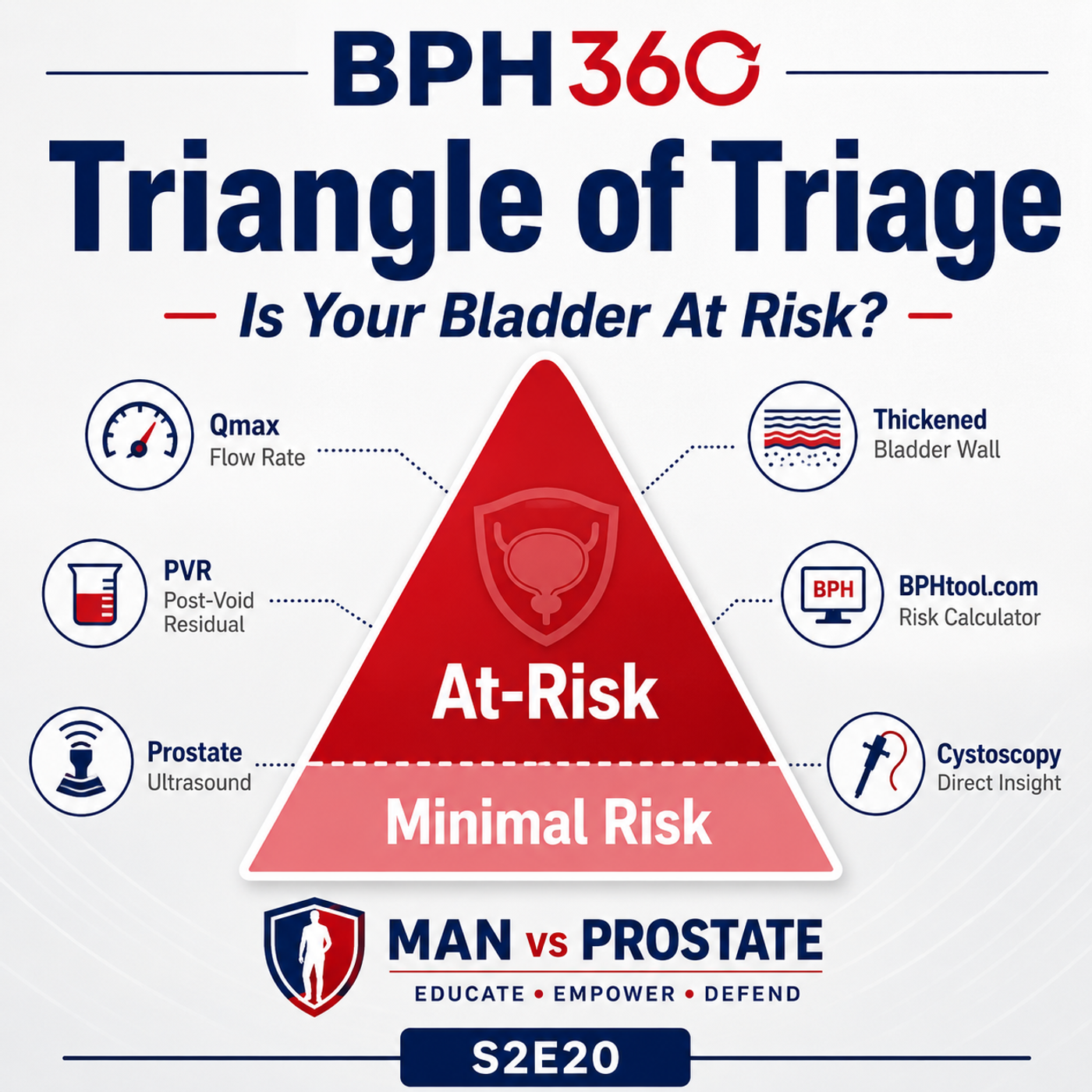
Your urinary symptoms may tell you that something is wrong, but they do not always tell you what is wrong. A slow stream could come from a tight prostate, a weak bladder, or other causes. Urgency could come from obstruction, overactive bladder, or more than one problem at the same time. You may even feel better on medication while your bladder continues working harder behind the scenes. Measure your Urine Flow with proudP: https://proudp-soundable.app.link/w5rhpKoU7Wb In this episode of BPH360, Dr. Wayne Kuang recaps the major Man vs Prostate concepts introduced so far and introduces the Triangle of Triage — a bladder-first framework designed to help answer one essential question: Is your bladder at risk? This episode connects: Why the bladder cannot simply be transplanted Why symptoms are only the beginning Why BPH/BPO can become progressive The role of the detrusor bladder muscle BladderSpan and the Window of Curability The Five Stages of Bladder Health Why observation is not always biologically neutral How data can help guide better bladder and prostate decisions The Triangle of Triage brings together what you feel — symptoms, leakage, retention, bladder-health stage — with what can be measured, including urine flow, postvoid residual, bladder wall changes, prostate size and shape, and overall risk patterns. This episode begins a six-part diagnostic series. The mission is not more testing for everyone. The mission is the right data, for the right person, for the right prostate, for the right bladder, at the right time — within the Window of Curability. Ask your clinician: What about my bladder? Is my bladder at risk? Do I need a bladder health baseline? proudP Disclosure Man vs Prostate has partnered with proudP, a smartphone-based app that can help you measure your maximum urine flow rate from home. To support the campaign, enter referral code MVPWK in the proudP app. If you access proudP through Man vs Prostate, there may be a partnership benefit to this campaign. This does not affect the price you pay and does not change the medical education. proudP is currently available in North America. Man vs Prostate is actively looking for similar partners to support men in other regions of the world. Chapters 00:00 Symptoms are only the beginning 01:33 Welcome to BPH360 01:54 Defenders of the Detrusor 03:15 Medications help symptoms but do not measure bladder health 04:15 The bladder cannot simply be transplanted 05:00 Why male urinary symptoms are complex 07:20 The Man vs Prostate battle plan 08:30 Prostate size, shape, and detrusor function 09:50 Shared Decision-Making 3.0 11:00 What is BladderSpan? 12:00 BPH/BPO as a progressive disease 13:00 Window of Curability 13:58 proudP partnership disclosure 15:14 Five clinical bladder experiences 16:00 Five Stages of Bladder Health 18:05 Consequences of inaction 20:20 Introducing the Triangle of Triage 22:00 Roadmap for Episodes 21–26 24:00 Three key takeaways Disclaimer This video is for general...
Wayne Kuang: Thanks for watching. If bladder health matters to you, watch more. Follow BPH360 to stay ahead of your symptoms. Listen on Spotify and Apple podcasts. Let's pause Man verse Prostate has with proudP a smartphone-based app that helps you measure your flow rate of urine from the comfort of your home. Welcome to BPH360, bladder health matters. I'm Wayne Kuang Cleveland Clinic trained urologist. BPH is not just prostate enlargement. It's about protecting your bladder. Learn to ask better questions, take control. For education only, not medical advice. For your care, consult your doctor. To support the campaign, enter the referral code MVPWK. On the home page you'll see that hamburger menu sign. ⁓ And if you click there, to profile and then enter the referral code ⁓ MVPWK. ⁓ If you've been living with urinary symptoms, proudP is one such tool that may help you measure your flow and help you change the conversation that you're having with your doctor because now you're coming in empowered with data. Note, if you access proudP through Manverse Prostate, there may be a partnership benefit to this campaign. This does not affect the price you pay, it does not change the medical education. Our message remains the same. Use data to make better bladder health decisions. proudP is available in North America. We are actively looking for similar partners to bring such screening tools to other regions of the world. The mission is not to promote one single app. The mission is to help you get your data earlier before it is too late. Your urinary symptoms may tell us that something is wrong, but that do not always tell us what is wrong. A slow stream could come from a tight prostate or a weak bladder or from a multitude of other causes. Urgency could come from obstruction or from an overactive bladder. You may even feel better on medication while your bladder continues working harder and harder behind the scenes. That is why symptoms are only the beginning. Today we connect everything that we've been talking about and learned about and introduce the Triangle of Triage, a framework designed to help answer one essential question, is your bladder at risk? This episode is a recap, but it's also an inflection point, a turning point Until now, we have focused on why your bladder matters, why urinary symptoms should not simply be normalized. Why BPH can become more than an inconvenience? and why delaying action may eventually lead to leakage, retention, or a bladder that can no longer empty properly. Now we begin to ask a more practical question. How do we move from awareness to action? How do we decide who may be safely observed, who may continue medication, who needs more information, And whose bladder may deserve a more formal bladder health baseline before another long term management decision is made. That is the purpose behind the triangle of triage. As we dive in, you all are ready to take your understanding to another level. I want to share with you the slides that I actually share with urologists around the world when I'm giving my talks, whether it's in Portugal or Italy or South America, we all need to come together, whether it's you or physicians or your brothers and your fathers, we all need to begin to understand at a higher level what's going on because so much is at stake with your bladder. When I introduce this message to urologists, I begin with a simple challenge, which is we are much more than just drug prescribing doctors. We are, or at least we should aspire to be what we call defenders of the detruser. The detruser is that muscle in the wall of your bladder. It is able to relax, to allow your bladder to fill, but it's also able to contract to push that urine through that prostate donut hole and out of your body. Our mandates are very clear. First is to preserve and to protect bladder health, And the second is to prevent late stage disease, the stage three leakage, stage four retention where you can't pee, stage five where the bladder starts to fail. Medications have an important role. They may help relax the prostate. They may shrink part of the prostate over time. They may calm urgency or frequency. They may improve your quality of life. But medication often treats the experience of the disease. It does not always define the underlying cause and it does not directly measure the health or the strength of your bladder. That is why the purpose of medication should not simply be to delay the next decision indefinitely. Medication may temporize symptoms while you and your clinician determine whether your bladder is safe. or whether more information is needed. Along with the brain, the bladder is one of the major organs for which routine transplantation is not currently an option. When the bladder becomes severely damaged, we cannot simply replace it with another functioning bladder. We may manage the consequences, we may use catheters. We may create alternative drainage. We may perform reconstructive surgeries, but prevention remains far better than trying to manage advanced failure. So we must take care of the one single bladder that we do have. The challenge is that male lower urinary tract symptoms are very complex. Now, this slide that I show urologists, we show MLUTs, male lower urinary tract symptoms are down here. And you'll see that there are multiple factors that contribute to this problem of where you're having symptoms. Now, very importantly, the bladder, its health. its disease, its dysfunction plays a very central part in your symptoms. And that is the challenge that we all faced. How do we use data plus your symptoms to begin to decipher how all of these causes contribute to bladder dysfunction, which then contributes to your symptoms? But it's so complex that actually there are causes that directly impact your symptoms. skipping your bladder. As you can see, it's really complex, so it's something that requires a little bit of effort, especially with some diagnostics as we put together the data with your symptoms. So yes, you may be experiencing the slow flow, the intermittency, urgency, frequency, getting up at night, even leakage. But these symptoms do not come with an associated diagnosis. So yes, a constricting prostate may be responsible, But we must be ever vigilant of other causes like aging, neurologic dysfunction, pelvic floor dysfunction, metabolic disease, stricture, as well as so many other causes. This complexity creates diagnostic uncertainty and When uncertainty is meaningful and significant, the answer should not be to automatically default men to more medications, for example. The answer may be better data. The man verse prostate battle plan for all defenders of the detroiser, the muscle of your bladder begins with an evaluation. That evaluation has three major responsibilities counseling, triage, as well as obtaining a bladder health baseline when the bladder appears to be at risk. Counseling helps you understand the disease and your choices. Triage helps determine your level of risk. A bladder health baseline provides objective information that may help guide what happens next. After evaluation, we can all make a more informed management strategy plan. And when a procedure is being considered, that choice is often influenced by the man verse prostate trifecta, where we are factoring in prostate shape, prostate size, as well as detruser function or bladder function. Prostate size matters, but it's not the only factor. It does not tell us how that prostate is shaped or how tightly it affects the donut hole constriction of your prostate. A prostate can grow upward, it can grow inward, it can grow at an angle. There's so many different variants that need to be factor in to see how the shape in addition to the size are contributing to the blockage and how is it affecting the bladder health, the detruser function. And bladder health, bladder function does matter because just simply opening the prostate channel or that donut hole does not automatically guarantee that a severely weakened bladder will suddenly heal and recover fully. This information is then factored in at the table of shared decision making as we see here SDM three point zero. Version 1.0 took place between you and your urologist or your primary care provider. Then there was version 2.0, which acknowledged that healthcare systems influence decisions, whether it's based on insurance coverage, whether it's available technology, the costs, local expertise, as well as access to care. Then version three point ⁓ where the bladder is allowed to have a seat at the table of shared decision making as an equal stakeholder Remember, it cannot speak, it cannot tell us, I am working too hard, I'm struggling, I'm beginning to weaken, I am storing urine under abnormal conditions. Or I may not be able to recover if you wait too long. That is why diagnostics serve as the bladder's translator. They help communicate its condition, preferences, and needs before management choices are finalized at this table of shared decision making three point zero. This brings us to bladder span. We often talk about lifespan, the number of years lived. We also talk about health span, the years lived in optimal health. Manver's prostate submits another measure, bladder span, the number of years lived with optimal bladder health, detruser health. These are years when bladder health supports your freedom to sleep, to work, to exercise, to travel, maintain intimacy, and live without constantly planning your life around bathrooms, pads, or even catheters. The purpose of BPH care or PBO care, right? Prostatic bladder obstruction should not be limited to making today's symptoms slightly more tolerable or livable. The purpose should be protecting your bladder health so that you can have a brighter future. And live the best version of your life. That matters because PBO or prostatic bladder obstruction BPH is progressive. As that prostate donut hole grows tighter and tighter, the bladder must work harder and harder to push that urine through the donut hole. At first the bladder can compensate. Pressures in the bladder begin to rise as the muscle is squeezing harder. And the muscles begin to thicken as you can see here. You see these lines in the bladder, even really severely here on the far right. Yes, the bladder is able to generate more force, but compensation is not the same as good health. Over time, structural changes to your bladder start to appear. It's not just these thickened muscle fibers that we call trabeculations, but it's also this pitting. You see these divots, we call those cellules, and if they get very big, we call them diverticuli. These findings can become visible evidence of the underlying cellular disorder and remodeling that's occurring within the wall of your bladder. And we see that here down below, where initially things look very organized and smooth and symmetric. But as this disease of PBO prostatic bladder obstruction progresses, we see that the cells start getting more and more disordered. And dysfunctional. The bladder may be able to endure this for several years, but it cannot necessarily endure it for the rest of your life. The concept of a window of curability is backed up by data. You all are ready for this data, so let's jump in. This is a study from 2020 looking at 50,000 tests on bladders in men. The top part of this graph is showing how hard is your bladder working. As men are getting older, as we can see along this bottom part of the graph, which is measures from age 20 up to age 100, as expected, we see as the men's donut holes are getting tighter and tighter, the flow is slowing down. So we see this line decreasing. As a result, the bladder muscle has to work harder. And if we look at this upper part of the graph, remember this is the pressure, the force that your bladder has to generate to squeeze and push urine through the donut hole. We see that as men get older, that pressure is rising. And we call that compensation. But we actually see here a very important detail. starting at around the age of 62, ⁓ we that the bladders begin to fail and decompensate ⁓ as bladder loses its ability to sustain that amount of work. This creates the concept of a breaking point. Obviously it's not gonna happen for every man at age sixty two because we all have different bladders, different prostate sizes, different shapes, and it's not gonna happen on one exact birthday or at not one universal moment. But for most men there is a transition from compensation to decompensation. The time before damage becomes advanced or irreversible is what we call this window of curability. And that's in red right here. That window raises the central question how do we intervene at the right time, not too early, but also not too late, but while the bladder still has the greatest opportunity to recover and remain functional for the rest of your life. The progression of bladder dysfunction can be difficult to explain, so we begin with five clinical experiences. It is more than the annoyance of slow flow, it is the anxiety of urgency, frequency, the exhaustion of nocturia, the shame of leaking down your pants, the terror of retention, as well as the despair and anguish of a bladder that can no longer emptying, requiring a lifetime of catheters. The man versus prostate, five stages of bladder health, gives us that shared language for us to be able to communicate the progressive nature of this disease. Remember, the heart is a muscle that pumps blood, the bladder is a muscle that pumps urine through that prostate. The prostate starts off about the size of a golf ball, but in the shape of a donut. As you get older, that prostate's getting bigger and that donut hole is getting tighter. As a result, stage one, things slow down. The bladder muscle has to work harder and it begins to struggle and then it becomes overactive, causing an overactive bladder urgency, frequency nocturia. If we don't take care of it, the bladder can actually act out like a rebellious child, squeeze without your permission, causing you to leak out urine. Then if you really don't take care of it, just like the heart can have a heart attack, the bladder can suddenly stop working and you show up in the emergency room needing a catheter because you can't empty your own bladder. And then stage five, just like the heart can go into heart failure, the bladder can go into bladder failure. And now you're looking at a lifetime of potentially catheters. This framework is intentionally oversimplified. Stages do not always follow a perfect order. Stages can be skipped, stages can coexist. And symptoms do not always match the severity of the underlying obstruction. and dysfunction, but the framework here teaches us one essential truth. This disease can progress from simply inconvenience to serious bladder dysfunction. And our priority should be to prevent you from entering needlessly into these later stages of disease. Long term studies have helped support this, and I don't mean to overwhelm you here, but I think you're ready to look at some data at a deeper level. In this classic study, they actually followed 141 men who had proven blockage from their prostate donut hole getting too tight. And they followed them for many years. In fact, some of them were followed for almost a quarter century. On average, they were followed for about 14 years. As expected, you'll see these numbers in the right side here. The flow decreased of the urine from ten point three to nine point three, which we would expect. We also see that the bladder's ability to squeeze is also on the decline. It went from a hundred and thirty-four down to one hundred twenty-six. But the real ramifications were that stage two detruser overactivity was increasing from 30 to 61, increased by 100%. Then if we look at stage three urgency urinary incontinence, we see that that increased by 50%. And more alarming is now we see that seven men had entered into stage four retention. They could not pee, they could not pass their urine when there were none. At the start of the study This does not mean that everyone who chooses to be observed will deteriorate. But it does mean that simply observing is not always biologically neutral or benign. Your bladder may continue changing while everyone is watching your symptoms. This leads us to the question at the very center of this whole episode, which is how do we identify the bladders that may be at risk for progressing into these later stages as we see right here? That's why we all choose data. This triangle of triage brings together two different kinds of information. First is what you are experiencing, your symptoms, your bladder health stage, your episodes of leakage or your episodes of retention. And second, it brings together what we can measure or observe, your urine flow, the amount of urine left behind, the appearance of your bladder wall, the size and shape of your prostate, and the overall risk pattern that's created when we put all of this information together. At the broad base of the triangle are these bladders that appear to be at relatively minimal risk. As concerning findings begin to accumulate, you move toward the at-risk portion of this triangle right here. This triangle is not a diagnosis, it is not a treatment mandate. It is not a substitute for clinical judgment. It is a conceptual triage framework. The purpose is to determine whether symptoms alone may be enough for the current decision or whether you may need a more complete bladder health baseline, which we see here on the far right in blue. You will see here are several measurements that we're using to help identify at-risk bladders. Today I am not going to explain each individual number or threshold in detail. That is what is gonna come next over the next six episodes. We will examine each part of the triangle. First, there's Q max, the maximum speed of your urine flow. Why it matters, what can make it low? And why man vs prostate believes this may be the next vital sign for men to assess their bladder health. Next we have the post void residual or PVR That is measuring how much urine remains in your bladder after you believe you have actually finished urinating. Then there is the thickened bladder wall, A potential sign that your bladder has been struggling and working harder in remodeling under stress. Then we will explore newer technology online called bphtool.com This is software where multiple measurements of your bladder and your prostate can be put together to estimate your overall risk pattern. Then if your urologist is using the very prevalent IPSS, we know that if that score is eight or above, that is something that requires more investigation. The same thing applies to the man versus prostate IBPSS, the International Bladder and Prostate Symptom Score, where the numeric system is the same. So once again, if it's eight and above, that needs to be investigated more. as well as whether you are reporting on the IBPSS if you may be in stage three for urgency incontinence or even stage four where you have reported a history of retention. Then, if you meet any of these criteria in isolation or in combination, that would then trigger a bladder health baseline with a minimum of a camera to take a look on the inside, which we call a cystoscopy. That's when we are looking directly at your prostate channel, the donut hole, as well as looking at your bladder, That may shed light on what's going on, especially when there's always the complexity of your symptoms, there's always diagnostic uncertainty. And we need to make sure we assess for not just your prostate donut hole or the shape and the size, but also are there other diagnoses going on, bladder cancer, bladder tumors, bladder stones, or even scar tissue, and more importantly, what is the condition of your bladder health? Each episode will answer one part of the larger question, but the triangle of triage where those answers eventually all come together. Its purpose is to identify when more information may significantly improve the decisions about which management strategies you should pursue. The right data for the right person, for the right prostate, for the right bladder at the right time within that window of curability can all be achieved with the triangle of triage. Here are three ideas to remember. First, your symptoms begin the evaluation, but they do not complete it. Second, is that your bladder deserves a seat at the table of shared decision making as an equal stakeholder? And third, the triangle of triage helps organize your symptoms and the objective data to determine whether or not your bladder may be at risk. Before choosing another medication, another year of observation, or even a prostate procedure, please ask, what about my bladder?