
BPH360 · Man vs Prostate
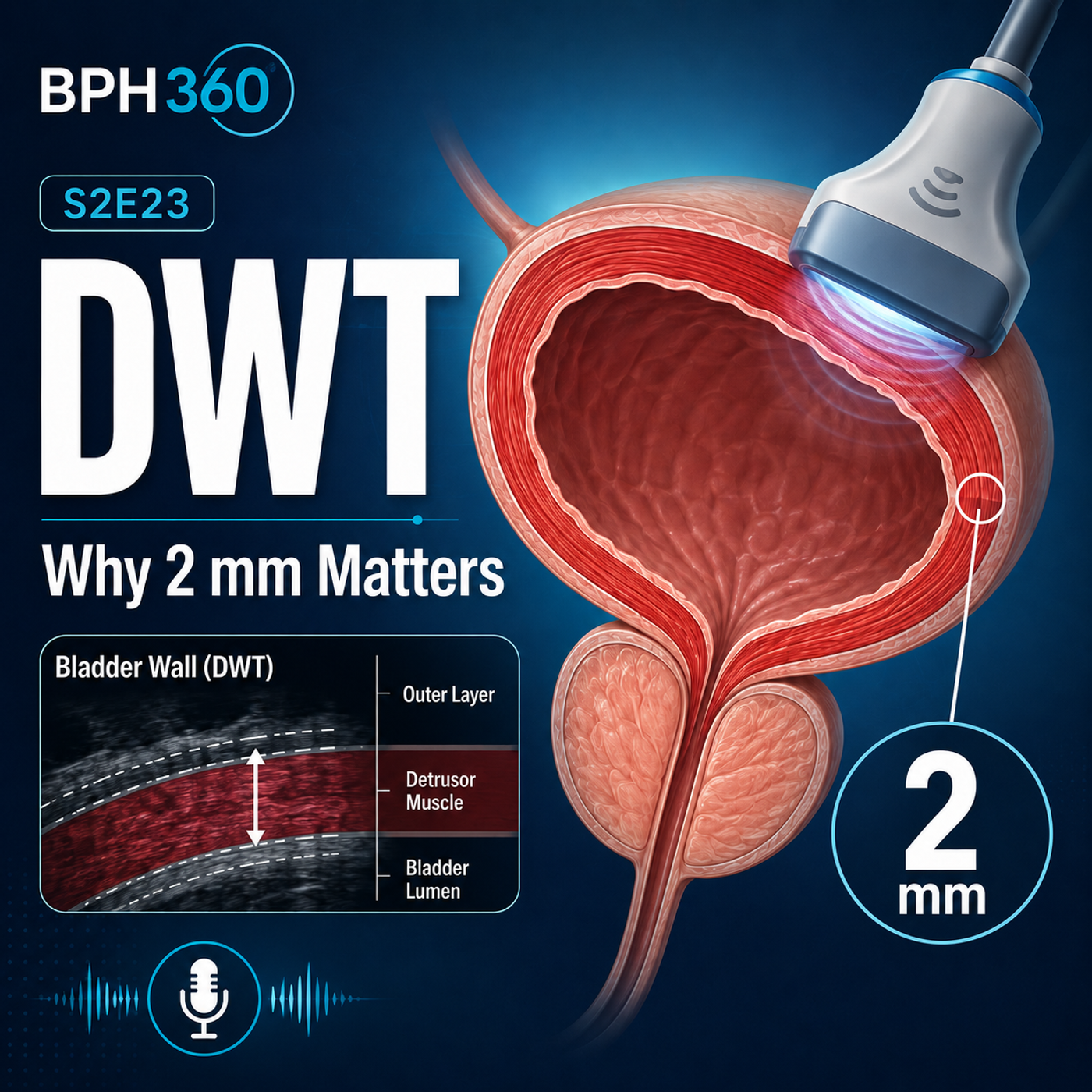
What if your bladder could show signs that it has been working too hard? In this episode of BPH360, Dr. Wayne Kuang explores Detrusor Wall Thickness (DWT)—an ultrasound measurement that may provide another objective clue about bladder stress and possible prostate-related obstruction. Measure Your Urine Flow Rate Qmax: https://proudp-soundable.app.link/w5rhpKoU7Wb Learn more:https://www.manvsprostate.com/ 00:00 Video Opener 00:28 Intro 00:49 Opener 01:35 DWT: Detrusor Wall Thickness 02:49 Ultrasound Image of the Bladder Wall 06:25 Understanding Sensitivity and Specificity 06:56 How Good Is the 2mm Signal? 09:30 Mid-Roll 10:30 What Is a “Normal” DWT in Healthy Men? 12:55 The Importance of Detrusor Wall Thickness 14:01 The 2mm Threshold Holds Up to Testing 15:32 Thick Bladders Are Common in Men with BPH 18:21 DWT Performs Well Against Other Tests 20:26 The Triangle of Triage for Bladder Health and DWT 22:37 “2 Millimeters” Is Not a Diagnosis 23:09 Takeaways 24:02 Outro Your bladder is not simply a bag that stores urine. It is a muscular pump. The detrusor muscle must squeeze urine through the prostate, and when it repeatedly pushes against resistance over years or decades, that muscle can remodel and become thicker. One number to remember: 2 millimeters. Research discussed in this episode has repeatedly examined DWT ≥2 mm as a potential signal of bladder outlet obstruction. Studies have reported sensitivity around 79–83% and specificity around 89–93%. But this distinction is critical: 2 mm is NOT a diagnosis. It is a clue. Dr. Kuang reviews: • What the detrusor muscle is and why it matters • How DWT can be measured with abdominal ultrasound • Why bladder filling affects DWT measurements • The evidence behind the 2 mm threshold • Why DWT cannot diagnose obstruction by itself • How ultrasound could become a scalable bladder-health tool worldwide • How DWT fits into the Man vs Prostate® Triangle of Triage Think of your bladder-health data as clues: IBPSS ≥8 → Your symptoms alone justify a bladder conversation Qmax → Another signal PVR >100 mL → Another signal DWT ≥2 mm → Potentially another signal You do NOT need all four findings to be abnormal before asking questions. As more objective clues begin telling the same story, there may be more reason to discuss whether additional evaluation is appropriate. The question is not simply: “How big is my prostate?” Ask instead: “What does my bladder look like?” #WhatAboutMyBladder ▶ Learn more about the Man vs Prostate® campaign and bladder-health tools at ManVsProstate.com. 📱 proudP: A smartphone-based option for measuring maximum urinary flow rate (Qmax) from home. Referral code: MVPWK. Currently available in North America. ✋ This content is for general education only and is not medical advice, diagnosis, or treatment. Discuss your individual condition with a qualified healthcare professional. ✋ This video is not sponsored. Some links may be affiliate links, meaning the campaign may...
Wayne Kuang: section thumbnail. Check, check, check, check, check, check, check, check, check, check, check, check, check, check, check, check, check, check, check, check, check, check, check, ladder with a ruler. Check, members only bonus. Why measuring bladder thickness is trickier than you think? you will see that when it comes to measuring the bladder, it's actually a little bit more complex than we would imagine. Here is the bladder, and you can actually see this is a model obviously, but the bladder wall goes from all the way from the lining of the bladder, the urethelium right here, that light pink, if you guys can see that. And it goes all the way through to the outside and actually on top of the bladder there's often going to be some fat on top of this and that is the bladder wall thickness which is different from the detrusor wall thickness which is actually the red muscle looking appearing meat of the bladder right there. So this part right here. They are not the same thing. The detrusor is specifically that muscular layer that I just showed you of the bladder wall, the pump that is actually responsible for allowing that bladder to squeeze that urine out. on ultrasound as you can see here the detrusor is the darker layer sitting in between a brighter inner layer which was that pink line I was showing you on the model that's called the lining of the bladder or the urethelium that's actually touching the urine and then there's going to be another brighter outer line that you can see right here and that's going to be on the very outside of the bladder wall and everything in between is going to be the muscular part of the bladder called the detrusor. When we measure all three of those layers, the white line, the darker band in between, and that inner white line, that is the bladder wall thickness. But when we are just focusing on the muscular layer of the bladder, the detrusor, it's just going to be this black band right here that we are measuring. The distinction matters because the research thresholds are not interchangeable. And when we think about the bladder, there's one other factor that we must consider, and that is how full is the bladder when it is being measured. Think about when we blow up a balloon. So here's a balloon. Actually, it's just a covering for an ultrasound probe when we're looking at the prostate. But you know that when the balloon is empty like this, its walls are going to be thicker. But then as it's going to fill and stretch, its walls are actually going to get thinner. And we can see that if I bring that up close here, and you can see that now, this is the... At this point, the balloon is thin and the walls look thicker. You can't see through it. But as I start to fill that bladder or fill this balloon, you can start seeing that it's getting thinner and thinner. I'm going to restart that segment where I start stretching the... As you can see here, Here's that balloon. Right now, you can't see through it. It looks rather thick. But as that bladder fills, the wall of the balloon or the bladder begins to get thinner and thinner. And you start to be able to see through it a little bit. You can start to see my finger through that. And that's the same thing that's happening to the Jatruzer wall, that as it fills, obviously, the thickness will be reduced. we can see here in this paper done by Ockel and associates out of Europe where they really looked at the bladder and specifically the bladder wall and detrusor wall thickness in detail. they were able to study healthy men and found that as the bladder was filling, They were able to study the bladder in healthy men as we can see here. And what they found was that the detrusor wall thickness was getting thinner and thinner during the first 150. during the first 250 milliliters of bladder filling. Then at around that threshold beyond that 250 milliliter mark, the thickness remained the same, which is actually pretty fascinating about the bladder. It's able to stretch and the bladder wall thins out, but after a certain threshold of 250, it actually remains pretty stable. And what they found was the Four. And what they found was that when a healthy man's bladder had at least 250 milliliters in it, the bladder wall, specifically the detrusor wall thickness, was approximately 1.4 millimeters. And you can see this line right here. and it goes out to 1.4 millimeters on this Y axis. Importantly, these volunteers were young adults ages between 15 and 40 so that 1.4 millimeters should not be treated as a universal number that's normal for every man, including especially older men. That means if somebody tells you, my bladder is 2.1 millimeters, the next question should be, well, how was it measured? Then was it actually the bladder wall thickness or the detrusor wall thickness? How full was the bladder? What ultrasound probe or technology or technique was used? And where was the measurement taken? delete those last two questions. Remember, the two millimeter threshold that we've been talking about is merely a clue. It is not a diagnosis. The greater value comes when you combine it with other measurements as well as the symptom score on the IBPSS. The true value of the two millimeter threshold that we've been talking about and teaching about is when you start to combine it with other measurements like the Q max, maximum flow rate or the post void residual PVR, that's the amount of urine left behind and especially the IBPSS, the International Bladder Prostate Symptom Score. And as we've been talking about when that score is eight and above, that is reason enough to start having a question. to start having a dialogue that starts with the question, what about my bladder? Section, clinician aside. Dear colleagues, I just wanted to clarify that the literature repeatedly supports an association between increased detrusor wall thickness and bladder outlet obstruction. As you remember, that detrusor wall thickness is going to be all that pink muscle. We're able to now measure that with an ultrasound. but one of its limitations is the variability in measurement methodology. Bladder volume, ultrasound frequency, image magnification, measurement location, operator technique, and the distinction between bladder wall thickness, which is that full thickness from even the fat on top of the detrusor all the way through the urethelium, all of those things begin to become variables that will affect the interpretation. That's why at Manvriss prostate it's important to us to emphasize both adequate bladder filling at the time of ultrasound, at least 250 milliliters in the use of high frequency imaging because clinically meaningful differences can be fractions of a millimeter. Yes, the 2mm threshold should therefore function as an adjunctive or triage signal, not as a replacement for more elevated diagnostics such as cystoscopy or even things like multi-channel aerodynamics. section 45 to 60 second trailer. You probably know something about your prostate. Maybe you know your PSA. Maybe you know how big your prostate is. But here's something you probably don't know. How thick is your bladder muscle? your bladder is a pump. And if that pump has been working overtime against resistance year after year, one decade, two decades, that muscle itself can begin to change. One ultrasound measurement called the detrusor wall thickness, as we all know, right, the detrusor is the muscle of the bladder or DWT may give us another clue. And across decades of research, one number keeps reappearing, about two millimeters. And across decades of research, one number keeps appearing, two millimeters. but it is not a diagnosis. Two millimeters does not automatically mean you have prostate obstruction, that the pipe is getting backed up. two millimeters does not automatically mean that you have a prostate obstruction. Today I'll show you what this number Today, I'll show you what this number actually means, why your bladder needs to be full when it is measured, and where DWT, detruser wall thickness, fits beside your IBPSS, Qmax, and PVR in that triangle of triage. Because the question isn't only, about my prostate? It's actually, what about my bladder? section cold open. You may know the size of your prostate. You may know your PSA, but you may not even know. You may even know your urinary symptom score, but here's a number that almost nobody knows about. but here's a number that almost nobody talks about. How thick is your muscle in your bladder? because your muscle is not just simply a bag holding urine. Your bladder is a muscular pump. And if that pump has been pushing against resistance for years or decades, that muscle itself may begin to change. And today we're going to talk about another objective bladder health measurement. And that's going to be DWT, your detrusor wall thickness. And as you remember, detrusor is the name of this red muscle right here. And there is one number I want you to remember, and that is two millimeters. Section intro, section segment one, the bladder is a pump. Let's start with something simple. The bladder, as you know, has a muscle in it and that muscle is called the detrusor. When you urinate, that detrusor squeezes and that's your pump and allows you to get your urine out. and it allows you to get your urine out through that prostate that starts off about the size of a golf ball and the shape of a donut, and it has to push that urine through the donut hole. And as we have talked about multiple times, as that prostate gets bigger, that donut hole... And as we've talked about, as that prostate grows bigger, that donut hole is going to grow tighter. So now that detrusor muscle, the bladder, is having to squeeze harder against resistance from that tight donut hole over years and decades. So what can happen when that muscle repeatedly is having to work so hard? Well, it can change. It can become thicker. And over time that bladder wall can undergo a lot of complicated remodeling. involving muscle and the connective tissue that surrounds it. That's why I don't want you to only think about how big is my prostate. I want you to start also thinking about how hard has my bladder been working over these past years to push urine through my prostate. And that is a bladder first approach. And that is a bladder first question that we need to answer. Section segment two, Ocals show me the bladder muscle. This is the first paper that I'd like to show you out of Europe by Okel et al. in the European Neurology Journal from 2007. And let's look at figure two in detail. What they've been able to do is begin to study what does the bladder look like when we take an ultrasound probe, just like the ones we use when we look at the baby in a pregnant woman. We're able to take a ultrasound probe just like this, handheld, place this on the abdomen, and actually begin to start looking into the bladder and begin to see the bladder wall, and specifically the detrusor wall thickness, which we're going to talk about right now. These are actual images of the bladder wall taken in patients. And if we look at the arrows in these images, what they're showing is that there's an brighter line on the outside, and that's often like some fat that sits on top of the detrusor muscle, as well another brighter line. And there is another brighter line on the inside, which is basically this lining that we're seeing inside the bladder. And that's called the urethelium. in the darker layer on... and the darker layer in between is going to be the detrusor muscle. And that's what we want to measure, the thickness of that muscle. This figure makes it easy for us to begin to interpret the meaning of the detrusor wall thickness. In the bottom left hand corner, you're going to see the ultrasound of a man without obstruction. And when they measure the thickness of the detrusor wall, this patch of darkness here in between those two bright lines, they're able to see that it's less than that two millimeter number that we want you to remember. In this image, it actually measures 1.7 to 1.8 millimeters, which is less than that 2 millimeter threshold. Then in the remainder of the image, you're going to see in the upper left, progressively men with worsening obstruction, as well as progressively increasing thickness to their detrusor wall. So in the upper left, we're seeing now the thickness progress to greater than two millimeters. So this measures 2.4 millimeters. And then if we go back down to the bottom right, Now we're seeing the thickness of the wall get to 3.0. Now as we go to the bottom right, the detrusor wall thickness, that dark patch and band, is now measuring 3.1 millimeters and then even 6.1 millimeters here in the upper right. Once again, three parts of this figure were all men who were obstructed. All of them had detrusor wall thicknesses, this black patch or band that is greater than two millimeters. Now let's go to table three, where they summarize that they looked at about 160 men and used advanced diagnostics to determine. redo this table three section since I was not sharing the right image. Now let's go to table three where they summarize the study. They looked at 160 men and used advanced diagnostics to determine who actually had bladder outlet obstruction. The pipe was being blocked off. The men who were not obstructed here on this left side, they had on average a detrusor wall thickness of 1.4 millimeters, and you can see that right here. For the men who were obstructed, the average thickness was actually 2.2 millimeters. Once again, we're seeing that threshold of 2 millimeters come up again. In fact, if you looked at all the men who were obstructed, their level of thickness was between 2 millimeters and 2.7 millimeters. And for the men who were obstructed, you can see that on average the thickness of their detrusor wall, the DWT, was 2.2 millimeters. And it ranged from two up to 2.7 millimeters for the men who were obstructed. That's important because now we can begin to see where the idea of approximately two millimeters comes. That's important because now we can begin to see where this critical number of two millimeters comes from. The investigators actually used that cutoff at the Detrusor wall thickness of two or greater millimeters as their cutoff for a positive test to help predict who might be at risk for obstruction. Interestingly, detrusor wall thickness at that cutoff performed actually better for identifying obstruction in this study as compared to other measurements that we've actually talked about in the past, such as the Q max and post-void residual or even prostate volume. So our first lesson is simply. 2 millimeters may be an important signal. Remember, it's not a diagnosis. It is only a signal. Section Segment 3. How good was the two millimeter signal? Now let's see if other researchers were able to see. Now let's see if other researchers were able to find something similar. In this article in 2013, in the African Journal of Urology, they studied 50 men. who all had urinary symptoms and compared several non-invasive tests against multiple advanced diagnostics. They studied 50 men with urinary symptoms and began to compare several non-invasive tests versus. They studied 50 men with urinary symptoms and began to look at several non-invasive tests to see. They studied 50 men with urinary symptoms. 23 of them had proven blockage in the piping system, right? They studied 50 men with urinary symptoms and they found 23 of them had proven blockage. at the level of the bladder and they use that detrusor wall thickness threshold of two or greater millimeters. They studied 50 men with urinary symptoms and looked at detrusor wall thickness and compared it against other non-invasive tests. In this group of men, 23 had proven obstruction. Once again, they were going to use that threshold of the detrusor wall thickness being 2 millimeters or more as the threshold for being abnormal. and they were pleased to find that the truser wall thickness, DWT here, had what was a... Heck yeah! And they were pleased to find that the detrusor wall thickness, DWT, right here, had a 83 % sensitivity and a 93 % specificity and 91 % positive predictive value. Wow, those terms definitely sound complicated. They're not. Let's translate them so you understand the importance of these numbers. the sensitivity of 83%, that's where if we take all the men who really had obstruction, how many were we able to catch using that DWT threshold of two millimeters or more? Well, it was about 8 out of 10. That's pretty good. More precisely, for this study, was 19 of the 23 obstructed men who had a positive test with that detrusor wall thickness being 2 millimeters or more. then the specificity, 93%. Now, if we take all of the men who did not have obstruction, how many did the test correctly identify as being negative, as not being obstructed? And that was about nine out of 10, which is really nice as well. Nine out of ten. Nice. then the positive predictive value, 91 % right here. That's where if the DWT was two millimeters or more on the ultrasound study, how often did that man actually turn out to be obstructed? And again, about nine out of 10, specifically 19 of the 21 men with a positive DWT test were obstructed. While those numbers are impressive, they are not 100%. ⁓ why I don't want you walking away. And that's why I do not want you walking away saying, hey, my DWT is 2.1, therefore I have prostate obstruction. The correct conclusion is that's another objective finding, another signal that tells me that I may need to ask more questions and start a dialogue about my bladder. The correct conclusion is that's another objective finding, an objective signal that I should understand a little bit better. Section Segment 4. What does normal look like? Now we need to look at the opposite question. If two millimeters or more is concerning, what does a healthy bladder muscle actually look like? Okol and colleagues also studied healthy adult volunteers in this study. 55 healthy adults ages 15 to 40. And they discovered that the amount of urine in the bladder matters when you measure the DWT. During the first approximately 250 milliliters of bladder filling, the detrusor wall gets thinner as the bladder stretches. So on this bottom horizontal X axis of this graph, you'll see it goes from zero to 945 milliliters. That's the amount of volume in the bladder at the time of the ultrasound. And we can see that here's the number zero and here's that number of 250 that we're talking about. And as that bladder is being filled up to about 250 milliliters, we can see on the y-axis this vertical line here, that's the detrusor wall thickness. It starts off thicker And then as that bladder fills up to about 250 milliliters, it's actually thinning out and then beyond 250 milliliters as we move out to the right, it remains stable in its thickness. move the word in its thickness. And that makes sense. If we take a balloon, actually this is a... condom actually for our ultrasound probe. But as you can see here, here when it is not filled up here, the thickness and the wall of the And that makes sense. As we look at this balloon, actually it's a condom covering for the prostate ultrasound probe that we use, it will be suffice here if we take that and we take a look at that. thickness of this balloon. And you can see you can't really see my finger behind it because the wall of this is relatively thick. But then as it fills up and expands we're going to start seeing that thickness of the wall begin to thin out and we can now see... ⁓ there you go you can see my finger now right there. You can see it through the thickness of that bladder or... balloon wall because now it's thinning out as we stretch it out. And that makes sense. we take a look at this balloon, it's actually a condom for the prostate ultrasound probe that we'll use, but it will be suffice. You can see right here, it's relatively thick. You can't really see ⁓ through it very well. But as we begin to allow it to fill up, if it was a bladder, the bladder wall begins to thin out and we can now really start to see it thin, as well as my finger clearly through that. So returning to this graph, that first part of this graph makes sense, right? As we see this bladder fill up to about 250 cc's or milliliters, that wall thickness of the bladder is beginning to thin out. What's really neat about the bladder, it's just an amazing organ. mean, that's why it's not routinely transplantable. It has so many features that make it so special. At above 250 milliliters, the thickness of the bladder remains stable. And as you can see on this graph, if we take this and move it across to the x-axis, we see that for this man, thickness here was 1.4 millimeters. And in this group of 25 men, the average thickness for their detrusor wall thickness, when the bladder was filled at or above 250 milliliters, their DWT was 1.2 to 1.6 millimeters. But there is an important qualification. These are all younger, healthy men. So please don't turn 1.4 millimeters into some universal normal value for every 70-year-old man who's having issues with urinary symptoms. What this study really gives us are two lessons. One is that... healthy bladders with healthy bladder muscle can be substantially. healthy bladder muscles can be. healthy bladder muscle thickness can substantially be below 2 millimeters. And secondly, we all need to pay attention to how full the bladder is when we take those measurements. Section Segment 5. This wasn't just one research group. Fast forward to 2019, suavely and coggly. Swavley and colleagues published a review of newer diagnostic tools being investigated for male urinary symptoms. DWT detruser wall thickness was one of them. They looked at a previous systematic review containing eight different studies that looked at DWT. Different investigators had used thresholds ranging from two millimeters to six millimeters. But here's what caught all of our eyes is when we look at Dachshund wall thickness and we look at all of these different groups from around the world who looked at DWT, five out of these eight use the threshold of two millimeters. and their group analysis reported approximately 83 % sensitivity and 93 % specificity. And remember, that's how well does the test capture all of those men who are obstructed and how well does the test capture all And once again, that means how well did the test capture all of the men who were obstructed, as well as how well did the test confirm the men? And that's how well... and that is how well did the test find all the men who were obstructed and how well did the test confirm that those who were negative And that is, how well did that test correctly find all of the men who were truly obstructed, as well as how well did the test correctly show those men who are not obstructed to be not obstructed. and it was pretty good. Eight out of 10 for the former and nine out of 10 for the latter. And so their work places detrusor wall thickness using an ultrasound alongside other emerging non-invasive tests for investigating bladder outlet obstruction. And now we're seeing that this is not just from a single isolated study, but now we're seeing a pattern begin to emerge as we're seeing similar findings from various groups when they look at that threshold of two millimeters or more. Section segment six. Why this could matter around the Now I want to take you to another study, specifically from the African continent, from the country of Nigeria. where they also looked at ultrasound to measure detrusor wall thickness. Now I want to take you to another study from the African continent from the country of Nigeria. they evaluated 110 men with clinical BPH using ultrasound to look at things like DWT to choose their wall thickness. Their average prostate volume was large, about 94 milliliters, and their average DWT was 5.9 millimeters. they found a statistically significant positive relationship between the size of the prostate and the DWT detrusor wall thickness. And I want to make an important distinction. This is not the same type of study we saw previously where they were looking at the diagnostic accuracy of DWT because in this study they did not use advanced therapeutics and diagnostics in every single man to prove who was and who was not obstructed. What they were able to show was that a thickened detrusor wall in elevated DWT was extremely common in the population of men with urinary symptoms with clinical BPH. For this study, we see that in this group of men, 90 % of them, this group right here, all had detrusor wall thickness, DWT, of greater than two millimeters. What their study was able to show is that thickened detrusor walls, DWT, was extremely common in this population of men with urinary symptoms with clinical BPH. Only 10 % had detrusor wall thickness, DWT. in this range marked zero to two. Impressively. See how some of these men had DWTs as thick as 15 to 17 millimeters. The bulk actually had thicknesses between three and eight millimeters. Far greater than that threshold of two millimeters that we've been talking about. The bigger reason that I want to share this paper with you is that ultrasound technology is widely available throughout the world in both lower and higher income healthcare systems. And the author specifically point out that DWT can be obtained from the surface of your abdomen, from your belly. We can use ultrasound just like we look at a fetus in a pregnant woman. we can do the same thing to actually look at the bladder and specifically at the detrusor wall thickness. And these authors describe it as a relatively cost-effective technology without meaningful and these authors describe it as a relatively cost-effective technology. and these authors point out that it is a relatively cost-effective technology and that matters. It matters because if we are serious about preserving bladder health globally, our tools cannot be dependent on expensive or highly invasive technologies. Sometimes there may already be valuable information just sitting right there available to most countries throughout the world on an ultrasound machine. We just need to choose to look at it. We just have to choose to look for that piece of data. Section segment seven. putting it all together. Now let's finish the evidence story with our largest study. Cheng et al. in 2022 did a meta-analysis and that's where they're looking at multiple studies with multiple technologies and trying to make some bigger conclusions that we all can benefit. Chang et al. Chang. Chung et al in 2022 did a meta-analysis and that's a fancy way of trying to look at all the existing data from all of the studies to make some impactful conclusions that we all can learn from and apply to our healthcare systems. And so here they looked at the diagnostic of value. Here they looked at the diagnostic value of non-invasive methods for diagnosing obstruction in men with symptoms. Instead of asking, you know, what happens in a small group of men, 50 men, 100 men, they reviewed 51 studies involving 7,897 patients. they compared multiple non-invasive approaches to detecting whether or not there was obstruction in these men. And across all of the DWT studies included in their pooled. and across all of the DWT studies included in their analysis. They found the sensitivity to be 71 % and the specificity to be 88%. And the area under the curve was 0.87. And yeah, that's a mouthful, but let's break that down again. delete the part across all of the studies. And when they- and when they looked at all of the DWT studies. using our familiar two millimeters or more threshold, this is what they found. with some fancy graphing, they found the sensitivity to be almost 80 % and the specificity to be... and with some advanced mathematics and specialized graphing, let's dive a little deeper to see what they found. As we dive a little deeper, we can see here down below, below these fancy graphs that here the top line is the DWT. And they found that the sensitivity was 79%. They found that at that threshold, the sensitivity was 79 % and the specificity was 89%. Let's translate that just one more time. With that two millimeter threshold, DWT identified roughly eight out of 10 men who actually had obstruction and correctly identified roughly nine out of 10. Let's translate that one last time. With that 2 millimeter threshold, DWT identified roughly 8 out of the 10 men who actually had obstruction and correctly identified roughly 9 out of 10 men who did not. That is enough performance to make DBO. That is enough performance to make DWT interesting. It is not enough performance to make DWT the entire diagnosis. And that distinction is critical. It is one more measurement that we need to take into factor. It is one more measurement that we need to factor in. It is one more signal that we add to the equation as we look at the IBPSS 8 and above alone or in conjunction with other signals like the Qmax, PVR, and the DWT. Section mid-roll, section segment eight. Now put DWT into the triangle triage. This is the most important part of today's episode. I do not want you walking away believing that you need four abnormal tests before you're allowed to worry about your bladder. You don't. Let's start at the beginning. an IBPSS of eight and above already means that your urinary symptoms are already in the... an IBPSS of eight and above alone means your urinary symptoms are already in the moderate to severe range. And that alone is enough reason to ask, what about my bladder? You do not need to wait for another abnormality to start that conversation. But now suppose you start layering on these different signals, more information. Your Q max is less than 15. That's another signal. Your PVR is now over 100 milliliters. That's the amount of urine left behind after you have thought that you have emptied your bladder. That's another signal. And now inappropriately performed ultrasound adds one more signal and that's the DWT, the detrusor wall thickness, using a threshold that we've been talking about today of two millimeters or more. using a threshold of two millimeters. Think about these as being clues. One arrow, one clue. Think of all of these pieces of data as clues. One clue points toward possible bladder trouble is enough to get your attention. Two clues is telling you, it needs more attention. And three or maybe even four clues is now telling you that the... And now three or four clues is lowering the threshold even further. for taking your evaluation to the next level. And that's what the triangle of triages designed to do. It is not, you know, pass three tests and now you have obstruction. It is. When should you and your physician stop treating this as simply a symptom problem and start asking more questions, have more dialogue about your bladder? and in the mannverse prostate pathway, these findings can help trigger a discussion about establishing what we see here in the upper right corner, which is a bladder health baseline, starting with a minimum of a camera called a cystoscopy, being one of those diagnostic tools that we will need to discuss further at future episodes. Section Segment 9. section segment nine. One thing I want you to remember. If you remember nothing else from this episode, remember this, two millimeters is not a diagnosis. 2 millimeters is not a diagnosis. It's a clue. Your symptoms are a clue. Your flow is a clue. Your residual urine, that PVR, is a clue. And now your bladder wall, your detrusor wall thickness, the DWT is yet another clue. And as you begin to gather more of these clues that seem to be telling the same story, the harder it will become to keep. And as you acquire more of these clues that are all telling a similar story, well, it is... And the more that those clues begin telling the same story, the harder it is to justify ignoring your bladder. segment. 10. Conclusions. So the next time somebody talks to you about BPH and tells you how big your prostate is, ask one more question. What does my bladder look like? If your IBPSS is 8 or higher, you already have a reason to start a conversation. And if your Q max, PVR, or DWT, detrusor wall thickness, are also abnormal. And if your Q-Max PVR or DWT detrusor wall thickness are also abnormal, you have even more reason to understand what's going on. And if your Q-Max, PVR, or DWT, the truser wall thickness, are also abnormal, you have even more reason to understand what is happening. And in the next part of this diagnostic journey, we're going to keep moving deeper into that triangle of triage and eventually into cystoscopy, that camera, where we can actually take a look inside the bladder and the prostatic urethra. because yes, your prostate matters, but the organ that we are ultimately trying to save and preserve is your bladder. Remember to ask, hashtag, what about my bladder?