
BPH360 · Man vs Prostate
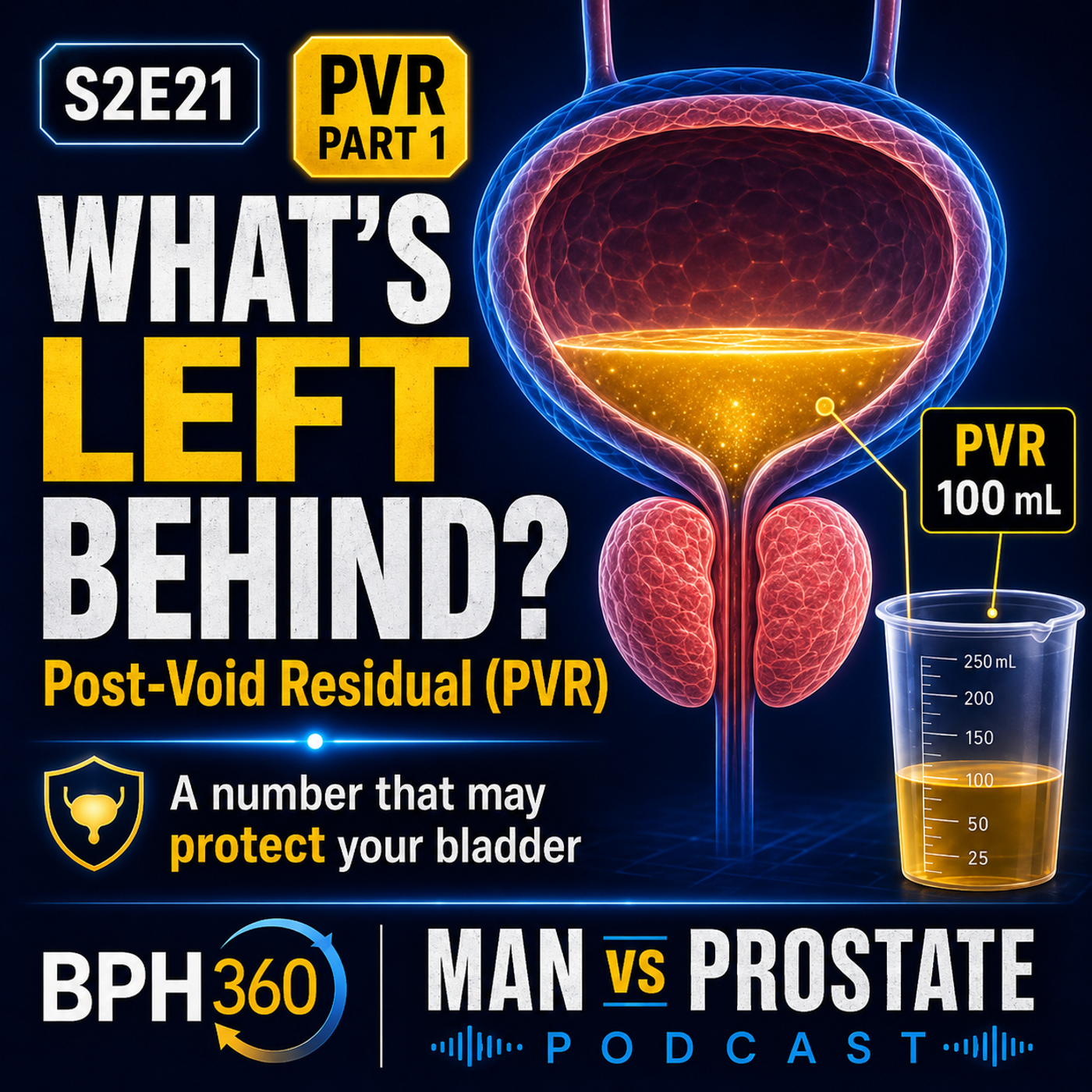
What BPH disease stage are you? www.manvsprostate.com/ibpss : Measure Your Urine Flow Rate Qmax: https://proudp-soundable.app.link/w5rhpKoU7Wb When you finish urinating, how do you know your bladder is actually empty? You may feel finished—but you could still have 100, 300, or even more milliliters of urine left behind without realizing it. That amount is called your post-void residual, or PVR. In this episode of BPH360, Dr. Wayne Kuang explains why PVR is an important bladder-health number and how it can help identify a bladder that may be struggling to empty. A high PVR does not automatically prove that your bladder is failing. It also cannot tell us by itself whether the problem is: • A tight prostate blocking the flow—the pipe problem • A weakening bladder muscle—the pump problem • A combination of both But it tells us that the question needs to be investigated. 00:00 — Opener 00:42 — Intro 01:03 — Reviewing Five Stages 05:01 — Build Your Bladder Story 09:21 — Defining a Weak Bladder 14:49 — Mid Roll 16:05 — Stage V is Underappreciated 18:25 — Multiple Causes of Stage V 22:04 — Post-Void Residual: Warning Sign 23:57 — Outro You will learn: • What post-void residual means • How PVR is measured after urination • Why you may not feel urine remaining in your bladder • Why urinary symptoms alone cannot diagnose the problem • How PVR fits with your IBPSS/IPSS and Qmax • Why an IBPSS or IPSS of 8 or greater plus a PVR over 100 mL deserves attention • The difference between an underactive bladder and detrusor underactivity • How pressure-flow urodynamic testing can help separate a pump problem from a pipe problem • Why repeated urinary retention can be a warning sign • Why prevention and earlier evaluation matter Symptoms such as slow flow, hesitancy, straining, urgency, frequency, nocturia, incomplete emptying, and leakage may occur with prostate obstruction, bladder weakness, or both. This overlap creates diagnostic uncertainty—which is why objective data matters. The Man vs Prostate® Triangle of Triage combines symptoms, measurable numbers, and warning signs that may trigger a more complete bladder-health evaluation. Ask your clinician: What is my PVR? Is it increasing? What does it tell us about my prostate and my bladder? Your bladder is a major organ that cannot be routinely transplanted. Know your numbers. Choose data over dogma. Protect your bladder before it may be too late. ManVsProstate.com Man vs Prostate® has partnered with proudP, a smartphone-based tool that can help measure maximum urinary flow rate at home. Enter referral code MVPWK in your proudP profile. A partnership benefit may support the campaign, but it does not affect the price you pay or the medical education presented. proudP is currently available in North America. Subscribe to BPH360 and listen on Spotify and Apple Podcasts. #BPH #PVR #PostVoidResidual #BladderHealth #MensHealth #Urology #EnlargedProstate #ManVsProstate #BPH360 This content is for general education...
Wayne Kuang: Thumbnail. Second thumbnail of a split screen holding a scanner. Thumbnail two scanners. Thumbnail scanner on bladder. Section members only bonus. A postvoid residual is an important piece of data, but it is not a diagnosis by itself. The post void residual, the amount left behind after you think you have emptied your bladder can change depending on how full your bladder is, whether you felt rushed, whether you were comfortable, whether you are urinating. In your usual position. Your post void residual can change depending on how full your bladder was Your postvoid residual can vary depending on how full your bladder was, whether you felt rushed, whether you felt you were comfortable, whether you urinated in your usual position, and what medications you take, or even whether you had to wait too long before urinating. Yes, your post-void residual can change depending on how full your bladder was, whether you felt rushed, whether you were comfortable, whether your urination was occurring in the usual position, what medications you might be on, or even whether you had to wait for a significant period of time between the urination and the actual measurement of your residual urine left behind in your bladder after you thought you had emptied your bladder. That means one abnormal result may need to be repeated. A residual of 110 milliliters just above that cutoff of 100 milliliters does not automatically mean your bladder is failing. Similarly, a residual of 80 milliliters, so below that 100 milliliter cutoff, does not automatically mean everything is normal. We always need context. What was your starting bladder volume? How much did you urinate? What was your maximum flow rate? Remember, Q max, which is the next vital sign, that's the maximum flow rate of your urinary stream. What is your symptom score? What are your symptoms? Are they mostly due to that tightening prostate from stage one, prostatic bladder obstruction, or is it potentially from stage two? The overactive bladder urgency, frequency, getting up in the middle of the night. Have you had infections? Have you ever entered into urinary stage four retention where you were unable to pass your urine at all? Is your bladder wall getting thickened? Are your kidneys beginning to swell? But more importantly, is the number stable? And most importantly, is your number, the post void residual, improving, staying the same or potentially getting worse over time? This is why the man vs prostate approach does not depend on one single isolated test. We use several pieces of information all put together. Your IBPSS score tells us your symptom story. Your QMAX gives us information about the speed of your urinary flow. And now your post-void residual tells us how much urine remains. Then for those who we feel are at risk for bladder dysfunction, we then trigger. Then for those men who may have bladders that are at risk for bladder dysfunction and bladder disease, for those men, we need to get bladder health baselines. We need to take the level of diagnostics up a notch, and things like a camera can be used, like a cystoscopy or even advanced computer technologies such as pressure flow, multi-channel, urodynamics, are all testing. that you may hear about from your urologist. These are all important tests because, as we all now know, the story between Because as we all now know, there is always diagnostic uncertainty when it comes to a man's bladder and prostate. One number cannot be. One number can raise concern, but a combination of numbers creates a much clearer picture. Section trailer. You may finish urinary. You may finish urinating, zip up, and walk away believing your bladder is empty. But what if 100, 200, or even 500 milliliters of urine is still trapped inside? You may still have urgency. You may still have frequency. You may still be getting up too often in the middle of the night. You may have a weak stream, and those symptoms could come from a tight prostate, an overactive bladder, a weakening bladder, or several of these problems all at the same time. That is why symptoms alone are not enough. In this episode, I will show you what a post-void residual is, how we measure it, and why an IBPSS of eight or higher combined with a residual over a hundred milliliters may trigger a bladder health baseline. In this episode, I will show you what a postvoid residual is, how we measure it, and why an IBPSS score of eight or higher combined with a residual over 100 milliliters may trigger a bladder health baseline. You only get one bladder per lifetime. Let's learn how to protect it. Section clinician aside. Dear colleagues, let us ensure that for a post void residual that we do not treat the one hundred milliliter cutoff as a universal diagnostic threshold. Dear colleagues, let us ensure that we do not treat one hundred milliliters as a universal diagnostic cutoff for a postvoid residual PVR. For man versus prostate, a postvoid residual greater than one hundred milliliters is being used as a triage threshold, not as a universal definition of detruser underactivity, chronic urinary tension, or bladder failure. There is no single accepted PVR cutoff that diagnoses detruser under activity where that bladder is beginning to fail. There is no single accepted PVR cutoff that diagnoses detruser under activity. Yes, the twenty twenty four EAU summary from the European Association of Urology states that elevated residuals may accompany detruser under activity, but no consensus diagnostic cutoff has been established. And yes, advanced pressure flow urodynamics remains the accepted method for diagnosing this condition of diagnostic. And yes, And yes, advanced pressure flow urodynamics remains the accepted method for diagnosing detruser underactivity. One of the criteria for the man versus prostate triangle of triage is an IPSS or IBPSS of eight or above plus a postvoid residual of more than a hundred milliliters. This combination identifies a subgroup that deserves additional investigation for potential obstruction, impaired emptying, bladder remodeling, or reduced contractility, as well as other possible causes of primary and or secondary bladder disease that may be contributing to your patient's symptoms. When we dive a little deeper into the EAU academic management thresholds, we are able to see with some clarity how they are distinguishing between certain thresholds for the postvoid residual. At 100 to 300 milliliters, the EAU algorithm supports behavioral recommendations. Like double voiding, pelvic floor relaxation, as well as to start the discussion about possible self-intermittent catheterization. At a persistently elevated PVR greater than three hundred milliliters or when there is upper tract damage. And a persistently at a persistently elevated PVR greater than three hundred milliliters or when upper track damage is a concern, clean intermittent catheterization is recommended as the preferred drainage method. Therefore, the threshold of a hundred milliliters should be presented as a reason to look deeper with your patient into the causes of their lower urinary tract symptoms, not as an automatic inclusion. Therefore, a hundred millimeters should be presented as a reason to look deeper, not as an automatic inclusion for catheterization, but as an automatic inclusion for a dialogue about whether to pursue further diagnostics to understand what's going on because for all men, when it comes to the prostate and the bladder, diagnostic uncertainty always exists. Section Opening Hook. When you finish urinating, how do you know your bladder is actually empty? You feel finished, the urine stops, you zip up, you walk away. But none of that proves that your bladder emptied completely. But none of that proves that your bladder emptied. You could still have one hundred milliliters of urine left behind. You could have three hundred milliliters inside. Some men are walking around with much more than that than they do Some men are walking around with much more than that and they do not even know it. Today I am going to show you how we measure the urine left behind after you urinate, why the number matters, and how it may help us detect a bladder that is beginning to struggle. That number is called your postvoid residual, your PVR. Section Intro Section Segment One Reviewing the Five Stages. In 2025, my colleagues and I published a hypothesis-generating review titled Tackling the Progression of This Disease Deobstructing Before It's Too Late within the Window of Curability. And that means can we find the right time for you and your bladder to open up that donut hole to stop that progression of disease? In twenty twenty five my colleagues and I published this hypothesis generating review. Titled Tackling the Progression of This Disease BPH PBO Prostatic Bladder Obstruction Deobstructing Within the Window of Curability. Can we find the right time for you and your bladder to intervene to prevent bladder damage or before the damage becomes permanent? This paper proposes a shift away from treating only bothersome symptoms and toward preserving bladder health while the bladder may still be recoverable. It introduces the man vs prostate five stages of bladder health as a patient-facing communication tool for you and your urologist. It introduces the Manverse Prostate Five Stages of Bladder Health as a patient-facing communication tool for you and your physician. To recap, these stages reflect five clinical scenarios that many men endure. These stages reflect five clinical scenarios that far too often men have to suffer through. Remember, your bladder is a major organ that cannot be routinely transplanted. So please, we need to take care of it. Your heart is a muscle that pumps blood, your bladder is a muscle that pumps urine through the prostate. And remember that prostate starts off about the size of a golf ball, but in the shape of a donut. So as that prostate gets bigger, that donut hole is getting tighter, causing symptoms of stage one where things are slowing down as that donut hole tightens up. So it's going to be the slower stream, hesitancy starting and stopping in the straining. Then stage two. As your bladder is having to work harder, that bladder muscle has to work harder, five years, ten years, two decades, right? It's working harder to squeeze urine through that donut hole, and as a result, it begins to quiver and struggle and becomes overactive. And we see that here in stage two, overactive bladder, where you're having symptoms of urgency frequency and getting up in the middle of the night way too often. Then if we do not take care of this problem, the bladder can start to act out like a rebellious child. It can actually squeeze without your permission and actually cause you to leak urine, sometimes a drop, sometimes a squirt, sometimes even more. Then stage four, if we really don't take care of it, just like your heart can have a heart attack, your bladder can suddenly stop working, you're showing up in the emergency room because you can no longer pass your urine and things are backing up. You're developing pressure in your lower abdomen as that urine keeps backing up. And now you need to go to the emergency room to have a catheter place to drain all that urine. Then stage five, just like how a heart can go into heart failure, the bladder can also weaken and go into bladder failure. Stage five. And at that time, you're now having to face the prospect of a lifetime of catheters. And remember, worst case scenario, the heart may be able to be transplanted, but for the bladder, it is not routinely transplanted at this time. And therefore we do need to take care of it. Please note this communication tool for these stages are not clean, distinct boxes. You do not necessarily move very neatly or cleanly from stage one to stage two, then stage three, then stage four, and finally stage five. Stages can be skipped. Stages can overlap, and multiple stages can coexist. Yes, the story of your prostate and your bladder is very complex, and that's why even the staging has its nuances. A man entering into stage five may still report stage one symptoms such as slow flow and hesitancy. Yes, a man entering stage five may still report symptoms of stage one symptoms such as slow flow and hesitancy. He may also report symptoms of stage two, urgency frequency, getting up in the middle of the night called nocturia. And that is why you cannot diagnose the stage from symptoms alone. Diagnostic uncertainty always exists. Section segment two. That is why man vs. Prostate wants you to take the time to start building your own bladder story when you're starting to have symptoms that we've talked about. Two important numbers are available at the Manverse Prostate website. The first is going to be your IBPSS score, right? You can fill this out, it'll talk about your symptoms and begin to help you see where you are in those stages. And so now you can bring that to your physician, and now you can communicate at the same level and understand a certain level of seriousness and urgency to your specific situation. More so if you actually go to the top, you can find that you can click and download an app here. For North America, we have chosen to partner with a Proud P company using a phone app, which allows us now to be able to help you listen to your urinary flow to see how fast you're urinating, and that's your Q Max. Remember, the Q Max is like your next vital sign to tell you about your. bladder health, just like you use a blood pressure check to check on your cardiovascular health. Same concepts and you can now use that with your phone. You can now bring that to your physician, your urologist, and now you can have a much more engaging conversation based on data. Please note this is for North America, but see where you are in the world, in the country, and there are multiple companies out there. Find the one that works for you and your physician, but once again, is gathering more data that you can potentially do at home and bring to the office when you have your first visit. You can also get very similar testing done in the office. Talk to your physician or urologist and see what technology is available for all of you. Reminder from Anverse Prostate, we are looking for similar partners in other parts of the world. And we would really love to work with you to spread this message of bladder health and preserving bladder span. Yes, QMAX is the next vital sign for men and their bladder health, and it provides objective information about how quickly that urine is leaving your body. But remember, Q Max does not tell us everything. When we see that the Q Max or the flow is very low, remember that we've talked about in past episodes, we cannot differentiate between whether it's a pipe problem or a pump problem. Right, the pipe problem is is the donut hole getting too tight or is it due to a pump problem where the muscle of the bladder is beginning to get too weak? We see that with stage five, and that's the topic of today's episode. And also remember that sometimes that low flow, that low Q max could actually be due to a combination of both, both the pipe and the pump having problems. So today in this episode we now add another number to the Q max, and that is how much urine remains after you finish urinating. That is your post void residual, your PVR. If you remember from a previous episode The triangle of triage from Manverse Prostate helps identify bladders that may be at risk for dysfunction. And it combines symptoms, objective data, and warning signs that may trigger a bladder health baseline. For this episode, we are focusing on one specific combination, and that is where the IBPSS or IPSS is eight or above plus the postvoid residual, the amount left behind after you urinate is more than a hundred milliliters. An IBPSS or IPSS of eight or above means you have already entered into at least the moderate symptom range. A PVR or residual above 100 milliliters means your bladder is leaving a meaningful mount. A residual over 100 milliliters means your bladder is leaving a meaningful amount of urine behind. Neither the QMAX or the PVR proves stage five by itself, but together they raise an important question. Is your bladder failing to empty because the outlet, that donut hole, is too tight, because the bladder is weakening, or is it because both problems exist together? That combination should not be ignored. It should trigger a more complete bladder health evaluation and definitely a more in-depth dialogue with your physician or urologist. Section segment three. Section segment three bladder versus detruser underactive bladder versus detruser underactivity. At Manverse Prostate, we want to educate you as best as possible with the latest from academic urology so you come in better empowered with knowledge when you're talking to your primary care provider or urologist. The International Continent Society was this academic working group that really started to dive into this concept of stage five, where the bladder is no longer functioning well enough. In fact, they gave it a term which is an Underactive bladder. An underactive bladder is defined as a slow urinary stream, hesitancy, straining to void, with or without a feeling of incomplete bladder emptying, sometimes with storage symptoms. Those storage symptoms may include urgency, frequency, nocturia, and even that incontinence that we see with stage three. Now listen to those symptoms again. Slow flow, hesitancy, straining, incomplete emptying, urgency, frequency, nocturia, even some leakage. Do those sound familiar? And they should. They overlap with stage one obstruction, they overlap with stage two obstruction, as well as stage three obstruc ⁓ These symptoms are overlapping with stage one obstruction where things are slowing down, but they're also overlapping with stage two and stage three. These symptoms are overlapping once again with stage one symptoms. Things are slowing down as that donut hole gets tight. But also with stage two and stage three symptoms, those storage symptoms of urgency frequency, as well as getting up in the middle of the night to pass your urine, as well as incontinence, leakage if you don't get to the bathroom in time. So you can see here how the stages can overlap and coexist because all of these systems Because all of these symptoms can also occur when the bladder is emptying. Because you can see how these symptoms can overlap, these stages can coexist right here. So you can see that all of these symptoms may also occur when the bladder is in stage five. The same symptoms can result from different problems. Delete this sentence the same symptoms can result from different problems. So yes, the International Continent Society is correct. All of these symptoms taken together speaks to the fact that diagnostic uncertainty always exists, especially when we get to stage five, because it could be an issue with the pipe, right? The bladder ⁓ Yes, the International Continent Society is correct. This whole constellation of symptoms is very complex and they overlap from stage to stage as multiple stages can coexist. But it's also because Yes, the International Kant Society is correct. All these symptoms together can exist in stage five. And it's because remember there's always diagnostic uncertainty. And it's unclear if things are due to a problem with the pipe or a problem with the pump or some combination of both. Now I want to take you to another level. It may be a little advanced, but I think you can handle it. There's another term. So once we trigger a bladder health baseline, because your bladder may be at risk for disease or dysfunction, we now can do more advanced testing to see if there's actual signs that that bladder is failing. And if so, we can now label it. A special term called detruser underactivity. So if you remember before, it was just simply an underactive bladder. And that was just to reflect a constellation of symptoms. But when you start to layer on quantitative data, measurable items that confirm that the bladder is no longer functioning well enough, you can now label it detruser underactivity. Detruser is the name of the bladder muscle. underactivity once again it's underperforming. So now let's look at the definition. The ICS defines detruser underactivity as a contraction. That's the ability of the muscle to squeeze, happening at reduced strength and/or duration. It's not able to squeeze as hard anymore. It's beginning to weaken. And that results in a prolonged bladder emptying. It now takes longer to empty your bladder. and or a failure to achieve complete bladder emptying, right? You're not able to get all of that urine out at an acceptable amount. and or a failure to achieve complete bladder emptying, you're not able to get an adequate amount of the urine out of your body when you're urinating. As a result, you're leaving too much urine behind. To prove detruser underactivity, to get the data to confirm that the bladder is weakening, we generally need special testing. And you may ask to see if they have it available, but it's called advanced multi channel urodynamics or pressure flow urodynamic testing. You don't need to remember all that, but I just want you to know that the technology exists out there in certain higher income healthcare systems. So it's something to at least be aware of. This testing measures How much pressure? How strongly can the bladder squeeze at the same time as seeing how fast you're able to urinate? What is your Q max? This begins to help us to differentiate between whether there's a pipe problem or a pump problem or some combination of both. When the bladder is still able to streeze When the bladder is still able to squeeze very strongly, that would mean it's able to generate high pressures, but the amount of urine coming out and the speed of the urine coming out is very slow. That is more consistent that the donut hole of the prostate's getting too tight. The piping system is getting too narrow. But if we see evidence that now the bladder muscle is starting to weaken, it can no longer generate strong pressures. It's actually stro But if we see evidence of the bladder weakening, we're going to see data where the bladder muscle is no longer able to squeeze as strongly as before. But for stage five, sometimes we're gonna start seeing that the bladder muscle can no longer squeeze as strongly as it could before. It is now getting weak. So the pressures that it can generate are much lower. And if you combine that with slower flow, that's now evidence that it's a pump problem as well. Or for stage five where the bladder is beginning to weaken and fail, we're gonna see evidence of that on this type of testing where the bladder can no longer generate sufficient pressures to squeeze urine through the prostate and as a result you're seeing slower flows as well. Now remember, that is signs of a weak pump. But now we can start to differentiate between is it a weak pump? Is it a prostate pipe that's too tight? Or is it a combination of both? Your PVR alone as a single number cannot answer the question by itself. Is it a pipe? Is it a pump problem or a combination of both? But it can tell us that this equ But it can tell us that this is a question that needs to be asked. Section segment four, stage five has been underappreciated. In 2011, academic researchers published this paper, detruser underactivity. You now know that term, right? So that's when we have quantitative measurable data to confirm that the bladder muscle is underperforming. It's underactive. Detruser underactivity. A plea for new approaches to a common bladder dysfunction. This is 2011, over a decade ago. This title says a great deal. This was a plea for attention where the authors are emphasizing that our understanding of stage five remains very limited. They called for better diagnostic definitions, better non invasive testing, better epidemiological research, better understanding of its causes and better treatments. They also noted that management remains unsatisfactory, insufficient, and that no effective medication could reliably restore bladder contraction, your bladder's ability to squeeze, your ability to have the bladder function as a healthy pump to squeeze urine out through the penis. That is exactly why stage five deserves your attention. Once your bladder loses its squeeze, its contractile function, our ability to restore it may be very limited. Sometimes we can help open up the donut hole a little bit, sometimes we can help improve the emptying, sometimes we can use catheterization, those tubes to help drain the urine when it's necessary. We can even consider similar technology to pacemakers for the heart muscle, but we can now use that for the bladder muscle called neuromodulation. Another fancy word, you don't need to remember that, but I just want you to at least have heard it once and understand that technologies like that can exist in very select cases. But currently with modern mess medicine. But currently with modern medicine we do not have one single thing, one single management strategy that can reliably rebuild your bladder muscle. That's why prevention and earlier identification of this problem between your prostate and your bladder or some combination of both is so critical. Section Midrol, Section Segment five, Why bladders become overactive. This twenty fourteen review by Osman et al. reinforces that stage five can have many causes. Remember it comes through two different names. Underactive bladder is the constellation of all those symptoms, whether it's from stage one, stage two, stage three. And then the term detruser under activity which confirms that the bladder is beginning to weaken using some advanced testing. Table two shows you how complex actually the situation is with men in their urination. For most men, a main contributor will be this back and forth between the bladder and the prostate. But in truth, sometimes there's even more factors that can all together contribute to stage five bladder failure, underactive bladder, detruser underactivity. And we can see that here. You can simply be getting older. Your muscle of your bladder can be getting older, and we call that primary bladder disease. And you see that with normal aging. But now there's a whole litany of other causes that can contribute to bladder dysfunction as well. Now the main one we've talked about today and have been talking about for this whole season is BPH or PBO, prostatic bladder obstruction. Where the outlet to the bladder is becoming too tight, that donut hole is too tight, and we see that right here. But once again, there's other causes, the neurologic causes, there's diabetes, whether or not you've had surgeries or radiation down there. For our discussion, yes, we're focusing on that donut hole of the prostate because it is a main contributor in many men around the world. That prostate, as it's getting bigger, it progressively gets tighter for the donut hole, which creates secondary bladder disease or dysfunction. Because now that bladder has to work harder, squeezing urine becomes overactive, stage two. If we don't take care of it, it can actually squeeze without your permission that rebellious child, stage three. And if you don't take care of it, you can have that bladder heart attack or even go into bladder failure, stage five, which we talked about here today. And as it goes through this progressive process, the bladder muscle will start to thicken and generate more pressure. It is compensating for that tightening donut hole. It has to squeeze harder to get it through that tight pipe. But compensation may not continue forever. The muscle may eventually become less efficient. the bladder can then start to lose its strength and its endurance. And this review makes it clear that low flow, an elevated residual, and urinary tension may occur with either obstruction or detruser underactivity. Delete this last sentence. If we take that table from that paper, we can now generate a pictograph to help you see that here in the center is your bladder, and that's bladder dysfunction. And there's multiple causes that can contribute to the dysfunction of your bladder. Now the main one, once again, that we are working with and focusing on, because it is a main contributor, is BPH, BPO, or PBO, prostatic bladder obstruction. Because it is a main contributor for many and most men. To be clear, a QMAX, a PVR by themselves or together cannot clearly distinguish and identify the relative contributions of all of these etiologies, especially the contribution of BPH or prostatic bladder obstruction. That's why we need data to shine light into all of this uncertainty. Section segment six. PVR is a measurable warning sign. In 2017, these authors, Erin and Drake, they list commonly reported symptoms and signs of an underactive bladder. And you're actually gonna know most of these because we've talked about them. And it reinforces that with stage five, you can also have symptoms from stage one, stage two, or even stage three. Stage one, right, you're gonna have the slower flow. Stage two, you're gonna have frequency nocturia. And even stage three, you can have that incontinence. Remember those symptoms alone are not specific to help you identify if you have a pipe or a pump problem. But if you look at the bottom of this table, the authors identify measurable signs, things that we can quantitate, and one is a high post-void residual. By the way, another is a history of multiple episodes of entering into stage four, acute retention, where you can't pass any of your urine and you have to go to the emergency room to have a catheter placed to drain your bladder. If that is the case, if you've had multiple episodes of stage four, recognize that you may be at greater risk of having an underactive bladder or failing bladder or entering into stage five. Repeated retention stage four is not simply an inconvenience, it is a warning sign. And even without retention stage four, a rising post void residual. Once again they say it right here. One of the signs is a high post void residual. may show that your bladder is becoming less efficient at emptying. It does not tell us why, but it tells us that we need an investigation. Section segment seven. Section segment seven why the triage threshold uses one hundred milliliters. If you are wondering why do we use a threshold cutoff for the triangle of triage of a hundred milliliters, well it's from the academic urologic literature. Here's a nice recent article from 2025, The Underappreciated Underactive Bladder. It presents a practical evaluation pathway from our colleagues in Australia. In this pathway where men have urinary symptoms, you see this at the top, they will then first undergo testing. And you'll note it includes two of the ones that are really important with the triangle of triage. One is the flow rate, the Q max, the next vital sign for men to assess bladder health. But also the PVR, and you can see that here, a post-void residual. Then They use a criteria just like the man versus prostate triangle of triage of a hundred milliliters, and we see that here. When that PVR is greater than a hundred milliliters, the path now moves to a camera, more advanced testing, specifically here called a cystoscopy. Now it may differ depending on where you are in the world, but when we see a combination of symptoms, for us It's an IPSS or IBPSS of eight and above in combination with quantitative data such as a PVR of at least a hundred milliliters that is now triggering a deeper investigation. And similar to the Australian pathway here, we also believe it starts with a minimum of a camera looking on the inside, which is called a cystoscopy. Now, a quick preview. Let's talk about this advanced testing of a camera called cystoscopy. It's just a quick preview, we'll go in more in depth. But the reason for that is when we're able to place a camera and look on the inside, there's just so many variables that we can gain insight about, so much more data about the prostate size, the prostate shape, as well as the status of bladder health. We can actually begin to see how healthy or not healthy the bladder is. Are we seeing evidence, all these lines, those trabeculations, if you remember from previous episodes, evidence that the bladder's not working as well? We can also, for some men, do a test and actually watch how the bladder and the prostate work together to empty the urine. Additionally, remember there is always diagnostic uncertainty, and there can be other causes of symptoms that have nothing to do with a prostate getting tighter from BPHPBO. For example, you could have bladder tumors, you could have bladder cancers, you could have bladder stones, or even scar tissue. So these are all things that are very important to rule out in your evaluation. All right, now back to this episode about or postvoid residual and how well do you empty? So yes, this academic recent review from Australia closely parallels our Manforce Prostate triangle of triage. Remember, if you have a postvoid residual of a hundred milliliters or more, it does not prove anything. It does not prove that you have bladder failure. But it does mean that you have enough evidence to stop assuming and to start investigating, to start diving a little deeper to see what's going on. Is there a pipe problem, a pump problem, or some combination of both? And now to round it out, I just want to show you that our academic colleagues in Europe have done a nice job of beginning to add another level of depth to your understanding in this 2024 summary of an underactive bladder, where they're able to differentiate the care based on certain thresholds of your post-void residual. When they see symptoms of an underactive bladder, remember that constellation of symptoms, stage one, stage two, stage three, or with or without When they start to see evidence of that constellation of symptoms that may be consistent with an underactive bladder in addition to a post void residual that's between one hundred and three hundred. They are asking your physician and urologist to begin discussing with you behavioral recommendations. And we're not going to dive deep into that today, but double voiding, pelvic floor relaxation. And now, unfortunately, you need to start thinking that in the future you may one day need to start using catheters to help drain your bladder if that bladder is getting too weak. Then on the right, you'll see once again if they have that constellation of symptoms for underactive bladder, but now that post-void residual, your PVR is greater than 300 milliliters, well now you're actually having to start self-intermittent catheterization. That's once again placing catheters inside your bladder to help drain that urine because your bladder is too weak to get the job done. Now on the far right, if you have that constellation of symptoms for underactive bladder and a post-void residual of greater than 300, then they are recommending that you initiate learning how to either place a catheter in yourself to drain your bladder, or if that's not possible, having a catheter placed all the time to ensure that the urine is getting out, because at this time it seems like that bladder prostate relationships not working. effectively enough to ensure that you're emptying out your bladder efficiently. So returning back to the Manverse Prostate Triangle of Triage, 100 milliliters is not a universal diagnosis. It is not an automatic order for a catheter. It is merely a threshold that should get your attention, should get your physician and urologist's attention, especially when it's combined with an IPSS or IBPSS of eight or above. And remember, you can go to the Manverse Prostate website to find out what your number is. And as well if you're in North America, do that phone test to see how fast your urinary stream is. What is your Q max, your next vital sign for your bladder health? Section segment A. Hands on P VR. Section segment A how to measure a post foid residual P VR. Let me show you what a post-void residual really means. Remember, imagine this is your body, here is your bladder, here's your prostate. Remember it's the size, starts off about the size of that golf ball, and as it gets bigger, that donut hole is gonna start to get tighter. Now that bladder is working harder, and it goes through that prostate, right? Process. And we all And we all go through that And we all go through that process for urination, right? The urine from your kidneys comes down to your bladder. In fact, you can see the two holes where it's going to be coming into the bladder. That bladder then is going to fill. And then when you deem it socially appropriate, you're gonna then go to the bathroom and empty your bladder, right? And so you'll empty it a certain amount. And the amount left over. Is your post void residual. So just to show it more dynamically, I just want to give you an idea. You know, it's pretty standard that most guys, this is a pretty normal average volume that your bladder will fill up before you go use the bathroom. So this is a can of Coke Zero. No disclosures, I just had it in the fridge. And this is going to be about 350, 355 milliliters or 12 fluid ounces. So That's that amount. And you'll see actually I put about the same amount in a graduated cylinder. So we can just do some basic measurements. And so once again, this is the average volume, 350, that you'd find in a can of Coke, Pepsi, whatever you prefer to drink. And here is that cutoff that we've been talking about of a hundred. So remember with a triangle of triage, if you have an IPSS or IBPSS of eight and above in combination with a post-void residual greater than a hundred, then it's time to have a deeper conversation about pursuing more investigation about your bladder health. So you can imagine for men who are not emptying their bladders effectively, remember that it could be a due to a pipe problem, that prostate's getting too tight, or a pump problem, the bladders getting too weak, or some combination of both. But as a result, that flow may be slow, and as you are emptying your bladder, that flow may be slow. It may start and it may stop. It may take a long time to start. But as you're emptying and that slow could be slow, we're seeing that slowly fill up here. And let's say you're able to only empty that amount. Well, you can now see for this patient, he started here, but he was only able to empty maybe half of it. And actually, if we look here, It looks like 200 milliliters is left behind. And as you can see, that is above the threshold of 100 milliliters. So if you also had a combination of IP PSS 8 or above, now's the time to talk to your doctor a little deeper about getting a bladder health baseline. And so really what we're trying to do is get you to a point where if you empty well enough, and we can see that here, perhaps, that's pretty close. A little under so if this guy came in and he's emptying now under a hundred. That is a more favorable sign, but remember you can't just automatically assume that everything is actually okay, even if this number is less than a hundred, right? So it's really just one more data point that you need to consider, and especially when it's in combination with your IBPSS eight and above. And if that PVR postford residual is greater than 100, definitely need a conversation. To help clarify, for most, an IBPSS 8 and above alone should be a reason to discuss with your urologist or physician more about your bladder health, without a doubt. But even more so, if you now have measurable data where your PVR is greater than 100, then please that should trigger a bladder health baseline discussion and deeper investigation. And I also just want to clarify, even if your PVR is less than 100 and you're still having moderate symptoms, at least moderate symptoms or even severe symptoms, you still need to have that dialogue. Just because your number's under 100 does not mean automatically that you don't have a problem that's affecting your bladder health, that's causing your bladder to struggle and have bladder dysfunction and bladder disease. For those of you in higher income healthcare systems, there's obviously going to be some nice technology that exists out there to help scan and see how well you're emptying. So here's one, for example, it's handheld, it's very cute. You can push a button and it will actually start scanning your bladder. I don't know if you guys can see that. Here is a handheld bladder scanner that uses ultrasound or sound waves to estimate how well you empty how much urine remains after you urinate. It's quick, it does not require a catheter. And ideally it happens immediately or shortly after you've gone to the bathroom and urinated and felt like you had completed your urination. Ideally it should happen immediately after you've gone to the bathroom to urinate or shortly thereafter. Then there's an added level of technology out there where you can have a similar handheld wand to do a similar thing where we're scanning the bladder to see how much remains. But what's nice about this is now we're able to connect it with an iPad. And for example, we can now start to actually get imaging of the bladder in real time to be able to exactly measure the bladder. And get a sense of how much urine is left behind. And then finally on the screen, you'll see that you can even get bigger machines that can add a lot more detail in addition to the postvoid residual. But often there are many centers that use the same machine for obstetrics or gynecology, and then can also use it for looking at the bladder and the prostate. And finally, whether it's a lower-income healthcare system or a higher income healthcare system, remember there's always those catheters. It's a tried and true way where you're actually going in and placing a catheter gently, softly, with a lot of lubrication, into the bladder, and we can then drain the bladder and actually just measure it, how much urine comes out, put it in a graduated cylinder, and actually measure. Yeah, the actual amount of of urine left behind. And we can measure the actual amount of urine left behind, your P VR. And then finally, we physicians and urologists should not forget the physical exam. So you can imagine if this is the patient and he's laying flat, as the amount of urine that is left behind gets larger and larger. And I've had guys where they literally have had as much as this whole container was their PVR. If they're thin enough, you can actually put your hand on the lower abdomen, their lower belly, right above the pubic bone, and you can actually feel that the bladder is distended after they have thought that they've emptied when they've gone to the bathroom. Once again, that's a way to qualitative crudely assess that the post-void residual is too high. Section outro. So here is the main lesson from this episode. You cannot know how well your bladder empties based only on how you feel. You may have a slow stream from a tight prostate, a pipe problem. You may have the urgency frequency from an overactive bladder. You may have also developed an underactive bladder at the same time. Multiple stages can coexist, symptoms overlap, diagnostic uncertainty always exists. That is why data matters. Know your IBPSS or IPSS, your QMAX and your PVR, your postvoid residual. In the triangle of triage in IBPSS or IPSS eight and above, together with a postvoid residual greater than that magic number of 100 milliliters, is definitely a trigger that says you need to have a deeper investigation and that dialogue about bladder health because you may have a bladder at risk for dysfunction and disease. Like the Australians and man verse prostate, the first step may include a camera. And we'll talk about that in future episodes, the cystoscopy to look directly at the prostate and the bladder and to make sure there's not something else going on in addition or separate from Like the Australians and Manverse Prostate, the first step may include a camera, a cystoscopy, which we will talk about in future episodes, where it's a camera to look at the prostate size, the shape as well as the condition of the bladder, and to make sure there's not other causes of these symptoms, such as bladder tumors, bladder cancers, scar tissue, or even bladder stones. Yes, cystoscopy can help us differentiate between that pipe versus a pump problem. And so until then So until then, remember to ask the golden question, what about my bladder? Please protect your bladder before your bladder. Until then, ask that golden question: What about my bladder? Please protect your bladder before it is too late.