
BPH360 · Man vs Prostate
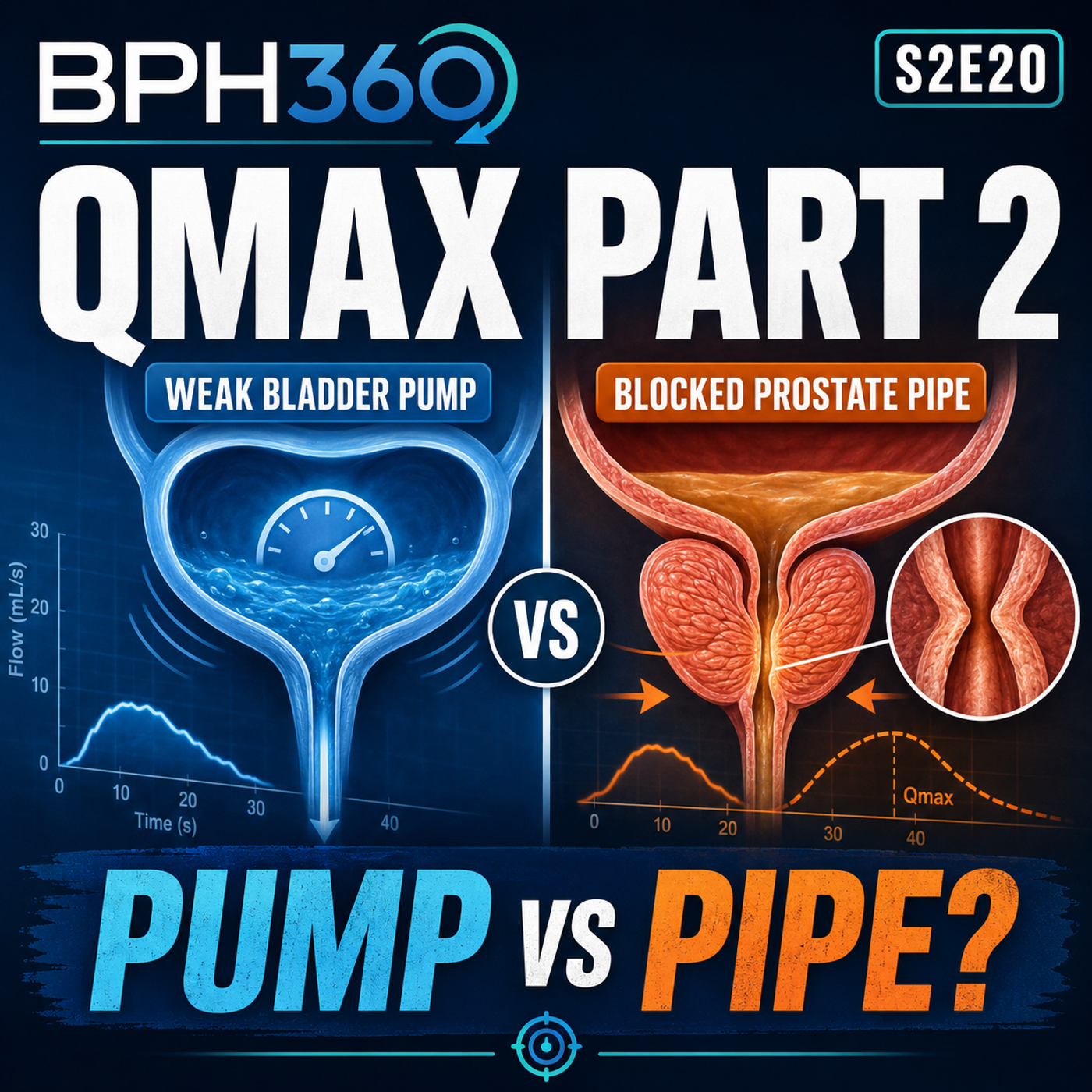
In this episode of BPH360, Dr. Wayne Kuang continues the Qmax conversation by asking the key question every man with slow urine flow needs to understand: Measure Your Urine Flow Rate Qmax: https://proudp-soundable.app.link/w5rhpKoU7Wb 00:00 Opener: Understanding Q Max: The Next Vital Sign for Men 01:03 Measuring Q Max: Techniques and Technologies 06:30 The Shift from Office to Home Testing 08:43 MidRoll 08:45 Qmax Baseline 10:00 Diagnosing Flow Problems: Pump vs. Pipe 15:03 Mid Roll 16:20 Need More Diagnostics? 20:29 Q Max as a Vital Sign: Trends and Patterns 23:37 What to Ask Your Doctor? 24:53 Questions to Ask Your Doctor About Bladder Health 27:24 Wrapping Up Is it a weak bladder pump, a blocked prostate pipe, or both? Qmax is your maximum urinary flow rate — the strongest part of your urine stream. In Part 1, we explained why Qmax may become the next vital sign for men’s bladder health. In Part 2, we go deeper into what a low Qmax actually means, why it does not automatically diagnose prostate blockage, and why better testing may be needed to protect your bladder before damage becomes permanent. A low Qmax tells you there is a flow problem. But it does not always tell you why. Some men have obstruction from the prostate or urethra — the “pipe” problem. Other men have a bladder muscle that is no longer strong enough — the “pump” problem. Some men have both. That uncertainty is exactly why Qmax should trigger a better bladder health conversation, not just another pill or a higher dose. This episode also covers how urine flow testing is changing. Office uroflowmetry remains important, but newer home-based hardware, smartphone apps, and remote monitoring tools are making it easier to measure Qmax repeatedly over time. One office test on one random day may not tell the full story. Tracking your Qmax at home may help show patterns, trends, and changes after medications, procedures, or worsening symptoms. Dr. Kuang also explains how Qmax fits into the Man vs Prostate Triangle of Triage: Symptoms Qmax Post-void residual, or PVR Together, these can help decide whether you need a higher level of diagnostic testing, such as ultrasound, MRI, cystoscopy, or other bladder-prostate evaluation. The goal is not to guess. The goal is to match the right level of testing to the right level of bladder risk. Key questions to ask your doctor: What is my Qmax? How much did I urinate? How much urine did I leave behind? Is my Qmax under 15 mL/sec? Could this be a weak bladder pump, a blocked prostate pipe, or both? Do I need a bladder health baseline? Do I need higher-level testing such as cystoscopy? For Man vs Prostate, a Qmax under 15 mL/sec is a bladder conversation trigger. A Qmax under 10 mL/sec is an academic concern cutoff. But the real message is this: do not ignore slow flow. Measure it. Track it. Understand it. Use it to ask better questions. Your bladder is not transplantable. Your prostate may be the obstruction, but your bladder is the organ we are...
Wayne Kuang: Last episode we talked about Q Max and why it may become the next vital sign for men, but knowing your number is only the first step. Last episode we talked about your Q, Max, and why it may become the next vital sign, a critical number for men's health. But knowing your number is only the first step now comes the harder question. If your flow is slow, if your Q max is low, is the problem with the pipe or the prostate? If your flow is slow, if your Q max is low, is the problem with the prostate or with your bladder? If your flow is slow, if your Q max is low, is it a problem with your bladder pump or with your prostate pipe? Or is it a combination of both? That is what this episode is about. We are going to talk about why low flow does not always mean the same thing, why better diagnostics do matter, and how QMAX can guide the next step in protecting your bladder. Let's get into it. Section segment seven B Technology Landscape Office Home Hardware. We've talked about identifying and measuring your Q max, the maximum flow rate of urine during the strongest part of your stream. And we've talked about how simple it can be as And we've talked about how it can be as simple as having a container that you pee into, and then you can use a measuring scale for weight, place it underneath, and as you pee into the container, you can actually weigh the amount of urine that you're voiding and begin to chart out over time how much urine is flowing out, and then you can calculate the maximum flow rate or your Q max. Now, in this modern era, we're seeing many different ways to measure your urine flow, and they can happen in many different locations. It can be done using hardware. It can also be used doing It can be done using hardware, but also with software. It can be done in the office as well as in the comfort of your home. Now let's take a quick tour of possible technologies that may be in your area. As we've talked about, it's really important that you at least get the data somehow, whether it's in the office in your urologist clinic or at your primary care provider, or if it's using some newer technology. Here's one example, and you can see here they have a funnel that a man will urinate into, and it's collected in this container, but underneath that right here, and you can see a zoomed-in image of that right here, is the weighing scale that can measure the weight of the urine and therefore be able to quantitate the volume of urine that's coming out. Here is another example of some hardware that can be done in the comfort of your home. And you'll see right here that it has a handle and a device through which you can actually void, and as your urine passes through this opening, it's actually able to measure your urine flow. And that's a really cool technology that's now come out here in North America, so it's something to think about. Another example of technology is here is a device that's actually placed in your toilet and as you void through it it's able to once again measure that volume of urine and it can be done in the comfort of your home. And now in the past year or so, we're now seeing the advent of using sound engineering, the ability to listen to your urinary stream and then convert it into your maximum flow rate. And we're seeing companies like this where they have using the phone ⁓ to make that measure. have to redo the mincy one, so here it is. And here's another example of using hardware in the comfort of your home. And you can see that they've put a little device in your toilet and you can pee into the device and your phone can then measure your flow and the amount of urine that's been passed. Here's another example of using hardware with software. You'll see they have their phone in hand as well as a device that's placed in your toilet bowl, and you're now able to measure the QMAX as urine is peed or urinated through this device in your toilet. This is an exciting time as we see the leveraging of software in our digital phones. Here's an example right here, and you can see that they're able to use the phone and be able to start charting out how well you pee. With yet another example right here, once again using your phone. And you're probably asking why am I showing all of these technologies? Well, it's because it's not about a single app or a single technology or diagnostic company. It's really about you getting your data to be able to start quantitating using a QMAX to get a signal about your bladder health to determine whether or not you need to take your game to the next level. With a higher level of diagnostic testing. Most importantly here at Manverse Prostate is we want you to find whatever technology is available to you in your country in your lower or higher income healthcare system. Find partners that can help your doctors to help you understand better about what your bladder health is doing right now. And Manverse Prostate for North America, we've partnered now with Proud P, which has a phone app. Which is helping our patients, helping my patients in my clinic, but it's not accessible to everywhere in the world. And so please we are continuing to look for global partners elsewhere because we want this technology out there as the next vital sign for men's bladder health. As you can see here, Proud P has done a very nice job. They have a phone app here, and you can see them now start to chart out as the stream strength begins to build. At the very peak is your QMAX, after which things begin to slow down again. This is an example of actually This is an example of my urinary stream on a night where I had probably held my urine for a little bit too long, so the strength of my flow wasn't quite as strong. But you can see here this red line is the QMAX, which is the bladder conversation trigger of 15 CC's per second. And you can see here my QMAX was 17 CC's per second or milliliters per second. And that is And you can see here, this is one of my own voids. I had woken up at five AM after sleeping for a long time. And you can see I've actually held on to a lot of urine. I probably had too much for my bladder. And you can see here, this is an example of one of my voids. I had slept through the night and got up at 5 a.m. to go urinate. And you can see actually I had almost a liter in my bladder from holding it overnight and storing it overnight. And you can see here that my maximum flow rate was around 17 milliliters per second. My QMAX was 17. On their system, you can see they have a nice little red line depicting a QMAX. Bladder conversation trigger cutoff of fifteen milliliters per second. And what's nice with all of these technologies, for example, you can see here, this is my data from when I was testing myself in December and January. You can now start to track your Q Max as a signal to assess where you are at baseline and how are you trending over time as you choose different management strategies to help with your voiding symptoms. And what's nice, especially about the testing that happens at home, whether it's with hardware or with software using your phone, is you can get a lot of tests in. You can get 10, 20, 30, 40, 100 if you wanted. And obviously more data gives you more accuracy to be able to really determine how reliable is that data in depicting where you are at now with your bladder health. А звелс тобін тракки. Section segment eight. To be very clear, this episode is not about, like I said, one company or one specific test. This episode is really about the bigger picture. the bigger shift in men's health. For years urine flow testing mostly happened in the office and now we're seeing that it's coming into your home. For years, urine flow testing happened mostly in the medical office. You came into a clinic and they urinated. And then you urinate it into a Eurofilometer like I showed previously, often with some funnel and you're voiding into a container, and it has the weighing scale underneath to measure the weight of the urine to be able to form that chart. That is still very important. Office Eurofilometry is still one of the most basic ways we measure QMAX. But now the technology is advancing and changing and there are home Euroflow devices using both hardware, software, or so combination between the two. They are home Euroflow devices. They are remote. They are remote monitoring devices. They are phone-based apps. They are sound-based systems. They are This matters because the future is not just one single or two office based tests on one random day. This matters because the future is not just one test on some random day in the office. The future is now getting your baselines and trends in the comfort of your home. What is your flow today? What is it going to be next month? What is it going to be in three months? Вот хапенс афте медикація з вохапенс афер а просіджу. What happens when you are at home? What happens at home when you are more relaxed? How much more accurate is the data when you're actually able to have thirty voids instead of just one or two in the office? What is happening with your Q Max when your symptoms are changing? And that is the bigger lesson. Q max is becoming easier to measure and when a number becomes easier to measure, it becomes easier to track and to follow trends and patterns. So whether it is office Eurofilometry or home hardware or a phone based app on your cell phone, the goal is the same. Better data means a better conversation Better data means a better conversation and better bladder decisions. Section segment, mid roll. Section segment nine office testing, home testing and phone apps. To recap for years, QMAX was mostly an office test. You went to the clinic. We talked about how you then voided or urinated into a office uroflometer. The machine then produced a curve and this is still useful. Office Euroflometry is simple, it's fast, it's non-invasive, but today, as we said, technology keeps going forward. We now do have home testing, whether it's hardware devices or smartphone apps that can now listen to your urinary stream. This matters because one test in the office may not tell the full story. You know, you might have been nervous, you might have been anxious. You might have been nervous, you might not have been in the comfort of your home, you may not have had a normally full bladder. Maybe it was a bad day, maybe it was a good day. Maybe your flow is different during the nighttime versus the daytime. It might be changing with medications, it might be changing after a procedure. The future is not just one test at a time. It's really about tracking. It's about trending. It is about establishing a baseline and then looking for patterns as your Q max changes over time. And that is how Q Max is so very similar to a vital sign. It's not because one reading is perfect, but because repeated testing shows the direction of where things are going. That is how QMAX starts to look like a vital sign, not because one reading is perfect, but because repeated readings can show direction, progression. Are you stable? Are you getting worse? Are you improving? And that is the question. section segment ten pumper pipe. Now we get to the most important clinical warning in this whole episode. Low Q max does not automatically give you a diagnosis and mean that your prostate is actually the problem. This is where the findings from this paper as we can see here from Chancellor et al. are very critical. They studied men with either a prostate pipe problem where the bladder outlet was obstructed, or where the bladder itself, the bladder pump, was no longer working very well. So I want you to think about that bladder as a pump and that prostate pipe as two separate things. It comes down to a pump problem or a pipe problem, or maybe a combination of both. In simple terms, some men may have a blocked prostate pipe and some men have And some men may have a weak pump. They looked at the Euroflow parameters, the Euroflow curves in those two separate situations. And let me show you what they found. As a quick reminder, here is a normal Euroflow curve. You can see once again that as the flow starts, the stream will build up until it reaches a maximum flow rate, which we call that Q max during the strongest portion of your urination, after which things will slow down. We talked about the 10 milliliters per second is the academic concern cutoff, but for man versus prostate, the 15 milliliters per second is a bladder conversation trigger for all men. When they looked at the Euroflow curves for those two scenarios, either a weak bladder pump or a constricting prostate pipe, they found that you could not differentiate between those two scenarios where both have a low Q max. You can see here on the left, this is the situation of a weak bladder pump, and that's what the curve looks like. It does not reach a very high Q max and it just kind of pitters out over time. And once again we see something similar with a prostate blockage. The curves look very similar and just because you have a low Q max you cannot determine that you definitely have a prostatic obstruction because you could also have a weak bladder pump or some combination of both. That is the lesson. A low Q max tells us there is a flow problem, but it has not. But it does not tell us definitively what the problem is or the reason why. Your bladder is that pump, your prostate and that main water pipe that goes out to the tip of your penis is the pipe. Your bladder is the pump, your prostate in urethra is the main pipe, and to urinate well, you need both. You need a bladder muscle that's strong enough to get the job done, to push that urine out, and you need an open channel for urine to pass through. If the stream is slow, there are only two big possibilities. The pipe may be blocked. That could be from an enlarged prostate or a tightening prostate and a nap. If the stream is slow, there are only two major possibilities. Either the main piping system is blocked off somewhere. And for most men, the prostate in that tightening donut hole plays a role in that. But we also have to consider other possible diagnostic causes, such as If the stream is slow, there's only two big possibilities. Either the main pipe is being constricted, or the pump itself, the bladder, is not strong enough to get the job done. Please note we are oversimplifying things here on purpose because, in truth, it becomes much more complex. It can be due to bladder tumors, bladder cancers, bladder stones, scar tissues, and that's why it's really important to work with your urologist or primary care provider. Listen to the right signals. Use QMAX as a vital sign to signal that hey there may be something going on that requires a higher level of diagnostic testing. Because yes, this is where men can get into trouble. Because if you and your doctor assume that every low flow low Q max situation is just because of your prostate, you may develop the wrong plan. Likewise, if you always assume that slow stream is just a normal part of aging, you may wait until the bladder is already damaged before you can actually. Likewise, if you assume that every slow stream is just a part of getting older, you may miss the window of curability. You may miss the opportunity to intervene before it's too late, before the damage to your bladder is irreversible. QMAX once again tells you that there's a flow problem, but QMAX does not always tell you why. And that uncertainty is not a weakness. That uncertainty is actually proof. That uncertainty is actually the point. Low Q max should not make us ask for Low Q max should make us ask: is it a blocked pipe? Is it a weak pump? Is it a combination of both? That is the pump versus pipe question that we all need to be asking when you're collecting data that signals that there could be something going on when the Q max is low. Once again, a Q max of 10 milliliters per second or lower is an academic concern cutoff. But for all of us here today, if it's now under 15, that is a bladder conversation trigger that you should be having with your primary care provider. And or your urologist. Section Segment eleven when Chemax triggers the next diagnostics. When we talked about the manverse prostate triangle of triage, there's three main points that are important to consider. One are your symptoms that you report, another is going to be your QMAX, and another one's going to be your postvoid residual, the amount of urine you leave behind after you have urinated. Together, those Those are the main elements of the triangle of triage. Now over time it's become more advanced we have two. With that said, the question is, what does a low Q max actually trigger? Well it's going to be more testing at a higher level to give you more data about the three things we've talked about, the man versus prostate trifecta. That's going to be prostate size, prostate shape, as well as bladder function. Depending on where you are in the world, depending on what resources you have in your community, whether you're a low income or high income healthcare system, many different technologies exist to give you insights into those three things, size, shape, and bladder function. It could trigger an ultrasound or an MRI to help determine the prostate size. But as you remember, we've talked about how you could have a very large prostate, but if your donut hole is very big, you may not have many symptoms. Versus you can actually have a small prostate, and actually if the donut hole is tight enough, that man with the smaller prostate may have more symptoms. That is why you cannot rely on size alone. We need to understand shape. Sometimes you can get that from ultrasounds. Sometimes you can get it from using a camera, just like we use a colonoscopy to screen and look for colon cancer. We can use cystoscopy, which is a camera that goes up into the tip of the penis, goes all the way up through the prostate into the bladder, and along the way we can see the prostate shape of The bladder. I mean And along the way we can see the shape of your prostate. We can see things like are the walls of the donut channel, the donut hole coming down and constricting, or is it the roof of the donut hole coming down, or perhaps it's the angle of the main water pipe, or is it, for example, part of the prostate growing up into the bladder? These are some advanced concepts and we'll discuss them later, but I just wanted to start introducing once again, it's about size, shape, and your bladder health, your bladder function. Here at Manverse Prostate, if the Triangle of Triage, QMAX, PVR, your symptoms, along with some additional concepts such as the thickness of your bladder, as well as software like BPH tool.com, if together they identify you as being someone who is at risk for a bladder that's dysfunctional, then that's a trigger for man vs.prostate. To start off with what we call the systoscopy. The triangle of triage, yes, the QMAX, the PVR, your symptoms together, as well as now we've added new things like the thickness of your bladder wall, as well as using software like BPH Tool.com. Together, if they identify you and your bladder as being at risk for dysfunction of your bladder health and disease of your bladder, then you may need what we would like you to. Yes, the triangle of triage, Q Max, PVR, as well as your symptoms. Additionally, there's other pieces of data like the thickness of your bladder wall, as well as software like BPH Tool.com. Taken together, if we feel that your bladder is at risk for disease and dysfunction for man versus prostate, we want you to think about seeing whether or not. A camera or that cystoscopy is available in your lower or higher income healthcare system. So much data can really be acquired by putting a camera on the inside. Yes, it's not your top ten things to do, but we need to know the status of your bladder health. We can look at your bladder and see if it's got those trabeculations, those signs of your bladder working harder and struggling. Additionally, it can make sure that there's nothing else going on, ruling out other causes of your symptoms like bladder tumors, bladder cancers, bladder stones, or even scar tissue, as well as getting a sense of the size of your prostate as well as the shape of your prostate, which we just talked about. That would happen at a minimum for bladders that are at risk for dysfunction. And depending on your healthcare system, you may need to do something even more to actually study your bladder, such as multi-channel urodynamics or a penile cuff test, for example. These advanced tests can now really start to sort out whether or not your low Q max, your low flow is due to a problem with the piping system or the pump or some combination of both. Most importantly is to stop guessing, to get the next vital sign for your bladder health, your QMAX, and use it as a signal to ignite the right conversation at the right time about your bladder health when it is under 15 milliliters per second. And then we want to match the right level of diagnostic testing with your level of risk. This is the whole point of triage. It's starting with basic data and then climbing that diagnostic ladder only when the signal says you should. than climbing the diagnostic ladder only when the signal says that you should. Section segment twelve. Now let's talk about why I call QMAX the next vital sign for men. As you can see here in this study by Roberts and colleagues, he looked at the Q max, the peak urination flow rate in a community of men. That is important. He was not just looking at specialty clinics full of men that are already selected for severe symptoms. It was a community-based cohort. They found that peak urinary flow rates declined over time. So if you look at on this graph, you'll see these are the different ages for men, and you can see they're Q max. And if you follow each of these lines, that's a single man, you'll see that over time as they get older, you'll see that on average there's a trending downwards as men get older. But for each specific man, often there's a trend that we can begin to follow. So yes, they found that the Q max, the peak urinary flow rate was declining over time as men got older. The decline was more important in older men and in men who had already had lower baseline flows. Delete that last sentence. This is exactly why QMAX can work like a vital sign. A single number is helpful, but the trend may be even more powerful. Blood pressure matters because we can track it. Weight matters because we can track it. PSA for prostate cancer screening matters because we can track it. QMAX also matters, and it's something we can track. We can follow the trends. We can follow the patterns. So for example, we take a gentleman like right here. If we look here, we can then follow him over time, and maybe as we see his QMAX starting to decline, we can Have the right discussion based on the right data about different management strategies at the right time, recognizing the need to protect your bladder span, the number of years lived with optimal bladder health. Yes, it is not because one flow test will tell the whole story. It's because your baseline and your trend, your pattern can tell us whether your bladder prostate system is stable, improving, or worsening, or progressing into those later stages of bladder health. That is the future. Population based bladder health screening, home testing, office testing, phone based tools, hardware apps and Hardware equipment. Hardware equipment, better baseline data, better conversations, earlier detection. And hopefully fewer men entering into stage four urinary retention with catheters or even stage five where the bladder is starting to fail. That is why I want you to know your Q max, not after years of slow flow, not after urinary retention, not after a catheter has to be placed. But earlier, when the bladder is still fighting, when the window of curability is still wide open, when treatment decisions can still protect your bladder instead of just managing symptoms. Section segment thirteen, what you should ask your doctor. So the next time you see your provider or specifically your urologist, here are just some questions I think that you should bring up, which is, Hey doc, you know, what is my Q Max? How much did I urinate? How much did I leave behind? What was my post void residual? Does my Q max match my symptoms? Or do we need to be concerned about my bladder health? Is my Q max less than fifteen milliliters or split? Is my Q max less than fifteen milliliters per second? Should we be concerned about having a bladder health conversation? Or am I already less than ten CC's or ten milliliters per second, which is an academic reason for concern? And if warranted, do I need And finally questions if it is warranted, like do I need a higher level of diagnostic testing, like a camera or cystoscopy? Do I need a baseline assessment of my bladder health, a bladder health baseline? Could it be a weak bladder pump or is it a problem with the piping system? Or is it some combination of both? That question is probably the most critical. Please ask it clearly. Could this be a pump, a pipe, or a combination of Could this be a pump or a pipe or a problem of both? Could this be the pump, the pipe, or a problem with both? Because if you understand that question, you understand the heart of the bladder prostate system. Section segment recap fourteen. So let's recap. Q Max is your maximum flow rate. It is the peak speed of your urine stream. It is not just a symptom. It is a number. The research tells us several important things. That first study I showed you reminds us that you may not be able to judge your own flow very accurately. We then introduced the data from Zinner, who showed us that your urinary stream can be quantified, it can be measured to provide useful clinical data. The follow-up study then showed us that symptoms and objective numbers do not always match up. And then we talked about the steel study where yes, a very low Q max, less than 10 cc's per second, is an academic concern cutoff, but that more importantly for all of us, for man versus prostate, 15 milliliters per second or lower is a bladder conversation trigger. And then Chancellor et al. told us that just because you have a low flow, it is not a diagnosis. And you cannot assume it's just because of one thing like your prostate. When there's low flow, a low Q max, it can become a pipe problem, a pump problem, or some combination of both. And finally, the Roberts study, which we just showed, shows how QMAX changes over time, especially for most men as we get older that QMAX is going to trend downward. And that's exactly why we want to use QMAX as the next vital sign. Get a baseline, begin to track it, look for the trends, look for the patterns so that you can intervene with the right management strategies at the right time within the window of curability. To prioritize your bladder health, your bladder span, the number of years lived with optimal bladder health. This is all the reasons why QMAX belongs within the triangle of triage with your symptoms, your maximum flow rate, and your PVR, the postvoid residual. Use your QMAX as your vital sign if it is low that it's time to have a better conversation. Ask about your bladder. Ask about your prostate size and shape. Ask about whether a camera or cystoscopy makes sense. Ask whether advanced diagnostic testing is needed. It is so much more than just asking for another pill or a higher dose. It is about asking hashtag what about my bladder. Section segment fifteen. So yes, your bladder is not transplantable. It's not replaceable, so let's take care of it. Your prostate may be the obstruction, but your bladder is the organ we are all trying to save. QMAX is one of the simplest ways to start measuring your risk and to understand your bladder prostate system. So please know your numbers. Better data drives better decision making. Remember, you cannot manage what you do not measure. Track your flow, understand the triangle of triage and when the data does not make sense, please do not ignore it. That may be the moment that better diagnostics can still protect your bladder. This is BPH three hundred sixty Real Answers Better Lives One bladder at a time.