
BPH360 · Man vs Prostate
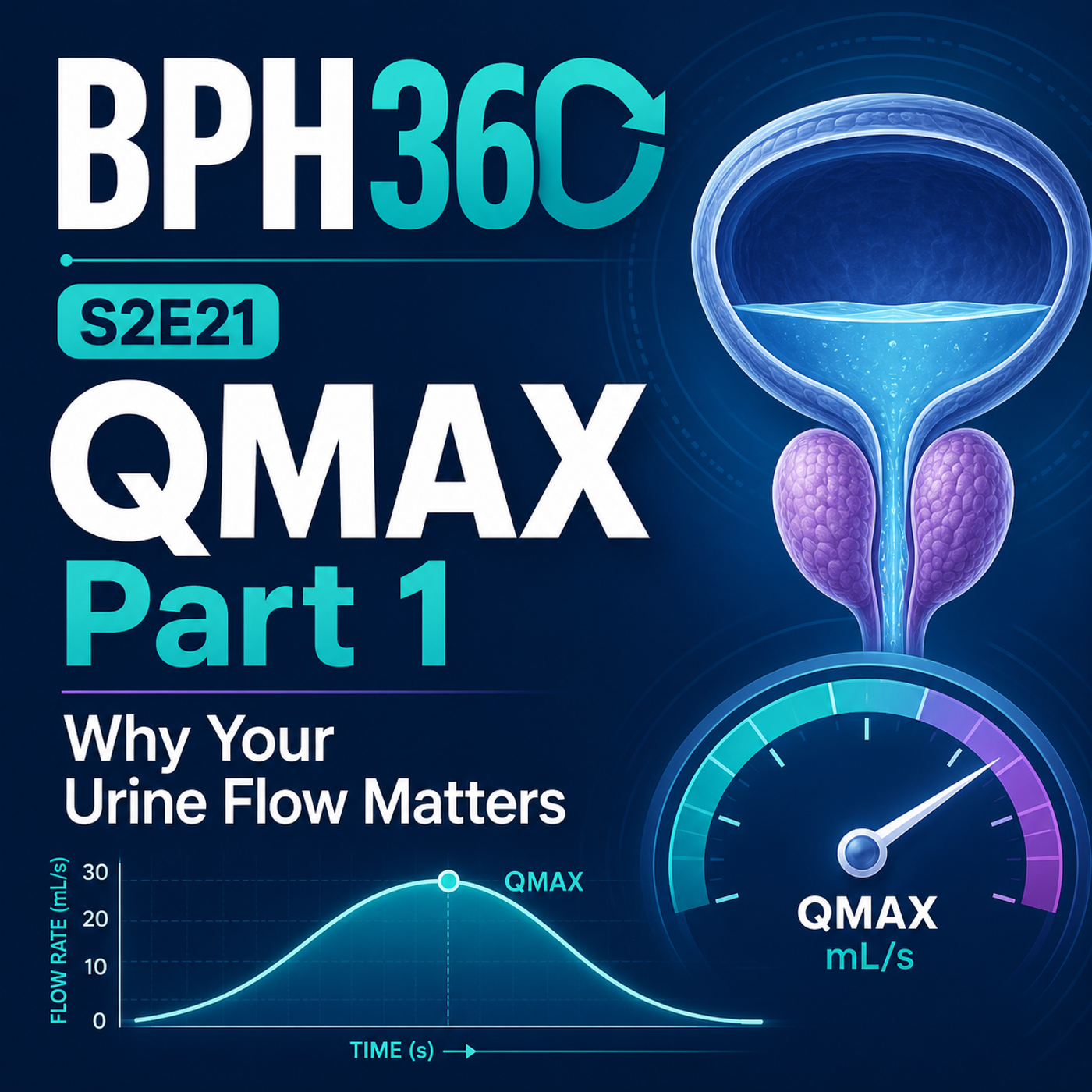
What if one of the most important numbers in men’s health is a number you have never heard of? You may know your blood pressure, cholesterol, PSA, weight, or BMI — but do you know your Qmax? Qmax means maximum urinary flow rate. It is the fastest speed of your urine stream during urination, measured in milliliters per second. And in BPH360, Qmax matters because your urine stream is not just waste leaving your body. It is a signal from your bladder. In this episode, Dr. Wayne Kuang explains why you may not be a reliable witness to your own urine flow. A stream can slow down gradually over 5, 10, or even 20 years, and because the change happens slowly, you may start to think it is just normal aging. But your memory of your stream is not the same as a diagnostic test. That is where uroflowmetry and Qmax come in. Measure Your Urine Flow Rate Qmax: https://proudp-soundable.app.link/w5rhpKoU7Wb You will learn: • What Qmax means • Why your urine stream can become a bladder health signal • Why “my stream is fine” may not be enough • How uroflow testing measures urine volume over time • Why Qmax is part of the Triangle of Triage • Why symptoms, Qmax, and PVR each tell a different part of the story • Why a Qmax below 10 mL/s is concerning • Why 15 mL/s may be a better bladder health conversation trigger The key message: Qmax does not give every answer. A low Qmax can mean the prostate is blocking the pipe, but it can also mean the bladder pump is getting weak. That uncertainty is exactly why better questions matter. In Man vs Prostate language: 10 mL/s = classic academic concern cutoff 15 mL/s = bladder health conversation trigger Not a panic trigger. Not a surgery trigger. Not a diagnosis by itself. A conversation trigger. If your Qmax is dropping, ask better questions: What is my PVR? What is my prostate size? What is my prostate shape? Is my bladder muscle still strong? Do I need further testing? Could this be pump, pipe, or both? BPH is not just about the prostate. It is about protecting your bladder before damage becomes permanent. To support the Man vs Prostate campaign, you can enter referral code MVPWK in the proudP app profile section. proudP is one tool that may help measure Qmax from home in North America. If you access proudP through Man vs Prostate, there may be a partnership benefit to the campaign. This does not affect the price you pay or change the medical education. The mission is not one app. The mission is getting your bladder health data earlier — before it is too late. Watch more BPH360 episodes and follow on YouTube, Spotify, and Apple Podcasts. Educational only. Not medical advice. Please consult your physician or qualified healthcare professional for your individual care.
Wayne Kuang: what if I told you one of the most important numbers in men's health ⁓ is a number you may never heard of. ⁓ You probably know your blood pressure, you may know your cholesterol, you may know your PSA for prostate cancer screening, you may know your weight, your BMI, but do you know maximum urine flow rate? That number is called the Q max. QMAX means the maximum urinary flow rate. It is the fastest speed of your urine stream during urination. And here is why it matters. If your flow rate, your Q max is slowing down, your bladder may be working harder than it should. If your flow, your Q max is low, your prostate may be blocking the main water pipe. But low flow can also mean something more dangerous. It can mean that the bladder pump is getting weak. And that is why QMAX may become the next vital sign for men. Not because it gives every answer, but because it tells you when you need to ask better questions. And in BPH three sixty, better questions are how we save more bladders like yours. Let's start with the hard truth. Men like you and me are not great witnesses to our own urine flow, to our own bladders. And this is not an insult. This is human nature. Your stream may slow down slowly over many years because it happens very gradually. This assault on your bladder as that prostate donut hole gets tighter and tighter takes years, five years, ten years, two decades. Because it happens so gradually, so insidiously, you actually adjust with it and begin to normalize it. Your brain, your mind, your spirit, your lifestyle, you keep adjusting and adjusting and adapting to this very gradual changes in your life. in what used to take twenty seconds may now take thirty two seconds. What used to be a strong stream may now actually be weak. But because the change happens so gradually, little by little, you may think This is just normal aging, or you may say, My stream is fine, But when we measure it, the number may tell a different story. In this paper that we see here by Small et al. from 1997, They did a really insightful investigation of how men perceived how they urinated versus the actual flow rate, how fast were they actually peeing. And you can see here in this paper titled Comparison of Patients Assessment of Urinary Flow Strength with Uroflometry. Uroflometry is that diagnostic test that measure how fast you're peeing or urinating. The first thing they did was they showed men this diagram right here They asked the men to report which of these urinary streams was most similar to theirs. And you can see a weaker stream is around one and up to a ⁓ four, where it has a nice arc. Additionally, they asked them two questions. Do you feel your flow is restricted or weak? And a second question: Is the force of your flow diminished compared with 10 years ago? And then what they did is they took those questions and the answer to that picture and they compared it to the actual flow rate, how fast they were passing their urine, So yes, this paper compared what men thought about their urine flow with what the actual diagnostic test of uroflometry actually measured. The point was simple. Can a man accurately judge the strength of his own stream? And the answer was: not reliably. That matters because your memory or your impression of what is going on can actually lie to you. Your symptoms do matter. Your story matters. But your feeling is not the same as an actual measurement. So I want you to remember this line. Your memory, your recollection of how fast or how slow your urination is, is not the same as a true diagnostic test as we see with uroflometry. That is why Q Max matters. It gives us an objective number. It gives us a baseline. It gives us a way to track change over time. Now let's define Q max clearly. When you urinate, your flow starts at zero. Then the stream will start to build in strength until it reaches a peak, after which it will then begin to slow back down. That peak is called the Q max. It is measured in milliliters per second. So if your Q max is more than 15, it means that the strongest part of your urinary stream is coming out at approximately more than 15 milliliters every second. But measuring the urinary stream is not something that's brand new. It's actually been around for decades. As we can see right in this article from 1969 in the Journal of Urology, ⁓ really our hat off to these ⁓ scientists and urologists from Seattle, Washington, and Charlottesville, Virginia, ⁓ they said, Hey, let's take a look the urinary stream using high speed ⁓ videography or if you look at the urinary stream ⁓ which we see right here ⁓ you'll find that what like a continuous stream here on the left ⁓ when you high speed cinematography you'll actually see that the urine's coming out in drops and you can see a drop here another drop ⁓ And what they were able to do was actually set up this system, which is called a drop spectrometer, where they had light beams shooting across two levels of that, and they could actually now start to count the drops breaking the stream of light. And now it was the first time that we've used technology to get a sense of a man's Q max. The concept was truly forward thinking. They were trying to turn urinary stream into data. Not just, hey, does your urinary stream look okay? Not just does it feel weak or feel strong? but actual measurable data. And that is the historical origin of what has really evolved over the last half century to bring new technology to help you optimize and prioritize your bladder health, your bladder span. Yes, your urinary stream is not just liquid with waste products coming out of your body. It is a signal. It tells you a story about your body, about your bladder. And one of the first signals that we are introducing to you is the Q Max. Just like you have blood pressure to check your cardiovascular health, we're now using the Q Max to check on your bladder health. By measuring your stream, your Q max, we are no longer just guessing. One more practical point is that the Q max is not the same as how much urine did you actually urinate. you can pee a large amount slowly, you can pee a smaller amount quickly. Volume does matter and so we like to think about making sure our men, when they're doing this type of testing for their Q max, that they void at least about 150 milliliters. In my practice, I actually have my men try and pee a little bit more, so around two hundred, two hundred and fifty milliliters at least. And we're looking for a natural void, a real stream with a real number to give you real data so you can make better decisions. ⁓ In fact, if we look at this now from nineteen seventy one, the same group Zinner ⁓ in his group two years later were now able to show differences in men who were urinating normally versus men who were struggling with a tightening prostate donut hole who are suffering from BPH or what you and I call prostatic bladder obstruction, PBO. And you can see here on this article, as we scroll down here, And we can see here that now they are able to chart out the number of drops versus time. And as a result, we start to see a curve. As we said before, when you start your urinary stream, the stream builds up and it reaches a peak flow, and that is where your Q max, after which things begin to slow back down. And that's what we see in a normal urinary flow or uroflow test. But what about for BPH or PBO prostatic bladder obstruction? We can see that over here now on the far right. You can see that as that donut hole is getting tighter and tighter, things are slowing down. And you can see that here. The flow starts to build, but it never peaks at a very high number before it then stays up there for a while and then slowly comes back down. It's Q max, the maximum flow rate is not as high as what we see here in the normal man. Now let me show you how we classically test your Q Max with a Uroflowmeter As you can see here, there's a funnel and then there's a collection device as well as a digital scale. The reason why is because the flow is basically urine volume, how much you are urinating over time. In a clinic, we can now use a medical Euroflometer like this one. as a machine that's measuring the urine as it comes out and it now can then draw us a curve, You can understand it with very simple tools. So, for example, we have a collection device, and you can imagine if you are peeing into this collection device, it can then measure how much urine you're avoiding. Another way you can actually measure the volume of urine is recognizing a very simple principle that urine is very similar to water and that every milliliter of water or urine is approximately one gram. Now we can start placing a scale, a weighing scale, underneath this container so that as you're urinating into the container, as that volume is increasing, it's detecting an increase in weight. And that weight corresponds to the volume of urine that you are peeing into this container. As a result, we can now chart out your urinary stream that you can see right here. And once again, as you start your stream, the flow will steadily rise and it will get to a peak rate right here, which is the Q max, after which it will slow down. And once again, we're measuring how much urine there is, the volume over time to chart this out. Most importantly, we are now moving from vague words of symptoms to actually quantitative data to real numbers. Not just my stream is weak not just I think I'm okay But what is your Q max? How much did you avoid? How much time did it take? How much urine was left behind? Is the number stable? How is it trending? Is it getting worse? Is your bladder health progressing in the wrong direction? This is how we move from simply guessing to actually bladder health tracking. This is how we move from guessing to actually bladder health tracking. Now let's place QMAX where belongs. ⁓ In the triangle of triage, you remember, ⁓ there's three main points to triangle. Symptoms, ⁓ QMAX ⁓ in the post-void the which is the amount of urine left behind ⁓ after you urinate. ⁓ Symptoms tell you how you feel about your urination. QMAX tells us how fast the urine comes out. PVR tells us how much urine is left behind. Each one tells part of the story, but none of them tells the whole story. That is why this study by Ez L Dean and their group matters. They looked at symptoms, and Q max, ⁓ and the message was very clear. ⁓ These elements do not perfectly line up. ⁓ As we've talked about the past, using the ⁓ IBPSS, the International Bladder Symptom Score, you can start to break down your symptoms ⁓ And what we see here is when we look at symptoms, ⁓ they do not ⁓ closely correlate with ⁓ QMAX. When we break symptoms into mild, moderate, or severe you can see here that for men report ⁓ mild symptoms, ⁓ the truth is, all of those men are actually doing okay. In when they looked at it, this is the men in black right here, and we can zoom in. ⁓ These are the men with extremely low Q max. QMAX less than 10, that's not okay. ⁓ once men are not reliable historians to their bladders. So even though they were saying, hey, I pee with that are mild, in fact, you get the real data, ⁓ measurable Q you can see that a percentage of these men, a significant percentage, were actually doing well with very low QMAX or maximum urinary rates. ⁓ We need data. Using only one of the three points of the triangle of triage is not sufficient. If you just relied on symptoms, you could run into trouble. So, for example, we just talked about men with mild symptoms may actually have very low Q max, showing a weak flow, as we see here in black. This is why I do not want you to think of BPH or prostatic bladder obstruction as one question. It is not just how bad are your symptoms. It is how fast is your urine coming out? How much urine is being left behind? How big is your prostate? What is the shape of your prostate? what your risk you look at the triangle of triage? ⁓ Symptoms, QMAX, and PVR. You need all three because each one tells us a little different part of the whole story. And if your symptoms are getting worse, your Q max is low, your PVR is rising, that is not just simply getting older. These are signals that your bladder is struggling. And if your bladder is struggling for long enough, you may be moving from simply compensating for this problem to actually real bladder damage. That is what we are all trying to prevent. Now let's talk about the number that may be the most important part of this episode. You will often hear that a number for the Q Max less than 10 milliliters per second is concerning. That is true. A QMAX below 10 is a classic academic cutoff. But here is the problem. If we all wait until you actually get below that cutoff of 10, we may have missed the window of curability to intervene at the right time before the damage is irreversible. Let's take a look at this article by Steele et al. from Boston area. And this was published in the year 2000. They looked at symptoms. They looked at the Q max, the maximum urinary flow, prostate volume, as a way to predict bladder outlet obstruction. Let's take a look at this article by Steele et al. Their research group out of Boston published this in the year 2000 in the Journal of Urology. And what they were able to find. Was that if they used a cutoff of 10 milliliters per second as an academic QMAX cutoff, you can see that here, here's the 10. And if you draw a straight line across, you can see that they can identify a very high percentage of men who have BPH, PBO, prostatic bladder obstruction. And you can see that every black dot is An obstructed man due to his constricting prostate that's making his bladder work harder. And you can see that if we use this cutoff of 10 right here, you can see there's lots of black dots under that threshold. But what we're talking about is what happens if we use a cutoff of 15, which you'll see right about here. And if you draw a line across here. We're actually able to capture or identify even more men, these men that are black dots here that have obstructing prostates with donut holes that are getting too tight. What man vs prostate is proposing is yes, the academic cutoff of a Q max of ten milliliters per second, as we can see here, is a classic academic concern cutoff. At this cutoff, we identify with a high percentage of certainty men who are obstructed. Yes, a very low flow, a very low Q max is a real concern. But if we only use this very low cutoff, we may miss men who really need a conversation about their bladder health. That is why we separate two ideas. The cutoff Q max of 10 milliliters per second is a classic academic concern cutoff. Whereas fifteen milliliters per second is a bladder health conversation trigger. Not a surgery trigger, not a panic trigger, not a diagnosis, a conversation trigger. So here is the practical framework. A Q max above 15 milliliters per second is generally reassuring. That does not mean that everything is perfect, but it is usually a better sign. A Q max between 10 milliliters per second and 15 milliliters per second is a gray zone. That is where I want you all to start having that conversation. We need you to start having conversations with better questions for your primary care provider or your urologist. Do not ignore it. Do not panic. Ask what your number means in your case. a Q max of less than ten milliliters per second raises more concern. That is where the conversation starts to get more serious. But for bladder health, I do not want you to wait until you are already below that cutoff of ten milliliters per second. Once you see your Q max start to go below 15 milliliters per second, that's the time to start asking, ⁓ Is this normal for me? ⁓ How is changing over time? Is it trending downwards? ⁓ What is my residual? What is my PVR? What is my prostate size? What is my prostate shape? What is the condition of my bladder muscle? Does someone need to look inside to see what's going on inside my bladder? Could my bladder actually be struggling to the point that it is a weak pump? That is the goal. It's not to overdiagnose. It's not to scare you. But the goal is to stop waiting until the bladder is already in trouble, especially waiting too late when the bladder has irreversible damage. So please remember, 10 milliliters per second is the academic concern cutoff. 15 milliliters per second is the bladder health conversation trigger. In the next episode we'll answer the bigger question The pump versus pipe question may be one of the most important question of men's health in the future.