
BPH360 · Man vs Prostate
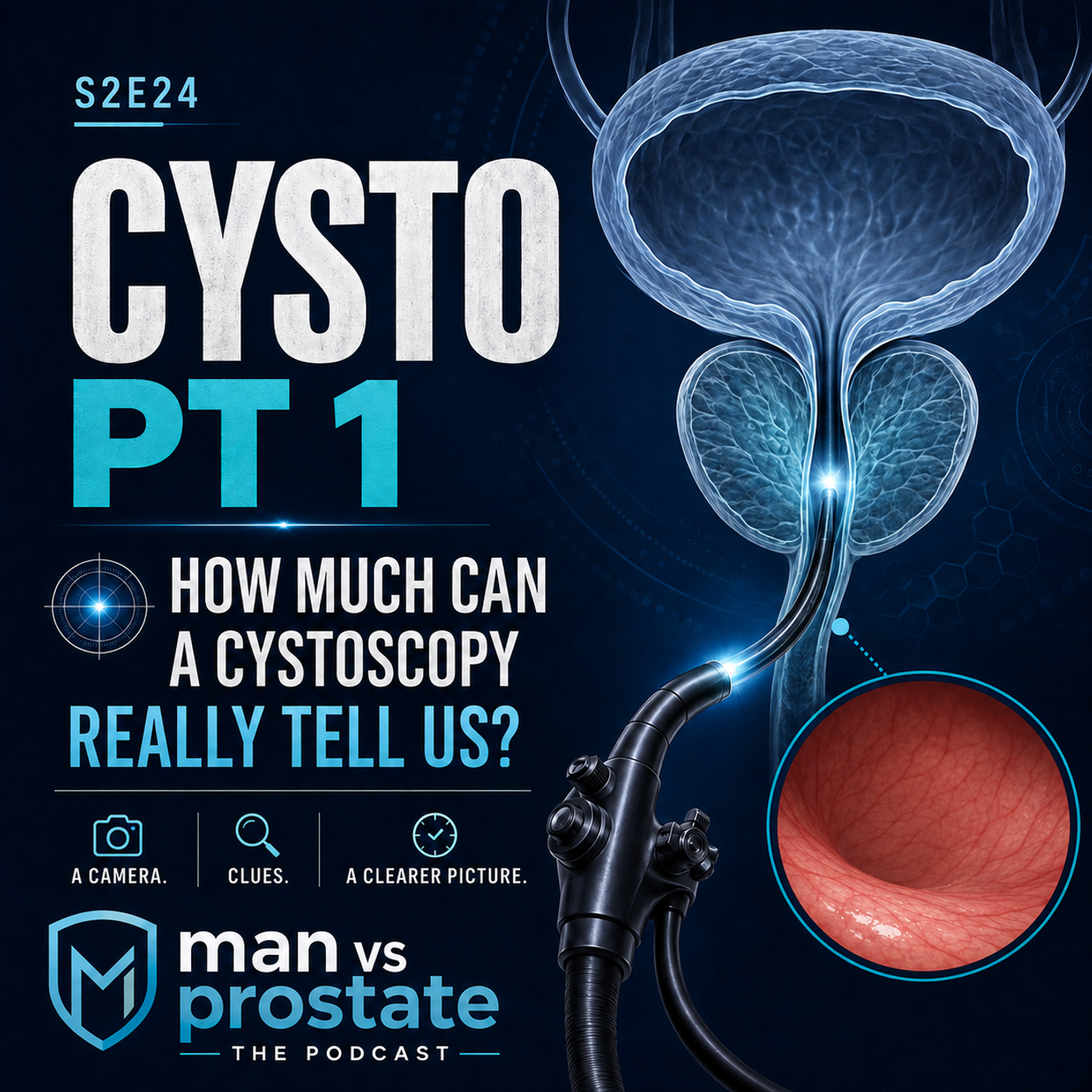
How much can a cystoscopy really tell us about your prostate and bladder—and when should you consider having one? In Part 1 of our 3-part cystoscopy series, we focus on the WHY and WHEN. A cystoscopy uses a small camera to directly inspect your urethra, prostate channel, bladder neck, and bladder. It can reveal important anatomical clues—but it is not a perfect test and cannot answer every question about bladder function or obstruction. The bigger question is not whether every man with BPH should have a cystoscopy. It is: What should trigger a closer look? In this episode, we review the 2026 AUA and EAU BPH/LUTS guidelines, the UK NHS pathway, and how the Man vs Prostate® bladder-first approach looks at cystoscopy differently. 00:00 Video Opener 00:47 Intro 01:09 Cystoscopy like a Colonoscopy 02:58 Overview 05:11 The Need for Objective Data in Bladder Health 06:57 Treatment Discussions and Lifestyle Changes 08:33 BPH Drugs & Armor of Masculinity 11:21 Academic Insights on Symptoms 12:30 MidRoll 13:31 European Guidelines 15:41 Diagnostics Before Treatment? 17:14 BPH Care in the United Kingdom 19:38 MVP Triangle of Triage: a Parallel Pathway 21:51 Power of a Camera: Cystoscopy 25:26 Next Episode 26:09 Outro We discuss: • What a cystoscopy can—and cannot—tell you • Why cystoscopy does not definitively prove prostate obstruction • Urethral strictures, bladder stones, tumors, bladder neck anatomy, and prostate shape • Why prostate anatomy is more complicated than prostate size alone • Lateral lobes, prostatic urethral angle, and intravesical prostate protrusion • Why symptoms alone may underestimate bladder risk • The difference between “Are you fine?” and “Is your bladder fine?” • Why medications may improve symptoms without answering what is happening mechanically • Why Qmax, PVR, symptom scores, and detrusor wall thickness matter • How the Triangle of Triage can help identify men who may deserve deeper evaluation • Why an IBPSS ≥8 alone deserves a bladder-health conversation • Stage III urgency urinary incontinence and Stage IV urinary retention as important warning signs • Why cystoscopy should be viewed as one piece of a larger diagnostic puzzle The Man vs Prostate approach is not cystoscopy for everybody. It is about getting useful bladder data earlier, identifying risk, and escalating testing when the constellation of clues suggests that your bladder may be struggling. Cystoscopy does not eliminate diagnostic uncertainty. It reduces some of it. Symptoms tell us what you feel. Qmax tells us how fast urine is coming out. PVR tells us how well you empty. Bladder wall findings provide another clue. Cystoscopy lets us directly look inside. Together, those pieces help create a clearer picture. Don’t let “I’m fine” become your diagnostic test. Ask your doctor: #WhatAboutMyBladder Coming in Part 2 We put the cystoscope in my hand and show you what modern cystoscopy actually looks like—and what we actually see inside the urethra, prostate, and...
Wayne Kuang: section thumbnail visual with a cystoscope. Serious look. Visual Visual again. Section members only How much can a cystoscopy really tell us? A cystoscopy is powerful, but I want you to understand what it can and cannot tell us. A cystoscopy is powerful, but I want you to understand what it can and cannot tell us. With this little camera, I can directly inspect your urethra. That's the main water pipe that carries the urine out from your bladder through that prostate out towards the tip of your penis. I can also look at your prostate channel, your bladder neck, as well as your bladder itself. It helps to reduce or minimize diagnostic uncertainty that always exists when it comes to men in their urination. I may find scarring or what we call urethral strictures. I could find a bladder stone, a bladder tumor. Or changes in the bladder that suggest that your bladder muscle has been working harder about it. Or changes in your bladder that suggest that your muscle, the detruser muscle of your bladder, has been working harder for longer against resistance. This recent review from the Society of International Urology from this year emphasizes the ability for cystoscopy to directly identify the structural abnormalities of what's going on inside of you. And that's a very important limitation. Cystoscopy is looking at the anatomy. What is normal? What's not normal? As well as taking a look around. This test does not do it all. It has very important qualitative information, but it does not have the quantitative information, the numbers, the data of advanced computer testing that does exist for your bladder function, where we can measure bladder pressures or measure how much resistance there is when your bladder has to squeeze against a constricting. Donut hole of your prostate. By itself, a cystoscopy does not definitively prove that the prostate's creating an obstruction. The AUA American Neurological Association Guidelines makes that limitation very clear as we can see right here. Cystoscopy has a limited ability to determine the presence of obstruction caused by BPH or what we call prostatic bladder obstruction PBO. But that's why man verse prostate doesn't rely on one single test, one single clue. We're looking at a constellation of clues, symptoms, Q max, how fast you can urinate, your PVR, your post void residual, how much you leave behind after you think you have emptied your bladder, these well as As well as clues from your bladder wall, the detruser wall thickness. In cystoscopy, using this camera to get a good look on the inside adds additional clues about your urethra, the main water pipe, your prostate channel, the shape of your prostate, your bladder neck, as well as the condition of your bladder muscle. Each piece of the puzzle comes together to help us paint a bigger picture, to help put together a constellation of what might be going on inside of your body. The goal is not one perfect test. The goal is to reduce diagnostic uncertainty, which always exists with men and their urination. Let's use this accumulation of clues to paint a bigger picture so that you have better data to make better decisions about your life and your bladder. Section clinician aside, Dear colleagues, let's take a look at the 2026 brand new American Neurological Association Guidelines for BPH. If you have urinary symptoms, they do recommend a symptom score. But when you look at the PVR and postvoid residual, But when it comes to the PVR and Euroflometry, the Q max, they say consider them. Then the pathway moves along this arrow towards lifestyle changes. Then the pathway moves along this arrow towards lifestyle changes and potentially medications. And if your symptoms become improved or tolerable, you can continue those medications. But here's the problem. But if your symptoms become improved or tolerable, you can then continue that therapy. But here's the problem. You can feel fine while your bladder is not fine. Men are remarkably good at tolerating urinary problems. And visually, this algorithm places additional testing, including cystoscopy, later on in the pathway after persistent bother, medication aversion, or intolerable side effects, as we can see right around here. To be fair, the full AUA guideline specifically says there is no evidence requiring a stepwise treatment approach. Manverse prostate proposes a different perspective, but in parallel to the AUA guidelines. We want you to get the basic bladder data earlier. QMAX, PVR, Detruser Wall Thickness, your symptom score, whether it's the IPSS or IBPSS, which is what man vs. Prostate uses. Then use the triangle of triage to decide whether you need a deeper investigation or a bladder health baseline. The disagreement isn't about the value of cystoscopy. It's about what should trigger it and when should we do one. Section trailer. Imagine two men, they're both sixty five, they both have an enlarged prostate, they both have urinary symptoms, and you ask them, how are you doing? How are you doing? The first guy says terrible. The second guy says, ⁓ I'm fine. But what if his maximum urine flow is only nine? What if he's leaving two hundred milliliters behind? What if his bladder wall is getting thicker and thicker? What if he's already leaking because he can't hold the urge anymore? Is he really fine? This is where man vs prostate takes a different approach. We don't wait only for bother. Don't wait only for Don't wait for only two. Don't wait only for bother. Don't wait only for drug failure. Use the data. Triage the risk. And if clues say your bladder may be struggling, maybe that's when it's time to take a closer look. Today we're asking when should cystoscopy enter the BPH pathway? When should we be using a camera to take a better look on the inside? To reduce or minimize the diagnostic uncertainty and find some clues to what might be going on down there. To reduce or minimize diagnostic uncertainty and find some clues to what might be going on down there. section hook. Most of you know what a colonoscopy is. Nobody loves the idea. But culturally, we understand the concept. At some point, doctors may want to put a camera inside your colon because there are important things we don't want to discover too late. That's why we do colon cancer screening. It affects one in 23 men. What about your bladder? Bladder disease, bladder dysfunction that can come from ignoring your prostate that's getting too tight, restricting the flow, making your bladder work better. Too hard for too long. And remember, the bladder is not routinely transplantable. For all intents and purposes, you only get one per lifetime, so let's take care of it. Isn't that worth a quick camera? Now I get it. If I told a man, Hey, I would like to put a tiny camera through your penis, through your prostate, and up into your bladder, I definitely get a lot of looks. I totally understand the fear. If I told a man I totally understand the fear. If I tell a man I'd like to put a tiny camera into your penis, through your prostate and up into your bladder, I understand that that is not an exciting prospect and that's why I often get many looks. And often a response like, Hang on, Doc, you wanna put what into where to get to where else? And often I'll get the response, Hey Doc, explain that one more time. You want to put what into exactly where in my body? Fair enough. It is called a cystoscopy, the medical leaves for a camera, tiny camera that allows us to get on the inside to get more details about what's going on. And no, I don't think every man with BPA should automatically get one, but I also don't think we should wait until everybody is miserable. But I also don't think that we should wait until everybody is miserable, medications have failed, or their bladder may already be getting into trouble and potentially sustaining permanent damage. And no, let me be clear. I don't think every man with BPH should automatically get a cystoscopy. But I also don't think that we should be waiting until everybody is miserable, medications have failed, and your bladder And no, I do not think every man should have a And no, I don't think every man with BPH should automatically get a cystoscopy. But I also don't think that we should be waiting until every man is miserable, medications have failed, or the bladder may already be getting into trouble. So the real question is not should every man get a cystoscopy, the question is what should trigger a cystoscopy? Section Intro Section Segment One. So let's jump in. This is the recent 2026 guideline statements from the American Neurological Association, and we applaud their efforts and their expertise for bringing these insights to all of you as we help guide you and work with you to choose the data you need. Alright, let's jump in now. This is the American Neurological Association Guidelines from this very year, 2026. This is exciting material to help guide our conversation about how we can help you make better decisions about your life and your bladder. Actually delete that first part there because I forgot the first part of the intro. This is part one of a three-part series. Today we're going to be talking about the why and when. And in part two This is part one of a three part series about cystoscopy. Today we're going to talk about the why and the when. In part two I'm going to in part two, I'm going to physically show you the cystoscope, the old rigid instruments as well as the more modern flexible scopes. As well as the newer single use technology, what we're doing for comfort, what we can actually see when we're using these cameras. Then in part three, we're going somewhere even more interesting. Instead of just looking at your prostate while everything is just sitting still in a passive state, I'm going to show you videos of the prostate while a man is urinating. But none of that matters unless we first answer. Who deserves a closer look with a cystoscopy? And to understand the why behind man vs prostate and how we look at the question differently, let's first start with the American Urological Association guidelines that just came out in 2026. Very informative and we are grateful for their expertise and experience that helps shape these guidelines. This is a nice figure that quickly outlines a lot of the principles behind the guidelines and let's follow some of the arrows. Here on the far left, patient presents with lower urinary tract symptoms, BPH. The AUA recommends taking a history, a physical exam, a standardized symptom score, as well as a urine analysis. I totally agree, especially that symptom score. That's one reason we've spent so much time in previous episodes talking about the IPSS and the IBPSS, the International Bladder Prostate Symptom Score. But then look at the next two items here in this box. What they're talking about here is to consider PVR andor uroflometry. Which we know as Q max, right? The maximum flow rate when you are emptying your bladder, when you are urinating. And they're using that word consider. This is the end. This is an important difference. If man verse prostate is In man vs prostate, if these tools are reasonably accessible and available, I don't want Q Max and PVR to be optional background information. I want them to be your core bladder vital signs. Just like if you take up blood pressure to check your h Just like if you check your blood pressure as an assessment of your cardiovascular health, your heart health. We're doing the same thing here, but for your bladder health. And if you ask why, it is because your symptoms tell me what you feel. While your QMAX tells me something about how urine is actually coming out, and your PVR tells me something about how well you're actually emptying. And neither depends on whether you consider yourself bothered. Symptoms are subjective and start a conversation. Flow and emptying give us an objective assessment, objective data. The AUA clearly shows and says this Euroflometry can provide a valuable addition over symptoms and PVR in the management of these patients. And as we have talked about in previous episodes, right, we can't tell if there's issues with the pump or the pipe. And the AUA states and acknowledges that a low Q max, a low maximum urinary flow rate can reflect either obstruction or a weak bladder muscle. This is exactly correct. That is diagnostic uncertainty. It always exists. And that's why I want you to be empowered with your data. Remember, good data drives good decision making for your life and your bladder. Now let's follow the arrow from this box in the left and we go to the next box where it says initiate treatment discussion. Which involves reviewing your storage and voiding symptoms, modifiable factors in your life, how much fluid you drink, when you drink them, other dietary constraints, other contributors. Where we review the storage and the voiding symptoms. If you remember from previous episodes, we can break down the types of symptoms in regards to symptoms that can be attributed to the donut hole of the prostate getting too tight or if the bladder muscle is working too hard, like urgency, frequency, getting up in the middle of the night, as well as even leaking because you can't get to the bathroom in time. Then in this box we are also talking about looking at your life. Are there certain factors that are modifiable? Are there certain changes in your behavior or lifestyle that can be altered or improved? And then at the bottom of the box it states consider a trial of medical therapy. Again, there is nothing wrong with talking about caffeine, alcohol, fluid intake before beg, constipation exercise, weight loss, pelvic floor exercises or issues. Those all matter And there is nothing wrong inherently about using medications. Where man versus prostate differs. Where man verse prostate differs is what the medication represents. We do not want the drug to replace the diagnosis. We want the drug, when appropriate, to temporize the symptoms. It may make you feel better while we figure things out. It may make you feel better while ye are figuring some things out. Specifically, is your bladder at risk for dysfunction? Treatments and an evaluation don't have to be opponents. Treatments and an evaluation do not have to be opponents. They can happen in parallel. Section segment two, the most important arrow in the AU algorithm. Now look at this arrow. Now look at this arrow over here. If your symptoms become improved or tolerable, the pathway continues downward to continue current therapy. And as they continue following you, it does say again, consider PVR and or Euroflometry QMAX. And this is where I want you to think about something we've discussed all season long. And this is where I want you to think about something that we've discussed all season long, the armor of masculinity. Some men are fantastic at tolerating things. I only wake up three times. I'm used to it. I know where every bathroom is. My father used to have the same problem. I to push a little harder. I push a little harder. What's the big deal? My stream has always been slow. It's not that bad. And then those magic words that can be so dangerous I'm fine. And then those magic words that can be so dangerous I'm fine. But there are really two questions Are you fine and is your bladder fine? Those are not always the same question. And that's where I worry about allowing tolerability to become too dominant, a gay peop And that's where I worry about allowing tolerability to become too dominant a gatekeeper for deeper evaluations. Because your ability to tolerate a symptom does not measure detrusure or bladder performance. Now let's look at this other area. On the major branch of this algorithm, the route from the treatment discussion towards additional testing is labeled medication aversion, persistent bother, intolerable side effects. Then and only then along this branch you arrive at the box containing additional testing PVR, urofilmetry, urodynamics, prostate imaging cystoscopy. Now again I want to be fair, the complete AUA guideline is not saying every man must fail medications, and it specifically states that there is no evidence requiring a rigid stepwise treatment pathway one size fits all men. But visually this algorithm illustrates a philosophical difference beautifully. For the AUA, it is a process of symptoms that lead to treatment discussion, which leads to additional testing when clinically indicated. For man versus prostate, yes, it starts with the symptoms, but with additional data. For man versus prostate, it starts with symptoms plus objective data, which then leads to For man versus prostate, it starts with symptoms plus objective data that lead to an assessment of triage risk that leads to advanced diagnostics when the data warrants it. It is not more testing for everybody. It is Earlier data for everybody we reasonably can measure, better testing for the people whose data raises concern. Earlier data for everybody we reasonably can measure, better testing for the people whose data raises concerns. Section segment three. The AOA actually gives us another clue. Here's where things get interesting. The full AUA guideline has another statement. If somebody's LUTS BPH symptoms worsens, If somebody's BPH worsens during follow up, If a man's BPH worsens during follow-up, clinicians may offer advanced testing, whether it's quantitative, computer-based, pressure flow testing, urodynamics, and or cystoscopy. If somebody If a patient's BPH worsens during the follow up, clinicians may offer advanced testing, and we see that here with BP. If a man's BPH worsens during follow up, clinicians may offer advanced testing which includes pressure flow testing, urodynamics and or cystoscopy. And that is labeled expert opinion. What does expert opinion actually mean? Expert opinion does not mean bad medicine. It means there is a consensus judgment based on the panel's training, experience, knowledge, and clinical judgment rather than a recommendation supported by evidence-based medicine. The AUA itself defines expert opinion in this way. So here's my point. Man verse prostate is also proposing a clinical paradigm, a different expert perspective. Worsening, why does worsening have to be one of the main reasons we become We're saying why does worsening have to be one of the main reasons? We're saying, why does the symptoms have to get worse before we become more diagnostic? Perhaps risk comes before worsening. Section Midroll Section segment four Europe. Now let's go to Europe. The twenty twenty six EAU European Association of Urology Guidelines has a very clear recommendation. Perform urethrosistascopian men with luts. Perform cystoscopy in these men if the findings may change the diagnosis or the treatment. This is with a recommendation strength classified as weak. They also recommend it in specific situations such as blood in the urine, known urethral scarring or strictures, or even bladder cancer, and when the prostate anatomy, particularly a certain shape, what they call the middle or the median lobe, which we'll talk about in future episodes, could change the intervention being considered. Again, all of this is reasonable, but man versus prostate asks How can we decide earlier whose diagnosis might change? Our answer is use the clues that we already have. And the EAU gives us an important warning. This page also shows why cystoscopy is not some magic bullet. The EAU reviewed studies comparing cystoscopy in the cystoscopic findings. The EAU reviewed studies comparing findings on cystoscopy with advanced diagnostic tests on your bladder and some med head obstruction. And some men had obstruction despite apparently normal cystoscopic findings. And some men on the other hand with severe bladder trabeculations, all of that scarring of the bladder did not have obstruction. Their conclusion there is no clearly demonstrated strong association between cystoscopies and advanced diagnostics for bladder function. That is very important. Cystoscopy does not eliminate diagnostic uncertainty. It reduces some of it. It adds It reduces some of it. It adds another piece of the puzzle, another part of the picture. And that's why we don't use one single number. We don't use one single symptom. And we don't use one single camera image from your cystoscopy. We build a better bladder story using multiple clues that together paint a better picture. Section segment five Section segment five, Jamma, do we need to know the cause before training? Now let us look at this review in a very prestigious journal, JAMA from twenty twenty five, from the authors Way et al. They ask a very simple question. Do clinicians need to identify the specific cause of the symptoms from BPH before beginning behavioral or drug therapy? Their position is essentially not necessarily. Many men can begin behavioral or pharmacal or sp Many men can begin behavioral or pharmacologic therapy first, with advanced testing such as cystoscopy becoming more relevant when treatment does not work or when there are findings such as blood in the urine, which we call hematuria. This is another place where man for a prostate takes a parallel perspective. We are not saying no medication until we've completed every diagnostic test. That would make no sense. We're saying don't let symptom improvement shut down the diagnostic conversation when objective risk is still present. A drug can make you feel better, but feeling better doesn't automatically tell me what happened to the mechanical obstruction. It doesn't tell me if your bladder muscle, your detruser, is healthy. It doesn't tell me why your flow is improving. It doesn't tell me why your flow is low. Remember, we can only manage what we measure. Good data drives good decision making. Temporize while you triage and diagnose. Section segment six the NHS Pathway. Now let's go to the United Kingdom. This is the National Health Service, the NHS program called Getting It Right First Time. It's their care pathway to help men with BPH PBO prostatic bladder obstruction. For bothersome symptoms, the early pathway shown here shows lifestyle advice, an alpha blocker, which is a medication, another medication called five alpha reductase inhibitors, in select men, and then later a one time assessment to For bothersome symptoms, the early pathway shows that when these patients are meeting with their family practice doctor, their internal medicine doctor. For bothersome symptoms when a man presents to his general practitioner in the UK the GP, the early path we shows as we follow this arrow here. Lifestyle advice, as well as medications listed here as an alpha blocker and or a five alpha reductase inhibitor in selected men. And then later, when urology, a urologist is consulted, they can then engage in a one stop assessment. Man vs. Prostate appreciates a lot of what's in this box. And we can see taking a history, getting a symptom score. Here they list the IPSS. Man vs prostate uses the IBPSS. Then as well, doing a physical exam, getting a Q max flow rate, getting a PVR post foil. Getting a postvoid residual which is called a PMR in the NHS system, but also a cystoscopy as well as some ultrasound information. There is a lot to like about this because we can now look at the data. Here there's data from symptoms, data from flow, data from the post-void residual. Those are exactly the kinds of clues, the kinds of data that we have been always talking about. What's missing from the triangle triage is our additional emphasis on bladder wall detruser wall thickness, as well as the five stages as a communication tool. But the bigger philosophical difference is the timing of obtaining these diagnostics. In this pathway it is described to The pathway here describes initial medication management from the primary care general practitioners, the GPs. And only the man And it is only the men who do not adequately And it is only the men who do not adequately respond to that medical therapy who actually get to move on to the specialist assessment by the urologist. Shouldn't some of those basic measurements help determine risk before we wait and see whether a man complains enough or if the treatment disappoints or even fails? Section segment seven. So what does MVP do differently? Here is our proposed parallel pathway, not a guideline replacement, not systoscopy for everybody. Step one, start with the symptoms. We use the IBPSS, but work with whatever your urologist or general practitioner is using. For the IBPSS, if your score is already eight or greater, you have at least moderate to severe burden. That alone deserves a bladder conversation. Step two, add basic bladder performance data or clues, QAX, PVR, detruser wall thickness. Step three, look for clinical stage. Have you reached stage three, urgency urinary incontinence, where you can't get to the bathroom in time before you start to leak? Have you experienced stage four retention where you were unable to pass your urinate and it turned into an emergency where you had to go and emergently, urgently, have a catheter placed in your bladder to drain the urine. Now we are not looking at one single piece of data, one single clue. We're looking at a pattern, a constellation. On this triangle of triage, we use these criteria individually or in combination to help paint a picture. So we can see if you have stage three urgency incontinence, stage four retention, an IB PSS, eight and above alone, or in combination with a slow flow, a high post-void residual, a thickened bladder, those would all be. triggers because there are now clues that are painting a better picture that your bladder may be in trouble and that you may need a bladder health baseline. You definitely need a bladder health conversation with your urad with your You definitely need a bladder health conversation to determine and talk about possibilities of a bladder health baseline with the minimum of cystoscopy, that camera on the inside, up to a maximum of some of those more advanced diagnostic testing using computers. Stage three urgency incontinence, stage four retention, IBPSS eight and above alone or in combination with slow flow, a high post void residual, a thickened bladder. Where these are all clues. And when these clues begin to accumulate The triangle of triage triggers a bladder health baseline, and at a minimum that means considering a modern flexible cystoscopy. Section segment eight. Why cystos becomes so valuable? You may ask why this test? Why a cystoscopy? It is because in one single examination you can directly inspect multiple parts of the lower urinary tract. We're able to look at the main water pipe, the urethra. We're able to look at the prostate itself, the prostatic channel. We're able to look right here at the juncture between the bladder and the prostate, the bladder neck, as well as start to look at the condition of the bladder muscle, the detruser. And while we're there, we can start to see other things in the bladder, make sure there are no bladder stones, any bladder tumors, any bladder cancers. Which are all things that may not be found on routine testing. And there's another dimension that we all we And there's another dimension that we will explore. The prostate, its channel, its shape, the middle lobe. Remove that part about there's another dimension we'll explore. The American Urological Association also notes how cystoscopy using a camera can really now begin to help us look at something very important, which is the shape of the prostate, the architecture of that prostate. And as you all remember, right, this is just a model. Most men, this is not what it looks like. This looks like a cartoon where things are perfectly lined up. But in truth, there's so many configurations. How much are these sidewalls squeezing in? We call those the lateral lobes. For some men, there's an angle to this channel. It's not perfectly straight. And so we call that the prostatic urethral angle. Also, sometimes the prostate will actually grow up into the bladder, causing a bump or a ball valve. Which can now block this bladder neck, the outlet. And there are many aspects of this prostate, the shape and the architecture that we can learn using a cystoscopy. And as we said, with a cystoscopy Remember, cystoscopy alone cannot definitively diagnose obstruction or bladder muscle dysfunction. That is the nuance. It is one powerful test, a lot of information, but still it is only one piece of the larger puzzle. So here's the difference I want you to remember. Current guidelines appropriately use symptoms. They appropriately use shared decision making. They appropriately use medications. And they absolutely recognize cystoscopy as an important diagnostic tool. Man verse prostate changes something further upstream. The trigger. We don't want you to wait only until you have become sufficiently bothered. We don't want you to wait only for medication failure. We don't want you to wait only for obvious worsening. We want to ask earlier, what does your bladder data say? What does your bladder data say? Because too many men like you can tolerate a lot and your bladder may not be able to. Please don't let I'm fine become your diagnostic test. Use symptoms, use QMAX, use PVR, use bladder wall clues, use the triangle of triage. And if those clues say that you are at risk, take a closer look. Take a closer look. Ask more questions. Specifically ask what about my bladder? In the next episode, we're going to do exactly that. I'm going to put the camera in my hand and show you what modern cystoscopy actually looks like. So next episode, should you use a rigid or a flexible cystoscope, reusable or single use? How small are these cameras? How much do they bend? What's lidocaine jelly? Do we ever really need it? Do you even really need it? Can nitrous oxide laughing gas help? And believe it or not, should you bring your playlist? I'll show you the equipment, what we do to make cystoscopy easier, and then we're going inside the urethra prostate and the bladder. I'll show you the equipment, what we do to make cystoscopy easier, and then we're going on the inside to check out the urethra, prostate, and the bladder together.