
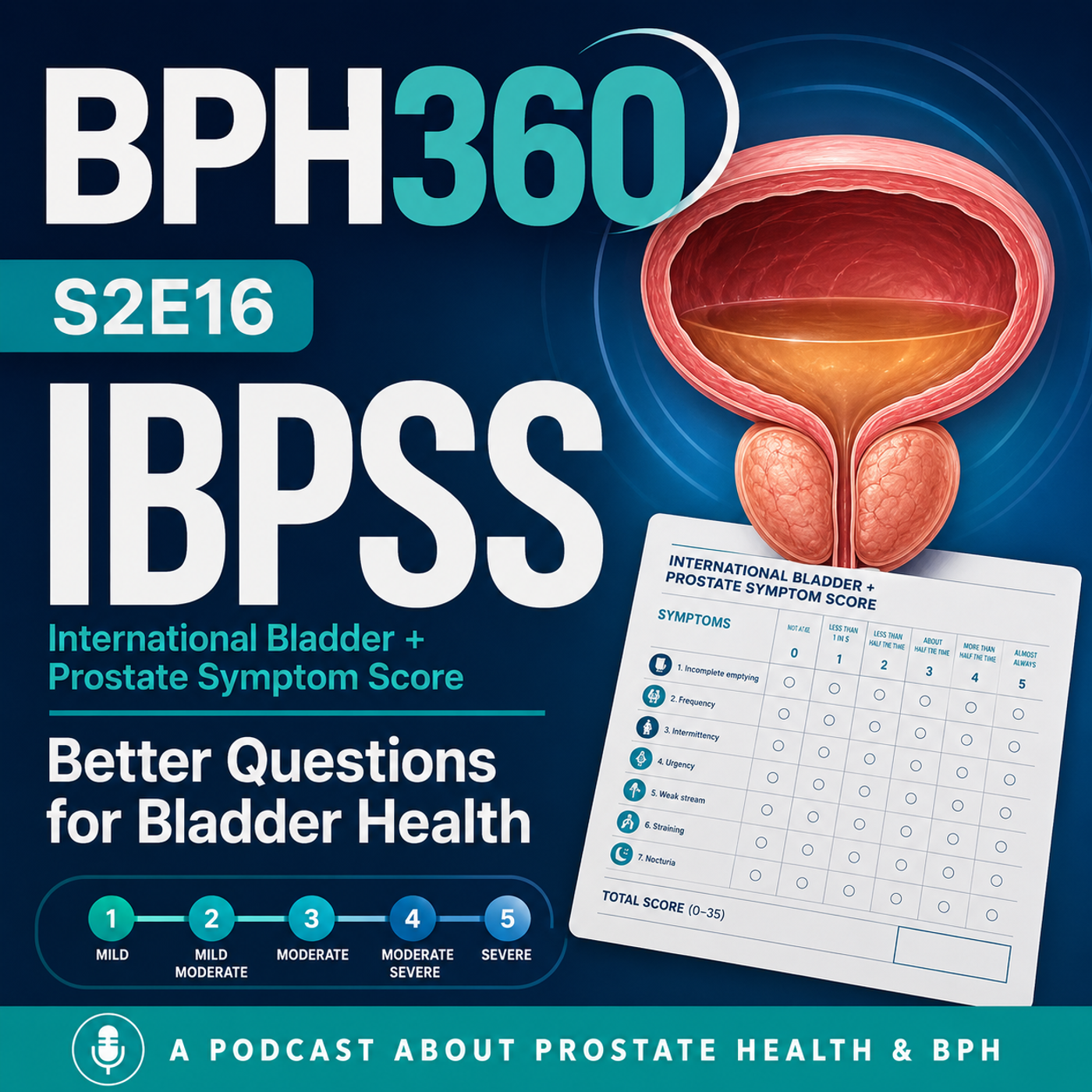
BPH360 · Man vs Prostate
IBPSS: Better Questions for Bladder Health Most men with urinary symptoms are asked one basic question: “How are you peeing?” But that question may miss the bigger issue. In this episode of BPH360, Dr. Wayne Kuang introduces the IBPSS — International Bladder and Prostate Symptom Score — a one-page communication tool designed to help men, partners, and clinicians see the bladder story earlier. The prostate may be the blockage, but the bladder is the organ at risk. It is the organ that stores urine, empties urine, wakes men up at night, causes urgency, leaks without permission, and may eventually go into retention or fail. Unlike the kidney, liver, heart, or lung, the bladder is not routinely transplantable. This is why BPH should not be viewed as “just prostate enlargement.” In the Man vs Prostate framework, BPH is better understood as prostatic bladder obstruction — a prostate-driven problem that can threaten bladder health over years or decades. In this episode, you’ll learn: Why “How big is your prostate?” is not enough Why the bladder must be part of every BPH conversation How the IBPSS builds on the classic IPSS Why the original IPSS questions are preserved How the IBPSS reorganizes symptoms into voiding and storage groups Why urgency, leakage, retention, and sexual health deserve a seat at the table How the IBPSS mirrors the Five Stages of Bladder Health Why Stage V bladder failure may require objective testing Why better questions can lead to better diagnostics and shared decision-making The 3 major IBPSS changes: 1. Bladder is added to the title Because the bladder is not a side character. It is central to the story. 2. Symptoms are reorganized Voiding symptoms help show when urine flow is slowing. Storage symptoms help show when the bladder may be struggling. 3. Three key questions are added The IBPSS includes questions about urgency urinary incontinence, urinary retention requiring a catheter, and sexual health. Key message: The IBPSS is not a diagnosis. It does not replace your doctor. It does not replace testing. It helps start a better conversation. Because if the first question is wrong, the whole care pathway can drift in the wrong direction. Ask: What about my bladder? Learn more at: ManVsProstate.com For education only. Not medical advice. For personal care, consult your doctor. #BPH360 #ManVsProstate #IBPSS #BladderHealth #BPH #EnlargedProstate #ProstateHealth #UrinarySymptoms #MensHealth #Nocturia #UrinaryRetention #OveractiveBladder #SharedDecisionMaking
Wayne Kuang: Thanks for watching. If bladder health matters to you, watch more. Follow BPH360 to stay ahead of your symptoms. Listen on Spotify and Apple podcasts. Welcome to BPH360, bladder health matters. I'm Wayne Kuang Cleveland Clinic trained urologist. BPH is not just prostate enlargement. It's about protecting your bladder. Learn to ask better questions, take control. For education only, not medical advice. For your care, consult your doctor. Quick pause. This is serious moment. If your urine flow is very slow or you're having worsening urgency, leakage or retention, that can be late stage disease. At that point, supplements and pills may not be enough. On manversprostate.com, there are simple tools to help you see where you may be on the bladder health stages and whether it's time not to wait. And to go see your doctor and to ask, What about my bladder? Learn more at ManVsProstate.com Back to the episode. Most men are asked the same basic question when they see their doctor for urinary symptoms. How are you peeing? Is your prostate causing you problems? But those questions may already be pointing us in the wrong direction Because the organ that we all are trying to protect is the bladder. The prostate may be the blockage, but the bladder is the organ that's working harder and that is struggling. It is the organ that now is becoming overactive and the bladder is that organ that may be starting to leak when it contracts without permission. Additionally, it may get to the point where it's unable to do its job and you go into retention where you can't pass your urine anymore. And yes, the bladder is the organ that if pushed too far can actually begin to fail. And unlike a kidney, a liver, a heart, or even a lung, the bladder is not an organ that we can routinely replace with a transplant. So when we talk about BPH, we need a better way to ask what is happening to the bladder. And that is where the IBPSS comes in. The International Bladder and Prostate Symptoms Score. Not a replacement for your doctor, not a magic test, not a diagnosis by itself, But a better one page communication tool to help you, to help your partners and clinicians see the bladder story earlier. For decades, men with urinary symptoms have been told that they have BPH symptoms, that it's just part of getting older, it's just your prostate. That sounds harmless, but it hides a major problem. BPH means benign prostatic hyperplasia. But as you now have learned from watching the previous episodes, there's nothing benign about it. That's why man verse prostate, we call it prostatic bladder obstruction. To remind everyone that there's a obstruction caused by the prostate That's affecting your bladder, which is not transplantable. It's not just about how big the prostate is, because it is like a donut. ⁓ And what we need to know is much constriction, how tight is that donut hole? Because when it gets too tight, it can have ⁓ adverse impact, ⁓ negative consequences on your function. On your bladder span, the number of years lived with optimal bladder health, which is critical for your overall health span, the years lived in optimal health. Because yes, you can actually have a big prostate, but if that donut hole is big too, your symptoms may be mild. But you could also have a smaller prostate. But if that donut hole is very tight and constricted, you can have significant major symptoms. Yes, a man can have urgency, especially when that bladder muscle is becoming overactive and struggling, and he can also have leakage because that bladder is squeezing without permission, causing urinary leakage. And yes, a man can go into retention when that bladder can no longer operate properly and cannot empty the urine. the real question is not simply how big is the prostate, the real question ⁓ is is the relationship between the prostate ⁓ and bladder and your symptoms? That is why the man verse prostate framework focuses on the five stages of bladder health. Because as that prostate may grow larger, it may grow tighter in the doughnut hole. Thus the prostate may be obstructing the bladder outlet and things will slow down stage one of the But over time the bladder may begin to struggle. At first the bladder can compensate, but then it begins to struggle and it begins to quiver and it becomes overactive stage two, causing urgency frequency getting up in the middle of the night to pass your urine. But then if we don't address this issue, the bladder can start to act out like a rebellious child squeeze without your permission, causing you to leak urine down your leg. Stage three urgency and continence. At this point, it's not simply an annoyance. It is now really beginning to affect a man's confidence. A man begins to distrust his own body. He may have to start carrying pads. He may have to bring extra underwear or a change of clothes. He may stop going out of his own house. He may stop seeing friends. And if you really don't take care of it, your bladder, just like a man can have a heart attack, the bladder may suddenly stop working and you show up in the emergency room with two liters in your bladder and now they have to put a catheter in, to drain out all that urine. For most men, this is terrifying. You may think that you're managing things okay, you may think that you're just getting older. You may think that this is just simply annoying, not realizing that it's actually dangerous. And heaven forbid if you wait for too long and don't get the diagnostics and the data that you need, it may be too late and you've allowed your bladder to get to the point of stage five. Where now the bladder no longer works and you're facing a lifetime of catheters. Yes, these stages are not always perfectly clean. They're not always perfectly distinct. Stages can be skipped, stages can coexist at the same time. Yes, a man can have blockage as well as urgency, or even getting up in the middle of the night, but also having leakage. Human biology is messy and it's very complex, especially for men. As you now know, it's not just your bladder you have to account for, but it's also that prostate. And as it gets bigger, its donut hole gets tighter, making your bladder work harder and harder over five years, ten years, two decades. because human biology is complex, it is important for us to have the stages because it gives us a language and language matters. Because if we say that symptoms are only because of the prostate or have symptom scores that only have prostate in the title, like the International Prostate Symptom Score, we may only think that what's going on is simply annoying. But if we say that your bladder may be under stress, maybe struggling. and ask what about my bladder, the conversation immediately starts to change with yourself and with your doctor. That is not fear mongering, that is simply clarity. Clarity of thought and clarity of communication. And clarity is what is required if you are to engage in shared decision making with your doctor. Where together you can look at the diagnostics, the data to make the best decisions for your life. And for both your prostate and your bladder. The International Bladder Prostate Symptom Score, the IBPSS, is a single page questionnaire. It is based on the very familiar, most widely used global IPSS, the International Prostate Symptom Score. Which is actually translated in over fifty languages. Now it's really important that we preserve the core aspects of the tried and true IPSS. We have kept those items from the IPSS a hundred percent the same. They are completely identical. The scoring therefore also stays the same. So if you complete both the IPSS and the IBPSS, the original symptom scores and the quality of life score will be identical. So you and your doctor can compare those numerical scores with all of the established medical literature that talks about BPH. To help you choose the best management strategies We are not throwing away the classic tried and true older ⁓ score. We are merely building upon it to help you and your doctor tell a better story to understand what is going on, what is at risk, and how to make your life even better. We are simply reorganizing it so it communicates a clearer picture, a better story for everyone. There are three major changes. Let's take a closer look. So you can see here, here it is, a single page. So it's easy to fill out, it's quick to fill out, and it's easy to review for both you and your doctor. Change number one is we put bladder in the title. Let's zoom in so you can see it a little bit better. As you can see here, we simply added the word bladder. But this is so important. It's important for all of you to know that your symptoms getting up in the middle of the night, slower flow, leakage, is so much more than your prostate. It is very complex, and part of that conversation must include the bladder. and your bladder health to optimize your bladder span, the number of years lived with optimal bladder function. Because yes, the bladder is not some side character in this story. The bladder is central. The bladder is an organ that helps you store urine. It helps you empty urine. It can be responsible for waking you up at night. It can be the one who's sending you those signals of urgency and having to find a bathroom quickly. It can be that organ that's causing you the leakage of urine down your leg that stains your genes. And yes, your bladder may go into retention. And yes, this is the organ that is not transplantable, that is so precious that we are trying to protect it and preserve its health. So adding the word bladder in the title here is not just simply cosmetic. It corrects the frame. It corrects the window through which we examine this problem that's very complex for too many men. If the title only says prostate, then we naturally think that it's a prostate problem, But with both the bladder and the prostate in the title, you can start to really put together the pathway of both the bladder and the prostate and how it affects your life story. And yes, the prostate may be the source of the obstruction, but the bladder is the organ that's been put at risk that is the victim. That is the shift in thinking that we all need with this very first change. Change number two. The second change is that the original questions were kept a hundred percent the same, but simply reorganized into two groups. First are the voiding symptoms. These are the symptoms that often reflect the difficulty of getting that urine out. We've talked about them, the weak stream, the intermittency where the urine flow starts and stops and starts and stops, the straining, That sensation of incomplete emptying. These are the symptoms that most men think about when they consider the prostate blocking the flow of urine from the bladder. This is one part of the story. This is the first stage. As we see here on the left, stage one, things slow down. But now as the bladder begins to struggle, working harder over five years, two decades, it begins to quiver and it becomes overactive. And we've talked about stage two, the overactive bladder, where men are starting to have issues with urgency, frequency, and getting up in the middle of the night. These are the storage symptoms, Yes, these are symptoms that often reflect that the bladder is struggling and needs your help. This is the stage where your bladder starts to take control over your life because now you're having to remember to pee and empty your bladder before you go out to the grocery store, or you're having to remember to book the aisle seat on the plane so you can quickly get to the bathroom. Or having to recognize that you need to always use the bathroom right before going into the movie theater. That bladder is affecting your sleep, it's affecting your travel, your exercise, it's affecting your work, your intimacy and your mental health. So as the IBPSS is able to separate the voiding symptoms that are correlating with your blockage of the flow of urine stage one where things slowed down, it also reorganizes the symptoms, the storage symptoms that show how your bladder is becoming overactive stage two as it's beginning to struggle with the work of getting that urine out. It helps you tell a better story both visually as well as linguistically. Not because the original questions were wrong or inappropriate, but But because the patient conversation needs to be clearer, it needs to have a framework within which we can start making choices about diagnostics and management strategies. When you see your voiding symptoms all grouped together, you can see that hey, I think my prostate donut hole is getting too tight. I think I may be already in stage one. Or when you start to see that your symptoms are also including this group of storage symptoms, urgency, frequency, nocturia, you can tell yourself that, hey, yeah, I think I might be in stage two, the overactive bladder. That is already a better conversation, not just with your doctor, but also with yourself. It can help you self-ignite to do what you think is best for yourself, for your own prostate, and for your own bladder, so that you can live your best life incontinence-free and catheter free. As for too many men, or even for you, we tend to always just group everything together into one big clump of symptoms. And for too long, we have simply called it prostate problems or just part of getting older. It's the aging process that all men go through. But from the perspective of bladder preservation or preserving your bladder span, these constellation of symptoms tell now a very different story. So yes, the way we organize these symptoms really matter. Then for the third change, we added three additional questions. These questions were designed to capture major clinical and quality of life issues that the original IPSS did not really fully bring into the conversation. The first question is right here below. You can see it. Stage three. Have you ever leaked urine or wet up pad after feeling a sudden need to urinate? Urgency incontinence. This question matters because leakage is not just a little bit more urgency. It is a threshold event. It changes your confidence, your planning, your travel, your clothing choices. Your relationships, your sex. It changes how you see yourself. In the five stages framework, urgency and con at stage three, it suggests that you're starting to lose control. Because your bladder is not simply irritated. It is now becoming rebellious. It's squeezing without your permission. The second question is about retention. We see that here right below stage three. Stage four, acute urinary retention. Have you ever been unable to urinate and needed a catheter to drain your bladder? Obviously this is a major event. We've talked about it before. A catheter is not just simply some form of treatment. It is a warning sign that you and your bladder are in serious trouble. Yes, it is terrifying to go to that emergency room to be in pain. Because now you're realizing that all these symptoms that you've been having for years is not just simply about getting older. Because in the five stages framework, this is now stage four, retention. Where just like the heart can have a heart attack, the bladder can suddenly stop working and you show up in that emergency room with one or two liters in your bladder. It means that the system has failed in a way that you cannot ignore anymore. And the third question is about sexual health. And we see that at the bottom down here. Sexual health in the last month, have you had ejaculation and or erection problems? This question about sex, your sex span matters because BPH treatment decisions are not just about urination. They are about your sexual vitality. It may matter to you to have continued full and hard erections. It may also matter to you that you continue to have full ejaculations. All of this matters, desire matters, confidence matters, intimacy matters. Yes, a man's pathway, bladder span, as well as a sexual health pathway, sex span ⁓ connected to allowing you to live the best version of your life. The decisions you make with your doctor can have consequences on both bladder span and sex pan, whether it's medications, procedures, conditions, or the stage of bladder health that you are currently in all can have ramifications on your sex life, and you need to make sure that this is brought into the conversation. That's exactly why we put this question at the end because For too many men, and actually for too many doctors. It is a very taboo subject and it's very uncomfortable. And we wanted to make sure the question was here so that it was at least on the table and you all together could choose when you want to bring that up Because yes, if you are serious about shared decision making, then sexual health cannot be ignored. It cannot be an afterthought. It does deserve a seat at the table with your doctor. The power of the IBPSS is not only in the questions, it is the sequence. The questionnaire is designed to mirror the five stages. And show you the progression that you may be on as you go from stage one, two, three, four, and eventually into stage five. It is one potential story. It helps you pinpoint where you may be in the present and where you may end up in the future if you choose not to self-ignite and not choose data from diagnostics to help you make better decisions. Yes, stage one is about obstruction. Things slow down. The prostate's getting bigger and the donut hole is getting tighter. The prostate donut hole is changing shape and blocking up the outlet from your bladder and now your bladder has to work harder. And this may show up with the weak stream, intermittency, straining, and incomplete emptying. Stage one. And we saw that in the voiding subscore, which is grouped together at the top, stage one. And then there's stage two where we group together the storage symptoms. How well does your bladder hold urine? And as that bladder now is working harder over five years, ten years, two decades, it begins to struggle, it begins to quiver. And becomes over active stage two. Yes, you are having those urgency, frequency, and getting up at night to pass your urine. And then enters stage three, the urgency and continence question. As men enter into this third stage from one to two to three, things are starting to get serious. These are tipping points for many men. When urgency becomes leakage, becomes incontinence, becomes having to wear a pad or to stuff towels in your underwear, it creates anxiety. Because you may not make it to the bathroom in time. You may stain yourself, you may wet a pad. You are bringing those extra clothes, you stop doing the things you love. That's why urgency incontinence stage three is such a serious moment because things have now crossed a line. And then stage four begins to enter into the conversation when you cannot empty your bladder. And now you're showing up in the emergency room. And we capture that here once again in stage four. This question, Have you ever been unable to urinate and needed a catheter to drain your bladder? yes, it's terrifying. Emergency room, a catheter being placed. for too many men or even for you, you thought you were managing things well, but now things have entered into a crisis situation. Because the system is crashing. And then there is stage five where the bladder begins to fail. If you notice, it's actually not on the IBPSS. And you may wonder why. Well, stage five requires the proper objective testing with the proper diagnostics with the right data. Working with your doctor at the table of shared decision making. The IBPSS will help you identify whether or not you're at risk of these later stages, especially if you're ready starting to enter into stage five. Quick tip, a very easy test is called the post-void residual. That means after urinating, how much is left behind in your bladder? That can often be done with an ultrasound If you are not able to empty your bladder well and things are beginning to back up to very high volumes, that may be a sign of your bladder beginning to fail and lose its function. Your bladder span may be compromised. Please note, stage five bladder failure sometimes is harder to capture. Because a failing bladder does not always scream. Sometimes it comes on very, very quietly. Over months, over years, over decades. And for some of you, you may think, we'll definitely know when it's happening, because I should feel it, but that's the tricky part. For too many men, it creeps up on you very insidiously, very slowly, and you may not even feel the fact that you may be holding back ⁓ one and a half, even two liters. So if stage five is suspected, talk to your doctor about getting some form of testing. We group many different tests into a categorical term called Eurodynamics. That's any test that sheds light with either qualitative andor quantitative data about how your bladder is working. Is it weak? Is it strong? Is it struggling? There are three levels to that. There's basic, enhanced, and advanced levels of testing with urodynamics. That's for a later date at a later episode. But understand that one of the very easy tests that we can do at a basic level is call post void residual. How much is left over in your bladder after you go use the bathroom and pass as much of your urine as you think you can. Remember, the IBPSS does not replace your doctor. It does not replace diagnostic testing. It points all of us towards better questions and better data. That is the key. The IBPSS is not trying to be everything to everybody. It's just trying to improve the beginning of the conversation that you're having with your doctor when you start having problems with your voiding symptoms from maybe the donut hole getting too tight or your storage symptoms because now your bladder muscle is beginning to struggle and is compromising your bladder span. It is critical that the start of the conversation with your doctor starts on the right track. If it doesn't, then your whole care pathway can begin to drift astray. Losing focus and allowing your bladder to progress needlessly into the later stages of disease. Because yes, a man can be quote unquote treated for symptoms for many years while your bladder continues to struggle. You may have already been reassured by your doctor that everything's okay, that it's no big deal, that your prostate isn't even that big. while your bladder has already started showing warning signs that it is in trouble. Another big fear of mine is you or someone else who's been challenged with BPH or prostatic bladder obstruction is falling victim to the polypharmacy epidemic where you may be given medication after medication or higher doses without anyone simply asking. What is my bladder doing? Am I at risk for the late stages of disease? Am I still in the window of curability? Do I still have time to protect my bladder span? This concludes part one. In the next episode in part two, let's talk about how we can actually fill out the form, where can we access it, and how maybe you can take this data and use it when you talk to your doctor about your urination problems to protect your sex span, your bladder span, and to allow you to live the best version of your life incontinence free and catheter free.