
Bourbon Lens · Bourbon Lens
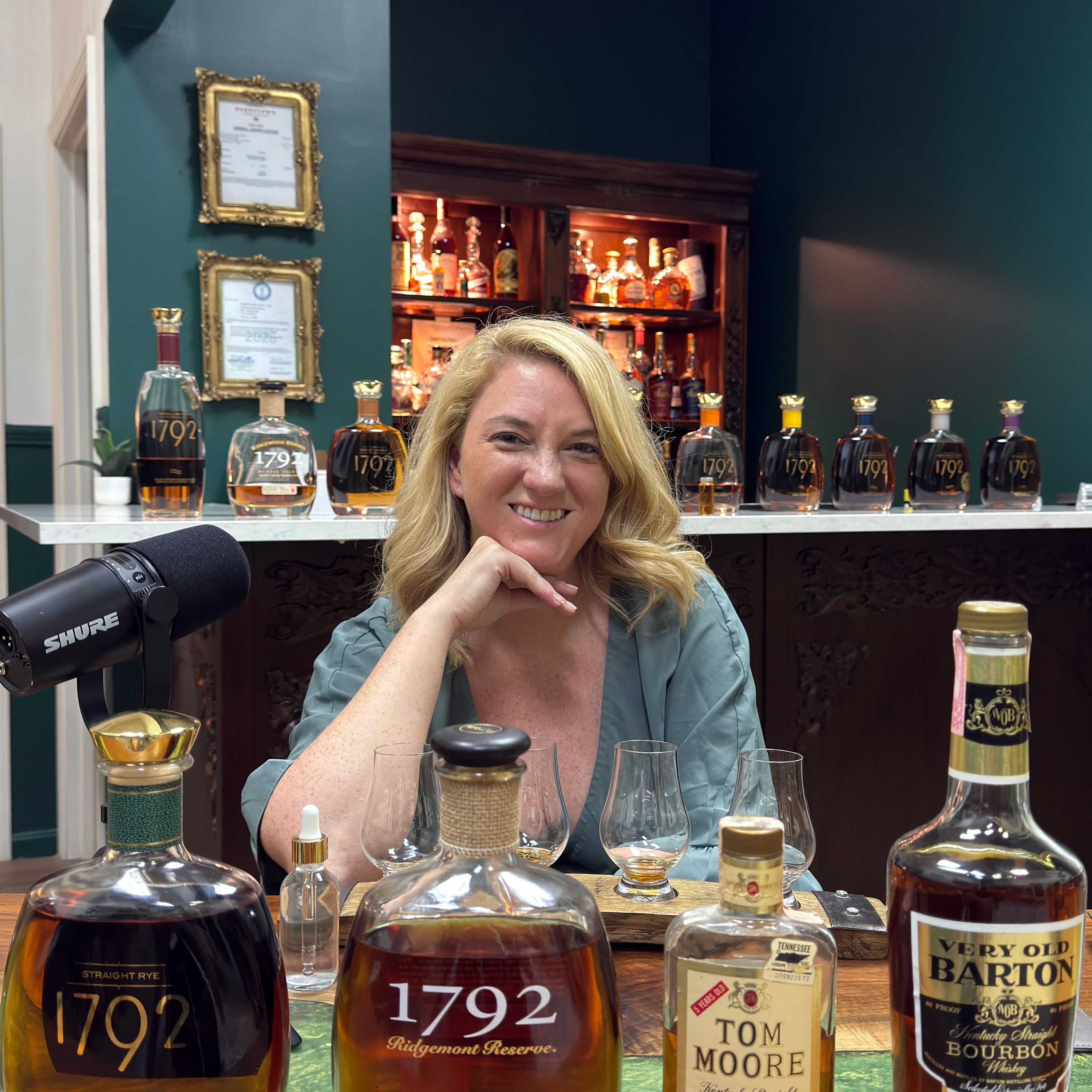
This week, Bourbon Lens heads to Bardstown, Kentucky to sit down with Whitney Rye — founder and CEO of The Parlor Room, host of The Mash Bill podcast, and better known on Instagram as Bourbon Duchess. Whitney built The Parlor Room around a simple idea: teach people the story behind the bottle, not just tasting-note jargon, in a space designed for rare, allocated, and vintage pours. In this episode, Whitney walks Jake and Scott through the tangled, dramatic history of Barton Distillery — from its 1889 roots as one of the first distilleries to reopen after Prohibition, through a 1940s fire and rebuild under Oscar Getz, a name literally drawn out of a hat, a trademark lawsuit from Woodford Reserve that forced a mid-run name change, and the 2013 pivot to Sweet Wheat. Along the way, the group tastes through a vertical flight of Barton-family whiskeys spanning nearly 40 years — culminating in a first taste of the brand-new 1792 Straight Rye. In this episode: Whitney's origin story — from My Old Kentucky Home State Park to founding The Parlor Room Why she intentionally leaves formal "tasting notes" out of her classes The real (and litigious) history behind the Barton/1792 name A vertical tasting: a 1986 Very Old Barton, a vintage Tom Moore, Ridgemont Reserve 1792, and the new 1792 Straight Rye Why 1792's rye whiskey is also the backbone of several Buffalo Trace rye releases A broader conversation on bourbon oversupply, aging whiskey, and why age statements may be bourbon's next chapter 🥃 Featured pours: Very Old Barton (1986), Tom Moore 5-Year, Ridgemont Reserve 1792 8-Year, 1792 Straight Rye 📍 Location: The Parlor Room, Bardstown, KY Subscribe to Bourbon Lens for more distillery visits, tastings, and bourbon history. The Parlor Room, Whitney Rye, Bourbon Duchess, Bardstown Kentucky, Barton Distillery, 1792 Bourbon, 1792 Straight Rye, Ridgemont Reserve 1792, Tom Moore whiskey, Very Old Barton, Sazerac bourbon, Buffalo Trace, vintage bourbon tasting, dusty bourbon, bourbon history, Kentucky bourbon, Bourbon Lens, Bourbon Lens Podcast, The Mash Bill podcast, bourbon vertical tasting, bourbon podcast, whiskey podcast Hashtags #ParlorRoom #BourbonDuchess #BartonDistillery #1792Bourbon #1792StraightRye #BardstownKY #BourbonLens #VintageBourbon #DustyBourbon #KentuckyBourbon #BourbonPodcast #WhiskeyPodcast
Bourbon Lens Studio: Welcome back to another episode of the Bourbon Lens with your host Jake and Scott. In this week's episode, we head down to Bardstown, Kentucky to stop into the parlor room. So sit back and buckle into the latest episode of the Bourbon Lens. We are joined by Whitney Rye, owner, proprietor, CEO, founder of the parlor room. And we are excited to talk to you, Whitney, one about seventeen ninety two, but more importantly, the experiences you have created here in Bardstown, Kentucky. So thanks for joining us. Thanks having me. This is so much fun. Y'all gave me a reason to pull out some of my just just some of my Barton. Some of her her children. Yeah, exactly. Small flex. Yeah, yeah. It is a it is a small flex. When you think you have 1792, you don't. Just just remember that. but we're excited to to talk to you. We got to come do a media kind of blitz. Shout out Deborah. for putting that together and kind of see what you all are doing. But today we're gonna walk through kind of a little bit of what you would do here in person to draw people here, but also allow you to flex a little bit of your knowledge on 1792. but first and foremost, you've got a really good story How did you get here? I started working at my old Kentucky Home State Park. And this was during COVID. I was basically talking to my manager, park manager, shout out to Jeremy Riggs. And he was like, We are missing the mark. We have to have some bourbon here. There's so many things that are happening right now and we just need to get on board. And I was literally like, I have the best idea. And so it actually started by me writing, researching, curating a Barton seventeen ninety two experience because this was just a little while after they had closed down the like tours to visitors that were coming in. And so I started doing this and I picked up my office phone one day. And it was Ross Cornellison, Master Distillery Report in 1792. And he was like, Hey, whatcha doin'? Like, I've seen this all over the place. What is it? And I was like, Come and see. And so invited him to come down. Him and sixteen of his executives from Barton and Sazrak end up coming and watching me like tell their story, which not intimidating at all. As somebody who doesn't get nervous, I was nervous, right? So I did the class and basically told him I was like, look, I'm gonna do this exactly the way that I do it for guests when they come in. I cause that at this point I had been doing it for two or three months and so I had it down packed. And I told him I was like, I'm happy to take notes at the end, but let me get through everything. And then whatever you guys want me to adjust, you know, if I got something wrong, tell me. So I come to the end, serve an old fashioned, because every single class comes with a cocktail. And they stood up and gave me a standing ovation. And it was one of the coolest moments up until, you know, that point in my life. Because I was just like, I have something. Yeah. This is this is what I need to do. And so shortly after that, I left and spent a ton of money creating this space. It took me six months. and then I opened the doors June 6th of 2025. So you guys were here for the media day, celebrating my one-year anniversary this year. And yeah, along the way, I started doing my The Mash Bill podcast, where it kind of allowed me to take everything full circle, right? So I want to become a whiskey historian, a bourbon historian, and I want to be able to like educate people about the stories behind the brand. That is what I fell in love with in this industry. That is what I love talking about. And so I started doing this podcast where I go in to distilleries, I sit down with brand founders, master distillers, icons, legends. And I let them tell me their story. And then I take that information and I come here and I teach the class to other people. Yeah. So it's been really, really cool. yeah. And then along the way I started doing a lot of social media and just kind of documenting, hey, I'm at this distillery today, I'm learning about this, I'm hanging out with this person, I'm learning about this. And that kind of blew up to become Bourbon Duchess. And so now I have, you know, multiple social media accounts that are really, really fun. It's a great outlet for me. And then parlor room and Mashville podcast. And in addition to all of that, I am a single mom of three kids. And yeah, so it's I'm never not busy. No, that that's true. And and one thing I will say is you have an incredible story. and that's another time for people to to be told that. But if you do want to get to know Whitney, I would say one of the the in the short time that we've gotten to really know you, you're very personable. and the second thing is Very vulnerable. So you you let people in to share that story with you know, the rest of us. And so I think that made this really easy to kinda, you know, tell Deborah at the end of that media day, like, hey, let's let's get something on the books. Let's let's have a discussion because we walked away both, like, man, like this is kinda cool. I learned something and you know, after eight years I learned something new every time I crack a bar. I was like like five minutes in, I was like, All right, I can crack Jake. I'm good. Because you were like Not I don't want to say combative, but you were like, all right, you want to teach me something? I am combative. Like, I do. Let's pull out the big guns. Fellow podcaster. I'm gonna start Right. Yeah. I mean, I but here's the thing, like, I want to challenge people because we think the status quo is, you know, pull up, I know this bottle or that bottle, dah dah dah dah da. We wanna unpack and tell the stories of the of the bottle. That's why we've been doing this for eight years. It's kind of crazy to think about. but it's fun because this is a brand. One, this is one of our very first barrel picks we did with was in 1792 during COVID. shout out to the SBS getting lucky and winning the barrel. but don't ever pick a barrel and two degrees in the warehouse because we tried to do that with ice on the ground. Didn't work. And then we went into the gift shop and they had a cinnamon candle. And they're Hey, which one would you pick? And I was like Cinnamon candle, I guess, is the one we'd pick. long story short, Danny Kahn was the master distiller at that time. Danny goes, You picked this one, right? And we're like, Yeah, we actually picked that one, and the barrel sells out in two days. So fun times with 1792. So excited to give everyone a little bit of a glimpse of what you would get here on site. So with that being said, give us the foundation of Seventeen ninety two. And you can go a little long winded here if you want to. Michael. Yeah. Because there there's a lot to unpack. There's so much to unpack. I I think the coolest thing is this is a distillery that has had to rebuild itself so many times. And like, how are you a how do you become a distillery that sticks around for a hundred and fifty years? Right? So I think just their story is something that I'm all I've always been really, really drawn to. And it really starts with Tom Moore. So I like snagged this bottle off of a secondary group. I won't tell you guys how much I paid for it, but not too much that I didn't pour it for us today. You know, I cracked this today because I was like, ooh, this will give me a reason. I was gonna take it over to Ross's house, but I'll just take it to the distillery when we're done and I'll just let finish it. but yeah, so this distillery goes all the way back. I mean, literally all the way back to seventeen eighty nine. And they still their claim You know, every distillery kind of has their own little hashtag, if you will, or like headline. And theirs is that they are the oldest fully operating distillery in Bartstown. So their sister property, Buffalo Trace, I'll say their big sister, Buffalo Trace is the oldest continuously operating distillery in the United States. I think I got those right. That's what they say at least. I've I've I've heard it from Freddie a few times. Yeah. Well, and the biggest thing that change that right is because they were able to get Buffalo Trace was able to get a medicinal license. Yeah. Barton was not. But the beginning of this distillery was kind of a lot of ownership changes. Let's buy some, let's buy five acres here, let's buy another 12 acres here. we need some more warehouses. So the first part of their story, literally from did I say 1789? 1889. Sorry. eighteen eighty nine, all the way back from eighteen eighty nine up until, you know, prohibition started was really the time that they were just figuring out what they were doing. when I say there were a lot of ownership changes, it it it's kind of a weird and confusing story, so I'm gonna go around it so I don't get anything wrong. But Tom Moore worked for a distillery and he ended up you know, the girl he married and the girl that John Willett married, they were like all related. So John Willett married his Tom's sister. And so they ended up going into business together. So the person who ended up, you know, breeding Drew Coolsbean down the line helped to start this distillery. And then he had some financial turmoil, they kind of parted ways. He sold his stock. There were a lot of auctions. There were a lot of different things. And again, I can go into detail. It's not as fun as once we get to like the 1940s part. So basically all of this kept happening and genuinely it was 116 acres in Bardstown and then they bought acres across the road to the point that New Haven Road, that is currently New Haven Road in Bardstown, was running down the middle of the distillery. So they warehouses on both sides, they had distillery parts. Prohibition hits, obviously they had to shut down. And then they started kind of rebuilding and they were one of the first to reopen after Prohibition. Before Heaven Hill, before Will It. They're, you know, DSP number twelve for a reason. So super super cool, but long winded. In nineteen forty, they had a little bit of turmoil, ended up closing the distillery, and then Oscar Getz comes into play. So that's kind of where Tom Moore's story ends. But that one's ninety proof, and we're gonna start with a very old Barton, which is eighty six proof. Okay. So I wanted to tell that story first, but we're gonna drink that for a second. All right. I still have to keep it in order. I mean, hey, by all means. Very regimented tastings. So we're we're two nineteen forty and one of the things that a lot of people don't get to see, especially anymore, because as Ross will say, or anyone from Sazraq will say, hey, this is a working distillery, it was not meant for tourism and Ross's or whoever the master distiller's office sits on top of the boiler basically and it you hear it and it's humming. Yeah. Ever make a proof of luness though? Yeah, it's it's a lot of fun up there. It is a lot of fun up there. but they're they're a really hodgepodgy place. So like even though it's down in the holler almost, they you know they've got rick houses up there and over there and back yonder and all of those things. Does that all play back to how they purchased land back in the day? Okay. They were literally trying to buy any piece that connected to the stillery at the time. And sometimes they were buying pieces that didn't connect, and then they would just wait a few years to buy that piece in the middle. But it's kind of this like sloped property that they ended up purchasing that made the big difference for their warehouses. And I also think that's a really cool thing about 1792 and Barton as a whole, you're getting such a variety from those warehouses, right? I mean, you will taste it today, obviously, but anytime you go through whenever you taste the single barrels and stuff. They do try to keep things consistent, but everything's proprietary. I always say if you're around Ross, you can play a drinking game with the word proprietary because he is very good at what he does. And especially around me. He's learned his lesson. Yeah. but yeah, I think I think that's something that's really unique because you have other places that are very adamant about the way that their product ages and then trying to reimagine that or not even just recreate that in a different place. Barton didn't really have that opportunity because they started this so long ago. And again, there were so many hands involved. Yeah. There were so many people that came up along the way. There were a lot of financial issues. You know, there were fires. There they're they had a lot of issues. They are a workhorse through history and then currently at their distillery. And I think that just I I think that's one of the things that really draws draws me to their story and their brand. For sure. So Scott, very old Barton. One that you are a familiar with. You you used to drink this old. Not this old. Not very not this very old buttons. No. No, we got a couple of the squat bottles, 1792, the s bottled and bonds, but nothing this old. Yeah. So tell us a little bit about this first pour that we have here in our glass. Yeah. So this first one is a age stated six-year-old. I was lucky enough that I picked up the phone one day and my mother-in-law was like, Hey We're cleaning out so-and-so's basement, and we found all these old bottles of bourbon. Do you want them? She runs to the bank. I was literally like, Yeah, I do. I got six of these. Wow. this is my last one, which is devastating. But it's I think it's Fulton, Hubbard and Hubbard was the law firm. So this one's actually like a single barrel. This was specifically like bottled for that law firm, and then they would give it out as gifts. I know because I have six of them that they would do this every year. So it was really, really cool to taste the difference. But this one specifically was from 1986. yeah, I mean I've been waiting to see a minute. happy birthday. Cheers. Cheers. So can I drink it yet? Yes. You can drink it any any time. So eighty six, same workhorse column. Obviously, it's been, you know, refurbished a few times and and cleaned up. So they've been pumping out of that particular distillery, like how long's that column been in there, right? So just from a history history perspective, you may not know the answer. I don't, and so I don't want to say I had a guess, but I I'm gonna I'm gonna not say that out loud. It's been a minute. Yeah. it's a very old still. It is a very old still. For very old Martin. Yeah. Well, and the cool thing is, and I will say this is something that I've researched but not confirmed. But I love what Bo Garrett says that wild turkey, we don't let facts get in the way of a good story in this industry. Yeah. So some of and I've read this in multiple places, so I'm just gonna throw it out there. But I was told, not by Ross, he's off the hook on this one, that whenever they replaced it and put that new still in, they actually left the other two because it was so difficult to get those out that they're just still sitting there. And so I was just at Barton in June, I think was the last time I was there. July. So I just picked a barrel there too. And so I was there July first and I didn't even think to look. Because like you said, right? So they stopped doing tours for a reason. Yeah. Yeah. You go to Bartsum Bourbon Company and it is this glorious, like pristine, beautiful place that they lit their hashtag tagline is a modern take on a traditional industry, right? So they were able to build everything from the ground up for visitors. Yep. Barton did not do that. Watch your head. At all. Don't touch that. You're literally like ducking under like hot pipes and different things as you go through. It is there's dust everywhere. There is I mean there it's just dust like grain dust. But they're I'm not saying they don't claim just for the record. But it it's a really cool experience because you feel like you're behind the scenes. Yeah. You feel like you're not supposed to be there for sure. You're not. But yeah, to be able to like go in there now. And still walk around. I still like yeah. I try to stay in that moment every time I visit. And I don't I mean, I love Ross, I love his wife Megan. They're amazing people. I don't get to go there nearly as often as I would like to because, you know, I have to have a reason. Like buying a barrel. So, you know, they'll always get my money. Clearly they'll always get my money. Yeah. But yeah, whenever I do get to go, I'm still I just feel like a little kid. Like just Taking it all in, I the amount of videos I have from Barton on my phone is insane. Yeah. So Scott, birth year whiskey. What do you think? What's what's your thoughts? Eighty six proof, right? So in from nineteen eighty six, eighty six proof. Yeah. I mean it on the nose it it has like a it has it feels like it's a wine. Mm-hmm. Like it's got like a light fruitiness, a little bit of oak. And then yeah, the sweetness is is definitely there. And then on the palate, if you told me this was eighty six proof Like after, I would have been like, wow, wow. 'Cause it it drinks a little bit more viscous and ol like higher proof than what it is. Yeah, I agree. A lot of people say eighty six proof, that's nothing, you know. But like this has body, it has viscosity, it has even like a little proof punch to it. Yeah. Which it's nice. Yeah, that that's what I was kind of shocked by, like it It drinks it smells inviting like an super easy to to approach. And then I was like, man, it's got some zip on the tongue. Yeah. and that's I feel like I think that's the allure for dusties is people who are pardon my French for all you proof people, proof horse that are going after, you know, the latest hazmat and esophageal burner. you know This can give you that feel of, you know, maybe ninety ninety, ninety-five and eighty-six. And so whatever they did, right? We have it on record, but we don't know what exactly they did to make it this way is is absolutely impressive. Yeah. and I think that's the most interesting thing about Dusty Whiskey is like the process. I mean, like you you go talk to Bruce, like the process hasn't changed a ton. It's become more modern, but like the processes are still there. I get this question a lot just because obviously, you know, we were talking about doing this and I was like, I'll just pull some bottles. Like this is what I do. And so I was actually I did an interview on the MASHO podcast with Aaron Goldfarb, who is the author of Dusty Booze. Yeah. Great read if you haven't read it yet. Yep. but we talked about it because I think it's something that I'm I focus on a lot. I love vintage whiskey for every reason you just said. Yeah. To me, it feels like this is a time capsule, right? You were traveling back to 1986 to open this bottle that I cannot even imagine like pulling this off a shelf for like four bucks or six bucks or whatever it cost back then. But that's that was what you were doing. And you were just pouring this and you were drinking this. And so to be able to go back in that place and enjoy that whiskey the way that we're sitting here and enjoying it now, obviously we have different references because you know, we're gonna try the the straight rye here later that just came out. But I think it's really fascinating when you really do dive into it. Because if you think about the way that grain is grown now, the way that our waters changed, the climate, right? Even the age of the oak that was used to make How old the trees are. Yeah. There is so many I mean, every single aspect of the process has been touched by time. Yeah. And I do think that Barton, because their equipment has been in use for so long, does have a really Like a leg up in trying to c recreate something that we all love. And but at the end of the day, this is a non renewable resource. Yeah. I can't go back to nineteen eighty six and pull this off the shelf for whatever the cost was at the time. But I can buy as many as I want right now. But when they're gone, they're gone. Yeah. And that's it. And it's got a screw cap. Yeah. Shout out screw caps. my gosh. They did so much better than anything else. I mean, not none don't get me wrong, a nice True corks fine, but screw cap. It's gonna stand the test of time. Undefeated. Yeah. But you know, one of the things that is interesting, we were chatting a little bit beforehand. Who's Barton? Who's this very old Barton guy? And why is he very old? I know. I love that. So all right, so we're going back to the nineteen forties, right? So Oscar Yetz comes in and basically buys this property and burns to the ground. They Do this magazine release that says it's coming back. We're rebuilding it. And so they they bring in Constellation Brands in nineteen forty five. And they did this big announcement in nineteen forty five that it was gonna reopen. Sorry, not Constellation Brands. This was There's so many people in this story. I'm trying to keep it all straight. They bring in somebody with a lot of money. I know, but I know this. I'll think of it and I'll just randomly shout it out later. You're good. But regardless, they got purchased, right? And when they got purchased, they were able to put more money into this. And that Oscar Getz, whenever he bought this, was already bottling Varial Barton. So Varial Barton was something that he already had. And then when he came in, he was like, you know what? I only bought this so that I would have a consistent source for my whiskey, Varial Barton. So we're gonna name this distillery Barton. But the story goes that he and his brother were trying to come up with a name because all these other brands in the forties and thirties had these like cool stories, whatever, whatever, right? They were said to have, again, we don't let facts get in the way of a good story in this industry, drawn the name Barton out of a hat. So and that's actually the story that the distillery still tells to this day. Is that they have no idea where the name came from. But apparently they just wrote both of them wrote a bunch of different names down that they thought would be cool for a brand that ideally wasn't you somewhere else. And Barton was drawn was drawn out of the hat and now here we are in 2026, still using that name, which is pretty effing cool in my opinion. Yeah. but yeah, I think Oscar Getz did a ton, a ton for this distillery. And He really helped it grow, you know, he reinvested in it, he made it what it was today. Now we're gonna go backwards a little bit because there's there's an older whiskey that we're about to try, and it's not from Scott's birth year. This Tom Moore So I haven't been able to date this. Is not dated. So sometime in the seventies, and that was me Chatting through things with Ross, you know, the only person I really didn't talk to about this was Owen Powell, who owns Neat. I usually will take things, but there's just it's it's very tough to date this one specifically because when I got it, right, the tax strip's a little off. Doesn't have anything except some numbers. Not much I can find out about this. But this is a five year old, age dated, Tom Moore, ninety proof. And that's really it. What's the Tennessee label on the front? That's just the liquor store that sold it. Nice. Yeah. So unfortunately, this spent time in Tennessee. I've got to I've saved it. Yeah. It's back to its original birthplace. but yeah. So as this goes, do they keep the same mash bill producing out of the distillery or does it change? Nobody knows. Proprietary. Proprietary. I will I only know that like the seventeen ninety two mash bill is not disclosed. I have had confirmation that the one that I think it is is the mash bill. I will not say it on the podcast because otherwise nobody will ever tell me a secret again. But former employee who was very high up in the company, confirmed that the mash bill that I thought it was is the mash bill. So it is a high ride. again, that's for seventeen ninety two. I have no idea about Barton or Tom Moore what the mash bill would have been. Yeah. So this is like Way more proofy on the nose. I was gonna say I almost smell like licorice. This one had a lot more of the sweetness. Like this is very typical caramel vanilla, beautiful, very, very sweet. This one has this almost has like smoky. Like a campfire. Yeah. Yeah. Like charred wood and You know, typically I don't like just sit here in my and just Huffing whiskey on the podcast. But when you you're drinking whiskey that's older than all of us sitting here, it's like you gotta savor it. And so guys, you get to you're gonna get to experience this straight out. So don't don't go to sleep while you're listening to the podcast. We'll get to tasting notes in a second. Yeah. So was this the first time you've had this? This yeah, I opened this just to to pour this for you guys. So like turn the label around a little bit. You can see this is there's There this one had a less of a fill line than the others. it was probably about eighty five percent filled. so I poured us three three quarters of an ounce. Yeah. Something like that. Well, thank you. Yeah, my pleasure. It's amazing how the nose doesn't match the palette on this. It's but it so That had an interesting shift. This is like I don't know about my palate today, but I'm getting this is like iced coffee vibes out of this. Ooh, I could see that. Like a little bit of like cocoa nib, a little bit of vanilla, like almost milky note. it's not viscous like the eighty six. This is a lot thinner on the palate. but it lingers a long while. It's just sitting there on the palate. And it pivots. I had to drink it twice. But it's like it's going down a road and then it stops and takes a turns a corner. And then the the hug almost gets like slightly higher. And then, you know, the Barton, I got a lot more nutty notes. Yeah. Like very wall nutty. So similar, you know, match the match the nose a bit. It had the sweetness. This one's interesting. This one tastes old. It does. But not dusty. It's got like a macadamia, like It's like one of those like really kind of bland, you know, nuts. like an almond almost. That's just like like Jordan almonds, what they give you at a wedding. I don't know why everyone passes out Jordan almonds at weddings, but we did it. Little sugar coated. yeah. And that's kind of what it reminds me of. It's like, here's like lightly sweet, lightly nutty, lightly like it's here's a piece of chocolate. And you're like, damn it, this is awful. And then you break it too. Yeah. like the Jordan Almond from an experience, not this whiskey. but this this is it's in it's It's hard to put your finger on. Well, we I do like how on the bottling they are proudly Barton Distilling Company, Nelson County, Bardstown, Kentucky. Okay, we are both of these releases, which Yeah. You know, with the times of sourcing whiskey from who knows where and all that. It's like this is this is where it is. Right. So it's like this is it. They're usually sourcing from Barton. That's that's the cool thing. They started sourcing, by the way, I didn't say this earlier, but they there are records that date back to like nineteen two nineteen three when they started like selling barrels out of their out of their warehouses. So they're like not the OG, but one of the OGs to like go to whenever you but I mean they had so many warehouses and they had an insane amount of whiskey. So it makes sense. But this one's also I think important to point out and reiterate, this one's five years old, right? So this is much younger. Yeah. we had a six year Lower proof, this is a five year, a little bit higher proof, and then we're going up to the eight year next. But this one's very interesting. Yeah. And then you said this one was a single barrel? Is the first one was a single barrel? That is my guess. It says privately selected, right? Right, exactly. Selected especially for. Yeah. So it's So a single barrel. Yeah. So a barrel pick would look like now. Yeah, maybe that's why there's a lot more character with that 'cause it Yeah. I think so. It's not blended to be a specific product. It was But I have an eight year from 1981 back there too. but that's what we tried at the media event. Yeah. Okay, yeah. So you guys got to have that. And there's such a small amount left in it. I actually need to just like move it to a smaller bottle because I'm really worried about that dissipation. Yeah. but I yeah, all of these have been just remarkable. the Tom Moore, again, was like an impulse buy. I saw it, it the prize was right, and I was like, All right, let's do it. This one's just I I'm not mad. No, it's just I'm very unique and interesting. but the nose to the palate is wildly different. Yeah. It's crazy different. Not lost for words often. This one's got me a little lost for words. And I'll reiterate, I don't do tasting notes at the parlor room. you know, I I tell you the story and that's something that I can sometimes get slack for, but I think whenever you're tasting a bourbon for the first time Unless you're in a setting like this where you're with friends and you're able to like really talk through it and you're wanting to dissect the bourbon. If you're just tasting it and then you start saying things like the schnosberries taste like schnosberries, it becomes very unapproachable for for beginners. Well, especially in a room like this where it's it's you know, four or six or eight guests. Typically it's like you don't want somebody to be intimidated to speak up. Yeah. Yeah. And they they do get that way, right? there's a lot of people and I noticed it honestly Been to a lot of distillery tours and special events and different things, and you can almost read the room. So next time you go to a distillery, just like pay attention. And when they start saying things about the tasting notes or asking what do you taste? Look around. The level of people who look like they're in a fifth-grade math class, hoping that the teacher does not call on them just skyrockets. Yeah. And so for me, I wanted to I wanted to be able to teach you something, which which I can just mark that off my bucket list. But but really I get a lot of people, I mean, we have a a ton of tourists that come to Bartstown and a lot of them are just starting their bourbon journey. Or they're getting to a point where they really want to expand, but nobody wants to feel intimidated when they're drinking bourbon. And so for me, having grown up in Bartstown, having dinner at Ross's house, right? And like I just messaged Dan Callaway the other day because somebody else posted a video with him in the Rick House, and I was like, I want to I wanna go. And he was like, come by any time. And so we like have it, I'm going there on Thursday. That's not everybody's life. And I realize that. And I'm very grateful for, you know, what I've built and and the people that I've gotten to know through this journey, but not everybody's there. And not everybody gets to really explore it as often or as much as I do. And I figured that out, you know, going back to my like origin story, if you will. maybe one day I'll become a villain, take over the world, but today's not that day. But yeah, I figured that out when I was like going and standing in line at distilleries because I was furloughed during COVID and I had nothing to do. Yeah. And my kids had to go to daycare because there like a two year wait list. So was like, Fine. Take my kid, I'll explore the day. So I was standing in line at distilleries and people were like, I'm from Michigan. I'm from Ohio. They're like, Where are you from? And I was like, Right. My name's Jeff. I'm from Barstown. I I live here. I'm gonna go right home after this. And the level of awe that people had just that I got to I got to do this every day. Mm. And I I respect that. And I am grateful that I do get to do this every day. And I know that not everybody's there. But I think tasting notes can make the industry unapproachable in my setting. Yeah. But there's a reason you guys are doing so well on your podcast. Well, I don't No one listens to us for tasting notes. Maybe because I was a world's top whiskey taster finalist. Because we slight credence, not much more than that. But I I think what what I always what we always try to do is this is what you should expect from this. Now that doesn't mean that grandma my grandma's pie is your grandma's pie. Right. You have all the flavor sensory notes from your growing up. So what I might think is Baked apple pie you think is apple struusel. Okay. Like that's semantics. Yeah. Like I think that's why like the people who can write about it, good for you. But like I want to tell you my experience. And I've had down home cooking my entire life. That's how I'm gonna approach, you know, the majority of tasting notes. I've never had a currant. I've never like, not a red one. Not a red one. Black currant. Or any of them. Inside jump. but you know all those things like I'm zero grants. I I've I've not done that. So you know what I'm gonna tell you? I'm gonna tell you what I what I can taste. Yeah. and if you ask me, I'm gonna be like, I'm not gonna tell you. No, I'm gonna tell you. But like we might not agree. You know how many times me and Scott agree on a tasting note? Zilch. Yeah. I mean you have different mallets. And you can also lead people down a path that that's probably they're like, I'm not gonna like that because you you say like licorice. I don't like licorice, but maybe I'll still like the whiskey. Well, I hate licorice. Yeah. But I still I'm gonna drink it and figure it out because like we said earlier, like the nose is so different sometimes. And I think it's a way that's why I love being able to open bottles and let people just come in and taste these rare and allocated in vintage pores, right? Yeah. You're not committing to buying a bottle. If you hate it, you don't ever have to see that again. If you love it, You can begin your search journey and I wish you all the luck in the world. you know, I think now in this in this modern era of of bourbon, it's become a lot more simple to find some of those rare and allocated bottles, which I think is great. I think we're gonna have a lot more age statements soon. I'm very excited for the next chapter because the Glut era was my favorite, as you can see in front of you. but yeah, I think there's just with tasting going back to tasting notes, I think there's So many variables. Yeah. And so take everything with a grain of salt, but also use that to guide you. Right? You know? I have different memories than both of you. And if if you start talking about currents to me, I'm gonna be like noop. Yeah. Nothing. If it didn't didn't start with biscuits and gravy, we didn't do it right. Starts and ends. See, I'm not a huge fan of biscuits and gravy. So we're And and you're from Bargetown, you kind of and Jake's sausage is from here. My parents We're not great cooks. My mom okay, we could go on a long story and another tangent. so her long story is my tangent. So this is not good for the podcast. Scott, keep us in line here. Okay. Yeah. All right, we're moving to the third floor. Okay, so this has one of my favorite stories to tell. And that and and it's honestly a big part of why I started with Barton. Other than the fact that they had just closed the stiller to the public. I love a good lawsuit. Right. So talking to the lawyer, you're a glutton for punishment. Originally in two thousand and two they started like creating this brand, right? So Bill Pharrell was kind of tasked with creating a premium product for Barton. And very similar to the Elmer Tilly story with like Blands, right? if you want to learn more about that, come to the part of the room. But Bill Pharrell was like, All right. I want to name something after 1792. So 1792, of course, is the year that Kentucky became a state. They love the state. That's why it's posted all over the place, right? Kentucky Bourbon, Nelson County, Barthestown. And so he named it Ridgewood Reserve, 1792. Well, because of the shape of the bottle and the fact that they put wood in it, this small little company that was located just right around the corner from where we are now, called Woodford. Took offense to this and they were like, hey, actually, we already have this and we've been around since 1996. Luckily, they were backed by Brown Foreman. So they took him to court, issued a cease and assist, and they won. So Ridgewood Reserve, which is this guy, Chaw. just so if anybody wants to see what that looks like side by side, only lasted for a very short amount of time. It was H-dated eight years. And so very shortly after that was released, they switched everything and they changed it to Ridgemont Reserve. And the reason I love this story so much is because how catty do you have to be to just say, fine, we'll take wood off the freaking they didn't change the bottle. Nothing else changed. It was just went from Ridgewood Reserve to Ridgemont Reserve. And I just love that fight and that feistiness. so this one is still H-dated. And it was age dated until about 2012, 2013. And that's an important time because they also took Richmont Reserve completely off the label. And that is the year that they released the sweet wheat. So sweet wheat was released in two thousand and thirteen. That was the first expression change. And it was a very big change because as I was saying earlier, seventeen ninety two mash bill is high rye. Sweet wheat does not have rye in it. So they completely pivoted And obviously it's a massive success because anytime somebody sees that on my website, they're pretty much like click click buy. Everybody loves the sweetweed. It's such a good pour. but again, if you want to hear more about the sweetweed, you gotta come here. So yeah. Ridgemont Reserve. Eight years, hundred 93.7. 93.7. Consistently. So that's the cool thing is that the proof on all these is crazy. Like the sweetweed is ninety-one point two, the port finish is eighty-eight point nine. The single barrel is ninety-eight point six. They all have these like really interesting points, but they're all proofed down to that point. Yeah. And it's because they did a lot of research and development and they were trying to figure out what what proof does this need to be at to taste as good as it possibly can. Yeah. No, this one drinks big. Drinks real big. Smells big. Yeah. Drinks big. I d added two drops of water to it while you were telling the story. the water does a number on this in a positive way. don't be don't be scared to add water to your to your to your beverage either. I agree completely. Scott, eight year ninety four ish proof. I don't remember the exact proof. I'm sorry. This is kinda like right up your your alley. I mean, this is just classic Kentucky bourbon. Yeah. But it has such a it has such a body to it. Again, it's like mid nineties proof. You're like you don't expect it, but it's there. I know everyone like clamors for like the foolproof seventeen ninety two. Me too. with a couple drops of water. Yeah. But this this drinks like a foolproof, right? It does. it drinks like in that bottle and bond category. The other thing I like about this one that you don't so again, you said two thousand eight, nine. This bottle? Yeah. Two thousand twelve. Two thousand twelve. So thirteen years, there's no banana note in this at all. Zero. Thank you for saying that. Thank you for saying that. So true. the the isolammel amyl tape, my favorite thing to say in all of bourbon. I need to put that on a flashcard. you know, there they're I'm sure it's in there. I'm sure that that congener is in there, but you don't get it from a flavor profile. Cause that's like if you were to say, what do you expect typically out of Barton today, especially in the small batch right behind us? The the bottleneck bond is the one that Ross always points to. Yeah. Like big banana note. Right. not present in this one iota. Which is which is wild. It's so full just full bodied. Like all the way around. Yeah. It's a big whiskey. Much higher than it's proof, but not in a bad way. Like I'm not getting any of the like the hug. Like it goes down smooth, but the flavor just hits you. A lot of flavor. Fully. You gotta think this was distilled in two thousand four. This is before the boom starts to even take off. Bourbon is picking up steam, but it hasn't hit full on like the locomotives going downhill and going downhill fast. which that doesn't happen till two thousand eight, two thousand nine. and then it r snowballs twenty twelve onwards. A hundred percent. That's when that was like the crazy that was the shift. Yeah. Right. even Sazerac as a company, they started releasing E. H. Taylor in two thousand eleven. And so that was when and but I think it's also again, I'm such a story person. I think it's important to go back to bourbon has to age for a long time, right? Yeah. What created that shift? Well, think about the people that we had in as master distillers as like the brand heads at that time. Jimmy Russell, right? Elmer T. Lee, you have all these amazing people when this stuff was starting to really pick up steam. And you can go back to 2004, 2005, when all of this was starting to get released. And then by twenty twelve, it was pure chaos. Everybody was scrambling, trying to buy anything and everything that was coming out because they knew about the quality. Because those people, Bill Samuels Jr., the start of the the KDA and the and the Kentucky Bourbon Trail, all of that was done during the Downturn. yeah. I mean fun. It's fun to think about. There's people that you forget like in that because like they've had like second lives on their career. Like Steve Nally, think about all the stuff he had. I'll never forget about him. I interviewed him. Back, you know, like four makers. and then Denny gets Denny and Jane get to play with it, and then you know, Blake and Beth get to like see it come to life. Yeah. Right? Like That's a makers is a great evolution story and you can come here and learn about that, I'm pretty sure. Absolutely. and so, you know, we go through a time where I find a passion for bourbon. Scott, you know, you've you've had bourbon in your background for a long period of time, but you we start the podcast in the middle of the craze. Never thought, you know, eight years later be doing this, but here we are and still still going strong. I did. Yeah. Scott definitely did. there was many times where he cursed me and the other co-host at the the top but we're here now. but I think the fun thing is while this is a perception question. Cause everyone goes chicken little. The sky's falling. god bourbon's dead. Yeah. Bloody bloody blood. Yeah. Yeah. But it's the the value play on economics. That I think people don't realize, like we're still buying bourbon high. A hundred percent. There's just so much bourbon. Exactly that's and that's exactly there's more supply than there is demand. Yeah. And so it's not that it's not that you don't want to go out and buy an eagle rare when you see it sitting on the shelf. It's that at this point, you know that it might be there the next time you come by. Yep. Whereas two years ago, the second you saw that, you were like, I don't even care if I have two bottles on my bar right now. I'm gonna buy this because I don't know when the next time I'm gonna have the opportunity to buy it is. Yeah. That's what we're at right now. But I think it's also important, right? I love history, and those who don't know their history are doomed to repeat the mistakes. If you go back through history, this is not the first time this has happened. Nope. I am very interested to see, and I'm paying close attention as I'm in this like modern as it's happening in my lifetime. I wanna be able to tell this story in 20 years, you know? So I'm paying close attention to what they're doing and how they're responding. Yeah. Because if they're shutting down, if they're panicking, if they're pulling away, I'm not saying that it's mistake, but I hope that they are prepared for that. Because the second that and everybody wants the demand to be higher than the supply from a distillery standpoint. That's the ideal, right? Like that's your perfect utopia, is that there's always more demand. But you can't do that. So my hope is that they pivot and they start putting age statements on things. And they start making things like, I just had the Russell's Reserve forty fifth the other night. Phenomenal. Phenomenal. But Bruce has also said, like, we wanted to celebrate this forty fifth. And so there's older bourbon in this. It's thirteen because that's the youngest age. Yeah. Yeah. Same thing they did with Cheesy Gold Foil. Yep. Right? But that's set on the shelves. And people didn't realize it until you know, more of that modern shift and we all got sick of all the stuff that we were buying that nobody else was paying attention to, so we started going backwards. I'm hoping that that is how they pivot. I'm really genuinely hoping that they start saying, look at the quality. Yeah. Stop looking at the quantity. Right. Start looking at the quality. Because I think that is the move. Yeah. Right. And my humble opinion as someone who studies this Literally every day. Well I don't I don't think that the distiller there's no way that the distilleries didn't see this happening. They were it was a race to mass capacity. Yeah. Build more stills. Like they had to know that eventually it was gonna happen. Yeah. So you just had to position yourself as a brand and as a distillery to say, Look at the whiskey we have. Yeah. And and like start to flex your muscles. Yeah. And what you For for a consumer, that's a great thing 'cause you say, okay, there's fifteen year old whiskey now on the shelf and it's a hundred and fifty bucks. It's not thirty five dollars like it was in the seventies, eighties, and nineties or whatever. I feel like that like still translates. It can it can happen, hopefully. But it's like, look at this this hidden gem and you'll start to discover hidden gems again. Yeah. Which I think that kind of disappeared after eight years of podcasting. Early in the podcast we always talked about the hidden gems. What are they? Where are they? So we'll start to find those again. And that's what I'm excited about. Well, and I think that's where you're gonna see NDPs take advantage of the overproduction. And can there be a new story to tell? Can there be a new blend to create? Can there be something new? Right. So I think they're gonna push the boundary, which the little guys have been pushing the big guys in a lot of different ways. That's the whole American single malt movement. Right. but I also think the interesting thing is this is your time to Get your processes right. Yep. Try something new. Get a get your best locally sourced grain. Get your whatever. And like people will pay for that. Like you look at all the estate, a whiskey, like estate whiskey alliance stuff, whether it's a fray ranch or whiskey acres, and like you might not everyone knows Frey Ranch on this podcast at least. but like they It's all local. It's all there. Like, just think if I mean Heaven Hill did it. Just think of these brands are like, hey, farmer, we're gonna do a run, and the run is about you. It's not about us. We're gonna use our brand to show what you can do in the field. And MakersMark did it. Yeah. With Star Hill Farms. Correct. Right? Jake Lewellen: Unfortunately, the episode cuts off at this point. Whitney goes on to share a little bit about what you can expect and where to book for the parlor room. So make sure you go and support Whitney and all that she does at the Parlor Room Tastings.com so that you can book your own experience. If you're looking for something new on the Bourbon Trail or your stop to Barstown, the parlor room is a great place to go. If you want to know more about Whitney, go over to the Bourbon Duchess. And as always, we just want to say thank you for listening to this episode. We really appreciate it. And we also really appreciate the opportunity to support small and local businesses. So make sure you do a great job supporting Whitney. We know you will. And thanks for tuning in to this week's. episode. Cheers!