
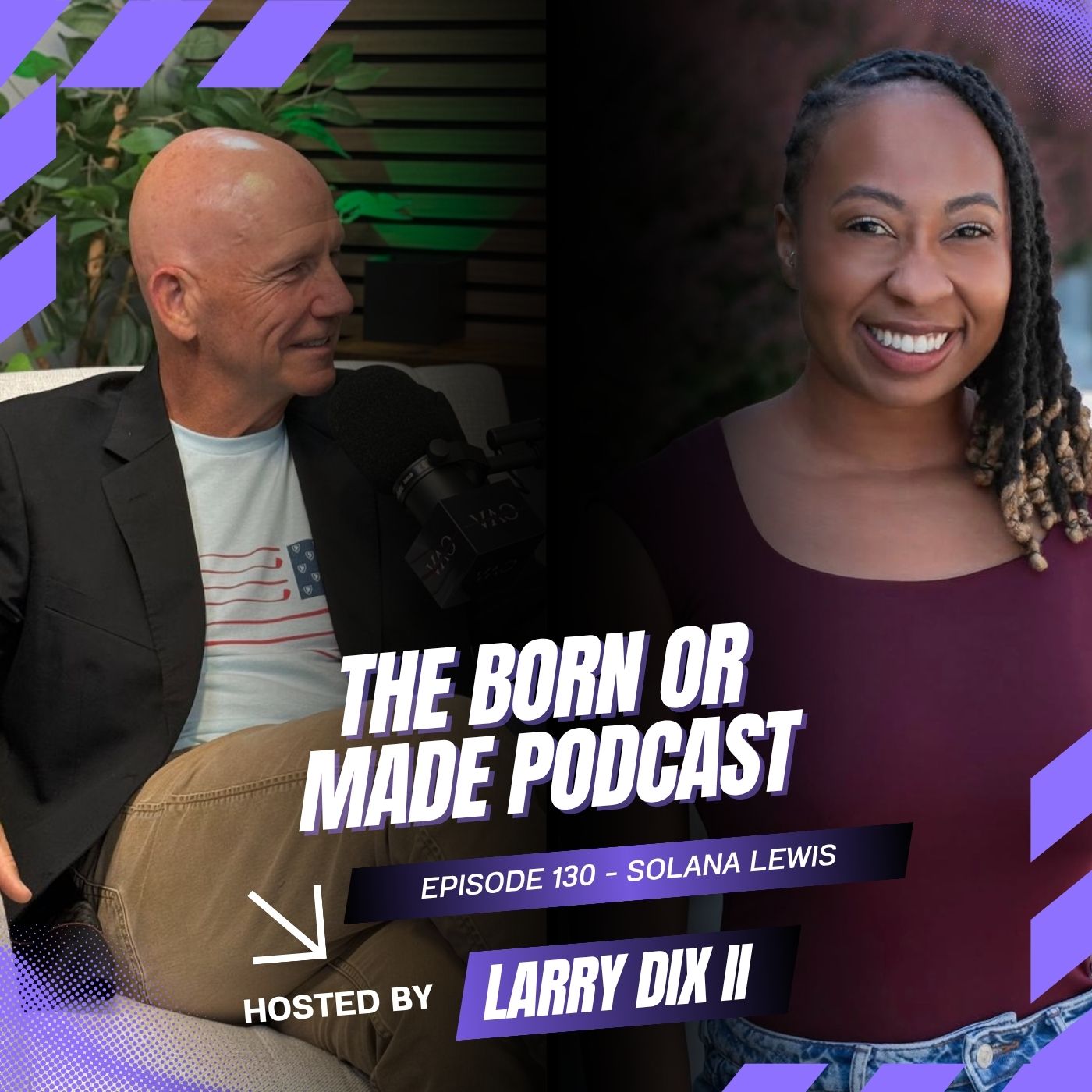
Born or Made · Larry Dix
Solana Lewis is a World Champion Powerlifter who earned her title through the International Powerlifting Federation at just 21 years old. She is the founder of Strength SoLutions Inc., author of Why Women Should Powerlift, and a TEDx speaker known for her talk, The Key to Reclaiming Your Time. Beyond coaching athletes and providing personalized nutrition support, Solana is an educator, national-level powerlifting referee, live-stream commentator, and youth empowerment advocate. Through her experiences in sport, business, and personal growth, she shares powerful lessons on discipline, goal setting, time management, and what it takes to develop a champion’s mindset.
Larry: Well, Solana, welcome to the Born or Maid podcast. Hi. I'm so excited to be here. I'm excited for you to be here. Like we talked about this a while ago. I think that our first speaker school and we just kept missing each other and you were competing or you were out of town or you were at some school giving some speech somewhere or something like that. So it's been but I got you now. Sounds like me. But yes. And I and I love your hair. She knows that. I love it. This is my competition hairstyle. Is it really? It is. No kidding. It's like my trademark. I didn't know because I always liked that. Cause yeah, don't you have that tattooed on your leg, right? And my book cover has this hairstyle. Yeah, I knew that. Yeah, I got that. So ⁓ where were you born? Virginia, Newport News. So you're a Virginia girl just like me. I'm a Virginia boy, so I am, but I call myself a Jersey girl. Cause I've been in Jersey since I was ten years old. And I'm 30. So I'm like, yeah, yeah, you really yeah, you're from New Jersey, man. Yeah. So what brought you to New Jersey? Jersey, ⁓ my dad when I was six Took a job in New York. He used to live there. And he took a job because it was a better opportunity for him. And it took him four years to be able to move the family up with him for financial reasons. Yeah. So when I was 10, he was like, all right, we got the money, we can do it. And we all moved to Jersey, really close to New York City. And I'm I'm staying because I love New Jersey. So that's how it got there. All the way through. Basically, so in Virginia I was homeschooled. Okay. And so I was homeschooled. By someone from my church. So it was like a homeschool with like 30 kids. Uh-huh. And then I switched to my mom's school that she was a teacher at. And then I moved to Jersey, where I mom was still a teacher at my school. And then, hold on. And then as a sophomore in high school, I got kicked out of the school my mom taught at because I was failing out of school. So then I had to switch schools. And then I went to another school in North Hilton, New Jersey. So yeah. You said you were failing out? I was failing out of school, yeah. So was that because you weren't applying yourself? Nah. It was me not knowing how to learn for myself. ⁓ I got ADHD, which is normal for people to have, but the way my brain works, I I'm like an auditory learner. So I have to like hear something a lot of times. So what works for me now is recording something and then listening back to it over and over again. But I didn't know that. So I would just write stuff down, I would try to repeat it, and I would just fail every test, every quiz, ev everything. I would fail everything. The only thing I didn't fail was stuff that was like writing and take it home homework. I I can survive that. Okay, I can like study this and like figure it out, but I failed like every time. What about visual? 'Cause I'm more of a I'm ADD, AD, HD, whatever too. And I'm more of a visual. Like you show me, I learn. But even like reading, I I just my comprehension was so bad. So visuals help me, but the auditory part is really important. So I guess a combination. Yeah, but auditory so I don't even think I don't even know if auditory works for me. I have to I have to spend some time thinking about that because I've so always so locked into the Visual side. So high school, you get out. So were you an athlete during school? The whole time. So all I ever loved in life was sports. Since I was five years old, I was on track and field team and swim team. And then ⁓ you were a swimmer. Mm-hmm. I was bad. I was bad though. I was bad. Still incr always incredible people though. I don't know what it is about swimmers. I wouldn't know because I never seen this with the swimmers. I wouldn't know. ⁓ I thought you said swimmer. Swimmers. Like the I was a swimmer, but like I was so bad. And how do you I just think there it's something about the mental side. Well, I mean, you're still you must have been good enough. You're not you're not I'm seeing you here, so you didn't drown. Yeah, good enough to not die, but you're coming. That's true. ⁓ but yeah, throughout pretty much middle school, high school, I was on a basketball team, ⁓ soccer team. But the two sports that were big for me were track and field and volleyball. So I was Libero. Which is the back row. Yeah, that was my daughter. Mm-hmm. And people always look at me and say, ⁓ you're kind of tall for Libera. But my school was mostly Dutch kids who were like six foot and up. So I was very short in my school. Yeah. Mm-hmm. Yeah, normally you are smaller. Yeah, but they're very, very, very good athletes. So I know, right? Yeah. So what was your ⁓ what was your track and field ⁓ as far as that? What did you do? Okay, wait, can you guess first? Everyone gets it right when they guess. Long jump. Yes. What else? High jump. Triple jump. ⁓ triple. Long jump. And then what running did I do? We had to have been pretty fast, so I'd say two twenty. So two hundred. Yeah, two hundred and four hundred. See, everyone gets mostly right right away. So triple jump, by the way, is so hard. That was my favorite. I love patterns. I mean my grandson was doing that, playing around with it. That is hard. Like I didn't realize how hard it was. Like running and just hitting it is fine. Triple jump's a lot harder. So when does it start the measurement of the jump in the triple jump? ⁓ just like long jump. Like the last jump you do at the board. Yes. Okay. You just have a whole pattern sequence to get there. That's it. And you do. So you start farther back. You do well with that? I loved it. I mean, I I forget what it was called, but in like the state championships I made it's like third place, something like that. So I was like good enough ish. Like if I had started strength training in high school, I think I would have been really, really good. But I was w so weak. So like it's really hard to be a good athlete for sprinting or jumping when you have no muscle. So So you were just you think you were just naturally fast. Yes. And then yeah, if you would have done that actu so you weren't doing even speed training, or were you doing some form of speed training? I just didn't my coach had me do. Our coach I'm not gonna pretend they were that great. Okay. It's a very small school. So there was speech training, but like now that I know what real speed training is, it wasn't great. But We did speed training. I watch these kids now on Instagram and the training that they're doing for the speed is sh though. There's one of them where they're they have yeah I think they have both feet on the ground and they throw their leg up on the box and then they also have a box and a box and they jump and switch legs. Yes. That type of stuff. I mean I'm like, holy cow. And then they show ⁓ later. The one lady, they show her as a kid training. Now they show her she's, you know, an adult. Her face is like jiggling. When she's running, she's so loose. Really? She's so fast. She wins all the time. But you know, you the tr the my point of that is the training. I think they've really dialed that in. So ⁓ obviously love to talk about weightlifting, obviously. And so tell me about that. What when did you like get into weightlifting? Yeah. So I my freshman year, I went to a place called Eastern University, a very small Christian school in Pennsylvania. And I had never done any weight training in my life. Like I went to the gym like maybe three times, like for fun. My mom was like, ⁓ we're at a hotel in the gym if you wanna go, so it you're out of my face. And like, I saw girls on Instagram who have bodies that I liked and they are pushing strength training, and no one ever told me to strength train. So I was like, So Katie Hearn was one of them who is in charge of Alani New, which is the big brand. It's actually the pre-workout drink I drinking. ⁓ but she's been around for decades. And I remember I was like, yo, like. She's saying lift weights to look like that? Cause I thought I had to stop myself to look like that. And it's not working. So I went to the gym. I was on by button.com every day, just like Googling workouts. And then my sophomore year, I switched to Montclair State. And that's where I met my friend Rob, who I'm still cool with to this day. And I was in the Montclair State gym, and he was like, you know, I see you squatting, I see you benching. You should start powerlifting. And I was like, I don't know what that is. And then I went to his personal gym to watch him powerlift. And I saw his friends doing it, right? And I thought that it was really weird. Cause his friends were all like 40 and 50. And they were slapping chalk in themselves. And I was like confused. And they were like lift the heavy weight and sit down for 10 minutes. And I was like, this is not working out. This is weird. Like, so I didn't like it. But then I went to go watch him compete just to support him. And I saw girls my age competing. And I was like, ⁓ this is powerlifting. Like the girls were having so much fun. They looked good. They looked Like now I would say muscular, but the toned, right? But they looked like they were just having a great time. The energy was amazing. So a year into me going to the gym at me and finding powerlifting, I was like, ⁓ I'm gonna start powerlifting. And like I just started right away. So I think with ADHD brains, it's very normal to t like something and go all in on it. So I got a coach within one month. I paid him with sneakers 'cause I went I worked at a sneaker store. So I was like, I can give you a pair of sneakers every month. That's all I got for you. I ain't got no money. Okay, I can barely put gas in my car. He was like, Yes, done. Crazy. So I started training for my first ever meet and like I became obsessed with it. I was at the gym five times a week doing powerlifting workouts. I was tracking my macros all of a sudden. I was like buying protein powder. I probably got drunk in college four or five times max. Like I did not prioritize drinking, going out, hanging out with friends. Like I just worked and like I worked, went to work and went to class and I just powerlifted. That was it. Did you get into the nutrition part of it early? Very immediately. I mean now I know way more about nutrition. Sure, yeah, we have access to a lot more information. But I at least understood, okay, my protein has to be high for this to work out. Okay, I have to use some vegetables. So I was like, make sure I hit my protein. Now I'm not gonna pretend like I wasn't still at Taco Bell and Wendy's a lot. But like I at least started to track my food and have my idea of calories so it wasn't just like, ⁓ whatever. No kidding. So you were hmm. So To walk me through, so when you start, you're just kind of feeling your way through, but you gotta coach. And when did you think you're gonna be good at it? I mean, you obviously had the ambition and the drive, but would you s I mean were you sudden like, hey, I can maybe do be pretty good at this? So I and okay, it's funny because I did my first meet and my I did my first meet, I just turned 19. It was a RPS meet, right? And they're those meets are known for being all day. It's a federation where the meet can just be nine, 10 hours long. It's not necessary, but it just was, right? But I do that first meet and I broke like three state records. The total record, which means the total, ⁓ a total is like your squat bench and deliberate, your best lifts, all added together. So I broke the total record for teens. I broke the squat record for the states and the deliff record for the state. And I was like, I didn't know what the records were. So I was like, ⁓ I'm breaking records. That's kind of cool. Do my next meet, switch federations to the actual federation where you can become like in the past to become a world champion, right? And like if you are in a specific federation. You can like go to the meets, then go to nationals, then go to IPF and win. Like that that's the path, right? So I switched federations and at that first meet I did really well too and made it into nationals. And I didn't know what nationals was. So I was very oblivious and ignorant. And then when I get to nationals, I didn't know anybody. I didn't know anyone's numbers. And I get second place at nationals. So like I didn't realize that I win? Really? Yeah, and I think it's because also there was like no real like social media was still very new. Power lifting was not really on it. So I didn't know of these big name people who were h hitting certain numbers. I was just doing it for fun because I loved it. She really had no expectations. None. But what's crazy is getting second place on nationals. I was like, cool. And I was a junior, juniors aged nineteen to twenty three, right? So the girl who got first place. Yeah, yeah. Okay, all right. So the girl who got yeah, I just turned 19. ⁓ the girl who got first place was turning twenty-four. So that means she aged out. So that's how I got invited to world championships. And when I got invited to the world championship, I didn't know what that was. So like when you asked me like how did you know you could be good, like I didn't until I won the World Championship meet and became world champion. I didn't know. Really? And how old are you at this point? At that point, I I turned twenty one going into World Championship. So that that was like a two year journey between the first meet, yeah, second meet, nationals, world championship. Yeah. So you were really during those two years, you were honing your skills, really getting your weight, I mean movements, right? I I mean, yeah, the trainer I had was in person. So I was just showing up to the gym and just training all the time and doing whatever he said. Right. But I can't you know like now I I know so much. Like I'm like obsessed with this. So like I've I've studied it, I've learned it. But like You could say, ⁓ you were honing in. It's like, no, I was just showing up and having fun. That's all I was doing. I was showing up and having fun. Like Are you still doing that? Showing up and having fun? I mean, it's serious. I mean right now, for the first time ever, I've adjusted my workouts to more bodybuilding style for fun. ⁓ because I've been doing this for eleven years. Wow. So I've I'm taking a little break from producting specific only workouts, but I'm still squatting, benching, and deadlifting. ⁓ but I'm still having a great time. I've always wanted to have fun in the gym. And I think when you stop having fun, you have to take a step back and be like, why am I not having fun? 'Cause no one wants to drive themselves five times a week to work out for ten hours a week when they hate it. Yeah, I could see that. So of the three, what's your favorite? ⁓ squatting always. I love squatting. Yeah, that would be my least favorite. I love squatting so much. Nah, like there's nothing like like When you are on the way down and you're like, No, I got it. Like the the groove is perfect, the foot pressure is perfect, the brace was perfect. Like on the way down, you know I got this lift. Like that's the best feeling ever. It's the only lift like that. Like bench press, like, yeah, there's a down and up, but like I will never love bench press. I don't hate it, but I will never love bench press. And then deadlift is fun, but like it should never be I think because it it was so inconsistent for me for years, I can never love it as much. So deadlift, I so okay, so squat. Up down, bench press, up down, or down up. Down up. Mm-hmm. Deadlift is just just grunt. When you pull on that thing and it gets heavy quick. ⁓ if you pull the slack out right and have proper tension before it starts, it doesn't. So when you pull the slack out, that means you're creating the tension of your your entire body. You're tightening your core. You're pulling the bar to where it doesn't, and then you're going. Yes. So that's the tent it is tightening your core, right? It is getting it's like Getting all the tension out of the bar so that by the time you start the lift, the bar should feel kinda light because you've already pulled up on it so much the bar had no choice but like to start going up almost. Which sounds kinda weird. But so deadlift, do you can you do do you do both hands? Do you alternate? How do you do it? ⁓ alternate grip. Hook grip is f for people who are more strong willed, I can't do it. I don't do. I should like harder? Why why grip is grip? It can mess up your thumb if Yeah. You don't do it perfectly. And when you're dealing with maximum weight, I've just seen too many people who try to hook grip and it ruins the lift and they miss it because of the grip. So for me, I've never had a grip issue in my life. So I don't have to hook grip, but so deadlift, you're pulling weight. You've got to go, you've got to get vertical. So do you have to hold it for a certain amount of time before it's considered a good lift on that one? ⁓ no. So for deadlift, you have to you stand up with it. Yes, I have your shoulders locked. That means all the way pulled back. ⁓ hips and knees are fully extended and you have to hold it until they say down, but the goal is just to hold it all the way at the top. Shows you have control. For like a second, yeah. Squat, you gotta get hold below parallel. Mm-hmm. The hip joint must be below the top level surface of the knee. Okay, the crease right here. This crease has to be below the top. Yes. So it's about how deep you squat and that's the main thing. Like the main reason people fail at squat is because of Depth not being deep enough. So do you when you do that, you don't go past parallel. You're you've you've trained yourself but I mean, you're going as low a little below parallel as you can to get back up, or do you go I mean, 'cause I can see going down could be even better, especially can you bounce? You can I wouldn't recommend it with maximum load. Yeah. Like if you're a high bar squatter, you can get away at bouncing a bit more, but it's still hard to control the weight when you're doing maximal effort. So people who tend to bounce more are like Olympic weightlifters because you do your squat but you're going into your clean and jerk. So it's like a hold it's like a faster movement. Like projecting is all about like getting a heavy load up. It's not actually fast. So for the most part not. Okay. And then I asked you earlier, so about this before we were online. So You're you're based on weight. So you're saying, okay, I'm a hundred kilo. I don't know the numbers. So you you go and you're a hundred kilo weight, let's just say. And then that each one of those classes has a max of those. So if you're you're a hundred kilos, your max total, you're trying to get a thousand pounds. I'm just throwing numb dumb numbers out there. That's all you're trying to do at that point is the three combined maximum amount based on your weight. Yes. And if in your competition the goal is to lift the heaviest of everyone in the competition. So yeah. So you could be lighter on deadlift but crush it on squats and bench. It doesn't matter. It's all about your total. So yes. Total, total. Mm-hmm. Okay. And so you like the squat the best. Is that your best move? Not deadlift. Still deadlift. Yeah. I've deadlifted four eighty four. Really? Four hundred eighty four pounds. ⁓ squat my best was I actually did it for a double, so I don't even know I want max right now. I hit four twenty nine pounds for two reps. Back squat? Yeah, back squat. It's always back squat. ⁓ my god, why are you making that face? That is like the male on his face. Yeah, yeah, I know. Yeah, I mean I'm like that is like the worst move. Like I hate back squats. I think most people hate b I think people who don't power lift people don't power lift or want to like weight lift like they Well I would do the snatch. I like the clean, you know, clean and jerk. Those those are fun because of I guess they call those quote Olympic moves and stuff like that. I'm always cause I feel like and I told someone on a guest earlier, I think that weightlifters are the most underrated athletes in in in America anyway, because we just don't get I don't think you get the credit. I don't think you get the credit for how good an athlete you are. Olympic weightlifting? Just any of them. Like dead like yours, like your weightlifting in general. I just don't think You just get the credit. I I just don't understand it. Like when I watch all y'all like these three moves and I watch the amount of weight and how hard it is, you're incredible athletes. But I I don't think you get the I just don't think y'all get the credit for any of the any of the Olympic, any of the weight like anything, I just don't think you get the credit. Don't you agree? I mean I I Well, I do agree because most first of all, most people don't know what piloting is at all. Like they all, whenever I say powerlifting, they always go straight to, yeah, you're on stage, right? And like you wear the bikini. No, that's bodybuilding. ⁓ piloting. ⁓ you overhead. No, there's nothing overhead at all in powerlifting. So yes, it's underrated because people don't even know what it is. Palloting is just your one rep max, squat, bench, and deadlift. That's it. Squat, bench, and deadlift. Those three movements. Back squat only. No, not the front squat. Bench press, deadlift. And it can be sumo or conventional. So. I will say yes, we are underrated because people don't even know what it is. Yeah, I even I mean, even even the people that do, I just don't I just don't think weightlifters get credit. That's just me. I just I watch these true like the squat. When I watch some of these guys and gals squat, that's the one that throws me. I'm just like, holy because it's hard. I think people don't give us the credit because they're like, ⁓ you're doing the squat, like, ⁓ I I can squat. You know what I mean? Like they don't understand the technique and how hard it is to do three and four times your body weight to a full range of motion. Just fall over. And not die. Like they don't get it. Watch all of your discs goop out the back. And I think the reason people don't get it is because when it when you say how much you lift, they respond, especially with a ⁓ as a man, ⁓ back in my day, and it's like st stop. Like whatever you did back in your day is probably not depth. You you weigh a hundred pounds more than me. You're a man, like you don't get it. Because you're not understanding that I'm a hundred and forty eight pounds lifting four hundred pounds. Like it's not the same as back in your day as a two or fifty pound man. Yeah, 'cause like for me, like pound for pound, you can outlift me by a mile. And that's the other thing. People don't understand, like, it's pound for pound, right? So it's not as straightforward. And that's why with powerlifting, people get impressed by the heaviest lift in the world. So like Hayes Tolavirus is the strongest lift in the world and he's quite like over eleven hundred pounds. But how much does he weigh? ⁓ like four hundred something pounds. But it doesn't matter because it's the heaviest weight in the world. So everybody can understand it. And they're all cheering for it, which is great. He's insane. Yeah. But like that's when people get it, like, ⁓ that's just the heaviest weight, period. But once you go to weight classes that are in the middle or lightweight, they they don't get respect, bro. They don't. Really? They don't. Like there there's a girl, her name is Heather Connor, and she can deadlift over four hundred and twenty five pounds and she weighs, what's her weight class? Forty seven kilos, which is under a hundred pounds. Under a hundred pounds. So a pound for pound, she weighs listening. She's doing more than four times. Yeah. She's the best lifter in the world. And like you'd have to be pushing 600 to be the same ratio. Yes. But people don't get it because ⁓ she's just small. Like they don't understand it. But you know, you definitely get it. But if you don't if you're not into weightlifting, like you don't get it. Yeah, when I watch people do those kind of weights and they're especially she weighs a hundred pounds. She's doing over 400. Like right now, I mean, I'm 63, I'm 170 pounds. I I don't I don't think I could lift that much. I I don't think I could deadlift that much. It's it's a lot. You have to put your all into it. You're you're basing your whole day, your whole life around the training session to get there. Like And how many chances do you get to hit the weight? So if you do the back squat, do you get three chances or just one? Yeah, so it's three attempts for each lift, and the goal is for each attempt to go heavier and heavier and heavier. Not just to try to go for the heaviest weight three times. Right. So it's like you're building into your max, and then God forbid you miss it. At least you have the first or second one, whatever you got beforehand. So that's the goal. For your third attempt to be the heaviest. When you get to your weight class of the the the amount of weights you're professionally, you're I mean a a pound can be a big difference for you, right? Because you're now you're sh it's like the sprinters. You're now you're shaving off the one sixteenth of a second. ⁓ but powerlifting The increments are by two and a half kilos, which is five pounds. So yeah, which is big. Especially on bench press for women. That's like a big jump. ⁓ but those are the increments. You can only do smaller increments if you're going for a world record attempt. That's where you can do like a half a kilo, which is like one pound or something really small. So have you gotten close to any of the world records on any of those moves? Any of the three? Funny enough, at the World Championships, I matched the world record. Because of a coaching error, I should have beaten it, but they didn't they put in the same number as world record. They didn't put in the actual chip, which is where you put in like one more pound. And then I had one more attempt and it was actually really easy. I got the way up. It was like five kilos over the world record. I got the way up and I fell. So I I dropped it. No. Yeah, it was devastating. It's in my book too. I talk about how that was devastating. So that did so it messed you up mentally? upset but I still won and I went into that meet not knowing anyone else's numbers. So I was still in shock that I won. So it was like fifty fifty. Like all I all I did know was that I wanted to be through a record. I had no idea I was going into that meet the strongest of everyone there, like number wise. So that was kinda interesting. So a lot of sports the young ones win. A lot of sports the older ones win. What is what is powerlifting? Which one? Yeah, powerlifting but I love about it is a lot of people who are winning are in their mid twenties, but they can also be in their thirties. Like there are world like there are world champions who won even last year who were thirty-eight years old. So that's what's so crazy about. So in the in the in the powerlifting thirty eight though, that's an old person. It it's very impressive to win at that age, but it's not heard of at all. Yeah. The the oldest I would say I we've seen forties, like young forties, but that's pretty rare. I can make I can think of two people right now, David Riggs and Jen Thompson. They won in their forties. ⁓ but those are the two that come to mind out of like hundreds of people who won. So So do they have masters, like old people like Yes, they do. We got we got every age group in powerlifting. I think it starts what's the youngest, like ten or something like that. But yeah, they have masters one and that's forty to forty nine, master two is fifty to fifty nine, master three is sixty and up. And up, yeah. So I'd beat them. Masters three. Masters three. I just no. There if if I that that squat, man, that would jack me up. 'Cause I'm a hundred and seventy pounds. So what is that kilo wise? Then I don't know anything about Lord. You don't make me just there'd be weight. So it'd be there there so there I would be in a weight class of that even at my age. Yeah. Okay, so it's still weight class at that point. Obviously I odds are I can't beat a guy that weighs two fifty. Well no, that's why we love weight loss. That the sport would suck if it was just everybody gets together and let no. I'm gonna look that up. So that would just turn into the the person who's the largest is gonna win. Right, yeah, guaranteed. Yeah, yeah. Mass times velocity equals force. They're gonna win every time. Interesting. So when's your next big event? When are you what are you shooting for? What's your next big one? Competition? Yeah, competition. I don't have one right now. ⁓ I'll probably do a small one as in a local meet where you don't have to qualify to get into it. Next year, 'cause well, it's it's August. Yeah. Like early next year, I took a step back from competing. I didn't stop training. That's not a bad but from competing. But I think, yeah, I was ten years straight at competing and then like mentally you need to take a year off. I needed a year off mostly because my some of my lists were not improving like I wanted ⁓ to. And I was always in prep for a competition. I was like, you know what? Like let me take a step back and like just work on technique again because I was not improving like I wanted to. And I was like, okay, if I keep doing two or three meets a year, I can never just have like a six month span to just mess around with anything. Like you're always in competition. You need at least three months to prep for your meets. Like that's not a for it's not a rule, but most of the time, if you have anything less than that, it's very, very short turnaround. That's very short. Even three months is like kind of short. That's surprising. I would have never thought that. What would you think? I just it I mean, because you're kind of You're training and then you're doing max. It just seems like to like every couple of months you could do that, but your body just doesn't When you're new, when you're new and getting newbie gains and like you're quickly accumulating and then you get to year five, eight, ten and like the recovery period from actually maxing out. And like maxing out's not the same when you're new. Like you can max out and hit new one more maxes, but that wasn't really max. You just haven't had enough time to get to your max. When you're actually like, yo, I grinded that squat for ten full seconds. Ace was everything I have for fly line on the bar, I would have missed it. That was my full max. Like, I'm gonna need a month just to even try to get close to anything decent in the gym again. I need a month of training. Did you say you were s ten seconds on a squat? I've grinded a squat for ten seconds before. It's a good feeling though. That's why I love squats. There's no I don't enjoy grinding out a deadlift. It's terrible feeling. For me. It's a terrible feeling. I mean I think about two seconds on a squat, I'd be like, I mean, I know I couldn't do it that fast. But I ten seconds 'cause what I know is you're going up and you're just like that's the part that's like just a thumper. Well, as long as you keep your brace, if you had a good brace at the start of it and good tension touch your body, like that's the only way you're gonna get that. That's why it's the best cause on the way down, sometimes you just know you're like on the way down, like, yo, this is the perfect groove. I just gotta stay right here and push up now. Like that's it. Okay. So I'm squatted. This is my knees. I'm going to full squat. Mm-hmm. When you're when you're got it on your rack, are you trying to get are you trying to get to the weight is kind of over the center here when it's on your back? ⁓ yeah. Bar path. Obviously far falling forward is a problem. Yeah. ⁓ bar path wise, you want the bar to be over the mid center of your foot. That's what you're aiming for. Okay. So too far forward, yeah, pancake can get announced mostly your back and l and less legs. Upright. If you're if you're doing a high bar squat, you can be a little a little bit more behind the mid and still be okay, because high bar position. High bar is like when the bar's like on top of your traps. Low bar is like Which do you prefer? Low bar. Most most products are doing low bar squats to do the heaviest lift because you can involve more of your back muscles and more of your hamstrings and more of your glutes. High bar is a lot of quad and not as much. Like it's hard to embrace your core too. Like use your core as much. And your back's not as involved. Do you ever hurt your back? Yeah. I mean, I could see that like I I just that makes me choke. I mean, like that that makes me pause. Like, ⁓ my gosh, like your back. That's what that's why I don't like them. It just scares me to death and my nap back's just gonna blow up. Yeah, I hurt this is in the book too. I hurt my back leading into World Championships two months out. When I went down for a squat, on the way up, I literally heard something. And felt something and I still don't know how I stood up, but I did stand up. Thank god I was at work because I was a personal trainer. So I was at I'm like, I can't fall down with this way, it's gonna really embarrassing. I rack it and but then I just fall on the ground and I need my coworker to to carry me to my car. ⁓ so I basically it was ⁓ I had c a compressed disc between my L five and S one, which is like the every Protestant's favorite spot to hurt is their L five, S one. Like every I am telling you, every ad they've had that came to me already with a back issue, I'm like, is it your L5 S1A rate? Yes. Okay, okay, all right. ⁓ but that that sucked. But that was also I didn't understand bracing properly. My first three years, even going into real chat, I'm telling you, I got strong, fast, and didn't really know what I was doing. ⁓ my technique was not good enough to s not get injured. So it was all technique issues. Like I didn't understand bracing at all. I was arching my back on the way down. Terrible. Looking back, I'm like, ⁓ my God. You're like, thank God I didn't get hurt. I did get hurt. ⁓ I love I know, but you could have got hurt a lot earlier when you start going at those kind of incidents. I could have, but I no, I was like barely able to walk for like six weeks. Like it's still like it's a miracle. So if you read the book, Why Woman Should Power Life, you'll see like the first there's a whole chapter dedicated to like how I actually won and what happened going into it. And I had days where I couldn't walk at all. I like canceling all my sessions my clients. I got in like three squat sessions or maybe four. in the last month and a half going into World Championship. Mind you, I was supposed to do that, I'm supposed to do like three squash squad sessions a week. And I got like three or four in over a month and a half. Like it was ridiculous. Really? It was insane. It's a miracle that I felt amazing on me. Cause I don't understand how I felt good on me. And I got sick. Two days out. Wow, so your body was just ugh. I'm surprised, yeah. I'm surprised you didn't screw something up. Like really 'Cause throwing being in that position and get sick, you're just asking for trouble. Yes. And then mind you, the next meet I did that was national is like four months later, that's the meet that I probably should have had at the World Championship. My back hurt so bad. I all my attempts were like thirty kilos less than it should've been. Like it just in pain the whole time surviving. No. That's the meat I thought I was gonna have at the World Championship. So I'm telling you it was God. I don't know how that happened. Wow. All right, so let's talk about the book. Yeah. So tell me all that. So what inspired you to write the book? ⁓ one day I was Googling powerlifting books and there aren't any. Like there's really not any. I found one by a person I'd never heard of that no no one's heard of this book. It was like, I don't know what it's called. It had very prouting in it. But I was like, okay, whatever book this is that no one's heard of. ⁓ Right? There's nothing else going on in powerlifting. There's weightlifting books, there's strength and conditioning books. There's books written by powerlifting coaches who talk about strength training, but there's no like specifically powerlifting only books that I could easily find. So was like, okay, let me be the first one to make it. Because at this point I became friends with people who were authors. And all of a sudden the idea of being an author was realistic because I had people who I knew who were authors. And when you're around people who are doing cool stuff, like, wait a minute, like you you're a regular person. Like you work hard, but you're regular dude and you, you're doing it. So I could go write a book too. So That book got started with just the let me be the one to do it. And it took me a year and a half to write it and there was a good there were so many times where I thought I was not gonna finish that book. I can't believe it's still like when I hold I'm like, yo, I actually got it out 'cause like I didn't think it was gonna get out. But that's what inspired it. I like, there's nothing else going on in it. And there's so many people again who don't even know what the sport literally is. Like by definition, they're ninety five percent of the time they wrong. So I'm like, maybe that's why no information about like what is proudlifting versus these other sports that are weightlifting. Well, I didn't until I met you and several other people around here. I never knew what it was. Yeah. I mean, I just think of lifting. I think of I mean, I've heard the term power lifting. I've heard obviously of Olympic lifting and stuff like that. But as far as like really understanding it, I never knew. I mean just it's not on TV. That's why that's what frustrates me is 'cause y'all are such great athletes, but you just don't you know, you know. I mean, obviously you're probably never gonna sell out a stadium just 'cause, you know, not That's not true. We have a okay, Sheffield ⁓ Okay. Sheffield, which takes place in the UK in Sheffield. ⁓ it's the biggest meet ever for powerlifting, where all you can only go if you're already a world champion. So it's like the best twenty four men and women of the year and they compete and they sell stadiums now. That's the that's the only they've done three. I think it's three. If I'm wrong, it's four. Three or four Sheffields now. So it's been going on for three years and it's incredible. ⁓ but that's very new still. So it's new that they're selling out it's the only thing that's ever sold out at Stadium before, ever. So what is the after you've written the book, what's the best thing about the book for you? What is it other than you finished, right? It's printed and I could actually physically see it. ⁓ I think my favorite thing is People have already told me, number one, they ha they never knew my story or and why I loved powerlifting, which is cool to get out there. But number two, they're like, ⁓ you really taught me more about the sport that I didn't know about. Like people who are already powerlift, like, I didn't know that this was going on in the sport. Like there are rules changes that have happened that made a big impact in sport that people don't know about. There's like, even technique-wise and programmer-wise, I dive into programming and people are learning about different types of programming powerlifting that they didn't know about. Like they'd know whatever they've been doing. But now I'm like, hey, there's different styles of programming. So here's what it is and here's what it typically focuses on versus this one versus this one. So for people who don't who want to know more about like what besides what is the sport, how could I get into it and get good at it? Like you'll learn all that in the book. So do you think ⁓ it'll inspire women in general just to start trying to do powerlifting? Because I'm a huge fan of weightlifting in general. And I think what happened to Especially for women, everybody thinks they're just gonna go and they're gonna turn into these big bulky women. And that's just not the case. Yeah. It's so good for you. Is it is, and people, yes, they have that fear. So I think it will inspire women to just start lifting in general. I really want every woman to get a barbell in their hands so bad. Like just lift a weight, please. ⁓ so even if you're not inspired to start competing in the sport, I think you'll learn not to be like, yo. Getting stronger is only gonna be good for me. Like you will not blow up and get bulky. That's very hard to do, actually. Like I've been trying to get bulky for 11 years. And here I am not. So it's very hard to do. But also it's so empowering. Like you get stronger mentally and physically. It bleeds into every part of your life with your with your confidence. Like I was such ⁓ my god, I was such a different person for browser. I was so shy. Really? I was shy. I didn't speak to anyone. I had no confidence. I was feeling out school all time. Like I was just trying to survive school. I had no friends. I couldn't speak my mind. Like, and but lit lifting weights and getting stronger helped me be like, yo, if I can do that and keep hitting these goals that I keep setting for myself, I can hit goals professionally too. I can hit goals in my social life too. Like I can do this in every area of my life. Interesting. Yeah, you can apply it. I love that. I think that is so inspiring to hear. Yeah. So and when you go to the gym and work out, it's not like you gotta throw big weight up. Right? Like you were saying, just a barbell. Like a barbell, I think, I mean, the one that we lifted with was was forty-five pounds. That's still a lot. I mean, I tell people all the time, you think weightlifting's not easy? Go try to put a 45 pound barbell over your head and try to squat without falling over. ⁓ Like it is impossible. When I first started, we did a PVC pipe. If I would not have had a PVC pipe, I would have fallen over. Of course. My nose is about to touch my knees as I went over. I mean you're just ⁓ wow, I gotta learn how to brace my core and actually like balance my body. Yeah, like right. I have no core. Mm-hmm. Mobility terrible, shoulders not even overhead, just overhead. ⁓ yeah, yeah. Yeah. And then you're yeah, ⁓ God, I I my my shoulder. Yeah, those that anything overhead is is that's one of the hardest. That's also why I love powerlifting, because overhead is very, very hard. Very hard. And For some people it's very unnecessary unless you're trying to Olympic weightlift. But ever really everyone can do at least a form of squat bench and deadlift, at least the form of it. So I tell people all the time, like I do squats every day, but I just do air squats. And they're like, ⁓ you're no weight. I'm like, well, I do twenty five or thirty-five of them in a row. It actually starts you start feeling it. But I my biggest issue I have is trying to stay somewhat vertical. Cause once you get tired, you start rolling over and that's where you you hurt your back. Yep. Yeah. Yeah, so what's the best chapter in your book for you? What was the like the one you just you were so happy when you wrote it? Mm. What was it about or something? It's chapter chapter five. Okay. And it's called we can title it. How powerlifting has changed women's lives. And it is four different women who I did an interview with and put their story in the book. But I made sure it was a variety of women. So one is a multi-time role champion. One is a world level competitor, but not world champion. One is a mom of six who never thought she would get into powerlifting or anything. Yeah. And one is a twenty-one-year-old. She's much probably twenty-four now. So okay, no. Maybe she's twenty three. Young twenties, right? And she had no athletic background, very low self-confidence, and like never did anything at all in the gym. And then she got into powerlifting and it changed her life too. So like you can be anybody. You can have kids, you can be older. Like the people who are world champions, they're in their ⁓ late thirties, you know I mean so ⁓ the mama sixties in her late fifties. So I want to like get a good variety of age divisions and just lifestyles and prolifting change all the lives the better. So you're never too old to power lift. You're never too old to power lift. You're never too young to get started either. it can benefit anybody. And again even if you read the whole book and you're not like you don't like want to start competing. I think it'll make everyone wanna lift weights if you're not already lifting weights. Okay, so where do we find the book? Yes, you can find it on my website, which is just Stan Store slash Solana Lifts, ⁓ or on Amazon. Just put in why woman should power lift. So that is my Instagram, Solana underscore lifts, the link in the bio, you'll see the book right there too. Well, the question always is were you born or made? But you go from a shy girl to a world champion. Do you think you were born or you think you were made? Made. Made. Cause from where I started to where I am now, I'm a whole different person. My mom always says, like, I can't believe you're my kid, cause this this can't be the same kid that was filling out school and and really sad, borderline depressed, and couldn't make friends and didn't know what she was gonna do with her life and had no confidence. This can't be the same kid. Cause like now I'm out here, I'm teaching the sport. I'm a TEDx speaker. I'm a public speaker. I help other kids learn their voice through podcasting. ⁓ I help women get stronger. Like I'm a whole different person. And that came with life experiences that changed me and shaped me and made me. So. Solana, thank you so much. I enjoy you. I you know, is is I d don't keep this one quiet. I always tell everybody the same thing. You have like the best smile. You're always a happy lady, and I really appreciate you being on the Born or Maid podcast. Thank you. And you're always a joy and pleasure to speak to. Thank you so much.