
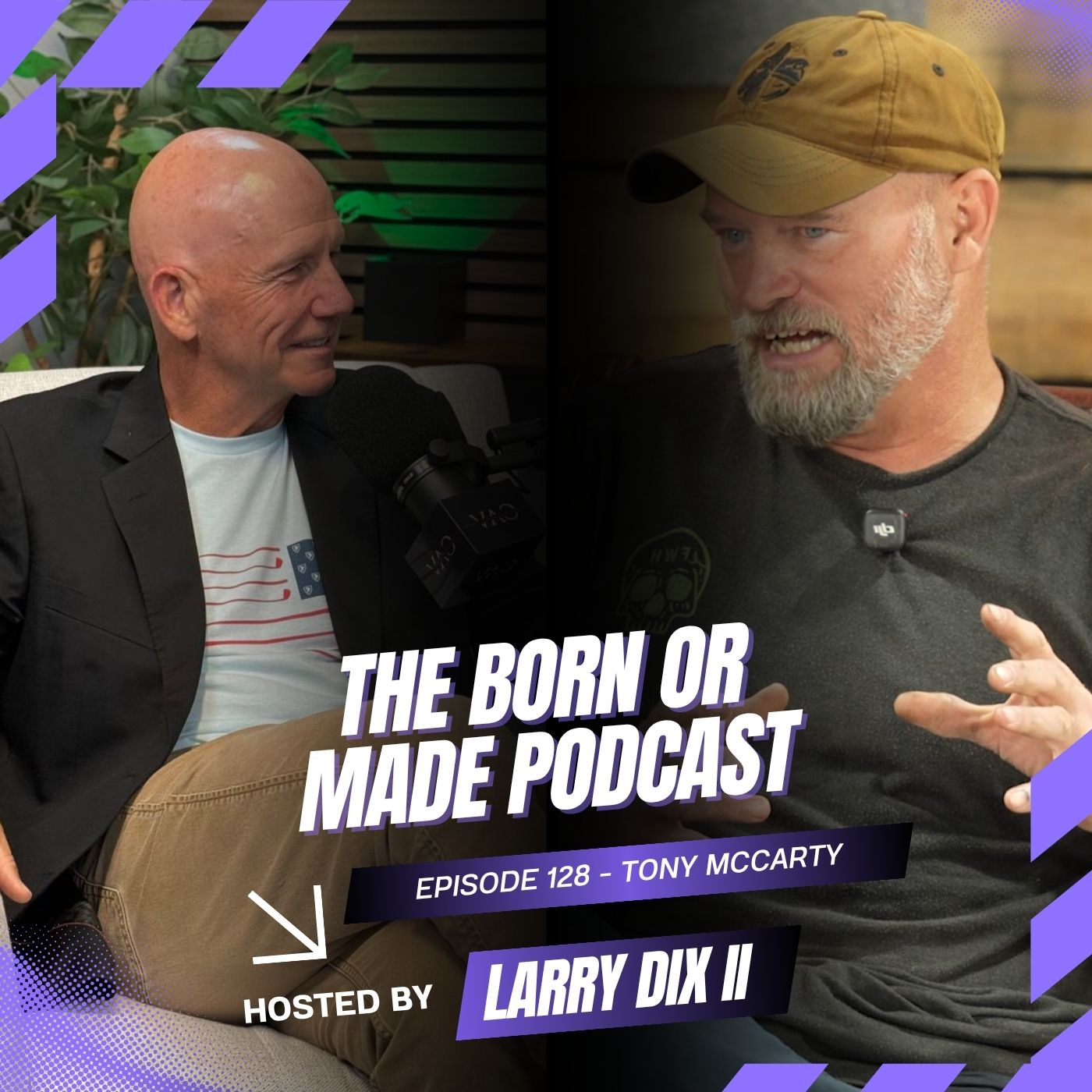
Born or Made · Larry Dix
1SG(R) Tony McCarty has served more than 25 years in the U.S. Army as an Infantryman, Paratrooper, Instructor, Company First Sergeant, and Special Mission Unit Operations Sergeant Major. Beyond his military service, Tony has worked as an SRT/SWAT Team Commander and Fire Fighter, operating in more than 25 countries while leading teams and protecting those under his responsibility. His career is built around leadership, accountability, preparation, and taking ownership when the stakes are high. Tony lives by a simple motto: “Own that s$&@, you don’t Know!”
Larry: Well, welcome to the Born or Made podcast. For the first time in our barn in Woodford, Virginia. It's kind of an interesting thing that I happen to have my ⁓ next door neighbor. I call him McSparty. His name is actually Tony McCarty. And I don't know where McSparty came from. He's probably never been called that, but that's what, for whatever reason, I like to call him. So, Tony, welcome to the first ever in-house Born or Made podcast. Thanks for having me, Larry. The barn. In the barn, yeah. In the barn. Woo woo! And we in case y'all didn't notice, we have a live audience. So Tony and I play around a bunch of stuff. We do a bunch stuff together, ⁓ work out in here in the gym, been to his house, we do some rugging, rucking. You can't see it on camera, but off to the side here, we've got these swords, which is kind of a funny story. We were trying to stuff because Tony's very good at at de self-defense and stuff like that. And I'm really enamored by some of that. And we were doing it with these swords, these I guess they're made out of bamboo. Yeah, they're bamboo wooden sword for training. Wooden sword for training. So we're doing this. Well, he doesn't one thing you will learn about Tony is Tony doesn't know what half ass means or half speed. And so when you're built like a fire plug and you're hitting this, you know, buck 70 guy, my wrists were so sore the next day. But anyway, that was a quick story. So Tony, sorry to talk this much. Where were you born? I was born in Atlanta, Georgia. Atlanta, Georgia. Well tell us about your story being born in Atlanta, Georgia. Where did it start at and where did it go? So I was ⁓ born there in Atlanta ⁓ in the 70s. A mother that had ⁓ three other children, but she didn't have custody of. So I was the youngest of four and the only one that she kept. ⁓ so that started my life out in this chain of events that led me to here. I lived in the the ghetto part of Atlanta. That's a lack of better terms, right? ⁓ government subsidized housing my entire life, single mother. ⁓ more story with my mom, amazing woman who worked very hard to raise me, to the point that she was married nine times. ⁓ so it kind of led to my lifestyle of being able to do many things from my carpentry work to my electrical work to the things that led me to building my own house and owning my businesses. Growing up in subsidized housing back in the 70s was kind of Cool. ⁓ if it was a three bedroom house, you had three mothers in there with their child. So I had more mothers than I had fathers growing up, which having nine, I had a lot of mothers. Wow. And so obviously a lot of these guys in the the audience know that ⁓ you were in the military. So let's talk about that. So you you get out of high school, you survive the ghetto, you go into the military. Talk about that. Yeah, so I joined the army when I was seventeen years old and went active duty, ⁓ went into the infantry. Early 90s. I served 26 years. I was in the infantry. I did many jobs, of course. Started out as a machine gunner and then worked my way up through sniper in the Army, went through as sniper instructor. And then culminated my career at some point around the 10-year mark as elevating myself to the special operations community. I'm in finished 26 years with about 12 to 14 years in special operations. doing everything from advising assisting nations to delivering long range precision fire. So it was a very ⁓ very important part of my life 'cause it gave me it gave me purpose. I I like to say it gave me structure, a lot of people do. And I think it did that. ⁓ but I think my situation in life gave me most of my structure because I didn't want to fail, because I saw a lot of failure in my life through my family and my my Stepfathers and family like that, but I I kind of set it in my mind that at some point I'm not gonna be like that. I came from nothing and I want more than something. Right? I don't just want something, I want to be more than something. But I wanted that with my life too, right? I wanted to be able to give more. I I wanted to serve my country. I didn't, you know, the I got a funny story I don't think I ever told anyone was when I went to talk to the recruiter, I was like, he's what job do you want? I said, I thought there was only one, shooting bad guys. And he laughed at me and I said, Well, all right, well, I guess infantry. And he says, Okay, that we have something like that. And I was like, okay. Well, are you not gonna ask how much you get paid? And I said, I didn't think you got paid in the army. I don't care what you get paid. You feed me and water me, right? And he he said, Yeah. And I was like, well, sign here, you're good to go. And 26 years later, I realized that you do need a paycheck. And thank God the army gives a pretty good one if you stick around long. Wow, that's amazing. So so you wanted structure because you didn't have structure. So talk about that and just the life, you know, going for the some chaos, but you wanted to go into some form of structure. Yeah, I ⁓ again growing up in the ⁓ the 70s and 80s, drugs became a big thing in America, especially in the ghetto in Amer ⁓ in Atlanta. And my family found themselves either doing drugs or doing and selling drugs. And that kind of disrupted my childhood as a teenager or before my teens, ⁓ moving all over the place. I went through five schools a year, you know, until I got into high school, I moved to my father's in Birmingham, Alabama, and actually got to finish high school in one school. But up to that point, I was going to school, five different schools a year, sometimes six, seeing the sale of drugs in my own house. possibly even helping with that without knowing that I was, you know, as before I was thirteen years old, those kind of things. And cops kicking in doors and us leaving a scene right before the cops come in. ⁓ you know, having to take out children that were my age outside as the cops are coming in the front door, acting like I was there to go play with them. So that that kind of disrupted my whole childhood and I realized I could see what Wright looked like. And I could see what other kids had and how they had families and different things that would work out for them and didn't have to live with that. and that's what I wanted. And it that stuck with me young. And then I didn't even realize what good money was until you know, I started building my structure on how the type of person I was gonna be and how I was gonna be building my businesses, that what money looked like and how it could be used to help other people. Wow. So You go from that, you have structure. Did did the army, the military give you kind of a sense of family too? I mean, with these guys and gu I these people you're sitting in the in the in battle with. Yeah. You hear that story a lot that you're you're you know, you make get real close with your teammates and and they become a family. That is true on deployment. Then when you come home, that changes, right? ⁓ I didn't want anything to do with my unit guys or or my team when I come home. ⁓ when I retired I didn't even really talk to money any of my buddies until more recently. ⁓ because it's it's really about the job and keeping each other alive while you're on mission. And then when you come home, it's you want to really decompress from all of that. I mean my family don't really know what I did in the Army or any of that kind of stuff because it's it's not something that you talk about. I mean it whatever it is, it's it was work. Right. And you don't want to talk about work anyway unless you were super excited about it and you did something great and amazing. But there's nothing great and amazing that you do on a combat mission other than stay alive. So you like to still jump out of planes, but you do it for a different reason now. Let's talk about some of your, you know, foundations you're working on, charities and stuff like that. That's really it's been a big pass since I've known you, just been big passion for you. Yeah, recently, ⁓ in the last couple of years I got back into static line parachute jumping. ⁓ that's the way the military does it, ⁓ for mass deployments of paratroopers. ⁓ get in, you hook up, you walk out, the same stuff that they were doing since nineteen forty four. World War II vets, the minimum guys that are left. And each one of those are a nonprofit of some sort that kind of raises enough money to support taking World War II vets over to Normandy each year. So when you've seen on the 80th ⁓ or the 79th anniversary, all those World War II vets that were on stage getting awards from the president, we paid for most of those guys to go. We sponsored their trip back into Normandy. ⁓ and we've been doing that. since ⁓ about fifteen, twenty years these organizations inside the US do that. And we maintain the awareness to the United States about the airborne community. ⁓ you know, you have veterans that do a lot of veteran stuff, right? They were in combat, they drove trucks, they were infantry, they do all these other things. But the ⁓ historical portion of the airborne community, dropping men out of aircraft behind enemy lines or in enemy lines, has been the pivotal point of the army that everybody looks up to. And being able to maintain that presence now and to kind of show the world what our forefathers did more too, ⁓ and living that legacy is what we do now. And ⁓ we do that, I continually do it with these jump teams ⁓ annually as part of one of our jump ⁓ fundraisers for 550 Court Inc., which is our veterans nonprofit. ⁓ our motto is a lifeline from veterans for veterans. And that's just not here in the States, we work global. Well because this is our first time we've had a live audience, I was wondering if anybody had a great question, because they're gonna be great, a question for Tony. So like you serve No, I didn't. actually I had a plan when I retired. I had structured my life so the day I retired I never had to work again. You know, and that's what all of us are here for with our meetings is kind of working our businesses so when we do retire, we can retire either wealthy or healthy or in a position that we don't have to do it unless we want to. ⁓ most people get out of the army and they have to work. They'll get out of the army at 20 years, take that early retirement, get that paycheck, but they're not set to be retired. Their kids are not grown up enough yet. They're still in the house, they're still paying for kids to go to school. They don't have their primary house paid for, and they don't have a nest egg. ⁓ from where I came from to the day I retired, I ensured I had everything I needed when I walked away from the army that I didn't have to do anything, that I didn't want to do. ⁓ And I didn't. ⁓ I got married again and we traveled the first three years of us being married anywhere we wanted and enjoyed that. And then the war kicked off in Ukraine and our son, ⁓ who was in eighty second airborne at the time, he got deployed to the border and ⁓ was the first set of troops there digging trench lines and foxholes on the frozen side of Poland. up against the border and we packed up and went over and started helping at the border at that time and that's where the nonprofits started. Okay. Great answer. Joel, you had something? So not long after I retired, I didn't have to start a full business, but I enjoyed ⁓ building guns and teaching shooting. And to do that legally, I had to get an FFL, which I still carry. ⁓ so from that point forward, I started a home-based firearms sales center ⁓ and kind of custom build shop. And I still run that and I do teaching ⁓ gun teach classes for the NRA. I teach conceal carry classes. But more importantly, I teach ⁓ women's self-defense classes for handgun carry ⁓ to ensure that they choose the right gun for them if it's something that they really want to do and it get them trained properly. And then for other people who want to get more advanced shooting techniques, I teach that also. And that's just mainly for friends, so that's why it's not a full scale business. The other business I have is a consulting business from what I did in the Army. ⁓ for advising and assisting nations, I can do that for corporations globally. So if they have ⁓ operations outside the United States or inside the United States that deals either with security or ⁓ streamlining or Lean Sigma Six or leadership, I can consult in any of those fields. So I have a question. How did you so like you've helped with we I built the sauna, Tony's one that gave me the idea, you know, everybody wants to walk by one out of a box. Well, if you've ever got to Tony's house, Tony pretty much made everything himself, took this big amazing barn and turned it into a house. And so, ⁓ where did you learn like electrical and you know, you're good at mechanics? I mean, did you do that in the army or did you just always have an interest in that and you just kinda figured it out? No, that leads back to my childhood. You know, I said I had ⁓ my mom was married nine times. So she married two of those men twice, my father and her first husband, which was my sister's father. Each one of my stepfathers had a different trade. She was smart enough to marry men that had a a trade, a profession. One was a carpenter, one was a mechanic, one was electrician, and they were all masters at this, master electricians. And as a young kid growing up, you went to work with your father on the weekends in the south because they needed help. ⁓ one was a mechanic, one was a body man. So I learned quick, if you're poor, you learn how to do everything yourself. And I guess I had seven role models that taught me how to do everything before I was had my own family, which works out for you in the end. So all of the trades that you've learned, what's your favorite though? 'Cause like right now you're doing the house over here and you're doing all the stuff and you're doing plumbing, electrical, you're doing all the f flooring, the trim, and what's the one you really like the most? I like advising and assisting young people who were trying to truly change their life and to move forward through all the struggles that I had to go through and ⁓ one of the things that the Army did give me was I had over two thousand sons and daughters that I had to raise. So by the time I was twenty-one years old, I had already raised probably a five hundred people who were beneath me in the Army in rank. What I mean by that is I might had a 40-year-old man who was a private and I was a sergeant. And I had to deal with everything that was going wrong or on in his life and help fix it for him because that's what your NCOs do for your sergeant for your soldiers. And I had from forty year olds to seventeen year olds and I had to do that in my entire career. And that's where a lot of people don't realize, well, leadership, so you were a sergeant in the army. What does that mean? Well, it means I probably had four thousand families and I had to deal with drugs and alcohol and Wives leaving and husbands cheating and I had to deal with that conversations over and over and over. And in my life, I was kind of I put the Lord into my plan when I have these conversations to whatever advice I give, it's led through me from him to give them the answers that hopefully that I have the experience that they're looking for. So the other day we had ⁓ one of our Tuesday night deals and you talked about that and you were one of the I I really admire this about you, you know, like you we talk about death, everybody, right? Nobody's leaving here alive. When did you bring that the Lord into your life and how did you do that? So my my mom goes back to mom, right? Yeah, ⁓ and the south. It it doesn't matter what you have when you when I grew up or where you grow up. ⁓ I say the south. I never was from the north, so I don't know, but the Lord's in everybody's life in the South, right? We feel like we're closer to hell than anybody else because it's really hot. Down in Georgia. Actually it was a joke that God offered ⁓ the devil Fort Benning, Georgia, and he took hell instead. But the South, it's ingrained in you. You know, my grandmother, my mother, no matter how my my mother had faults with drugs or anything, she still had her Bible every night. You know, my grandmother had her Bible every day. My father, ⁓ my father still goes to church more than the preacher does. ⁓ And it wasn't forced on me. I just got to see it. I was able to see it. I was able to see how it affects lives. I went on mission trips young. And I will say in my first firefight, I had conversations with God. ⁓ I have been attacked by demons. And I've called for Saint Michael and the angels and they come. So I have my relationship with my Lord and my angels. And that has grown over the years. Amazing story. Didn't get into as much as I'd like to, I knew some the stuff about you. So we like to finish that up with do you think you were born or do you think you were made? I think I was born by the grace of God, and the experiences in my life made me who I am today through his glory. Great answer. Thank you very much. Come and thank you. Come very much for coming.