
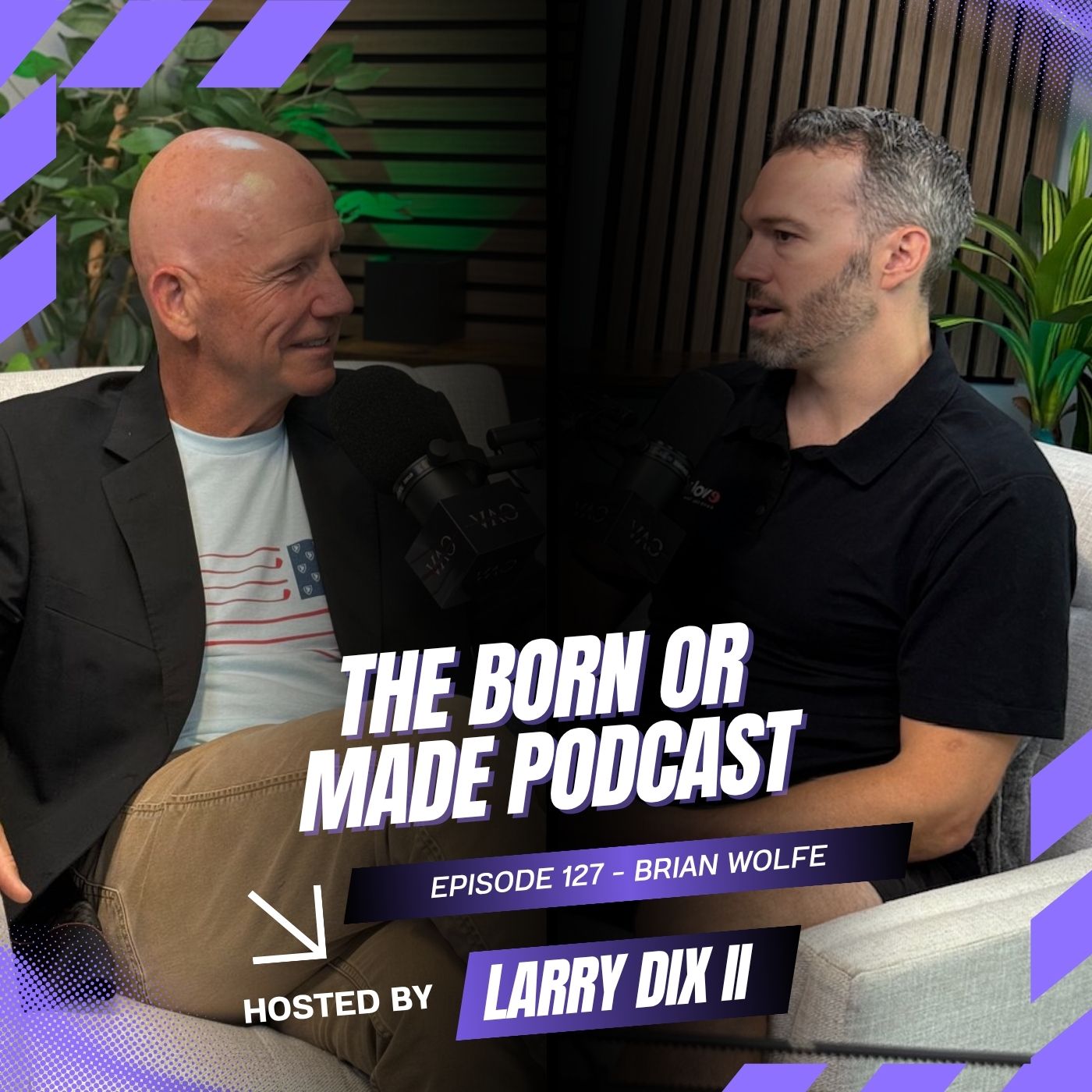
Born or Made · Larry Dix
Brian Wolfe, PT, DPT is a Doctor of Physical Therapy, orthopedic specialist, and healthcare entrepreneur who has spent more than 15 years at the intersection of rehabilitation, performance, and longevity. As the owner of Evolution Physical Therapy & Fitness, Brian has helped bridge the gap between traditional physical therapy and high-performance training, working with everyone from everyday adults to professional athletes. He also founded PhysioGrowth, where he coaches physical therapists and healthcare entrepreneurs on building profitable practices, using AI and systems to work smarter, and growing their businesses without sacrificing patient care, family, or integrity. In this episode, Brian and Larry explore strength as medicine, longevity, building businesses that don’t burn you out, and what it really takes to build a career and life that lasts.
Larry: Well, Brian, welcome to the Born or Maid Podcast. Thanks for having me. Yeah, excited to have you on today. So we always like to ask you, so where were you born? So I mean, I was born here in Westchester County in New York, just like about twenty, thirty minutes from here. Okay. ⁓ yeah. So I'm I'm a local guy, so it's cool to to be here and doing this with you. So you went to school, this whole region then did you go all the way through Kata K through twelve in the same school district? ⁓ basically. I mean I moved I moved once when I but it was same Just change elementary schools and then the whole same school district. Yeah, exactly. So so local right on the other side of the border here when you get up to North Stanford. Right up to the other side in ⁓ Westchester. I know you've got the the physical therapy business and stuff like that. So let's talk kind of through your athletic were you very athletic growing up? I mean, kinda started doing sports and if so, what were those? Yeah, it's like the classic, you know, everybody everybody who has like a physical therapy background, I feel like, has a similar story, right? So ⁓ yeah, I got really into baseball, loved baseball, got into wrestling, like loved wrestling. ⁓ and so played a lot of sports when I was a kid and then ⁓ got athletic, you know, obviously, you know, had more of athletic background. And so, ⁓ for me did that all through high school, recruited to do it in college, didn't end up doing it in college when I found out PT school was really hard. So I ended up and I wasn't gonna be you know, I like a division three type of athlete. It wasn't like a division one pro level stuff. ⁓ but like just everybody else, I got hurt when I was sophomore year in high school with my shoulder, just having issues like throwing. And ⁓ so I got really into the physical therapy side of it, got got introduced to it there. And I always joke, I go I go just like every fourteen year old, when I have a t twelve year old, my my dad turned me goes, This would be a cool profession for you to do, right? And I was like, no way. Right. Like of course like now, fifteen years later plus obviously fifteen years as a PT and loving it and you know, obviously have the entrepreneur side, but also just Genuinely love treating patients and working with people. So that's just where my passion kind of And you were always baseball, pretty much. I mean, you said you did wrestling, which is a great sport. Yeah, yeah. Well, I I you know, I I tell people too, like, you know, one of the things that I I would say about both sports, I loved both sports. And I I honestly was probably a better wrestler when you actually look like achievements versus versus baseball. But you know, if you've ever done wrestling, you realize it's it's the fun aspect of it isn't the same as the hard work, you know. There's a different I explained now I'm getting my nine year old son into it. He did it last year and I was like the difference is you goof around here and someone's better than you, you're gonna stick your face in the floor. I was like versus Yeah, and hard. And hard, exactly. Versus like baseball was kinda nice is you're goofing around like, you know, it's not a big deal. You know, there's not a not a big aspect of that. So yeah, the ⁓ the for for me, both sports I was very passionate about. ⁓ I I liked baseball a little bit more, so that's where I think I naturally kind of gravitated more. ⁓ And what I've always wanted to do past, but now I actually help coach both at the youth level with my kids and get involved in it and ⁓ always have a passion for it. Wrestling, you know, the cool part about the differences between those two sports is, you know, wrestling's an individual sport. I think it truly teaches like accountability and discipline and hard work, right? All that stuff. So it's it's it's where I think I get that those attributes from in my life. ⁓ and then I think on the flip side. the baseball side of it, the fun, the hand-eye coordination, the strategy, the the the gamesmanship, you know, some of that stuff. The team aspect, right? How to work in a team, how to be a leader, it kind of came from that aspect. So I I I I try and do that with each one of my kids. It's like individual teach them the individual sport. And that could be it doesn't be wrestling or martial arts. It could be golf. It could be tennis. Cause you know, one of my wrestling coaches you say, like, hey you get pinned on the mat, you can't say, hey, so and so messed me up. Right. But Sun got in my eyes, right? Exactly, right. You you you you're pitching playing baseball and somebody makes an error, right? That's a big difference versus versus anything else. So, ⁓ you know, whereas like the also the locker room is also key to be a part of a team and be a leader. So I think I got really cool, you know, that's what sports are all about. For for the ninety nine point nine percent of us that aren't going to be professionals, it's it's more around what does it teach you to be as a better human, right? And a better man. So so that to me is ⁓ You know, something that definitely molded me and and now it's fun is I I consult in professional sports. I do this at a high level. Like I I enjoy it. So I'm still around the games, ⁓ but with a cool with a cool different background. So when you're in college, did you go did you get a physical therapy degree? You said you you at first you found it was harder. So Yeah. So typically what happens in PT school is most people have some sort of undergrad. So, you know, that could be in anything. Like for me, my undergraduate degree was in clinical science, but ⁓ Some some of that could also be an exercise science degree. It could be athletic training. It could be anything along those lines. ⁓ and then what happens is you transition into a master's and doctorate. And so that's the graduate school side. And there's honestly, it's funny if if you want to dig in on it today, we can, but it's but it's one of those things where like there's pros and cons to that, in my opinion, that I think's affecting the field positively and negatively and affecting my business positively and negatively. And I think, you know, for me, obviously we're doing something like this where it's like there's a lot of stuff on social media about it that's very negative. ⁓ there's anything I hope you walk away with today is like I'm super passionate about this because I just genuinely love helping people. and so to me, I think the the bigger piece of it was was going through physical therapy school was, you know, seven years of school to have as an entry point can be difficult for a lot of people. And so I wanted to make sure, yeah, it's a lot, it's a long degree, right? You got you got your bachelor's degree, your master's, and then your then your undergrad. You know, I'm very blessed of you know doing it with the guy I picked a program And I wanna tell you that like I had a much more intelligent, like this is why I'm doing it. But if you go, I got recruited to play baseball there. And and so that was the initial piece as a high school, you know, high school athlete. But ⁓ it was a five and a half year program, it was accelerated, so it was very vigorous, right out of the gate. And so that adjustment from high school to college made me kind of press pause on the baseball side and ⁓ and and and I'm and I'm happy I did, right? It's ⁓ it's a it's I wish I scratched a little bit. Definitely, because I wish I could tell you, hey, yeah, I was a college baseball player. But yeah, yeah. At the end of the day I was also gonna be a division three baseball player. So let's not, you know, but Yeah, keep it in perspective, but still you're better than most. For sure, for sure. So that's the thing that I would say in general that I that I was I that I that I, you know, again, I don't have any regrets on because I'm enjoying doing what I'm doing now. So are you specializing so your your physical therapy, you're really going after athletes? So so yeah. I mean I think You know, I also use the the term athlete very specifically, right? To me, like you were kind of talking about before, like this is in my gym, right? Like I consider us athletes. Like while I might be maybe washed up weekend warrior status on that, right? I think my initial passion that came from physical therapy and why I want to start my company was the idea that basically I didn't like the idea of people going to see somebody and them saying, Hey, you really should stop doing this now. And I'll give you an example 'cause like For me, the one of the first clients and one of my perfect clients that I think about all the time, ⁓ played division one lacrosse, right? He he it was in his forties, was doing crossfit actively, was super into it, and then went to go play in like a Lake Plastic tournament they have every year for for lacrosse, and he got injured. And so, you know, had a hamstring, soft tissue injury, came to see me and somebody randomly said to him, and it wasn't even who you'd think, it'd be like a gym owner, was basically like, he should just stop playing lacrosse. And to me, that always bugged me because I know what we do and how we work as physical therapists and how we can help people. And so I always wanted to be helping that person go on for a long period of time. I'm happy to say that guy's still doing like CrossFit and lacrosse and he's got and then what happens for me is then that guy, we've treated all of his kids, right? And they're playing division one lacrosse now and they're getting recruited. So what ends up happening is for me, my target at our audience as a business is generally that sandwich generation, the the you know, the the parents of kids that are still trying to be active weekend warriors. those are one great clients because I genuinely have a passion to help those people keep doing what they want to do for the rest of their lives. But they also obviously I I see and we also work with their parents, right? They could be 60, 70, 80, 90 years old and still be trying to do stuff at a high level. So, you know, for me, I work out regularly, I have different goals. They always are changing, but I'm always trying to help people continue to do those things. And Yeah, high school and college and professional athletes always find us too because of that background as well. It kind of it translates well, right? So Yeah. And I think people don't ⁓ the guy that I work with, I mean, he calls me an elite athlete. So I'm a thousand twenty-seven days. I've never missed a workout. ⁓ nice. And I'm not an elite athlete. I never did D anything, right? Except in grades. And so for me, I I appreciate him because he treats me so uniquely because I'm a very disciplined person. I work out every single day. You know, I'm obvious I'm 63 years old and I'm as good a shape as I've ever been. So I think what you're doing is great because these guys and gals that you're dealing with, they really are elite athletes where they do no, but when you start playing sports 40s, 50s, and 60s, you better be in pretty good shape. Those soft tissue like a hamstring, that's debilitating. Yeah. And can be long term because then you're messing up your hip. Right, because you're walking weird or and then your knee or something like that. Yeah. Yeah. So what I've also told people and I've done like talks on this when it comes like the longevity space, right? Because now it now it feels like that space is really starting to blow up more and more that you're seeing online. People are becoming Yeah. And people are becoming more aware of this. Right. You know, I think you're seeing younger generations, people are drinking less, people are being more active in exercising. Whereas like that wasn't a narrative thirty plus years ago, you know, and and Beyond, right? Because 30 years ago is pretty recent. ⁓ but in my mind, one of the things I I tell people all the time is, you know, the keys to longevity are really decently simple. And physical therapists in general need to be involved in this conversation around longevity more, in my opinion, because we're the we're the experts in the main part of this, right? And the first is everybody needs to be maintaining some. kind of muscle mass for a long period of time. They need to be doing that. So from a fitness and physical therapy perspective, that's essential, right? You see that. We don't even talk about that because everybody thinks you got to go to the gym and and pump big weights. Yeah. I call it functional fitness, not a new term. I came Yeah. Man, I'm just throwing up basic weights, but I'm doing volume, trying to but I'm trying to maintain muscle. Yeah. And and there's like smart ways to do it, right? Like I told people at the time like You know, I think the difference that you can get away with when you're younger, that you can put on more muscle mass is like in your tw you know, in your teens and twenties, you're pumping testosterone, your joints are as healthy as they've ever been. Volume training, you can do a lot of it and you can build it. But then obviously as you start getting into the thirties, the forties, the fifties. I mean, I've noticed myself, I'm turning forty next year. What ends up happening is if I do too much volume all the time, there's only so much my body's willing to grind before it's like, hey, this is the stop. You gotta stop. Yeah. And so Yeah, building muscle can be done in so many different ways and it can be done very intelligently. And that to me is essential. You know, so that's I mean, that's the first major piece I tell people. The the the second part is working on, you know, your aerobic and anaerobic capacity, whether it's your VO two max, but also your cardiovascular system, like being able to go run a five K, being able to train for that stuff. Like a lot of times those those two elements I just talked about, people usually do one and not the other. And they're both important, right? You should be You need good cardiovascular fitness, but you also need to build muscle, right? And so those two things, like, you know, I was talking to somebody the other day who's like, I bike, I swim, I run. I'm like, but what do you do for muscle mass? Right. Or then I also have the power lifter who's doing X, Y, or Z thing or Olympic lifter, which is great and zero cardio, right? And so it's like you need to have a balance of the two from the longevity perspective, right? And then why I think physical therapists need to be involved in this concept is also the third piece, which is You need to be doing certain things like accessory movements and preventing injury. So you can keep doing those first things on a regular basis. Because the reality is if you're if you're having, you know, if you're not doing the exercises or the things you need to do, working on mobility, flexibility to prevent injury, that I I tell people to go, that delta between under training and your performance in training, eventually what's going to happen is you're gonna end up on one of my tables and you're gonna have to stop you know fitness for ⁓ for a certain amount. Whether it's the performance of your fitness, like we gotta like, you your workouts every day just need to be little bit different and they're not optimizing your performance. And now the strategy is more on the intervention side. or what we're doing is we're gonna focus on, you know, X, Y, or Z thing to get you back and you need to rest. And that's that's the thing that messes people up. So those are the three major pieces of longevity. And and so It's relatively simple when you boil it down. Obviously there's more nuanced. We can get into tons of science around it. It's it's very technical at certain times. But to me, if people are just doing that regularly, just that's they're gonna make a massive impact on their on the longevity in general. Do you talk to people about nutrition when you're doing this? Talk about that. Yeah, na naturally what ended up happening, which which is funny because it was not something that was on my radar. I got a minor in nutrition when I was in college. We ⁓ What is interesting was it was something in the first 10 or so years of my career I never really I talked about it a little bit. We'd refer it out, but you know, then we the more and more research comes out and and what I recognize is it has to be an essential part of the conversation. Right. Because what ends up happening is people will come and they'll exercise. And ⁓ I was I was joking about this and and someone's put this this perfectly. It's like, you know, people are working out regularly, they're doing different stuff. But then they're eating cheeseburgers and fries on a regular basis. And then they'll be like, well, I'm not really seeing any results. And the vast majority of people will kind of give up, right? And and they don't like saying it that way. I'm probably being a little more blunt about it than than than than they like it to be. But the reality is then the extreme is, hey, let me eat salads for six weeks. And it's like you there's a there's a there's a combination of how we can do this more intelligently, right? It's the same exact concept behind I've never exercised before. But let me sprint as hard as I possibly can for six weeks straight. Most people are gonna get hurt doing that. Yeah, so you're gonna blow up. You're gonna blow up, right? So the idea of like the nutrition is kind of the same equivalent. Like if I've if I've eaten like crap for the last ten, twenty years, but then I wanna really be really good for six weeks and go back to that, like it's just not gonna have the same impact. You'll see results, but it's short term and you know, you'll probably gain weight back plus more because of the way you did it. So So what I recognize was we really we talk a lot about macros. I'm a huge believer in that and like helping people calculate their macros. AI is incredibly helpful in this in this category, I think. And ⁓ just educating people on protein intake and you know, how to be in caloric deficits, or if you're trying to gain weight, 'cause I'm also work with high school athletes that need to gain weight, how to gain weight safely and effectively. Is that the type of athlete that they need to be? Do they need the extra weight? So it's just giving people more clarity. So we definitely dove more into it because ⁓ You know, it it's a it's an essential part of the conversation. And honestly, being now in my late thirties, I would tell anybody who's training hard and trying to maintain muscle mass, nutrition's where you can make the biggest impact. ⁓ I was g that's where I was going. Yep. I've seen it. Yeah. I just I just have found that on a regular basis, man. Like I think that's a huge part of it, you know. So so no, I I I genuinely like it a lot. I think it's one of those things where it's like you you gotta be consistent with nutrition and ⁓ listen. Like I had I like full disclosure, I'm not I'm not somebody who's gonna gonna tell you that I don't do it 'cause I think there's also a lot of unfortunately on nutrition, there's a lot of noise in in the community. ⁓ I'm somebody who, you know, does well in athletic performance. Like, am I three percent body fat? No. ⁓ I'm not thirty percent body fat by any means, right? I have good muscle mass, I'm pretty strong, like I do the stuff I need to do and and exercise. ⁓ And and am healthy in the longevity space because that's my goal. My goal is more to be able to do, you know, high level stuff in my eighties versus putting a massive weight now. even though I I do okay in that department too. So that's that's good. But but more so from the perspective of like I had the chocolate shake with my kid yesterday. You know what I mean? Like I'm also not a believer in like you have to eat salad, you have to only eat fish. Like I I, you know, I'm more inclusive than anything because I think consistency is more important than anything. And that's where I think people struggle the most on the nutrition side. Yeah, I've struggled with that because I would always be just like hardline, like this is what I'm gonna do. And it gets boring. I mean, you do struggle. ⁓ you know, I was like yesterday I had a I had to eat a sandwich. You know, I try to avoid bread, but I was like, you know, I'm okay. My I'm the nutrition guy that I deal with, he's like Larry, it's okay. Totally. You know, I try not to eat sugar, you know. Yeah. it makes a difference. Yeah. Well, when I when I think when I think about nutrition, like If you're trying to avo like if you're an elite level bodybuilder, right, there's a different discipline level that we need to be, right? And it's the equivalent of if I'm working with a professional athlete. Like there's certain metrics at the pro level that those guys like and I do that, right? Like how we measure everything to how we look at intelligent, you know, training sessions, to how we, you know, how we make sure we're managing load to to the exercise piece, the nutrition side. Like that rabbit hole goes super deep. But the reality I think that happens a lot for a lot of people is they look at that rabbit hole and they get intimidated by that journey. Right. ⁓ but by the way, I think you could build this into business as well. They see the mountain that they gotta climb. And so they're just like, no, thank you. And they just don't do anything. We live in like a world of extremes, right? So I'm like, listen, you don't have to go down that. Let's just let's just take one step at a time together, right? And and let's set goals and let's get you in the gym three times a week. And let's start eating a little better. Let's start tracking stuff. And naturally you'll see impact over time. And you can see massive transformations. Again, can little, little wins, little consistency, you know, pieces where you can start really stacking up those wins. and just, you know, you said something before, and I and I do believe it. It's like I'm just a huge believer in doing the boring things consistently over time, just works really, really well. Right. It's there's nothing sexy out about it. It's really pretty simple. So, you know, you can You can get to that high level and I can teach that. But the reality for, you know, ninety eight percent of the population, if they just make small adjustments and wins, they can make a massive impact on their lives. You know what I mean? And so Yeah, we talk I I talk about thirty day challenge. Just totally. You know, people are like, ⁓ and I'm like, when I started my journey three years almost three years ago in October, I mean, I could do ten push ups and it was hard. Yeah. Today, this morning I can bust forty out just like that. But That's a thousand days of showing up every single day. But it's just consistency because you talked about CrossFit. I did the CrossFit thing. Well, the problem with CrossFit got it got too heavy for the average bear, right? And so I learned, so I my functional fitness does have kettlebells. Well, guess what? I'm doing a 30-pound kettlebell. Not a 43 or 50, you know, what's the biggest one? Six, I think the biggest one I have sixty one. I'm not swinging that thing. Yeah. I use that for farmers carries. Yeah. You know, stuff like that. But really reducing the weights. See, I I'm like just movement, right? Just functional movement. Yeah. See, I'm like what I love, I'm a massive fan of like CrossFit. And like we, you know, as a just just to just to not even plug my own stuff. We don't really do CrossFit stuff anymore. We do some higher stuff. We do some functional fitness stuff. We do a lot of that. You know, I don't think we have like evolution doesn't even doesn't really have like a brand on anything of like what I would say we do fitness wise, right? ⁓ but I'm a huge fan of F forty five, you know, orange theory, cross. So what's F forty five? I haven't heard of that. F forty five similar. It's it's it's lighter probably I'd probably say lighter weights, cardio circuits, like hit training, like that kind of stuff. And it's done in forty five minutes. So it's like in, out, boom, go. ⁓ very structured. Very structured. Yeah, yeah, yeah. I think all those brands are awesome. ⁓ You know, to me, anything that you would say, Hey, it got me started on my fitness journey, right? I'm I'm all for. Right. And I started with, you know, CrossFit. Like I said, this re these rabbit holes go deep. So, you know, for me, more of what I try to do in evolution, you know, is is create a system where people can get wins, right? And and and how they can be intelligent. And so I think sometimes what happens with CrossFit, I found it with my own journey is like there may be a point where volume training, 'cause those are all kind of more volume training based. Because that's what people want. You know, people want to get their butt kicked. People want pain, right? They want that. But let me tell you go chasing for pain, what ends up happening is you end up on my table. That's what from the physical therapy side, it's great for me because what happens is a lot of people are like going a hundred miles an hour when really there should be like a slow ramp up. And we see it like in our fitness facilities too, in in our in our physical therapy pill practices, you know. So but again, I I tell people all the time like the coin line that I have is You know, people who are finishing physical therapy with me, they'll say, Well, well, now how how long should I be doing these exercises for? How often do I need to keep doing these exercises? And go, Well, well, we all should be exercising in some capacity, you know, regularly during the week for the rest of our lives, right? Like that's a normal process. And so that's why we kind of developed a lot of our fitness programs to something that we could hand people off into and and give them something to hold them accountable so that they have an accountability partner in that. ⁓ and that's what's great about the CrossFits, the Orange Theories, the F forty fives, all these different community-based programs is you're you're getting people together that ha really the the, you know, that that component of accountability is massive. You the the fitness and nutrition side, but if you're not doing it and you're not doing something that makes you show up and something that you love to do, it's it's not gonna work. And so that that to me is the biggest piece of it. But to your point about the CrossFit side, like I I found that to be challenging too. I sort of hit a plateau at one point and then you know, trying to get back into it and hold it. And I I sort of lost goals specifically. Like I got to a point where I was like, this is my goal and this is what I want to do. And it was awesome for hitting that. I loved the community. It's great. Yeah. ⁓ I do things a little bit differently now. Obviously we have a little bit closer to home with our business and and ⁓ you know I love what I'm doing now. And now the new thing with high rocks is these competitions. I have recognized as I've gotten older, you need something to train for. That's massive because it it keeps again, that in itself will hold you accountable, at for me personally, it holds me accountable to showing up and and driving my intention. Right. So if I don't have a goal that I'm moving towards, then I'm sort of, I don't want to say floundering. That's probably not the word, because I'll still find a way to be decently successful. But I'm okay with things being a little sloppy sometimes. And the reality is like you clean it up when when you know you're like, ⁓ but I only got X amount of weeks, or I only got this, or I only got that. Right. So That that I'm a I'm a bigger proponent of as well and and helping people get that. Yeah, I like I one thing I like about these like cross the one thing I liked about CrossFit, once I learned how to dial it back, you know, kind of go more girls R X instead of trying to do and it worked for me, was that you walk in, they tell you what to do, and you leave. Totally. So nice. Like you don't think, ⁓ I need to do legs or I need you just go in and they tell you what to do and you just do it. And that's that's so that's kind of what that you said F forty five is kind of the same That's what we're So that's what we do with evolution, all of our facilities too, right? You come to our classes. I I think you nailed it. That's what I love about it, right? I would show up, someone intelligently programmed something, you bang it out, you're in and out, you know, it's it's you driving. So you're not killing yourself. Exactly. Exactly. And so the nice part about and you're getting coached, right? You're getting and so and they and they, you know, for for physical, you know, for not for so much physical therapy because we take insurance, but for a lot of the people that, you know, do ⁓ fitness programs one on one, they can get pricey, they can get expensive. So the the issue becomes obviously that becomes a barrier. Well group classes are now a fraction of that cost. So what is happening is, ⁓ cool, I want to go to your class. I want to show up. I want to get I want to get coached. I want to have intelligent programming that I can just follow. Someone's gonna teach me how to do that programming and then I get the heck out of here. Lot better system than like I show up and don't know what to do. People are so funny when I've done these meetings with people. They're like You know, I don't want to go and look like a doofus in the gym, right? No one wants to be judged. It's classic. Yeah, for sure. Of course. Yeah. ⁓ I do the machines because I'm like trying to be a wallflower in there, right? Or like, you know, so there's always different components to how how that works. But, you know, the the the you know, I I explained the nice thing about a gym and and honestly, like in this area, a lot of people have their own gyms. But the kind of analogy I give is I'm like, if I imagine if I build a beautiful mechanic shop in my in my house. Right. And you brought your car over, or I brought my car in, I wouldn't know what to have to do with it because I don't have a mechanic background. Right. Like I don't do that. You I take it to somebody and they go do it. What happens in the fitness world is so many people like, I have a gym at my house. Like, okay, cool. Like, what do you do with it? And they're like, Well, I sort of do like this, and I sort of do that. And I'm like, I'm getting now while you're sitting here on my physical therapy table. I was like, because, you know, I explained to like if you think about the activities that you goals you're trying to hit. Right, really what ends up happening is you wanna have your training level about here. So, and then what you can do is you can always raise your goal and then raise your training level. But the way that injuries sort of occur is if this is my goal and this is my training level, this delta right here, if under training is essentially what ends up on you end up on my physical therapy table for, right? If you're doing this and this is your goal, it's this delta for over training that's gonna put you on my table. So the intelligence is finding that place. I go it's kinda like ⁓ You know, when you're doing doing the jump and you're trying to hit like a goal for like the the high jump. Mm-hmm. Right. You don't necessarily need to jump all the way over the bar. If you are, then you want to have your goals elevated, right? But you also don't want to be under the bar either. You don't be hitting the bar. So it's just it's just finding that that balance of, you know, is it recovery that you need a little bit more of actively? Is it something that we need to focus on nutrition a little bit more? Is it something that we need to do supplementation or hydration or focus on sleep, all that stuff? Like, There's a lot of elements that go into like I said, this rabbit hole goes deep. So it's a matter of where where is it that I can help you adjust, you know, to to to make the biggest impact on your, you know, whether it's athletic performance or longevity or whatever your particular goal is in in fitness. My number one problem is, well, two. I don't stretch because it's boring. So I get in there, get it done and get out. But my number one issue is sleep. Yeah. You know, we're starting to you're starting to hear more about that. Like I average like six and a half hours sleep. Well, I'm not I'm not the guy like, ⁓ I can go. I only need six I mean, I need eight hours. And so these technology, like this whoop that I've got. Yeah. Yeah, you got the ring. I got the oar ring, yeah. Yeah. Yeah. ⁓ it tells you that the war ring's better for sleep. It really apparently tracks sleep better. Yeah. But my sleep pro that's my biggest issue. You know what's funny? Consistency too. Yeah. You know what's funny is because I've been wearing the ring and people notice it on my hand, they're asking me more about wearables than ever before. And ⁓ th this is where I actually think it makes the biggest impact is the sleep. Like I look, I don't want to say I look forward to it every morning, but when I see my sleep data, like I I think the other aspect that, you know, we were talking about Orange Theory, we've done it evolution. The other thing that's great about, you know, with with whether it's CrossFit, Orange Theory F 45, these wearables, the gamification of things, I think is also s essential. People like that, right? People like the like, ⁓ my sleep score, ⁓ my resili, you know. And and I think that what what I found. That I have found in my personal family history that I I am now becoming much more aware of and trying to be better about about understanding is is sleep because I think that tracking it, you know, again, it one of the things that's made me successful in business, one of the things that's made me successful in fitness and anything I've ever done is learning the process, but also tracking what's working and what's not working. And so these wearables help with that, right? And so. You know, you wanna you don't it's not that it has to be perfection and you wanna understand what that is. Like, you know, I work with some really amazing people who, you know, when I when I think about what they're doing and how they're how they're doing ⁓ you know, PhD level work in this area, they've even talked about like the subjectivity is just as important as the objective measures, meaning like, you know, how many hours did you get? Because when you the one thing when you look at these wearables, deep sleep versus not deep sleep. If you were in a lab controlled with electrodes on your head, it'd be hard it'd be hard to c you hard to see, right? Right. ⁓ but the aspect of, hey, you know, I see ⁓ how many hours I was out to to when I was lying in there, what the latency looks like, you know, what my heart rates, you know, and and tracking trends, ⁓ I think it's incredibly awesome. I like I I I have found especially for recovery. So to your point about like you're talking about s you know, exercising every day, you know, for me like that ready state of like I'm ready to roll and and work out really hard. I have found that one of the most you know, people ask me about recovery all the time. And I tell people it's really five main buckets you got to focus on. And and like I'm not anti sauna or cold plunge at all. I think they're great. But again, I think there's a lot of noise out there. Basics, right? Boring stuff. Exercise prescription, like it like if you're if you're feeling banged up, like maybe just got to adjust some of the exercise stuff that you're doing, right? Just to just accommodate certain things. Two is nutrition. Right, like we kind talked about. Three is sleep. I and I might not necessarily even put it in that order. Like I think sleep is maybe they're they're arguing maybe the number one. Yeah, and particularly for like mental readiness too. Like sleep is huge. Hydration, right? And now you look at supplementation because supplementation can kind of help all these things. Right. And so if you're l focusing on those five buckets and doing one at one at fifty percent level and the other ones at like ninety percent, let's focus on that bucket and get that right. Right. And see what impact that makes. ⁓ and again, for like the professional level athlete, I would argue that we probably want to focus on these five, optimize them to a hundred percent. And then let's look at the other things that can keep moving the needle. Right. And so there's there's ⁓ and and the one thing that I've learned in professional athletes and and you'll see, because people will say people say this, well, my grandmother smoked forever and never died of you know, lived till a hundred and something. And like, yeah, I've worked with a professional athlete that doesn't need to worry about any of this thing, and they're unbelievable. There are outliers to this, but the vast majority of people, the it's it's the I think what happens is people look at those extremes and then think that they can get away with it. That makes sense, right? And the reality is like, yeah, I mean, that's cool. They have that like amazing genetic a anomaly, but most of us don't have that. So let's let's focus on the things that really make impactful changes and ⁓ and and do it, right? And and and help people do that. Yeah, I'm a big, you be like said sixty three. I'm always like Like I do air squats. People like you do air squat. I'm like, you don't put weight. I'm like, don't need to. Give me thirty-five air squats done correctly. Your legs are talking to you. You know, you still gotta be able to reach in and the trunk and pull your, you know, your groceries out. You gotta you know, people don't wanna talk about it. You still gotta sit on the pot. Yeah. You gotta be able to get up. You know, these are basic functional things that people don't talk about. That's where the weight doesn't really matter. Yeah. It's just movement function. Like I've worked out a thousand plus days. Well Some days it's just I walk for forty five minutes. Yep. Yep. That's still exercise. You know, we don't even talk about that. Like walking for an hour or forty five minutes, that's good for you. For sure. Just let your body settle down and get you get your heart rate up, but not, you know, smoking at 160 for 20 minutes, you know, that kind of stuff. For sure. I I you know, I think that one thing that I've preached to a lot of people from a PT perspective that I think gets lost in some of these group fitness things that sometimes, including our own, right, is Can you do full range of movements with great command of your musculature? So, like, in essence, like this is a PT concept, right? That that injury prevention side that we talked about in the beginning with with the longevity side, if you can't do a full functioning air squat with good form, like with ease, then loading stuff up with weight is actually gonna get hurt you over time. And people might disagree with that. People might say, ⁓ no, you know, that's that doesn't make any sense, blah, blah. To me, one of the things that I would say in general is like, again, I I have a client right now that I'm thinking about who she has, she's like, I've never been able to do a proper air squat. Right. I've never been able to squat properly. So what ends up happening is people give her weights, people do things, whether she's working with a personal trainer or working with somebody. And she and not only does she not need it, it's actually hurting her, right? Because I'm watching her form and I go, Well, we actually did was we used bands and like TRX stuff and just actually took body weight off of her, right? So she can hold it and stabilize herself. And guess who can do a great squat now? Right. And I was like, if you think about it, and by the way, then if we think about nutrition, we're also trying to help her lose some weight. So if you start losing weight, because which makes squats easier. It's a body weight movement. So now all of a sudden you lose weight. Now you have great squat and now we can build up for that. So when you think about load it it's just loading in general. So people don't think about that. And so some sometimes, and so you know, someone who's had knee pain forever and isn't squatting properly through full range of motion comes to see me. One of the big things I say is like we're actually gonna unload you. We're gonna work through this movement, get the form right, and then what we're gonna do is we're gonna start loading you, and then you can do the back squat at five hundred pounds. Like I'm also not a proponent. against any of that stuff. It's just doing things right because the reality is if you're not squatting properly and then I start loading you up and you're not doing the basics correct. Calm down with the problem. It's a foundational thing. Right. So it's like if you don't have the foundation, we're building it on a shaky ground. So that's something that I think physical therapy can really help a ton of people, whether they're active in CrossFit or whether active is like, hey, let's break this down into basics. And and and I think You know, again, to kind of bring it back, a lot of people will say, Well, this is what I need in my CrossFit gym. And they'll blame like coaches. And I'm like, no, this is just a this is just a very unique educational background that I have. And why physical therapists are so essential to be parts of these conversations is because this is what my training is in. So the idea of, hey, I can help you supplement this process. You don't need to stop doing CrossFit. We're gonna rebuild this piece. Maybe we just unload you on that on those specific days initially, and then we'll go from there. And then you can kind of build it. And that's That to like where the narrative that that's how we launched our business. And that's how like and and the narrative continued. And we work so well with a lot of trainers because the one of the biggest feedbacks I got is to go, the reason we like you, Brian, is you're not trying to shut people down. And I go, Of course not. Because the reality is I still want you to have those goals and pushing yourself. You know, one one of the things that I think that I have found as I've gotten older is I've gotten more resilient and and and been able to improve how hard I work, right? ⁓ I see it with my kids and your tolerance just I see with myself over time, right? My tolerance for hard work is just continue to increase. Your body's no different as long as you're doing things the correct way. So if you try and cut corners, you try and do the, you know, get distracted by certain things, like your body's gonna punish you for it a little bit. So it's it's about doing it properly and just giving it doing the boring work and going consistently and seeing what's being effective and growing that way. So how do you make For guys like me stretching fun. Cause I mean, that's like I was a runner forever. I just I hate to stretch. It's so boring. Yeah. I I think the most important thing is understanding where the impact can make. Education's obviously a huge piece. It's always our most engaged content. It's always our most engaged thing in the session, right? ⁓ what we do is I think I think it's kind of tricking you into realizing that you're stretching when you're not. So, like, you know, one thing we do before every one of our classes is you know, for 10 to 12 to 15 minutes, it's like an active warm up, a dynamic warm-up. That's going to improve flexibility and mobility. And and and here's the thing about stretching, right? That I would also say to most people. And and I don't want to put something buzzy that's like, you don't need to stretch, but the reality of stretching is is there's three things that are limiting your motion, right? And your flexibility. And or mobility, however you want to call it, right? But the reality is the first thing can be soft tissue. So musculature, right? The third thing or the second thing can be the joints in general. And then the third thing can be your central nervous system. So you talked about like walking and breathing, like those are also great active recovery days because you're stimulating your parasympathetic nervous system, right? It's just a relaxation. And so I would, I would make the argument for a lot of people that they're thinking, well, I gotta stretch and lengthen the soft tissue a lot in the stretching aspect. And so what I'd say to you is I'd be like, Listen, Larry, I don't think you need to worry about so much stretching after like stretching after your workout's always gonna be good because you're gonna lengthen tissue and that's that's when the optimal time to do it. So now I've also 'cause you're warmed up. Yeah. The other the other thing I can say is, hey man, you just gotta stretch for three minutes at the end of your warm up and that's the most efficient way to do it. And maybe somebody like you is like, nice. Brian's labeled it the three minutes I gotta do. And if I do it at this time, I'm gonna make the best impact. And maybe that's the thing that clicks for you, right? Maybe for some it doesn't. I I don't know, right? ⁓ So there's also more than one way to skin a cat, right? How how we can educate. The second part's obvious that active that that active piece in the beginning. And what I would argue to most people's limitations in motion is more their central nervous system. So the person like we talked about who is trying to squat but doesn't squat properly, it's teaching their body how to move through range of motion. Very rarely is it, you know, ankle dorsiflexion or knee flexion or hip mobility. You know, it In the sense of if we just teach you how to move properly and then train you over time, you know, that's the person who goes and squats and goes, I can't, I can't squat very deep. Then I say, let's just practice squatting deep, and all of a sudden they make an instant impact. So, you know, if people because because the other two by definition, if you have a joint mobility problem like arthritis or some sort of joint problem, or you have some sort of soft tissue injury or some sort of like, problem that's being caused from from ⁓ you know a contracture of some kind. Now those are going to take longer to fix. So the person who can gain more range of motion quickly in front of me in my eyes, like if I can all of a sudden teach you how to squat better within 10 minutes, that's a central nervous system problem. That's not by defin it can't be the definition of the first two. And so I think that we get bogged down. Yeah. So we get bogged down on all this I don't again, I don't want to use the word misinformation. It's just It's just we highlight certain things more than we should. And so so I think the central nervous system is a bigger piece than people realize. And so from an I and I tell people like I'm an orthopedic certified specialist, like I'm orthopedic guy, but I treat with a neurological brain because what I think about is how can I influence the way you move? And if I can make an instant impact, that means it's usually from the neurological side that's actually limiting you. It's practice. You know, I don't know if you're a big golfer, but I'm a big believer. Like if you've ever watched someone who's never played golf swing a golf club and they've never swung a baseball get that, they kind of look funky, right? They do, for sure, yeah. But but somebody who's got the swing of a baseball player naturally has the hip turn. Exactly. But why? They've practiced that a zillion times, right? And so the reality is that's a neurological pattern. You've just learned that versus somebody's trying to relearn this pattern. Now you can teach the pattern and then that's why all of a sudden, like, hey, the golf swing looks that much better in ten minutes. I didn't just improve your spine mobility at the joint level. I didn't just improve your lengthening, you know, length tension relationship of your spine, your hips, your hamstrings. I just, you know, you we just taught you how to do it and you move through it. It's the same reason for why somebody who plays golf for the first time who could be an ultra marathon athlete and all of a sudden they're like, ⁓ my God, I got all this back and hip pain. Absolutely. Why am I so sore? New stimulus, right? Brand new. So it's the same kind of thing. People need to respect the central nervous system a little more because it's what what drives us, right? The it's it's what drives everything. So that I'm actually like that's how I would educate the person on the stretching. It's like, where can we make the biggest impact the most efficiently so that you're like, ⁓ cool, this is where I'm actually improving this stuff and making a huge impact. Yeah, I'm working hard on that, like the HRV trying to get that spread. Like the other day, the ⁓ it was s Thursday night, I was exhausted. I woke up the next morning. My HRV was 125. Wow. Never been that high. Like I'm terrible. I woke up, I had bags under my eyes. I was ex I and I but I felt so good because I had slept so well. And that was the first time I've been working on this now for a couple of months that I was like, okay. Cause this whole central nervous system is new to me. Yeah. And I'm learning this and I'm like, holy cow, like this real that goes back to the sleep, the nutrition, the hydration, all these things. But the parasympathetic, you know, I didn't even know what that was three months ago. Yeah. Yeah. And also I'm like, okay, now I'm starting to understand and I'm starting to see an improvement. Yeah. It's a I was joking, it's a thing in ninth grade, right? Biology that you're like, What is what are we talking about? Exactly. I'm trying to throw a baseball on it. Exactly. And it's funny because I think like I think that when it comes to the concepts around like anatomy and and and the individual joint structures and stuff, like yeah, we we can always go into those things. But I find that when you can make such massive impact On the central nervous system side and the parasympathetic nervous system side, where you can teach people like specific breathing patterns, specific ways to relax. But you nailed it, man. I think, I think like, you know, there's there's sl sleep is such a massive part of this department because what are you doing? You're stimulating the parasympathetic nervous system to reset. Like, you know, I always think of these longevity docs that talk about it. They go, you know, we don't think about sleep because if we didn't need sleep, We just wouldn't sleep. We would just go all the time. All the time. We go a thousand miles an hour. It wouldn't be a big deal, right? Well, the reason that we're making sure that we're changing this is because we have to stimulate that so we can recover. And so it's a ⁓ I I'm truly b and and also, you know, we're talking from a from a physical perspective 'cause that's my background, but I'm also from a mental and and brain health perspective, like that to me is like even a bigger impact with sleep. And so I think that's a that's that's why I think it's so important. ⁓ for people to be focused on on a regular basis. I think it's awesome. Yeah, I love it. So how do we how do our folks get in touch with you? What's the best way? Yeah. So so evolution physical therapy dot com probably is the best way. you know, I you know, my I'm for me, you know, requesting appointments or chatting with us or emails, you know, Brian at evolution dash pt dot com. If you want to email me, that makes it super easy. ⁓ all of our contact information is on that on the website. ⁓ and that's our our local business here in Stanford. But we have We have locations down ⁓ in Colorado and in the Denver area on outside Colorado area and same thing in Los Angeles. So we got plenty of places out there as well. ⁓ so yeah, so so you know, whether you're coming from New York City or or LA or Denver, happy to chat with you and obviously l Lower Fairfield County here is is ⁓ our stomach grounds too. So that and again, whether it's physical therapy or fitness, any of that stuff, we're we're happy to help whoever and and however. Well, great. Well, Brian ⁓ we like to finish up our podcast with the question of do you think you were born through this process or do you think you were made? You know, I love it because when you first told me about this and and I heard about this concept, I was like, I I don't know how I would answer that question. But now I think as we were kind of talking, I was thinking about it a little bit in the back of my mind. I think I was made for this. And I think the reason I say that is, you know, I think I could have done naturally from my background in athletics, I feel like no matter what I would have done, I would have found a joy in hard work. I that's something I think I found. So whether I was, you know, working with you and what you do for a living or, you know, any anything that I did, I would find joy in the hard work and like the goal setting and pushing towards that goal. but for me in particular, I think then the athletic background, jumping into this and getting g seeing what you can do with it, I was sort of molded and made into to finding that. And as I keep stumbling, I keep trying to push myself. Like you talk about nutrition, like I wasn't talking about that 10 years ago, but then I realized the importance of in talking about it and ⁓ and how some people I and I and now and now I mentor a lot of young physical therapists as well, where they're saying, Well, I don't feel comfortable talking about nutrition. And I go, got it. You don't have to, you know, but I've also gotten out of the habit of saying, but then refer them to me and I'll talk about it. Because now I can't impact as many people if I do that. You know, I'm happy to work with as many people as I possibly can, but I'm one person. Whereas now we got a staff over a hundred plus PTs across our country. ⁓ wow. If we educate those PTs on how to have that conversation, I can have much bigger impact on on patients. And so, you know, evolution, the the company mission for us is to change the perception of physical therapy. And my my personal mission is is to bridge that gap between rehab and performance. And so how many people I can do that with as one person is is is limited. But My ability to do that across the spectrum and help more younger physical therapists is now also what I'm focused on. And I think that that passion was made. Like I I think I I I've slowly been chiseled into that versus versus born into it. Well, I love that answer. Well, Brian, thanks for being on the Born or Made podcast. Of course. Love, man. Thanks for having Thank you. It great. Cool.