
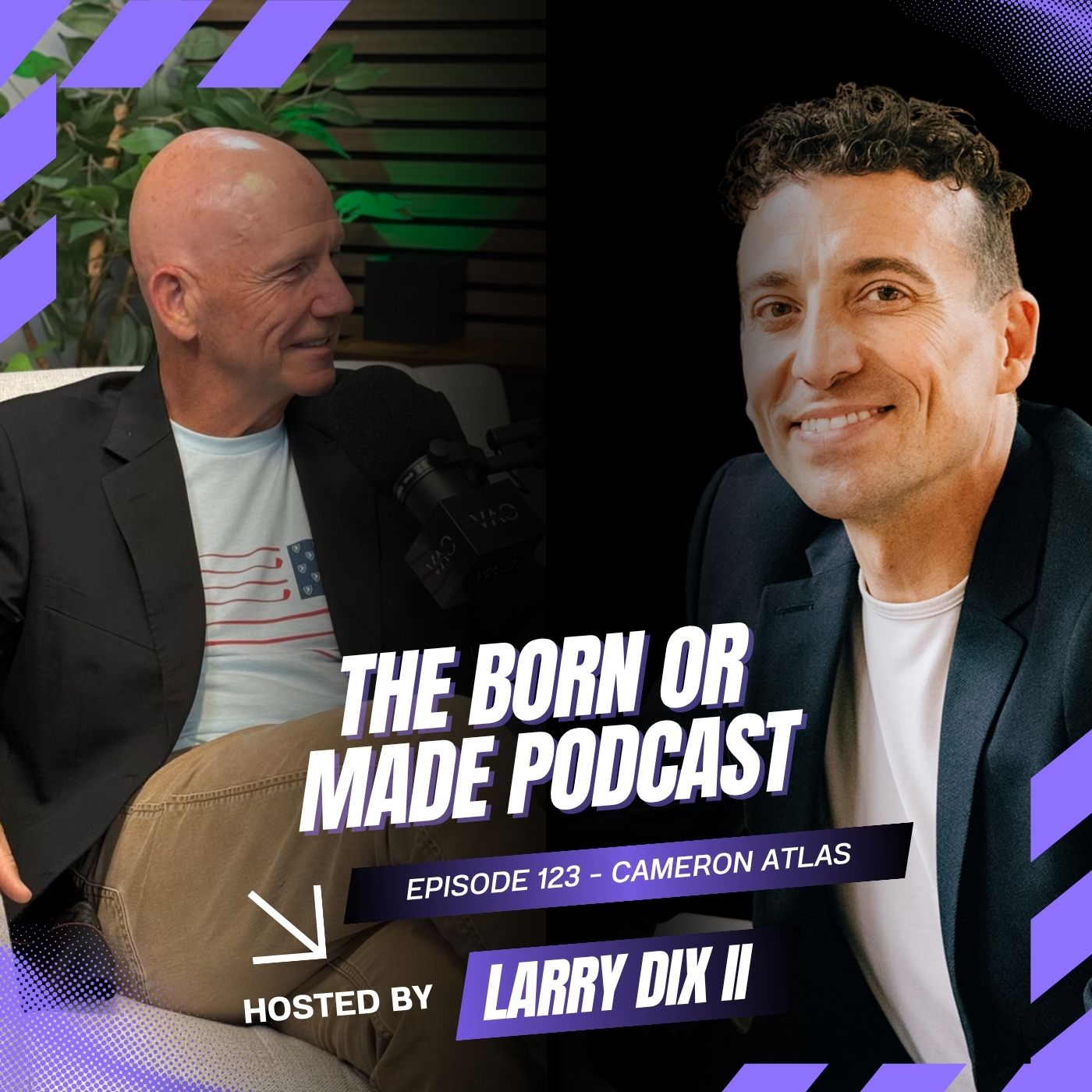
Born or Made · Larry Dix
As a leading authority on adaptability and continuous improvement, Cameron has spent more than 15 years helping organizations, leaders, and teams breakthrough to new levels of performance in the face of constant change. He hosts The Edge of Possible, which was recently featured as a top 100 self-improvement podcast on Apple Podcasts, delivers immersive keynote experiences with live music on stage, and empowers audiences around the world to unlock their best selves both personally and professionally. Cameron’s own journey embodies reinvention. He went from growing up on a farm in Outback Australia with 11 people in his graduating class, to embarking on a global adventure that led to becoming a National Geographic Explorer, delivering a TEDx talk in Rome, and building a fast-growing self-improvement podcast.
Larry: Well, Cameron, welcome to the Born or Me podcast. Thanks for having me. I appreciate it. Yeah, very excited to talk to you today. So easy question. Obviously, not from around Texas, it doesn't sound like. Where were you born? Come on, give that away, right? Almost had a little southern draw. yeah, I grew up on a farm in Outback Australia. it's a long way from anywhere that anyone knows of. So the closest city was Adelaide, and it was a nine hour drive west of Adelaide. so eleven people in my graduating class. had to have singing lessons over the phone 'cause it wasn't a singing teacher for hundreds of miles of of where I grew up and yeah, it's a different lifestyle. But I I I love getting back there each year and spending time with family. It's while the US is home now, it's it's really cool going back and one thing in particular is it's been about six years of doing this now. I I go back and I surprise my nieces and nephews by dressing up in costume and so I get back onto the farm and it's yeah, we have we have an absolute blast. So beautiful upbringing and yeah, look forward to talking more about that. So did you was you raising cattle? sheep. Sheep was the main livestock and then and then the crop was wheat. So dad dad had had that big broadacre farm. My brother's taking that over now, which I'm more than more than okay with. yeah, there's a huge amount of work involved. very admire, you know, what they what they put into and yeah, what they get out of it. So I raise cattle and people just don't realize how hard farmers work. yeah. And I don't have a lot of cow. I have twenty-six cows. And it's work. I mean, if they run out of water, it doesn't matter if the weather's bad, good, middle of the night, you're fixing it. It is it is an insane amount of work. I think just to give people like a just a small amount of insight, I think, is dad mentioned, I think this was last year, that The amount of wheels as in tires on vehicles on the farm right now, there's about three hundred. And so you just think about what can go wrong just with the tires alone, let alone everything else with a different machinery. Because it's like, you know, twenty thousand acre farm over there and so big broadacre farm. And so, yeah, again, huge amount of work that goes into it and yeah, massive respect for for my dad and and now my brother as well. God, so that's like What is that? That's gotta be what thirty something square miles? It's it's it's a lot of land. It's a lot of land. So what's the topography? Is it not a lot of tall you probably don't have a lot of trees? No, I mean there's there's trees. It's not huge. They're not they're not towering towering trees though. So yeah, there's still trees there. but it's pretty flat. I mean, the where we grew up, the it's the last town before you get to a stretch called the Notherbore. And the Notherbore plane is I think it's in the southern hemisphere, the longest stretch of of of land without trees. And and so that that part is there's no trees. But it's awesome. If you viewers and and listeners check this out, you go and check out the Great Australian Bight and Nullabore Plain. you just got sh flat, flat land. There's no no hills, there's nothing. But then it just drops straight off on the cliff face because you're on the southern part of Australia, and the only thing between yeah, that and Antarctica is ocean. And so you've just got it battering against there. So it's it's I mean it's amazing to witness it from from above, like a drone, for example, or or from aerial. because yeah, you're just going across and then it's just straight down and it's just rugged cliff cliff faces. Really? Yeah. Yeah. And how high are the cliffs? I don't know. I I wouldn't be able to say definitively, but I mean I think they'd be at least a hundred, a hundred and fifty feet. Just yeah, a long way down. Yeah, I mean you're not returning. Definitely not. Nah, no, you're you're gone you're going for good. So you go to school there, you did then you w how old were when you left Australia? left Australia when I was thirty. I left I left the farm when I w like left home when I was eighteen and went to the city from there. So yeah, there's some progressions that are that occurred, but yeah, still try to get back to back to the farm once a year. But do so you were kind of never gonna be a farm boy? Nah. No, it wasn't wasn't my thing. Yeah. I got into music pretty early on and and really enjoyed that. I I learned piano growing up and did that for many years. And and yeah, I w there was always a desire to to see what was out there and it's taken a while to get there, but but yeah, it's it's been a pretty wild ride. So you leave the farm, what do you go into the big city for? You going to school, do you go into university? Yeah, I I went to university for a couple of years, dropped out. Okay. Definitely went through my lost, don't know what I'm gonna do for f with my life, partying years. yeah, went very, very deep into that and lost my way a fair bit. And and it wasn't until I mean, there's been a few different pieces in there, but it was my mid-twenties. It was there's a a pretty devastating moment that occurred. It was dusk one evening. I was living in Adelaide at the time. and A relationship of mine had come to an end a a while before that. and a young boy took his own life across the road from where I was living. And there's there's nothing I I don't feel that will ever have that leave my mind because I was the first neighbor as well as another neighbor across when his mother found him. And so it wasn't like he just found out. To wit no, no, to witness everything that happens in the immediate aftermath of of of that occurring and seeing the the dad come home and the grandparents come home while I was looking after the younger brother and sister inside. And the mum was with you. the the mum yeah, I mean the mum found him I that's I meant. Yeah. She was out outside where it where he was and holding him when we when we first made it through the house. Yeah, I I can only imagine what what she would have gone through. And I remember that like the dad came over the next morning to to just say to say thank you. And the he was just this shell of a man. You know, there's nut didn't matter who he was, what he'd achieved, or anything like that, there's nothing he could do to change the situation. And I can only imagine what they what each of them went through after that and and out of that for me I said, dude, there's no one should have to go through that. Not the boy that felt like it was the only way out, nor the family and all the everything they would have gone through afterwards. And the second thing was there's people that need help. What are you doing about it? And and at the time, you know, I'd I'd written music, I'd I'd, you know, aimed to make some kind of a name for myself in that space. but something just wasn't quite clicking. With that, it just wasn't the lifestyle that I necessarily wanted. And it wasn't until then I started searching around and and stumbled across a coaching course. it was in Melbourne in Australia. One of one of the largest coaching schools at the time. And yeah, but I think it took maybe a month or two of of talking with them and saying, Okay, yeah, this seems like it could be could be it. what's crazy is that I I So my two years of university was psychology. really? And so but and it was just so it was it was amazing how it just wasn't the right time. I think for me as well, there wasn't the hands on learning that I that I like to learn through, how I like to learn. whereas into the coaching and the first weekend of training, I think it was about ten or eleven o'clock in the morning and I called up the the work that I was doing at the time and and resigned. 'cause I was like, yeah, I know what I'm gonna do for the rest of my life now. there was just this knowing of, this is a missing piece, where I'd always written music ab about the different things that I I find interesting about overcoming adversity and about purpose and change and resilience and courage and all these different things that make up a beautiful life. and and it was like, there's this peace now that I that I haven't had the the education or the wisdom around that I that I think could could insert here and Yeah, it was it was a pretty, pretty interesting experience. In your mid-twenties at that point. I was mid-twenties, yeah. Yeah. Yeah. Wow. And you thought it I mean, even the knowing what you know today, that was the moment. Like that was that kind of put your It was a yeah, it was a massive that was I mean, there's been multiple major turning points for me. Like that one with the the boy taking his life was a huge one. Yeah. going back, there was actually one earlier on where I was 13 and I there was this moment that I had with a another boy in class and I came back with my sheet music. I'd just had a lesson with a with my piano teacher, and the boy could have caught a glimpse of the title of the song. And he said, is that that song by and it was like a rock band at the time. And it wasn't, it was a you know, it was a pop song by by an Australian band. And it was interesting, see there there wasn't any words spoken in that moment. But the way that I perceived it was that there was absolute disgust on his face that what I was learning at the time wasn't cool. You know, what it wasn't wasn't what I should be doing. and I couldn't shake the regret on my, you know, we have about a forty five minute bus ride home to the to the farm. And I could just couldn't shake that feeling of rejection. You know, and in in such a small town you you aim to fit in. And and and have a sense of belonging and and I didn't feel that. And so I was torn between okay, what it what I want to do, but then what others think I should be doing. I gave up. I stopped playing for two years and and that were two of the toughest years that I've been through, to a point of being suicidal, to a point of not wanting to be alive anymore. And in the process of trying to fit into what somebody else's definition of cool was, I completely lost myself. And it wasn't until I two years later I walked past the piano one day and maybe I'll give that another go. Sat down and soon after wrote yeah, wrote my first song. So there are there are a couple of moments there. There's there's some others that we'll I'm sure we'll we'll touch on as we go through the through the journey here. But yeah, there are there are a couple of big ones from childhood. Isn't that it's so funny because and I'm not meaning that in a bad way, just there's things that we all do and when you look back, it really wasn't that big of a deal. No. He he probably wouldn't even know it happened. He probably that's right. If you asked him, he'd be like, what are you talking about? Wouldn't even know. In that and we everybody does this little bitty things and you wonder what that is. The I mean, it's the the way that I see it from more than 15 years now of coaching folks on this kind of stuff. I don't care how successful someone is, whether they're 30, 40, 50, 60, 70 years of age, almost every single time when I have that first breakthrough session with a client. We're getting back to childhood. And and they're they are we're we're aiming to make sense of the world. We're aiming to make an understand ourselves. And in doing so, like our brains love patterns, right? And they like they crave predictability. When we form an assumption that we believe to be true about something, our our brains is a design to protect that pattern and not question it. And so when we have these things that worked in that moment, right? In that case, when I was thirteen years of age, it worked for a specific reason. Didn't work in many other reasons, in any other case, in in fact, it almost resulted in me not being here. but they they they make sense in a certain moment. But then we we expand those out in our lives to being, well, okay, if that was the case, if for example somebody doesn't, you know, couldn't trust someone because trust was broken in a certain area, then it becomes, well, I can't trust that person to then, or I can't trust my community to I can't trust anybody. And you wonder, you know, within business why somebody struggles with trust. Almost always it's something that's happened, either the business deal has gone bad or something that's happened early on in their childhood, and all that's happening is just repeating over and over again until they make an actual change. Yeah, wow. Hmm. Yeah, because I've learned that now. I I when I wrote my first book, it was after the death of my mom. And I was trying to figure some stuff out, like, you know, and that's where it became born or made, right? And I wrote all this stuff down and I started realizing there was all these things as a kid that actually impact your life. And you don't they're there and they come up when you need them or don't need them. You don't need them. Maybe they just come up. And man, it that's I never I never realized that. And here I was 60 years old. Yeah. Writing this stuff down. I'm like, wow, this had an actual impact on me. There was someone, you know, you mentioned about being sixty. There was someone that I coached years ago who was sixty-four. And I remember after the first session, this is early on in my career, we came into the second session. I said, What have you noticed? And he said, I can't believe it was that easy. And he'd been holding on to something really challenging, really traumatic for sixty years. Mm-hmm. And he didn't realize he could let go of it. Yeah, mine was I I went through this one thing and I held on to it for fifty-two years. Wow. Mm-hmm. Fifty-two years. Yeah. Isn't it amazing though when when that realization is there? It think makes me think about well, you the best time to plant a tree was twenty years ago, the second best is now. And that's right. I heard that recently. Yeah, right. Just like, yeah, you know, if if only I'd known this years ago. Yeah, but then you wouldn't have learned this or gone through this growth or understood this or overcame this challenge or met this person or had this opportunity. There's just so many different pieces that go into it. And all we can do is say, Okay, here's the reality of where it is right now. And I think it's important. That that we continue challenging our assumptions as to what we believe to be true. Because especially as change continues to gr to to speed up, the rate of change continues to speed up. The rate of which something used to be true that may not be true anymore, speeds up with it. And our ability to continue challenging those assumptions is what enables us to open up to new possibilities. And and I think that's that's a recipe for success. It's a recipe for growth, it's a recipe for Being bold enough to to go after what it is you really dream of. And it's never too late. That literally the when's the best time to plant a tree? Yeah, what it's two hundred years. Now. Yeah. And literally I've been on this journey now for two and a half years. And it's like I I can't tell you how excited I am all the time. Yeah. 'Cause I'm getting to do all this. And plus I've got sixty years of knowledge to back it up. Incredible wisdom. Yeah, I'm I'm so much more energized now. I I really feel like I may be more energized now than I was twenty six years ago when I saw that. That must feel really good. It feels amazing. Like I can't, like, I mean, I see you and you have this incredible infectious energy, you know, and I'm like, I'm hoping I'm gonna, you know, be like that, you know, and stuff like that. It's just like, yeah. And I just it's this this this guy that I interviewed earlier, same thing. You know, he's like, Yeah, and he's sixty eight years old and he's all of a sudden like, There's no telling how much I can do Just getting started, right? Yeah. My grandpa. Yeah, my grandpa just taught me this amazing lesson through his actions, not through his words, through his actions. He started woodworking when he was 80. 8-0. Not 18, 80. Just decided, yep, just gonna make tables and chairs and stuff. And just got himself sorted. He had that. He had roses that he played, like, I think probably like 50 to 100 rose bushes out the back, nailed that. And yeah, family members have still got things around their their homes, some of these like sofa type pieces made out of wood. amazing. And just you're never too old to reinvent yourself. And literally. Yeah. And it's important that we I I heard years ago that just the importance of having something that keeps your mind, body, and spirit active. Because otherwise you waste away. You waste away very, very quickly. I don't care what age you are. And that's really important to make sure that you're staying sharp physically, emotionally, mentally, spiritually, all of the above. Mind, body, spirit. And it's literally I've really been keying in on that. And you said that mind, because this is our trap, right? This is the one that just crushes us. And and what you have most control over, I feel as well. In in in a in a lot of ways. Do you I that's a great I don't know. I mean sometimes I don't feel like I do, but then I feel like if I hone my body. Yep. It helps my mind. Yes. And then obviously I dive into the spirit because my mind now lets the spirit get in there. And yeah, I guess I mean you do control your mind, but man, that sucker can throw you down. It's tough sometimes, isn't it? I mean, and and this is the thing, all three of those are working beautifully together. I mean, the purpose side of things and the spirit side of about having a I see it having a purpose that's bigger than your problems. The bigger the problems that you have, the bigger your purpose needs to be. Otherwise you're gonna succumb to the the challenges that you you're going through and think that you're not capable of overcoming them. And so a purpose bigger than the problems. The the body side of it, yeah, I mean your ability to be in great shape, eat great food, sleep like just the basics from a sleep from a recovery standpoint. I play a lot of pickleball here in Austin and yeah, I'm I'm I'm in my 40s now and and it's important from a recovery standpoint. If I'm playing 20-year-olds, I s I I want to smack them. You know, I want to absolutely crush it. And that mobility is so important for ensuring that you're not getting injured. one thing that I noticed though with pickleball, especially, and I I've heard that this is the case with racket sports, that is such a great thing for longevity. And and it makes sense because One, you're moving from side to side, you're moving forward and back. So you've got different range of motion. You've got community where you're actually playing with folks. My reaction time grew off the charts in a very quick quick amount of time. Speed. Which yeah, speed as well. The reaction time's an interesting one because as you get older, slows down. Your yeah, your reaction time is incredibly important because what happens if you fall? You fall. the the I mean you if you don't have core strength or you don't have the ability to hold yourself yeah you're going over and you're potentially gonna end up with some pretty serious injuries. and so that body piece, but I coming back to the the like the mind and and what we do have control over when it comes to that, there's there are there are certain things that flow through us that yeah at at different times we might not feel like we have control. one of the things I like to think about with that is is allowing the emotions to flow through us rather than get stuck in us. The moment you try to have them like try to fix it straight away or need it to go a certain way, no, allow it to flow through. Allow it to flow through. And because how do you do that? That's interesting. So I I've I've never thought of it that way. So these things get in our head. Mm-hmm. So take deep breaths, write down big on breaths and and let out slow, but That's what I'm trying that's how I'm trying to let it flow through. Do you have any other like I mean a ton of them? H here's a story. So I had this experience because this is this is the thing. It is natural for us to not take things personally. And here's what I mean is there were I went out for a massage when I was back in Adelaide living at the time. And the Adelaide Hills, it's about a twenty, thirty minute drive to this person, this person's place. Amazing massage. Haven't found a massage therapist that is as good as this person yet. amazing. It's about 15, you know, 10-15 years ago. And on the way back, I would go to this small town called Sterling. And Sterling is this picturesque kind of place, like there's beautiful trees around. And it's it's really it's idyllic, you know. And off to the off the beaten track, there is a a lake. And not many people know about this lake. I go there. And sometimes there's kangaroos, sometimes there's like birds and ducks and that kind of stuff. On this occasion, there's all these birds, ducks, and that kind of stuff in the water. And then these two birds start fighting each other. And so I do what any normal person would do, I grab out my camera and start filming it. Right. Because I think, you know what, I've heard this story. I want to see if it's true. And so they're fighting away. All of a sudden, a third one comes in, and there's two against one that are fighting against each other. And then there's a fourth one, there's two against two fighting against each other. This video goes for about two and a half minutes. I've still got it. And and so they're they're out in the water. Two are over here, two are over here, they're fighting each other. Eventually, there's a victory that occurs, and there's a like a high-pitched cry of like ow, ow, kind of sound. And and and I kid you not, I'm waiting, I'm waiting, I'm waiting for the moment. And like clockwork, within the next 30 to 60 seconds, every single one of those birds, while they're in the water, does this. And then floats off. Is that terrible? Damn, you're kidding me. What that is, it's a natural instinct that animals have. We are animals that animals have to let go of the excess energy that was required in that specific moment, but is not required any longer. If we as humans, I think our one of our greatest assets is our ability to think. And one of our greatest liabilities is our ability to think. Is that if we get stuck in these ruts of believing the thoughts, if we get stuck in these moments thinking that we can't change the situation or change our thinking around a situation, that is absolute BS. We have control over that. And that is where allowing again to flow through, just like the water birds, okay. In that moment, they need to be angry. But if we were if that if they were humans out in the water, they'd be floating off going, you wait till I go get my, you know, I'm not gonna tell my thing, think about it. You wait till you I just Like the stories that we make up that end up being wasted energy. If we're gonna make up stuff, because it's made up at the end of the day, if we're gonna make up stuff, we might as well be making up stuff that's supportive of our success. And we have the ability to control that narrative. Now we might not be able to control how we feel in a certain moment, but we can have control over the overarching narrative as to who we are, where we're going. And you know, if if you're tired, we coming to some practical pieces. One of the things that I have in, you know, my playbook is that no big decisions are made when I'm tired. Okay. ideally. If if it is maybe there's a case where a big decision has to be made. But ideally, if I am lacking sleep, like go and have a nap, man. Or get an early night and think about this tomorrow. Just get through the things that you need to get done right now to make sure that you're still productive in the day. Breath is definitely a big one. I recommend that you just have like five to seven different things that are work for you. For me, going and sitting at the piano and just closing my eyes and playing, great one. Music is another. Going for a walk, getting yourself into a different physiological state, as you mentioned before, from a body standpoint, you change things from a body, it absolutely changes your psychology as well. And so yeah, I having those ahead of time though, because when you're in it, that's not the time to think about, okay, now what what have I got to be able to handle this? No, you need this when you've when you've already got the capacity. Because when you don't have the capacity and you you're exceeding that which you think you can handle, that's a that's a recipe for feeling that you're not good enough or feeling that you're not cut out for it. And I think the last thing I'd say is that, you know, if anyone's experiencing things like imposter syndrome or stuff like that, which is very natural to experience, is just noticing like reframe it in your mind that. I'm just simply growing faster than my comfort zone right now. Cause imposter syndrome at the end of day largely is exceeding the level we currently believe we're worthy of. for sure. I never even understood what that was until a couple of years ago. Yeah. And then once I'd heard it, I'm like, okay. Now I know what now there's a description of it. Yeah. Cause I had it. We all have it on some level. Yeah. And yeah. And I've I've struggled with that my whole life. Yeah. I mean, challenging those as well. Like I I'm I'm I'm a big believer in this this acronym of CAR, C A R. Challenge, activate, and reframe. You challenge your assumptions, you activate your courage, and then reframe any fear that's bound to come up along the way. and those assumptions, first and foremost, is that yeah, we are assuming things on a day-to-day basis. Even things that are that years ago were scientific fact are no longer true. You know, people thought we weren't able to travel faster than a certain speed, or that computers wouldn't be, wouldn't be a thing, or the internet is just a fad. Like these things. were were seen as, yeah, gospel almost. Now it's like couldn't be further from the truth. So if that's the case, if certain things that people believe scientifically that weren't possible, then there's a good chance that some of your thoughts aren't real. Aren't true. So cause the guys that like we're doing all the time is we're pushing ourselves to the limit. So that's where you get into write that imposter and you're trying to get to the next level, but you don't feel you feel like you're here But you're in the room here. And so what do you do to try to clear that gap? Right. That getting in there. Because if you're trying to be better, yeah, you're gonna get that situation. You are. And and and you should be getting if you're not getting that situation, right? And you're aiming to grow fast, then I my my challenge to those listening is that you're probably not dreaming big enough. Right. Because if you're not experiencing some form of discomfort, then yeah, maybe you're not expanding as fast as what you possibly could be. And and yeah. There's times where we're pushing, we're pushing, we're pushing, and if you're not careful, you end up burning out. I'm definitely guilty of that at different times. and so I've got to continue to monitor that and ensure that I'm getting the basics right first and foremost. And and so this is where some of the things to to bridge that gap. First is the fundamentals, like things like sleep, recovery, eating great food, drinking drinking plenty of water. These Such basics, there's a reason why they continue coming up over and over and over again is because they help to increase our capacity to deal with a situation that is occurring. the purpose piece is another one of again having a purpose that's bigger than your problems because and continue coming back to that and have it somewhere where you can see it every single day. Like that mission that you're that you have, your true north, it should be somewhere where you can see it every single day. Because if it's away somewhere or you've thought about it, you haven't written it down. Like there's gonna come a time where you don't feel good enough. There's gonna come a time when you're not you feel not cut out for it. And if you can just come back to that and go, that's why I'm doing this. All right, game on, let's go. Yeah. So capacity builders is what we're looking to to build there. And then when it comes to the actual action, is to say, okay, why am I feeling inadequate right now? What specifically is missing? Because and and then asking yourself, okay, is that warranted? Or am I just lying to myself here? Because sometimes we're just lying to ourselves. because it protects us, it keeps us safe. Right? It's because that's what our mind wants to do is protect us. Yeah, we want we at the end of the day, our minds are there, our brains are there pr to protect us from being eaten by something, you know, thousands of years ago. those patterns are still there. It's it's just have are we calling the shots rather than them calling it on us and calling the shots on us. and so in those moments. Challenging those assumptions and and asking, okay, where is it? Is it true? And if it's not true, then that's where we can reframe. So we reframe that fear, we reframe what it is to be that. The other though, if it's not true, I mean, if if it is true, then then we've got to ask ourselves, okay, what specific skill sets are missing right now? Because all this is doing is it's helping me to prepare for a situation that's going to come in the future. That if I don't prepare for, I'm not going to be ready for. And if I can prepare for it in this moment, grow, evolve, become better. I'm ready. I'm ready. Yeah. Or at the very least, more a little more prepared. there was this ex experience that I had years ago. I entered in this talent show back in the the town that I was in. It was a so many people were in the hall. I think probably at least 20 or 30% of the town was was in the hall that day. it's and I I remember I was across the other side of the road when my family and I we got out of the car and I had my sheet music with me. And I put my sheet music back in the car. I go, I got this. And went in, everyone else was up, and then it was my turn. And I start off flawlessly. I'm like, yeah, I'm I'm in the zone. And then I just completely lost my place. And I royally screwed this up. Like, like screwed it up like I'm really happy that there aren't. like smartphones and stuff like that around today because that'd definitely be on the on the camera of I mean on on social media say like little you know boy boy screws up screws up your salad show 15 million views yeah exactly right yeah gone viral for all the wrong reasons yeah I carried that around with me for a probably about 15, 20 yeah about 20 odd years. And it wasn't until I actually gave my first talk with a grand piano on stage Back in 2017, where I had the realization that the question that I was asking myself was, what if I screw this up again? What if I screw this up? And it was all come back from what we're talking about earlier from childhood. And that was unconsciously, it didn't even know it, was calling the shots over and over and over again, having me feel like I wasn't prepared. And yet I couldn't possibly base my current reality on a previous version of myself, a cocky little kid. Who felt like he was prepared when I look now and look at the thousands and thousands of hours that it's taken, that yeah, it preparation is key. And so there was an opportunity there for me to learn and grow. I didn't learn it at that time. it took a while for me to to understand that. But yeah, these are the patterns that are playing out that unless we actually analyze that and really go deep, we're we're bound to repeat the same patterns over and over. And I if I had that. Patents still, I wonder, would I still be doing what I'm doing? And I possibly not. I possibly would have given up. Maybe. Maybe. Yeah. But I mean you can't, right? That's that mind thing, right? There it is. Yeah. Yeah. There's the mind thing. So tell me, so you're doing now, you're doing a bunch of stuff on stage now. Piano, you said you had a bunch of other musicians with you. Is that what you were saying? no, so j just just myself. we are I have a producer as well, over in Europe. We've been working together full he's been with me full time for like seven years now. and yeah, I'm the the a coup one of the big moments that happened for me when it came to like the the massive trajectory, because it was a massive shift. I back in 2014 a relationship of mine came to an end. It was a serious relationship of mine. The first one that I felt like I was able to really give everything to 'cause it was a previous serious relationship of mine where I gave everything that I had at the time, but I was very emotionally unavailable. you know there was just certain things that I didn't know how to access in in my in my makeup that that required me to go through some massive transformation of my own. but with this in this occasion 2014 she she said the words of you're so rigid as in I was just so stuck in my ways and I was I was accused of that. my gosh. It was such a I didn't take it to heart in the moment because it wasn't until that fully ended. And and and I I just decided to do a full 180 flip in that like f like like a flip around of of that. I in the first 40 days, I went overseas for the first time. I went scuba diving, mountain climbing, whitewater raft d diving, whitewater wrapping, gliding, There's a couple other repelling down waterfalls. There's a few others in there as well. It's all in the first 40 days. And and I just discovered this. my gosh, what is what is out there? And I realized life is about experiences, not things. and there was this moment that I had in Bali. This is the first trip that I'd been on. And this is a month after this relationship happened. So just I I I don't know whether. There's a universal intelligence or God exists, or whether it's just our brains conspiring for our success, I don't know. But the amount of moments that have occurred where I look back and just go, how did that occur? So in this final day, I'm a couple of hours before I had to head to the airport. And I was going to this cafe and I looked in the in my maps, and it was a long walk. Going, sh I'm I might just go to a closer one because I've only got a little bit of time left. Little voice just goes, go to the go to the further one. Like go to the one that's further away. And I go, all right, fine, I'll go to the further one. And I've learned to listen to that voice. All right. So I walk in, there's a beautiful woman that's sitting there. And the voice goes, You should talk to her. The other one goes, Don't be silly, you just split up and you know, don't like just back and forth, back and forth. I sit down, have my food, didn't talk to her. Wasn't until I walked out, she's still sitting there. Dude, just go and talk to her. So we ended up having a chat for a probably about an hour or so, hour and a half. before I had to go. I shared her some of my music. She shared with me then one song. And I had the headphones in, and it's this beautiful piano piece. And there's these other instruments coming in. I was like, this is such a beautiful song. And this experience that I had. In Bali, was that life was about experiences, not things. It was a massive rev revelation that I had. And I looked down at this song and I kid you not, the song is called Experience. And I'm like, you are kidding me. And I'm listening to this song and just this, I'm thinking, I need to be doing more of this. I need to be, I need to be creating more, and I need to be experiencing more. And didn't think anything more of it at the time, but 18 months. you know, what yeah, about 18 months later or so, I sold everything that I owned, went on this crazy journey around the world, staying in places that had grand pianos in them to write and create and as I went. Like that whole journey led to becoming a National Geographic explorer, led to a TEDx talk in Rome with a grand piano on stage, led to a viral video in in Colombia that led to that National Geo Geographic piece. And in July 2017, I was lying in my on my bed in Argentina. I spent a week there and this question popped in my head out of nowhere of if this all ends today, what haven't I done yet that I wish I had? It's such a good question, Larry. It's such a good question. Because you can be at the end, you you think about like the end of your life, what's it been about to be worthwhile? Great question to ask. It can also lead to some complacency. 'Cause I've got plenty of time. I've got ten years, twenty years, thirty years. But if you're dead today, you've got nothing more to give, what haven't you done? That you wish you had. And for me, it was giving a talk with a grand piano on stage immediately. And I get I got booked for one two years earlier. The entire conference got canceled two days before the event. And I was crushed. I was thinking, you know what? I'll just keep the two separate then. Speak over here, coach over here, music over here. And on that day in Argentina, I go, dude, if you really want this, like, come on. Let's go make it happen. And I just reached out relentlessly to anyone who'd listen, rejection after rejection after rejection. Someone finally gave me a shot. And in front of seven hundred people, you know, two events on the same day, seven hundred people at each, opening up one of them, closing out the second one, grand piano on stage, and walking off that, just thinking, all right, if that's possible, I wonder what else is. So that's like just yeah, it's it's been a wild ride. And that's real, you're doing that a lot now. Yeah, it's yeah, spe speaking's a huge part of it. It's why why I'm here in the US. It's why I'll I'll I'll be here permanently. I mean my wife is here as well, so that's another reason. But but from a career standpoint, yeah, that's a huge part of it. The Edge of Possible is the keynote. we have grand piano, now guitar on stage as well. Like Yeah, 'cause I thought you'd said you had something out. Okay, so there is a guitar now. Yeah, yeah. I I only learned how to play the guitar a a number a few years ago. So 2021 and and yeah, put in two thousand hours over the first five hundred days. so four hours a day average to to add that to the keynote. That I delivered because I had certain objections coming up from event organizers saying, We can't get a grand piano. I was like, now I can just say, All right, for the ultimate experience, yeah, fantastic. But you haven't got a grand piano, that's cool. Just give me something to plug into and I'll bring my guitar. And like seventy, eighty percent of the keynotes now are guitar only, which is wild. Really? Yeah, yeah. It's pretty cool. It's twenty twenty one was the when I when I first started picking up the guitar and giving it a a serious go. Yeah. Five hundred which how many hours? 2000 hours over the first five. I don't dare. You know what's crazy. I so on the two thousandth hour, I was back in Australia visiting family on the farm. And no one was home at the time when I did my two thousandth hour. So this was only for me. and I thought, well, where where do I want to do the two thousandth hour? This storm was just going off in the distance. I thought, you know what? I know exactly where I'm gonna go. I grabbed the guitar, I climbed up on the roof, I sat on the chimney top. of the house that I grew up on grew up in as a kid and played the two thousandth hour while I watched the thunder and lightning, you know, ov off in the distance. And it was just this beautiful moment. Yeah. It was just this beautiful moment of one being home, being back where I grew up. and two, just taking the guitar to the place that the piano can go the least. You know, like where where is the the place the piano cannot go? Cause it was just this reinforcement of of I I can take the The thing that I love the most to the places that I love the most now. And it's just opened up this beautiful amount of freedom as a result. Well, the cool thing too is I mean, that's where it all started for you too. I mean, you you kinda you didn't end it there, but that was a that was a great bookmark. Definitely. Definitely. And and again, just fully for myself. Like I share it in some examples like stories when I'm when I'm, you know, on a podcast like this or or elsewhere. But yeah, I mean that that moment was really for me. That is so cool. And so you're doing this like all over the United States? Yeah, you really North America is the main main part. Yeah. I mean, there's been four continents that I've spoken on now, but yeah, North America is I mean, it's a and it's an outstanding location for just so many events happen here and I I love it. It's I love it here and it's yeah, it's I I I look forward to for many many more years. And how long have you been in Austin? since two thousand twenty three. Okay. Yeah. So I got my first work I got my first work visa for for the US back in two thousand eighteen and was in a number of different places from LA to Boulder and Denver, Asheville, Nashville. yeah, and Nashville was was my last place before coming here. So all those places I I still love going to. I Nashville I'm in a a bunch of times each year for for keynotes. And but yeah, it's Austin I feel I feel really at home here. It's you know, we'll we'll see what what the future holds. But yeah, I I now have my permanent residency and yeah, citizenship isn't too far away. So So you're gonna become an American. Yeah. Good for you. Yeah, yeah. Yeah. It's yeah, it's it's a it's a decision I've come to fairly recently because yeah, there's there's a lot that goes into that. but yeah, I mean it's the first time time that I've shared it on a on publicly on a podcast. So Well I'll be excited to Text you the day you become a United States citizen. That would be super cool. It's very, very, very, it's very, very close in terms of time frame. And yeah, you've gone through the entire process of what it takes. And I'm very proud of of proud of that, of of what it's taken to to build an entirely new life in an entirely new country. I still remember the first time that I was building my network here in the US, I reached out to folks on LinkedIn before I even came over here. and the first time I dialed someone, it was using Skype, I think, back then. And and I had to dial their phone number and it was a plus one. And I like, I don't even know what I'm doing here. Like, okay, plus one? I the country code. I I just a complete rookie. I had no idea what I was doing. But I think there's just something to be said for just going after what what it is that you dream of and and not taking no for an answer. Yeah, you've got some drive though, man. Just going out there and I love the fact that you one of the things you said talked about, you know, how many times you were told no and you just kept going. Yeah. Yeah. Yeah. I mean, we we all experience rejection in our in different ways. some people might strike at lucky in some way, but I mean, yeah, there's there's just thousands of hours that it takes and so many no's before there's yeses. And then there's then there's yeses, but then those yeses are You screw something up in that opportunity and then there's another opportunity to learn and grow. I think that's that's maybe the the big one. I've had those before where really yeah, absolutely, where yeah, I feel like I'm making the progress. There there was a talk that I gave a while ago, like a fair few years ago now. and yet it I bombed, completely screwed it up. And I thought I did better than what the feedback was. But when the feedback came, it was pretty ruthless. And I you know I I could have easily taken that. And there were definitely moments in there where I go, maybe I'm not cut out for this. Maybe there's maybe this isn't gonna be what I what I want it to be. and I think it's those moments that's the real making of somebody. It's it's the real building of somebody's character. Right. Because anyone can do it when it's easy or when it comes to you and it's pretty straightforward. But it yeah, it's the it's the no's and then continuing to drive forward. But it's when you get a yes. And then that yes doesn't go necessarily how you wanted it to, or it goes well for a certain period of time, but then it all of a sudden backfires. I think that's the real making of somebody because it's it's when it's like, all right, are you really cut out for this? Because you've just taken some steps back when you thought you were further ahead than where you actually are. There's some humble pie that you've got to eat right in that moment. And whether you're willing to do it or not. Largely determines what the outcome is going forward. That is great advice. I never really thought of it. I mean, we've all had it, but you're right. You think I got it. Tunk. Somebody smacks you down like that. Like you get that bad review, or people that you're like, ooh, that's when you gotta decide, do I really want this or not? Yeah. And and life will throw you a yeah different curveballs. I I this has been a wild experience that I've witnessed from again. More than 15 years of coaching now, the amount of times where someone in those sessions has said, This is what I want. This is where I'm going. And we have, and there's just so much conviction around it. And within the space of a week, two weeks, there's something that gets thrown their way of like, it's the universe just going like, Yeah, but do you really want it? Show me what you got. Show me what you got. Show me how much you really want it. And it's like the it's like it's testing us in some way of like, are you really cut out for this? Because if you're not cut out for that, how can you possibly expect more to come into your life? From an abundance standpoint, it simply can't be true. If you're struggling to handle this, life's not gonna throw you, yeah, here's this great opportunity then. Let's since you can't handle this, let's see if you can handle this. It's even more. Not gonna happen. No, you've got to show what you're made of. And and that comes through every action, every interaction, every conversation, every time you choose to show up, even when you don't feel like it. Well, our time just like blew by. So how does how do people get a hold of you? Yeah. Get in touch with you. Very straightforward. CameronAtlas.com. Search Cameron Atlas and that's on all the social handles, Edge of Possible Podcast. You can search for that. And yeah, you'll find me there. And we'd love to yeah, have folks reach out, connect, and always good to have a conversation. Well, great. Well, we like to finish this with the same old question is so listen to this amazing story so far. You still got a ways to go. Is do you think you were born or you think you were made? I I think definitely the made is is resonates much more. I mean, there's certain innate skill sets that we all and traits that that we have. But I mean, yeah, the the just the thousands and thousands of hours that it's taken and and that we can build discipline, we can build consistency, we can build persistence, we can build belief in ourselves, and I'm living proof of that. and I'm a work in progress and will be for the rest of my life. and that's what's beautiful about the made component, I think, because there's always another level. I love that. This has been great, Cameron. Appreciate you being on the Borner Maid podcast. It's been great. Really appreciate the time. Thank you.