
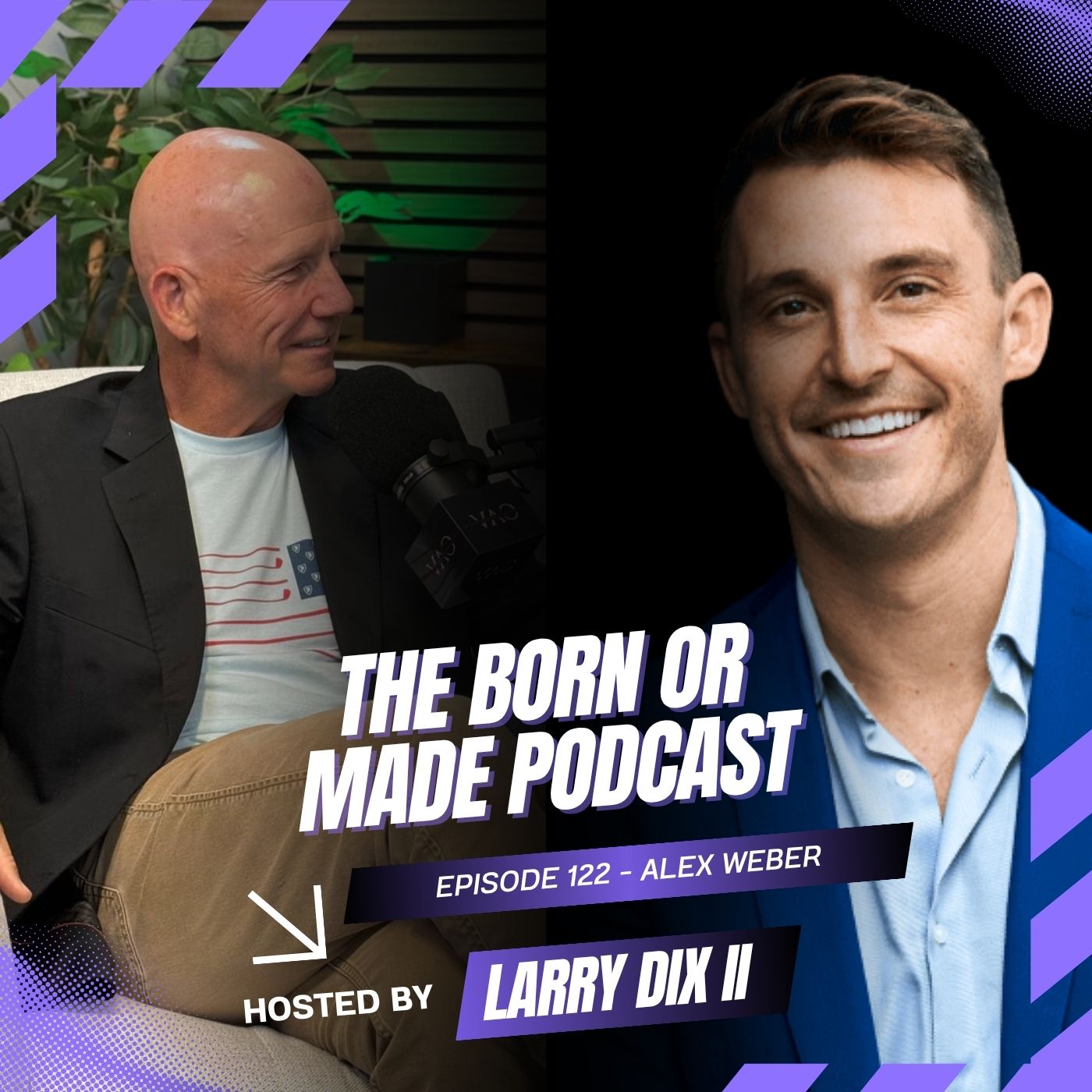
Born or Made · Larry Dix
Alex has positively impacted over 5.5 Million people worldwide to overcome changes, challenges, and uncertainty to achieve their highest goals! Not only has Alex talked the talk as an in-demand international speaker, he’s walked the walk as an elite competitor on NBC’s Emmy-nominated series American Ninja Warrior. Well, more like, leaped the leap! This wildly popular TV show has sparked a global phenomenon! Alex is the only person to host and compete on NBC American Ninja Warrior. Alex is also an acclaimed Author, US Lacrosse Coach of the Year, Award-Winning Performer, and graduate of Cornell University's Psychology of Leadership. Alex’s greatest passion is giving you his Unstoppable System for peak Leadership & Performance so you can reach record-breaking achievements!
Larry: Well, hello, Alex. Welcome to the Born or Maid Podcast. Thank you for having me. Yeah, it's good to see you. So like to start off asking, so where were you born? I was born in Westchester County, New York, Hudson Valley. great place, very woodsy, with New York. People always assume New York City. Not there. but then I'm also not upstate. So we're kind of in the middle, but I love it. A lot of pride from I just loved like country New York. And yeah, ironically it's gotten more and more trendy over the last years, which is funny because some of the places like the deli that we used to go to, you know, in middle school now has become like a boutique, I don't know, cheese shop or something. But you know, but it's hey, that's where it's happening everywhere. Did you go kind of like K through twelve in that same area, same hometown? Kind of pretty much. We're Bedford Pound Ridge. I went to the public high school there, Fox Lane. absolutely loved it for so many reasons. I think we were fortunate to have great teachers and coaches and I loved public school just like you just meet it was so so diverse, so eclectic, both in economic backgrounds, like everything. So it was it was awesome. Yeah. So were you big into sports, academics? yeah, I I, you know, I'll tune it. I was Male athlete of the year, and played high high, you know, hockey lacrosse, loved it. yeah, I I like I loved high school. I got bullied in middle school and beginning of so I got really bullied in middle school and then freshman fall. I didn't have a sport. I did like cross country because a buddy was like, try it out. I didn't like it. and but I'll never forget, and this is one of the blessings of sports, freshman fall. I was a lost kid, ninth grader, puny, watering the halls, just trying to get by. And then hockey season started. And I was really good at hockey because from five years old, my parents, bless them, took me to hockey and I played hockey nonstop. so I went from being like a nobody scared of getting bullied to being a cool kid and having friends and getting invited to parties. And so I Yeah. I I oftentimes will when I talk to parents or or young athletes, I'm like, you gotta find you gotta find a positive outlet. you know, it changes your life. No kidding. So once you finished up high school, you were obviously very athletic, you're going off to college, or you're just gonna go in the working force, or were you gonna do Yeah. I played division one lacrosse at U Penn. I played four years there. had ups and downs, which is sometimes I'll speak about that journey of why some years were great and some years were really terrible. And But it was my dream, absolutely, to play college across. And so I did do that. And yeah, I mean, the experience of it, the growth of it, doing things when you don't want to do them and being somewhere when you don't want to be there, but still doing your best is that getting ingrained in you is is really, you know, you use that for the rest of your life. So I talk about that some. So I I believe discipline and determination are a learned skill. I think there's some of us have advantages over others, and that's just life and er in every aspect of life. what do you think on you? I mean, were you able to build that residual like determination and discipline? Obviously, like said, being where you didn't want to be and and doing the best you could at that point. Let's just talk about that. So Yeah, I mean, I think you can I think you can develop that in a lot of things. And I think of course you can develop that skill in band or debate. And I've done both of those things. I think they're great. There's something very there's an extra dimension when you involve your physical. Cause it's one thing to, you know, not want to do whatever you're doing, practicing something. It's another thing when it's hot and you're tired and someone's hitting you with a stick. It adds another dimension to that discipline and that grit. So I yeah, I just I love sports for so many reasons, but I was fortunate to coach after college as well many years and I I just think like the the character quality of especially team sports being dependent upon and having to do everything we just mentioned, doing something you don't want to do, being beat up, tired, disciplined, and then having other people depend on you for that is I mean, that's such a lesson for life. Yeah. People depend on your success or failure. Yeah. Right. So you talked about highs and lows. So let's let's talk about some lows in college and lacrosse. Let's talk you get injured or No. thank you God. Never really had that. I you know, I was and I've with a lot of humility to say this because I'll say the other parts as well. I was an im I was very talented at lacrosse. the negative was really the mental game where I just applied too much stress and pressure and expectations to myself. And I was just too honestly just too hard on myself. Where I when I fell short of basically perfect results, I beat myself up so much and then I would kind of relegate myself to playing very comfortably or safe and not really going for the big shots and the big things. Yeah, it's it's a safety mechanism, you know, to try to do that. and You know, there was other elements that played in, you know, if but where I could say, like, well, if I'd had a college coach who might have connected with me on that level, or if I had but at the end of the day, I think the real reason was just, you know, if I were better at navigating those moments. And gosh, I I I the answer isn't caring less. The answer is just there's this very thin line with intensity where I'm extremely intense in everything I do, but I've learned through the years there's a line where that intensity is really great. It's really firepower and it'll get you there. But then there's this line where if you pass it and you go to like over intensity or hyper intensity, then it starts to become detrimental. It's like the car's redlining. And so you don't want that. And I I think in college I was hyper intense where I was kind of redlining. And so I mean, you know, it's just it's just a time game then before you kind of spin out. Hmm. So that's interesting. So I you I first thing I thought was, you know, mind, body, spirit, right? 'Cause you talk about your the mind, you're putting all this pressure on yourself. And people athletes talk about that a lot now, and people in general, it's kind of become a hot topic because this mind we're in is a very complex. Little computer we got. Yeah, absolutely. Yeah. And so how did you get out of that? What did you do? I mean, did you just keep redlining till you got 'cause you you can red line, you know, there's a lot of things like red line here, but then that's your new red line. If you get past that, then that's your new red line. Did you keep pushing to that or did you just learn? You know, my kind of four years of college were freshman year. I came in and I was like eye of the tiger. I beat out the seniors. There was three or four starting seniors for my position. I beat out three of them to start at to start at my position. But then my freshman year, I just, you know, again, I just had so many high expectations and I it was fine. It was like, it was okay. But my sophomore year was when I really kind of crumbled. and I remember after my sophomore year, I remember it was like, you know, like June. And I went in my backyard where like, you know, that's where I lived. in high school and middle school, just practicing in the backyard. And I like grab my stick and I'm like, all right, there's there's a fork in the road here. Like like this is June. We don't start our season until February. But I'm like, do you where do you which which path do you want to go here? Are we done with this and that path? Or do we start today and we get it back? And so yeah, I I mean I love this sport. And I also knew that I couldn't live with myself if I had given up on it. And so just started committing again and practicing and working hard and and that junior year I led the team in goal scoring. but I still could have been better. I didn't solve the mental issue. I just outworked it. And so I was gifted enough and hardworking enough that I could still keep beating it out. But that's again, that's not a solution. And then it really wasn't until I became a high school coach, coaching athletes at a high school in Los Angeles. And I could see those athletes, seventeen, eighteen year olds, going through what I was going through. And it was very cathartic because I could help them go through it. And as a result, I think that was pretty healing for me to do that. You get a different view, right? Hundred percent. You weren't in the fight, you were watching these kids in the fight. Yeah, hundred percent. You see yourself and these kids and you're like, Hey, if we don't fix this now, it's gonna be a problem. A hundred percent. Yeah. Really. And so You were t I mean, I go back to that red line thing. It's a one I haven't heard in a while. So your your red line, you said you kept pushing that. So did you keep pushing that red line farther, you felt like? And then so when you were under that, what used to be your red line is now kind of your high end idol or high end, but it wasn't red line again? I mean, for me with lacrosse, it was just I just attached way too much pressure and intensity and that was just not needed. Like, I remember looking around the locker room. I remember it. And there was a teammate of mine, and we were about to play a game, and he was laughing and joking with someone. And I was just like, I I remember like this feeling of longing and envy and and just like baffling because I was like, I could never feel like that. I could never in my bones and body feel laughing and joking before we played a game. And The reality is like every person's different but you absolutely like you wanna be Eye of the Tiger, but you absolutely want the looseness and the love of the game and the confidence and the ease rather than so intense that you're white knuckling something. Were you that way when you were little? I mean, I can certainly trace it down to like my childhood and upbringing. And there like there's a like, listen, like I both my parents are always do your best. They work very hard. My dad is very intense. And I but the thing is, is like, it is what it is. I've succeeded at literally everything I've done. And it's because I don't say that as like a cocky thing. I say that because I have an intensity that was given to me from my dad that like. Is not easy to live with. But because of that, if you channel that intensity towards a positive outlet and you're mindful with it, you can accomplish some pretty darn big things. But if you are not mindful of that intensity, it can really harm you. And I've also had that. I've been an alcoholic and had depression and had all that. So it's you know, it's a be careful what you wish for with it. Yeah. Wow. So high school, you're helping kids. You get through how long are you in there? How long at the high school and coach for five years? We won championship in Los Angeles, won US Lacrosse Coach of the Year. Kids won All Americans Awards. and then I I left that. Okay. And so at this point, you're twenty-eight-ish, twenty-nine-ish, twenty-seven? Yeah, I was about twenty-six, twenty-seven. Yeah. So where'd you go? I was in Los Angeles and the What I really wanted to go after was TV hosting. That's why I moved to LA was to go after entertainment. And so really took a lot of chances and leaps of faith and worked my butt off and and got hired to host for for some TV shows. Yeah. No kidding. So during all this, you were still that was where you were wanting to go. 100%. Yeah. No kidding. All right. So you get into that. Yep. And what who are what are you hosting? Sports. Yeah, I hosted for a few different things. Discovery Channel and things like that. But the the biggest opportunity and so grateful to them was for NBC American Ninja Warrior. So that was Yeah. So that was definitely biggest opportunity. Yeah. No Kinsey, you're one of you were I've seen you on TV then, clearly. On one of the things, maybe, yeah. Yeah, probably on Ninja because I've everybody's kinda see at least seen that a few times. Yeah, yeah, yeah. Yeah, for sure. Did you ever do any of the courses? I did. I ended up competing after hosting. No kidding. Yeah. Yeah. Yeah. Yeah. So where which which one were you in? Which state or I my first year was in Los Angeles, second year was in Tacoma. Okay. Yeah. Yeah. In Tacoma? I didn't know they did one up there. Yeah. Yeah. Yeah. Yeah. Did you get all the way through? I did not. my best year I missed finals by about two people. Yeah. No kidding. Yeah. Okay. So you do that for a couple of years without just an a Something I guess an itch you needed to scratch or just kind of work out that way. I mean, I think looking back, definitely God's hand. I it was yeah, I mean, there's chapters within that, you know, hosting. I was hosting for two years and then stopped hosting and began competing. you know, and there's obviously longer stories with all that, but yeah, you know, six years was really the One year I broke my hand. you know, each year was was pretty different than the one before it. Yeah. Okay. Yeah. All right. So we get through that. Now where are you going from there? yeah. I I had been doing, you know, well in entertainment and was doing stand-up comedy. And that's kind of a dream that I I just liked that, you know, and I was like, okay, that's that's maybe my archetype and what I'll do. And then I had a moment, a very honest moment with myself. There's a question that I encourage that we all ask ourselves, which is what do you really want for your moments on earth? Pretty big question. Yeah, big, deep. Think it's worth think it's worth asking. it seems straightforward, but because it's a big question and it can be scary, we busy ourselves so that we don't ask it. Or were too scared to actually honestly answer it. So my real answer was that I felt a calling to go to to speak. And so I said, okay. And I remember pulling over the car and I went to this ca coffee shop and that day just was like, let's try to figure this out. And started that day. And really and when people talk to me or ask me about, you know, speaking now, I I I like. The if you feel called to speak, speak. Like it, you know, I think I think everyone has their own journey. And of course, there's gonna be someone who's a big Fortune 500, whatever, and does it, you know, part-time on the weekends, or you're a doctor and you do here and there. But if you're if this is what you feel called to do and it's in your bones and you're doing it for the right reason, then you should just wanna do it. And so I just spoke wherever I could. Volunteered, drove my own way, paid my own way, anywhere that I could. And things happen. One is you get to work on your craft and get better at it. Two is you get to actually do the thing and fulfillment and see people getting something from it and getting better. and then you get better at it. And I'm so grateful for those early years of doing it because then it led to. Some opportunities that were a little bit higher stakes. And I'm really grateful that I had all the years and reps of trying it and figuring it out. So that when you have an opportunity where there's a little bit more stakes to it, you feel confident. And so, yeah, I'm so grateful. You know, I I really got into it doing it. kind of full time in twenty nineteen and then twenty twenty was ready to go full time and COVID happened. And so that was like two years of that was dark. Like honestly, that was a a hard time. And yeah, and then twenty twenty three was really where I finally did it full time for a year. And so yeah, I don't don't take it for granted for one second, you know, the opportunities to do it. No kidding. So You said you were you like you like to drink a lot? I I did. I'm four and a half years sober. yeah. I mean, I I guess at a at a macro level, yeah, that's the you know, but I think there's there's a bit of layers to that because there's there's grabbing a drink with your friends to celebrate on a Friday, and then there's sad drinking 'cause you're depressed or want to disengage with life. So there's there's a wide brushstroke there. Yeah, absolutely. Well, congratulations. Thanks, man. I'm two years myself, being two years in July. Awesome. I quit nursing. Yeah. Yeah. Yeah. I highly recommend it for everybody. Yeah. I really do. I shocking people like really. And I'm like, yeah, you really have no idea how much better you actually feel all the time. It is. And I I I think like, you know, I think it's important that people are honest with it, which is to say that it's not fun. to have some drinks on a porch or out to dinner or on a boat or whatever. That's fun. So let's be honest, that's fun. However, that's usually for a lot of for me, that was the minority of it. And it was just the compounding. It compounds both ways. If you're meeting people for drinks three or four times a week and you have one or two or three each time, you know, to me it got it just it it wasn't worth it. And then there was, you know, and then I a blessing of it, I think on the other end is you're going through now some life moments where maybe in the past I would have reached for a substance to make that life experience easier, you know? And now you're just sitting in it and you're gonna experience what you're gonna experience. And then from exactly what you said, like the clarity and the health, that definitely compounds where, you know, you're not having to bounce back. And so I I think that's really a a blessing of it too. Yeah, you don't waste a half a day. Yeah. Completely. And you get to be my age, you lose a day. Yeah. Okay. You know. Yeah. Because it's just harder. Your body doesn't, you know you'll find out in another thirty years, you know, like even when you get hurt. Sure. You know, you broke your arm, you got you healed pretty quick. You break your arm my age. Yeah. It's gonna take several months. Yeah. Yeah. It's the same. Yeah. Same kind of principle. Yeah, yeah. So I guess that kind of goes into, you know, you're kind of you're unstoppable, you're highly driven, highly motivated. I find that most of the people that I interview that have had a lot of them have had drinking problems, myself included, is that they are high intense people and they tend to do really good at everything. And unfortunately drinking is one of those as well. So you are you kind of talk about unstoppable and discipline and things like that. So let's kinda go down that path and just tell me about all that and how you got it, where you got it. Just morphed into You know, unstoppable to me is it's a view, it's a mindset and it's a belief that we are going to go through hard things. But it's a reframe of maybe those things can lead to great things, even if it's hard in the moment. And maybe those things are gonna be outside of us or maybe it's gonna be inside of us. and I think that that's just it's been the journey of my own life going through all those different things. and then the more that I've done speaking and I talk with people, it's the human life. I mean, we're always gonna be going through hard things or changes or challenges and so making us equipped as much as we can to do that. Yeah. Rather than trying to avoid it, because it it is going to happen. Do you think what's harder, internal or external? For challenges? gosh, I'm trying to think of an example. You know, external would be there's a policy that affects how you can do business. internal would be You just have a belief system or an issue that you're dealing with. And I'd say it's probably the internal because that is one you're gonna be living with twenty four seven. External you can get away from potentially. Maybe find a workaround or maybe there's a season for it. If it's a bad job, you can go home. Yeah. But if it's in your head, it's with you no matter you take that one with you no matter where you go. Completely. I would th I would think internal, you know, for me, thinking about my mind and how You know, you get amped up on stuff, like you said earlier. Yeah. You know, you just take things a little too serious. Sure. And that that's a challenge for most of us. Yeah. So if you're getting in that, you know, a lot of mine is through athletics, working out. You know, I tend to work a lot of things in my head out because a lot of times you can just beat it out of you. Sure. You know, how I like to think. Yeah. And so what do you find that works for you? I mean, do you read, do you meditate, do you work out? you know, it depends on when you would have asked me this. over these You know, probably last eight years perspective, which is ultimately rooted in faith. Mm-hmm. so I would say that. I mean, obviously there's things that I can lean on that are within my control. like, yes, I can go work out or I can go structure something, or and that's those definitely help. You know, they they app talk with a friend, hang out and joke with my wife, like that. Thank you, God, those absolutely help. But I think a deeper awareness of what can I do and what is out of my control? Hmm. What you can do and what's out of your control. Yeah. Yeah. Yeah, which, you know, really there's what do you have two always tell everybody two things, right? Your attitude and your effort. Those are kinda little two things you have control of. Yeah. Yeah. Yeah. Have you always I mean, do you read your Bible? Have you always been that way? Did you go to church as a kid, or did you just Kind of later in life. I mean, how'd that work out for you? Yeah, no, I I was, you know, for the first absolutely, you know, twenty years of my life, I kinda thought religion was just made up kind of BS, people being people making up rules for power and control. And and I I absolutely think that religion can still be that, especially when People are being people and we're all broken, faulty people. We are. 100%. And so I absolutely think that that still is the case. However, no, I just had too many experiences in my twenties where I say like the veil got broken or like my armor got cracked, and I started to get curious about what actual faith is. What is this? What is this? Existence, where did it come from? Why are we here? All those questions. And actually, then really in my 30s was the first time I actually cracked open a Bible. And I and I think this is the case for a lot of people, and I was one of them. I had a whole lot of opinions about the Bible. I had a whole lot of assumptions about the Bible. And it's this, it's made by people, and it's I never read a page. And the more that I actually started to just read it. Not as a little kid who's being forced to, but as an adult Ivy League graduate in his 30s who's accomplished stuff in the world, and I looked at it with a very critical lens. I was blown away by the amount of profound wisdom, humility, and the things that no one would say for their own self-interest. Every part of it is die to yourself and love other people. So This is not so you so it's just and that journey has been the most life transformative of my life. Yeah, truly only by God's grace getting sober, truly only by God's hand in my life, having the desire to want to meet someone who also loved God, which is how I met and was able to walk with my wife Jessica. there's And it's also a the more that you do the walk, the more that you also realize how broken and flawed and sinful and I have dark parts of my own heart. And it's it's bittersweet because it's a reminder that you're honestly doing the walk. Because if you're honestly doing the walk and you're trying to get closer to God, you're gonna be aware of the dark spots. And then it's also Man, I wish I didn't have these dark spots. You know, I wish I yeah. So it's for me, it's I mean, it's an everyday, it's an everyday thing. Yeah. Really. Yeah. Yeah. So I had a a young man I was interviewing the other day and I was talking to him. One of the things that I started doing, I so I've been on this journey for I've read the Bible front cover to cover twice. Been in church since I was a child. Been serious and not serious. couple of years ago I really turned the you know, pulled the veil back 'cause you like I thought that was a great analogy and really started reading the Bible. So I was always very frustrated about the Bible because I was always enamored by the guy that's like, well if you go to, you know, Ephesians six, chapter ten, you know, now I know, you know, is like the the full armor of God or things like that. These guys could just like and I was always like But I felt so like I wasn't adequate, right? Yeah. And so I started praying a lot about like, just let me read the words. Yep. And let me know what they say when I need to know. That's good. And I started doing that. That's good. And in the last six months, I've been in opportunities where all of some like, Hey, well, have you ever thought about this? Or someone would talk about this? And I started all of a sudden I'm like, Yeah, I'm not able to quote the scripture, but I can say, Hey, go into Ephesians and So good. Hey, chat you ought to check out chapter six. So good. It's verse ten. I can't tell you, but it's about putting on the full armor of God. Yeah. You know Romans eight, eleven talking about the same Holy Spirit that raised Jesus Christ from the dead is in you. Yeah. I read that one a few months ago, and all of a sudden now since then I feel like I'm Superman. It's all of a sudden I'm like this, you know, so stuff like that. So I so anyway, I started doing this thing about a year ago though, was every morning I get up, I put both feet on the ground, and I pray. So good, man. First thing before I get out of bed. Now it's not a five minute prayer, it's about a 30 second prayer. Yeah. Just kind of, but I kind of get I start building this foundation, is what I call it. So good. And encourage everybody to try that. You know, because it I the in a matter of fact, the young man I did yesterday, he texted me this morning, goes, I did it this morning. He was like, that's such a great idea. And it's like just something simple. It's just you, you know, you don't have to get up there and and man, that made it's made all the difference in the world. Cause I just kind like crack the book that morning. It's like, okay, I'm here for you. Yeah. Use me. So good. So good. And at least I started that way. I'm not saying I get it right most days, but at least I'm trying to continue to do that. And and I I I think about, you know, and that's such a great way to put it too, is like, you know, what even is right? And and and and of course there is, you know, Jesus instructs on how to pray. you know, I also think about like if you're I'm going to the heart of God and the character of God. And if your God willing a little daughter or little son made you a picture and really tried and gave it to you, is there a right or a wrong? Or are you just so touched by that gesture? And I I do believe that's the character of God. And the heart of God is that He loves us that much that Yeah and and I always remind myself, and this is like, it's just it all comes down to the heart. It does. And it is, you know, I I've tried to increase my own knowledge of recalling verses and and and cause I think it's great. And I I think it it it's it's it's it's biblical and it empowers us. And so it's great. ultimately I I feel it is, you know, what are we doing? It's like those moments it's behavior and it's in our heart and it's those Are we forgiving people when it be when we want to keep a grudge? You know what I mean? It's like that's I feel like that's the measure of our faith walk. Are we are we loving people and trying to help them versus being greedy and our own self-ambition? You know, and it's like those moments, those are very telling for me of where I'm at in my own walk, you know? Yeah. Yeah, just being nice to the person that gets the door for you. The clerk that's, you know, I think about when I go up checking into all these hotels and you know, you can tell that person's not maybe not having a good but give a smile. Yeah. Hey, how you doing? So they're like, Good. You know, you kinda help bring them up. You know, that's a servant's heart. People think about, you gotta be doing this or feeding the poor. We actually you're feeding them in a different way. Completely. Yeah. Completely. So do you do you talk about that when you're on stage? Or you just try to live it through your actions more or how do you know. Yeah, you know, I I It's it's something that I've thought so much about. And it's I am not being invited in to share the gospel. I'm not correct. That's right. I'm being invited in in a professional capacity to speak on leadership or peak performance or team. And that's I'm so fired up to do it. That's my life work. Like I'm ready to go. And I truly feel that God has positioned me in a place to serve and help people in this way. If someone were to look at, okay, Alex, what's helping you be at your best and what's helping you do this, you know, just like if someone would be like, well, I make sure that I do my magnesium supplement or whatever it is. Well, it's like, well, okay, mine's not that, mine's faith. You know? And so like people, I gotta wake up at 4 a.m. and I got mine's not that, mine's faith. So if people are curious about where everything good in my life has ever come from. I'm happy to talk about that or shoot me an email. Or I I hope that if you looked at any of how I'm living my life or social media, that that reflects the glory of God. I truly hope that. but I think that it would be inappropriate to it's just not the correct medium. And God doesn't have me. If you were yeah, yeah, god i if I I feel like And I am gonna be serving with my church and and leading a men's group or things like that. Like that's the capacity. But I've prayed on this and thought about it a lot. And God has me, I I feel I what am I trying to do? I'm trying to give people hope. And some of the best messages that I get back are like, You've given me hope today, you know, or people will say that after. And it's that's what I'm trying to do is I'm trying to help people have hope, have love for themselves, love for other people. love for their work, to honor their work and do their best. And that is all if you trace it back, that's all biblical. Absolutely. But I'm trying to have them do it at the finance company they're doing or their hospital they're doing. And so it's all really what we're talking about is we're talking about good. Right. And we just we want that's what I'm trying to empower people with. Okay. Yeah, I guess where I was going with so you're mainly doing like corporations then. Yeah. Okay. Yeah. And I feel so grateful for that. And and again, I think it would be it would be inappropriate of the situation to you know to force anything. but yeah, but I mean when you distill down, you know, so you know, I've pro last year I spoke in 95 organizations, and whether it's healthcare or finance or sales or whatever it is, if you distill down what we're all going through down to a a a bottleneck or a point. It's we are going through a change or a challenge and I don't know if we can do it. And so that is my goal is to meet people in that moment and to ignite them and give them tools so that they now believe we can do it and are committed to doing it. Really? Yeah. Hm. Now have you written any books? I have wrote one called Fail Proof, Become the Unstoppable You. And looks like in the next year, you know, getting ready for round two, which is that's a bite off, but I'm excited for it. Yeah. Good. Yeah. Yeah, that's great. Yeah. Yeah. I enjoy I I've written two books and I actually enjoyed it. I never thought I would. in actually in working on the third, struggling with the third one. That one's been a little bit harder because the first one was actually pretty easy, not saying that arrogantly. Just I had a lot I didn't have anything I'd re written down, so I had plenty to write about. Yeah. The second one was a little bit easier. Now suddenly I've already written about that. So now it's kind of like the next one. It's a little it's a it's a little more challenging. A hundred percent. You're kidding. So you you've been married, how long you've been married? we have been married for it'll be two years, September first. Okay. So you're you're early. Yeah, we're creeping up on there. Yeah. Yeah, good for you. So how long ago did you move to Austin? I moved fall twenty twenty two. Okay. Yeah. So kind of Right at the kind of semi into COVID-ish. We were kind of getting a bit getting closer to the end. Yeah. And you came here because your wife was from here, did you say, or she was bitch? I just moved to Austin. I was curious about it. I had friends, friends here, like just a handful. And I was like, you know what? Let's give it a shot. I was pretty I felt like my chapter in LA was done. Mm-hmm. And so I was like, you know what? Let's give it I did a year in Colorado living in the mountains. And that was awesome. But I was like, I I can't be a mountain man right now. Like I gotta go, you know, be a part of society again. So I was like, all right, let's try Austin. I moved for six months. And then I was like, you know, I I'm still curious. And so yeah, ended up, you know, now it's been four years. I met my wife in January first, twenty twenty four, actually outside right over there. we're at Squatch Gym here. squat right here. Literally that one right there. Yeah, I know exactly. So I gotta shout out Noah and CJ and and the crew here. but they have a a great first of the month kind of workout barbecue co ed and January first was obviously a bigger one. So I went with my buddy Dan and I met Jessica and yeah we met January first, got married September first. Yeah. You actually did it quick. Boy, you're like unusual in this time and age because most people like give you, what is it, save the date and wait two years. Man, and I'll tell you that. Like that's that's because it was the first time for both of us, me and Jessica, we said, let's do it God's way. And I get it, because you know, we didn't live together, we didn't, you know, romance, intimacy, we didn't. And it you're either in or you're out. It's great. You're like, is this the person? Let's we don't have any of this. We don't have any of this other stuff distracting us. I'm like, is this the person, the heart, the soul, the mind that I want to be with? And yeah. And so I was ready very quickly. Yeah, yeah, I'm sure. And then yeah, I proposed to her in six months and they got married in nine months. Yeah. Yeah. So that's funny because Sheryl and I were same way. We were think we knew it I met her October twenty second, nineteen eighty three and we got married August eleventh, eighty four. Awesome. Same thing. Super quick. I mean I love it. Yeah. It was it was And you all are still together? yeah forty two years. Beautiful man forty two years, three kids. Wow. Nine grandkids. My goodness, that's cool. Yeah. It's it's actually yeah, yeah. You throw kids in the equation. It gets a little harder. Of course. It's a little more challenging. Yeah. but if you can you know you gotta survive to the other side and then it it actually you think it's great when you get married. You have kids, it's hard. Then when they're gone, it's actually better. Wow. That's why I tell everybody, like it's it's ten times better. Wow. Because she's not gonna do anything that surprises you. And when I say like, you know, my wife loves to leave, like she'll take her medicine or whatever. She has a lot of allergies living in Virginia. She leaves the little packets always on the counter. And people like, Does that drive your kids? And I'm like, No, I mean she's still here. And that's what I 'cause that's and I literally will see it and I'm like, She's still here. So I look at that as a positive. That's good. And you know, I look at it, you know, things like that. And you don't dwell on people's negatives. You know, you just learn to seek the positives. You've got negatives. She's got negatives. Yep. So not to give, you know, marriage lessons here. Hey, hell love it. But it yeah, I mean it's all part of it. And it's just it's a long journey and it's well worth it if you can get through to the other side because it's you will have your moments. Yeah, yeah. Sure. Yeah. So got anything new and exciting you're working on other than a book or going forward? We well, very grateful. Thank you. Jessica is pregnant. So when do you do? October. All right. Congratulations. Man. So she's obviously doing the the heavy lifting. But yeah. So that's you know, we're just trying to enjoy that journey. and then I'm just trying to honor the work that I have, you know, the speaking and maybe getting ready for a book. But yeah, yeah. Having a kid. So I interviewed this guy, Pat. in Stanford and he's the big kettlebell guy. And so he is incredible athlete. And he s he did a deal, you ought to try this. He s his wife, she's an athlete too. They s they shrink wrapped a watermelon onto him and he had to do a complete work. This guy is an incredible That's awesome. And it was comical. That's and it just said for you, you know, b both being great athletes, whatever, you try that, but it was so cool 'cause you're like Okay, this is a lot harder than I thought. You know, he was like doing these kettlebells, and all of a he's like, Man, my hips are hurting. You know, dude. She's like, see, I told you, you know, and stuff like that. So it was yeah, yeah. I love watermelon too. So yeah. Yeah, at least you get to eat it afterwards. He didn't break it, but it's a great video because he's just shrink wrapped. This is so funny. I love that. Yeah, yeah. Well, that's great. Congratulations. Well, tell us how we can get a hold of you and lock in on you. Yeah. So my name's Alex Weber, one being Weber, and at I'm Alex Weber on all the platforms, Instagram, all that. And yeah, I always love hearing from people, especially if this resonated or yeah. So I I I love that. Well, we've listened to you're still early. You don't even have a kid yet. So but do you think you were born or you think you were made? man. You know, I know we've touched on it a bunch in this podcast, but I I think that I mean I gotta go combo platter, but Born in the sense of God knows every hair on our head. So I I and and you know, if you had asked me 10 years ago, 15 years ago, I would have said made because I work real hard and I'm very intense. And I and I do think I'm still using my free will, you know, imperfectly, but I I think I'm really doing it. but I just truly believe it's all a gift from God. And so any of my determination has probably come from a challenge that He's given me. In order to create that determination to do it. I'm funny because in middle school I got bullied and so I became funny. So it's it's all, I think, a gift of his hand in it throughout. So yeah. That's a great answer. Yeah, thank you for sharing that. I appreciate it. Thanks for being on the Born or Maid podcast and congratulations on that new baby. Thank you, brother.