
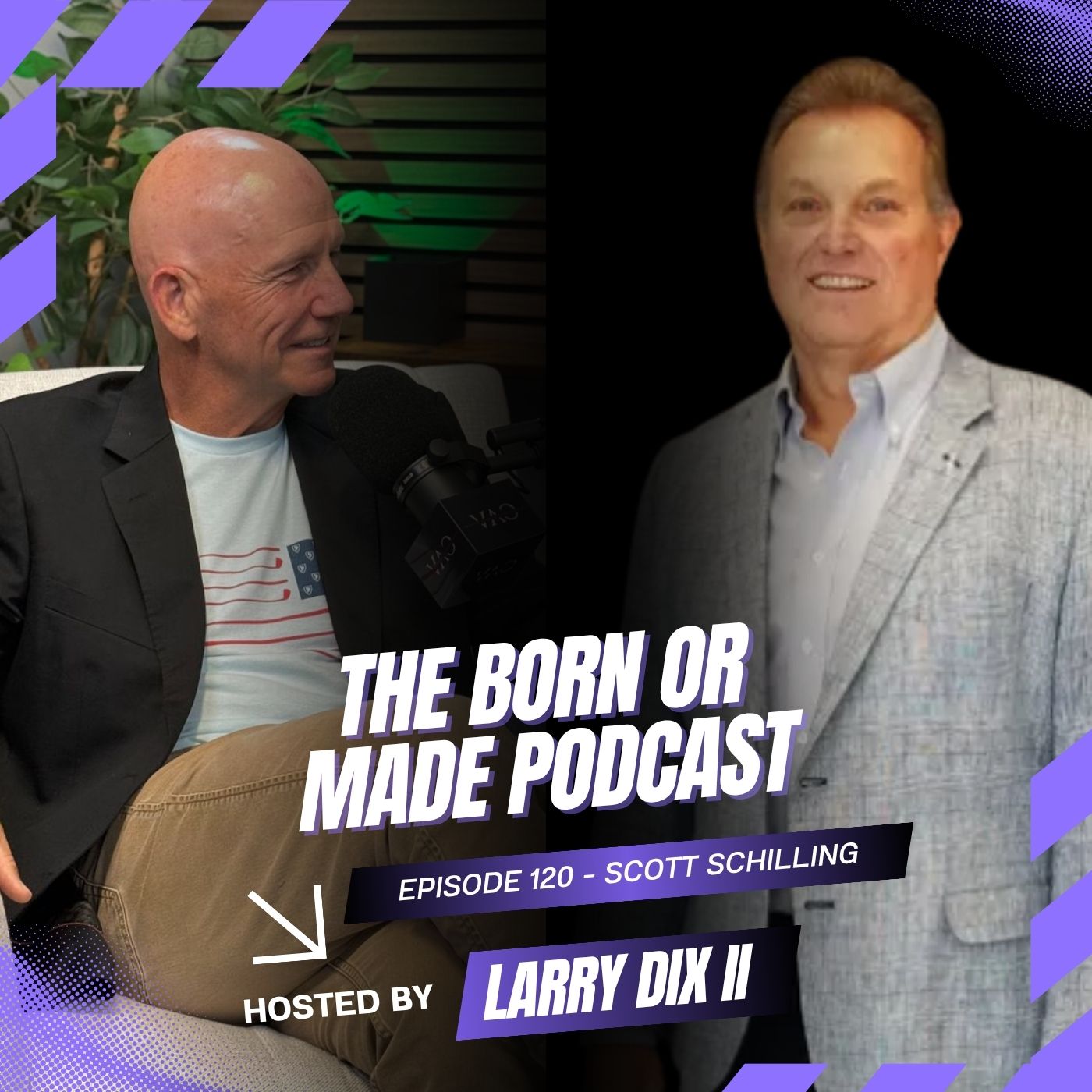
Born or Made · Larry Dix
Scott Schilling has spent decades helping business leaders, entrepreneurs, and organizations turn ideas into action. Through his speaking, coaching, and consulting, he has impacted hundreds of thousands of people around the world by focusing on results that last. On this episode of the Born or Made Podcast, Scott shares lessons on leadership, personal growth, and what it takes to create real change in both business and life.
Larry: Well, Scott, welcome to the Borner Maid podcast. Thanks. This is a great opportunity. I'm looking forward to it. Yeah. So tell me where you were born. I was born in a suburb of Milwaukee, Wisconsin, Wawatosa. Wawatosa. Why did they come up with all these names? You guys and y'all say them so well. I wouldn't be able to say that right if you put it on a piece of paper and like wall, wall, wall, wall. Yeah, you know, it was it was Indian country. Yeah. Yeah. Okay. I guess that that's right. It was. That's cool. So did you stay there most of your childhood or did you Yeah, I was there through Age eighteen. Okay. Graduated high school and then it was time to go off and and hit the real world, you know. So where were you taking off to you going off to college or your sports or what were you doing? I was very blessed. I went off to the University of Iowa, Gohawks. Yeah. And I played college football for the legendary Hayden Fry. So absolutely amazing opportunity. So what was it like playing college football? You know Iowa is an amazing place. It's a football state. It's a football state. Well, there's no professional sports. That's right. So if you either play football at Iowa or wrestle at Iowa, or maybe even Iowa State, but we won't talk about them. But y you come out to seventy seven thousand screaming in black and gold, and they think you hung the moon and you don't want to disappoint them for sure. What position did you play? I was a kicker and a punter. So I was a hero or a zero very quickly. Yeah, especially the kickers, man. You guys you're the hero or the goat. You know. Yeah. So what was your give me your best and your worst on what was the game that you kicked the win and field goal for and then the one that you missed? you know, the w well the the one that I really remember is the f is the first one, forty one yards left hash against Northwestern. And and so it was just it's because it was the first one. you know, you're nineteen years old. Are you nervous? You know, you're really not, believe it or not. You've done it so often and belie even with seventy seven thousand people there, you would think you hear but you really don't. The only time you hear is if you miss. Then you hear the very defe definition of buoy, right? Yeah, there's a there's a difference. and you know it's interesting. I can't think of one that I really missed. I'm not saying I didn't miss any, but I don't I never remembered those. I you know, you compartmentalize, right? You a lot of psycho cybernetics there, you know, as opposed to it's kick it through the uprights as opposed to don't miss it right. You know, I mean it's it's the positive thinking versus the non negative thinking. No kidding. And so you did that. So what were you going to school for? What did you what kind of degree were you going to I was Gonna get a Bachelor of Business Administration degree in marketing. And it was going to be a time where, quite frankly, there weren't jobs coming out of school. So as an 18-year-old, I became a college life insurance agent while going to school, playing Big Ten football and selling insurance, not because I necessarily wanted to sell insurance. I wanted to learn how to communicate to people. And what that did is four years of you know, in the field experience, when it came time that I did graduate, I ended up having seven job offers at a time when most people had none. I was very blessed. That extra knowledge from the field gave me choices. And that's the way it's worked the rest of my career as well. So you're in Iowa, but you're from Wisconsin. So where are you going from there? Do you stay there or you get job offer somewhere else? Well I I had A $500 million company in Iowa and a multi-billion dollar company in Houston, Texas. And I said, well, let's see, I can rocket to the top of this company, the $500 million company, faster than I can this multi-billion dollar company. And who the heck would ever want to live in Texas? So I stayed with the Iowa company. And after a year In Iowa, they transferred me to Chicago six years in Chicago, and then they transferred me to Dallas to open up a new division. And I've been in Dallas ever since. Ever since. No kidding. So how long were you in Iowa again? Right out of college? About f you know, f five and a half years. Okay, and then you jumped n went over to Chicago. Yeah, and then to Chicago for si you know, six years in Iowa, six years in Chicago, and the the rest of of my life and career in Dallas. Gosh, you so what year was that when you moved to Dallas? 1988. Eighty eight. Okay. God, and that was when DFW was still way out there. yeah. They I we I remember when they were building it, people are like, why why are they building that all the way out there? And it's so funny. Now it's just like in the mid of six million people. It's in the middle of it all. Crazy. Yeah. So when you move there, I mean it was still I mean, it's still a big town, but God, I mean it by eighty since eighty eight, what is it? Double, triple. It's probably I would guess it's probably double. I think the funniest thing is I was moving from Chicago and I got to Dallas and everybody said, you're gonna hate the traffic here. I said, This isn't traffic. I moved from Chicago. That's traffic. Yeah. Yeah, we actually had a good football team back in eighty eight too. Eighty five. Yeah. Yeah. Yeah. We were actually pretty good back in those days. Yep. Yeah, we ain't seen a lot since then. We won't go down. I'm still a Dallas Cowboy fan. yeah. Well Eighty sorry, I was thinking of the Chicago Bears in eighty five when I was there. But I was talking about Dallas. Yeah, no, Dallas the nineteen ninety. Yeah. It's been a long time. It's been a long time. I mean I I think we're the longest team yet now or something like that that hasn't at least made it into the quarter finals. I mean, we just haven't done well. Yeah. Yeah, but man, I I I I remember living in in Virginia. And Dallas got but that was the first year that Jones had bought them and they went one and fifteen and the only team we beat was the Washington Redskins in Washington. And I was so excited because we went one and fifteen, but we had won that. So you either love or hate So you're you're in you're in the Dallas market, so now what are you doing there? So you're selling insurance and you're moving up obviously in the company and you're directional. I wasn't I I used the selling insurance to get me the the skill set. Okay, sorry. So that I could go into I was actually in home appliances. I was with a man of refrigeration. And you know, great training ground. We we grew a man of Southwest and we beat goals, we beat everything from that side, but in nineteen ninety two corporate America changed. Shocker. And It just didn't seem like the place for me. Now the reason I was there in the first i I mean, the reason I chose that path or one of the reasons. My dad worked for the same company for forty six years from the time he was seventeen till he was sixty-three. So that's what I saw modeled. I didn't know this whole entrepreneurial thing. Yeah. You know. I I knew that. And then once you live that for a period of time, you go, Okay, I've learned this. I think I'll go do something else. And so where did you go after that? Well, I I really went into consulting and started doing it. But but classically I've always been a sales guy. Yeah. A sales guy and a sales trainer. And a lot of people need that. And so I would I would find a client, I would, you know, fix their systems or put systems in place or do whatever. And they'd go, Hey, you know, why don't you become part of us, become our executive vice president? And so I would for a period of time and But then we'd have an exit and I'd go back out and I'd do this with somebody else and they go, you know, why don't you join us as your executive vice president? Okay. And so I had a pattern of of doing that. You know, I'd go in and I'd help somebody fix somebody, grow somebody, and then leave. And and I affectionately say people say, Well, how'd you get into the speaking business? Well, I'd always been a trainer, so being in front of the room was was no big deal. and I was affectionately eight years into a five year plan. with one of these. I was the vice president of sales and marketing and we were gonna become gazillionaires because we were gonna go public. Mm-hmm. And of course we were gonna go public during the dot com era and silly us, we had a physical building with an actual product that actually made money, but our multiples weren't big enough, so we couldn't take it public. So anyway, you know we go, well, we'll delay it one more year, we'll delay it one more year, we'll delay it. When well, when you're in a stock play, you're making okay money, but you're not really you know. And so I said, you know, God's put I could serve more people if I was a professional speaker on my heart. And so I I told a friend of mine who ran a seminar company, I said, I really wanna do speaking professionally. If you ever got a spot Why don't you let me know? And and I said, I'll make it, I'll make it good for you. You know, he called me one day and he said, Were you serious about helping me out? And I said, Absolutely. He said, I well, I got not only one spot, I got two, and I'll pay you for both. I said, I'm in. He goes, You don't even know where it is. I said, I don't care. He said, It's in Toronto. I said, I don't care. He said, Do you know what's going on in Toronto right now? I said, I have no idea. He said 8,000 people have died because of SARS. That's why I had two speakers cancel from our event. And I said, That's okay, I'll take both spots if you'll pay me for both spots. And he goes, Are you sure? I said, Well, I can either die on stage or die of SARS. Let's go. And what happened at that event is Jack Canfield, Mark, Victor Hansen were the keynotes of the event, chicken soup for the soul creators. And they came into my room, they heard me speak and came up to me afterwards. And said, Are you doing this professionally? And I said, Well, I'm working toward it. And they said, Well, why aren't you doing it professionally? And I said, Because I got a job. They said, That's a horrible answer. You can give us any other answer other than I've got a job. I said, Well, I don't have a different answer for you. And then they thumped me on the sternum and they said, Son, God's granted you talents and capabilities most people don't have. You can stand in front of an audience and share a message. Like people we've never heard before. And if you're not utilizing that talent and capability, you're robbing humanity, you're cheating humanity. In fact, you're being selfish. Wow. And I said, Man, we just met. And they said, That's how serious we are about this. You need to do this professionally. And the rest, as they say, is history. No kidding. And you didn't get SARS. And I didn't get SARS. That's the best part. Yeah, that was the best part. Yeah, so i it was just a Mark invited me to megas his mega speaking event. I met my speaking mentor there, and I've written checks to nineteen mentors across my career and I said the exact same thing to each one of Give me everything you got, and my commitment is I won't keep it. I'll share it with my students and my clients, and ultimately I'll become an extension of yours. And so therefore they did. And and I've been told from one to another the exact same thing. Nobody has ever asked us for more than the standard other than you. Really? Isn't that amazing? It is. And and so I was blessed. They gave it to me because I ask. Great lesson to learn, right? Yeah. And years later, my speaking mentor came into town. He said, I'd really love to buy you dinner. And I said, That's awesome. You ain't bought me nothing. So I would love to love to have dinner with you. He said, I gotta ask you a question. I said, Okay, what's that? He said, I've trained thousands and thousands of speakers. He said, You're easily the most successful. You've done the most events, you've sold the most from stage, you've you've But he said, I need to I need you to answer this question. I said, Well, what's the question? He said, Out of all those thousands of speaker, you're the only one That has implemented one hundred percent of what I suggested you implement. I need to know why. I said, Great question. I'll answer your question if you answer two for me. He said, What are yours? I said, How many dollars worth of checks did I write you? Just a little less than six digits. That sounds about right. How many of them did you cash? He said, Every one of them. I said, You now have your answer. Why would I pay you to learn the industry and learn the business and not do what you taught? He said, You're the only one who ever has. Really? Isn't that amazing? So that goes in hand in hand when you hear people tell, I'll give you the exact process to make X amount of dollars and ninety-nine point nine percent of you will never implement it. It's it's literally that's the same what I just you just said. I'm like It's exactly the same thing. It it is. My speaking mentor said two things. Always give them everything you got. Two reasons. Number one, they won't remember everything you said. Okay. And number two, they'll try to change it and put their spin on it. So don't be afraid of proprietary information because everybody they feel like they have to make it their own as opposed to just doing what works. And that's where we we've really lost that in the sales industry. People are, you know, think of all the books and all the names and all the different I'm this selling and I'm that selling and I do this and I do that. Here's the reality. Sales is four words. Identify problem, provide solution. That's it. It's no more complex than that. But you can't sell a book on four words. No. But you can from stage. You can from stage, absolutely. Wow. So you mentioned earlier Zig Ziglar. Yeah. So America's salesman, right? Zig, love Zig. Yeah. Still friends with Tom and Julie and Cindy, his his kids. In fact, I'll see Tom tomorrow, a couple of times tomorrow. I learned so much from that man. I I read See you at the top, I'm guessing I was probably seventeen, eighteen, nineteen years old. And there was a quote in that book that forever changed my life and my career. You can have everything in life you want when you simply help enough other people get what they want. Total foundation of servant leadership. And and that was Zig. And I was blessed to be out on the road with him and so many great stories and just observations of the man and the humility with which he delivered it. He he was he was such an expert and he did it with such humility and grace. It was amazing. I mean, I've listened. I mean, I was listening to him when they were cassettes. I remember buying them and like I mean, I would listen to those things driving around them. I bought my first new car was a Subaru and it had a cassette player in it. And I would listen to Zig Ziggler. I mean, I burned those things up. Yeah, he he just he had a he had a way of of communicating a message that everybody could grasp. And and again, that's where too many times speakers and and even trainers, they try to be so authoritarian and they try to be so smart and they try to be and they they talk over the heads of the audience, of which then the audience goes, Uh-huh, uh-huh, are you ready to buy? Uh-uh, why not? it's just not right for me. That's not why they're not buying. They have no clue what you said. And they will never embarrass themselves to tell you that. You can always start at a fifth grade level and get more technical if that's required. And if you start too technical and lose you'll never get back. So d was he a was he born that way, like as far as sales? I mean, 'cause or did he go to training or what was he cause Well he had such a great s he was such a great storyteller. Well that's exactly you know He was yeah, he studied like anybody else. I mean, you don't he he was an he was a natural and I think it it comes to the I think there are things that you're born with. Right. You know? You gotta have a love for people. And and when you have a love for people, then if they've got a problem or a challenge, you naturally want to do something about it. And they gravitate towards you 'cause they feel like it's Sincere. Exactly. And and that's what he had. He he was just down home, you know, just truly wanted to solve something for somebody. And and didn't have a bunch of hoopla around it. Y you know, I mean just just really solid, great information. And I I was blessed to share the stage probably virtually every name you know, in and what you one of the greatest parts of of that w while it people go, What it had to be cool to be on stage. Of course yeah, it's cool to be on stage. Well what you know what's cooler? Is being back in the green room. Yeah. And being able to sit and ask questions and just listen. You know, people say, Boy, I'd love to be a fly on the wall. Yeah, you really would. 'Cause some really cool stuff happens. Yeah. And it's so just genuine and you see as just these humans, you know, they're still You know, all of y'all when you're up there on the stage, you're great you're bigger than life, right? But then you get in the green room and you're just you're just like everybody else. Well, and and that's the i we were doing an event, I think it was in Providence or somewhere out east, and and Colin Powell had just given his leadership talk and and came back into the green room. I said, Wow, that was just really awesome. I said, Where did you develop that? I mean, it was just So foundationally amazing. He said, I can assure you, way before I ever became a general. You know, it started it started as a kid and it it just grew and I over time and I watched my commanders and I watched what they did that that led well. And anyway, he just shared how he developed his whole leadership talk over his lifetime. I mean, where do you get that kind of information? You know? You you can't guess at it 'cause you don't really know. And so it's just th those are the things that you just you have the opportunity to ask questions and watch people and w w y which you find out things, you know. You find out that all of for the most for the most part, the the good ones, have a philanthropic bent to them. They have a desire to give back. It's it's Their mission is way beyond them. And that's very consistent with the quality person to person to person, you know. And you can spot the difference between the authentic and inauthentic very easily. So did you have somebody growing up, was it a grandmother, your dad, your mom? I mean, that was kind of was like that for you. You kind of saw that growing up that was like that, that had that servant. I hear that word I I've I've keyed in on that word a lot over the last year. And you see the guys like you and you can see like it's you know, people think, servants is out digging ditches. It's like it's not. You know, it's the compassion. It's Yeah, I I had two great models and my mom and dad. My dad spoke for the United Way for twenty plus years, never got paid a penny. And I used to watch him practicing in the mirror. I go, What are you doing? He goes, I'm about to give a speech to help people enroll in the United Way. I'm gonna cast the vision of why they should. And I was like, wow, that's really cool. And then my mom, funny story, my daughter's graduating from high school. and so my mom flies up from Florida for my daughter's graduation. She's got a new gold watch. My mom's eighty-five at the time. I go, Mom, what's with the bling? I mean, that's not like you to have, you know, a gold watch. That's that's pretty, pretty snazzy there. And she goes, I got that from Florida hospital this week for twenty five years of volunteering. I said, You started when you were sixty? She goes, Doesn't everybody? What a great lesson. Exactly. And and that's the you know, I look at my parents and sometimes I was fortunate coming down to to do this podcast to have lunch with my son and and his wife. And we were talking about those kinds of things. And we were talking about I think we out lay it on me. I have an opportunity to help the younger generations. Who have a desire to be helped. Unfortunately, not enough people have invested in them teaching them how to hold a conversation on, how to get away from screen time, how to do things. There's purpose in screen time, there's purpose in all that stuff, but there's also purpose in being human. And unfortunately, not enough people have have downstreamed that. And I said, we just had that conversation. And I said, I look back at my mom and dad and and we did we had distractions, but we don't have we didn't have the distractions like there are today. And people have made the decision that the younger generations aren't worth investing in. That's a bunch of hooey. That's crazy. They're the future. They are they're running this place whether you want them to or not. I if we don't we some of us more mature that's code word for older. If if we don't in fact invest in the younger generations, who is who's going to? See as boomers, I'm a boomer and and we have knowledge, experience, expertise, education, wisdom. Well guess what? Millennials have energy, excitement, enthusiasm, drive, go get it. Well what do we need as boomers? Those five things, what do they need as millennials and and Zs? The five things that we have. Wouldn't it make sense to come together and do some really great work together so that we can lift up the planet? Rocket fuel, right? It's exactly what I thought. Opposites that need each other, you put them together and they create rocket fuel. Exactly. And and that's what I think we all that's why I I appreciate the opportunity to do the podcast and share some thoughts. Hopefully this is thought-provoking. Somebody might say, he's full of junk. Okay, cool. It's not my job to convince you of what I believe. It is my job to be a living example of what I believe. And therefore, I share it. Now you can choose to accept it or not, but the reality is I know that my mentors, I wrote 19 checks, and every one of them invested in me. And I know things about them their wives don't know because they invested in me. Nor will anybody know, by the way. But the but the point is that somebody else invested in me. I now have the opportunity to invest in others in similar ways. All they gotta do is have want to. If they don't want to, I ain't pushing a rope. I ain't in the convincing business. That's not gonna happen. But if you wanna learn, I'm right here. Come on, let's go. So you said something earlier that really intrigued me and I'm on this same kind of journey is you know, you think you can do more with the time you have left than you did the first I don't know how old you are, but years before. I mean, that's a great I just loved hearing that from you. So tell me more about that. Like 'cause you have all this knowledge, like so much information. Well, thank you. And i you know, it was an epiphany. I I had a prospective client say, you know, you've you've talked about how much you've sold over your career. Okay, I'll bite. I'd like to know what you've sold at what price point and how many. And I said, Okay, cool. For what duration? They said, your career. I said, You know I started when I was eighteen. He goes, Yeah, start there. And at first you kind of go, Well, that's Kind of a crazy ask. And then I went, well, wait a second. This could be a big client. He deserves to ask that. I'm gonna do it. And I sat I literally two days in detailed from age 18 and wrote 12 pages of documentation of everything I had sold, how much, the total dollars. It was crazy. But I sent the message this way. I said, I just want to thank you for having me do this exercise. It helped me truly understand how much I've achieved and accomplished throughout my career. Thank you. And quite frankly, if you can find somebody else that has more expertise and desire to use that in your behalf, I would suggest you talk to them because what you made me realize is I have been living Breathing and talking sails every minute of every day for fifty years. Thank you. And that's what really did it. Th th it was this epiphany. I don't know about you, but I don't look I've had some amazing accomplishments in my life, but I'm not that guy that holds the tote board. Right? I've never been that guy that talks about that. So when I actually had to go back, I went, boy, they're not a whole bunch of people that have done that. Wow, that was pretty you know. And it just again, not from an ego point, from a From a wow point. And all of a sudden I was standing there and it was, wow, isn't it amazing? You're gonna now accomplish more the rest of your life than what you've accomplished to this point in your life. And I all of a sudden had a framework of what I had accomplished and how well God has trained me up to have even bigger impact going forward. And that was the real key. It's all of this was just training. Some people might call it accomplishments, but it was training. Okay, bring it on. What's the next what's the next task? What's the next goal? That I mean, that just gets me excited for you. Well, thank you. I mean, I'm tremendously excited about it. And and by the way, that day I also said From this point forward, I'm gonna get younger, thinner, and better looking too. So I'm working on those. We can talk about that one. I'm I'm doing that stuff like all the time. I'm all in. We can chat on that stuff. I love talking about that kind of stuff. Yeah, it you know, it's what it comes down to ultimately becomes mindset. And I said it earlier. If somebody else has want to, they want to learn, they want to get better. They want to improve. They want to serve more people. They can learn how to do it. But the vast majority of people don't want to. And what I again, a great realization in this was I'm done pushing ropes. I'm done working with people that don't want to. If you want to, I am right here. Let's go to work. If you don't want to, I'm not gonna convince you you should. It's not gonna happen. And that's okay. And that's okay. Yeah. Because there's eight and a half billion people on the planet. I don't think I'm gonna run out of prospects. I never thought of it like that. That's pretty funny though. Yeah. Well, but I but I mean the reality is, right? We we we get into this mentality sometimes that and sometimes it's a savior complex and you know, it's like Because you've been able to help somebody and because you've been able to convince them and because you've been able to win them over, you feel like, well, I've done it once, I I can do it and I should do it more. And then you really look at it and go, Yeah, but if I would have taken that same amount of energy, I probably could have helped ten people who actually wanted to. And so at some point we've we've got to get back into personal responsibility. That's what I think a big part of what we've lost on the planet right now is Is personal responsibility. As soon as you take 100% responsibility, you get rid of blame, shame, and justification. Blame is you did it. Shame is I did it. Justification is let me tell you why it happened. And if we take responsibility, it's amazing what can happen. And so again, it's like you're so gracious to offer me this opportunity to be on your podcast. A friend called said, You live in Texas, right? I go, Yeah. He goes, There's this great podcast being recorded down in Austin. He said, Is that anywhere close? I said, Sure. He goes, What does that mean? I said, It's three hours. It's not that big a deal. It's not on one side it's not that big a deal. On the other side, it's simply the h there's only two answers in life, hell yes and hell no, and hell no gets you nowhere. That's right. It's it was a hell yes answer. Yeah. Let's do this. And you get to have lunch with your son. And I got to have lunch with my son and and his wife. It was awesome. And I get to meet you and we're gonna do a whole lot more things after, I can tell. yeah, this is gonna be fun. I'm excited. I've just I I got goosebumps just now thinking about it again, like you can do more now. I mean, I just that was just like that whole you really think about that. I don't know if it's a sense of urgency or what it is or it just you feel in emboldened. Wh what you said right there just popped up in me. It's a sense of peace. Yeah. It's it's a sense of I'm I'm unabashedly grateful for all the things that have happened in my life. The good, the bad, the ugly. And they've trained me up for what's yet to come. How exciting. It it brings back that that childlike curiosity, that childlike wonder. What can we do from here? The reality is, and we talked about this. My son and his wife and I talked about this at lunch. We didn't have the technology that's available today. my goodness, the things we can do if, as more mature folks, We embrace technologies. The millennials. And and exactly we start to help folks. It's amazing what we could do because we can see where the divides are. You know, it's I actually do a talk on this about communicating through the generations. You've got disk personality profiles, right? You've got disc, you've got bank, you've got Myers Briggs, you've got all these different things that are designed. To look at the four temperaments that Hippocrates started thousands and thousands of years ago. Is that what it's based on? I've done I just did disc a few about two months ago. Yeah. Well basically there's four temp temperaments. And so all these programs were designed to look at the differences in temperaments and therefore be able to identify people by their outward characteristics. What they wear, they wear a puffy sweater versus somebody's really buttoned down. All those kinds of things. Well, that's kind of the the whole personality profile. I created this a very similar thing, except it's by generation. You can tell the generations by outward actions as well. And now and now if somebody prefers to text, you can you can spot the the fact that they prefer to text. So don't try to Talk to them verbally, text them. So it's very it's a very similar thing. The point is. I did this through observation, just watching the younger generations and the old we got four generations in play. We got boomers, X's, Millennials, and and Gen Z in play right now. And they act very differently for very different reasons. And and the it would be like in the disc system, a D, somebody who's very driven and whatever. Looking at a conscientious and going, Well, you're Nambi Pambi, you're a tree hugger, you're and belittling them. That's that's not that's right. Right. And it's no different than a boomer that looks at a a millennial or a Gen Z and says, Well, you're weak, you're lazy, you you you're not committed, you're not all these things. There There's a th I've written a book on this and and it's I there's two things. I call it one boomer bias. Boomer bias is, you know, we walked uphill both ways to and from school in the snow without shoes and and just glad to do it, which is not correct. And then there's millennial bias. Well, you're on your fifth marriage, you drink too much, you're unhealthy, why would I want to be like you? Well, boomer bias isn't right. Millennial bias isn't right. You know, I mean their characteristics, yes. But the point is, there's such divides right now. If we would just all go, Hey, we're brothers. We're brothers in arms. Again, there's eight and a half billion people on the planet. I'm pretty sure they've figured out how to make more. That is not gonna stop. So we've got to get more human. We've got to get back to talking to one another, caring about one another. AI and all this technology will never have empathy, it'll never have compassion, it'll never have these things. If if you want to truly AI proof yourself going forward, become more human. Love one another. This is not really there's a pr This isn't new. This is a there's a pretty good manual that talks about this, right? The first one is love him, the second one is love thy neighbor as thyself. The other eight are suggestions. So right. But you know what I'm saying? But it but if if that's all we did is the first two and got and and we won all those, just think how different the world would be. That's that whole servant thing. I just think about that and just like being nice to a person. Is being is a servant heart. People think, like I said, you know, digging ditches or helping mow, you know, the widow's, you know, grass or whatever. It's just being nice to the person that's checking you in at the hotel. Exactly. It's it's so it's They're so cumin. You don't know what they're going through. One of the things I I often share from stage is by a show of hands, how many of you know how to smile? Mm-hmm. Well, I hadn't seen many so far, so I was just wondering, right? But as soon as you smile, you now improve two lives. Yours and mine. Mm-hmm. At the very least. It doesn't cost you anything. It's just top of mind consciousness. Mm-hmm. And, you know, I do a variety of different things. You know, when people say, Scott, how you doing today? How many times do you get asked, How you doing? My answer is the same one hundred percent of the time. Fabulous. And I'll get better. And it changes state immediately and it gets people to stop down. And again, it's just something being nice, having some fun. anyway, it people think I think far too often that stuff is really hard. It's not. It's foundational. Mm-hmm. If you think we make it hard, right? We're we're we're looking for things that we have to fix. You don't have to fix being nice. You don't have to, you know, open a door for somebody. It's a nice thing to do. Did it did it really take you a whole bunch of time or did you affect your day one way or another? Yeah, this this is gonna put me out if I do this. Yeah, that three seconds is gonna ruin my day. Yeah. Yeah. You know, it's funny you said something earlier about the you said the word peace. And that was the first time I've heard that where the first thing I did was I went. Like I felt you say that and I felt peace. I I I live through a near death experience and I truly believe I I found the equation to total peace. Would you like it? I do. God's plan and timing is perfect. Yep. Plus all things work together for my good equals total peace. So, what was your near-death experience? I had a full-blown cerebellar stroke. Cerebellum control, speech, memory, fine motor skills, walking, talking, vertigo. By the grace of God, I walk away like this. Really? Yeah. And for six days, they kept on saying, We have no clue why you're alive. And at some point they came into my IC room, ICU room, and I said, You guys can say anything to me, but just don't say, We got no clue why you're alive. And they said, Well, we got no clue why you're alive. And I said, Well, I got it all figured out. And they said, Okay, what's that? I said, It's obvious. It's God's grace, mercy, and favor on my life. You wouldn't tur you won your time. They th they said, That's as good an answer as we got and they discharged me. No kidding. How long ago was that? December fourteenth, twenty fourteen. Almost eleven and a half almost Eleven and a half years ago. Really? Yeah. And it was I truly believe, you know, God had been tapping on my shoulder, tapping on my shoulder, tapping on my shoulder, and at some point he used a two by four. and it was actually the back deck of my Lexus. I was going to a speaking event, balanced a box of books on my knee, flipped open the back hatch, ducked underneath it, it came down as fast as I threw it up. hit me in the back of the head, dissected the pica, posterior interior cerebellar artery in my brain. Yep. And eight days later I threw a a major cerebellar stroke. It didn't happen then. No. It just set the ground. Yep. The the inner and outer walls of the pica were dissected. They came they came apart. And so at one point it closed down. pulled up enough and then sent the stroke. And you had no paralysis or anything? No. You know, I mean I did right after immediately. Yeah, my legs stopped working. I was walking in Austin, I was standing on two tingling stumps from above the knees down, and I I looked down at my right foot and said move and it said no. And I looked at my left foot, said move, it said no. And I I started getting disoriented. There was a railing behind me. I went to grab it. Walking with seven people, three of them doctors, coincidence, I think not. One of throws a chair underneath me. I fall into the chair, and he spins around, he goes, What's your phone number? Eight one seven, two three nine. Why would you be asking me that now? Can't you see I can't walk? no reason. I was cold, I was gray, I was clammy, I was sweating profusely. I was in the midst of a full blown stroke. And there's no pain when you have a stroke, right? Or do you get a massive headache? Well I've heard different stories. Your your head doesn't feel real great. Yeah. or at least my head didn't feel real great. But but the you know, you get disoriented and and it's it's a major, major, major thing. and the reason they kept on saying they said we got two others the doctors again, they kept on saying, We don't understand why you're alive. And I said, Why do you say this? They said we got two other stroke patients on the floor. Both MRIs not near as bad as yours. One's not gonna make it. They're they're just not. The other one's gonna be pretty incapacitated, more than likely, for their whole life. Your MRI is worse. You're in here laughing, goofing off, joking with us. We don't understand it. And that's when I said what I said. And they're like, great answer. 'Cause they didn't have any answers. They they knew it happened. They again, I'm phenomenally blessed. And and as blessed as I am to come through that for a number of years, it was also very confusing because I take no credit for being here. God, you get the glory. You save me. Well, what do you got for me? And I heard crickets. And that's probably as hard as anything is going, okay, I'm here, I'm available, you know, what do you got? And so I was actually, when I went back out on the road speaking, I was with an amazing speaker and evangelist, Chris Dunham. He's absolutely phenomenal. And I said, Chris, I don't get it. My prayer every day is, God use me. Crickets. I'm hearing nothing. Is my discerner off? Am I am I not do I not know how to hear from God? You know what's where's the Holy Spirit? Yeah, what's what's going on? Right. And Chris starts laughing. I said, Did I say something funny? He said, Yeah, wrong prayer. I said, Come on, how can God use me? Be the wrong prayer. Yeah. He said, It's totally the wrong prayer. I said, Okay, what's the right prayer? He said, God make me use a bull. Okay. Never thought of it that way. It's another one of those mic drops. Mm. He said, just ask God to make you usable. Usable. And that's again, we we start to the again go back to the equation, the total peace. God's plan and timing is perfect. Whatever he's got laid out for each and every one of us is perfect. I didn't necessarily say it was easy. I didn't necessarily say it was fun. There's gonna be mountaintops and valleys, right? But when you put together all things work together for my good, I wouldn't have wanted to have the near death experience. And yet he did that for my good. He didn't do it to me, he did it for me. And so we have that opportunity to now take this. And you you take these little nuggets, right? God make me usable. He did it for me, not to me. Doesn't matter what it was, it was for my good. And you start to tie these things together, and also you just go, I'm right here. What do you got for me? I I'm just in a season of saying yes. Hmm. Boy, I got two good ones out of this and surrender and make me usable. Isn't it wild? Yeah, like I never thought about usable. I hadn't either un until he did that. And I've shared that story so many times now. And it's really i he doesn't God doesn't want our ability. He wants our availability. And and we tend to my generation especially, we could make anything happen. Yeah, well I'm right there. I mean you're I'm in your generation. I mean I'm sixty th I was born in sixty three, so I'm arguably the last year. Yeah. Really it's Cheryl sixty four. Right. You know, same thing. But that but that's what I'm saying is right, we could make anything happen we wanted to. And the challenge with being able to do that is you think you can do that. Mm-hmm. So you tend to continue to do that. Yeah, you just drive. Yeah. You're about that disc. Yeah. My guy that looked at mine said he said that he thinks that mine is the highest D he's ever seen. He literally told me that. That's crazy. And then I'm sitting there linking about that and I'm like, well, yeah, but am I usable? Like I'm also Well, but I mean I think that that's the thing. It it's when you it's the blessing about, you know, the Jim Rohns and the Zig Zigglers and the go back to the Agmendinos and the the names that some people go, who the heck's he talking about? But if you go back to the to the greats over the years, they had this desire to serve and this humility that that made them really special. Les Brown. Les Brown, good friend. I've done sixty events with Les. I've I've listened to his that speech of his in the Georgia Dome. You gotta be hungry. Hungry. That's where I got I am the one. I got that from that speech. Yeah. I mean, jump and the net will appear. Yeah. That's less. Yeah. He was in the bathroom puking and went in eighty eight thousand people engaged one of the best. I've l I literally have probably listened to I think fifty times. I'll listen to it when I'm walking. e less less is great. And and that's what I'm saying is is one of the I'll tell you bit Again, I coach intuitively, so it this just popped up, so I'm supposed to say it. I had the blessing of being on the get motivated stages where we had twenty-five thousand people in arena. And as cool as that was, and as much of a blessing as it was to be on stage, I truly believe with all my heart, that wasn't why I was part of that group. What people don't know is underneath the arena there was a room full of prayer warriors. Twenty to twenty-five people that prayed over the event all day long. And before you go on stage, you had the opportunity to go get prayed over. And I took advantage of that and loved every bit of it. And actually, this this starts here in Austin. We were at the Austin Convention Center, and I got prayed over by a group, and a gentleman by the name of Ken Renner, great dude here. In Austin. You need to talk to Ken. He's a good dude. Ken stands up and goes, Scott, God just put a verse on my heart for you. Can I share it with you before you go out? I said, Yeah, nobody's ever done that for me. I I'd be honored. He said, Jeremiah 29, 11, for I know the plans I have for you, declares the Lord. Wow. Thank you, Ken. That was wow. Went on stage. Amazing day. The next month we're in Ontario, California. Different group. Differ these are Pentecostals. I mean, they were prayers. They're they were they were after it. They pray over me. Somebody stands up, says, Scott, God just put a verse on my heart for you. Can I share it with you? I said, sure, this is a little freaky. Jeremiah 29, 11. For I know the plan declares the Lord, plans to prosper you and not to harm you, to give you hope in a future. Wow. What is going on here? Go on stage. Awesome. The next month we're at the Thomas and Mac Center in Las Vegas. I get prayed over. It's absolutely amazing. Female pastor jumps up and says, Scott, God just put a verse on my heart for me, I for you. I said, Let me prophesy. Gener Jeremiah twenty nine, eleven, for I know the plans I have for you, declares the Lord's plans to prosper you, not to harm me, give you hope in a future. She goes, How'd you know? Like I'm buzzing right now. I mean, you that's the experience. I truly believe that my entire reason for being there was that experience. And to have triple confirmation on Jeremiah 29, 11, and have have people pour into me to say, God's got you, just chill out. And by the way, I don't think I was totally chilled out at that point. I hear surrender. That that's exactly it. So that's where surrender comes back in. Isn't it amazing that Monday that will mean mu talk at the Ziegler Devotional, The Power of Surrender to God's Will. All right, you'll have to send me that one. I'll give you the link. You can listen to it live or I'll send it to you either way. Yeah, I'm gonna be in Dallas. Yeah. I'm gonna go up there with my dad and hang out with him for three days. Anyway, it's the the blessing of all this is having opportunities like this to share messages and put good things out that people have the opportunity to accept and in and embrace or not. And one of the things I share with my coaching clients is I can never control how you respond to anything that's ever said. The one thing I can control is my outbound intention and my offer. Which is again why, you know, if if I can be of service to anybody, I'm right here. Reach out. I can't control whether you take advantage of it or not. I can only control whether I offer it. Okay. Well, on that note, that's our time is up. So that was perfect segue. So if people want to get in touch with you, is there any particular best way website? Scott at Scotchilling.com. Easy. Or my website is Scotchilling.com. I don't hide well. Yeah, no, that one's that one's pretty straightforward. Well, great. Well, we like to end all of our podcast with our question is so listen to this amazing life and story you have so far. That's right. So far is do you think you born or you think you were maid? It's a combination of both. Yeah. It is I was I was born with great parents who modeled some great excellence, played five sports, whittled it down to one to play Big Ten football and those experiences and and everything that that happened. And then that gave me enough rocket fuel to to now go out and write checks to nineteen mentors. And when I wanted to become a professional speaker, I didn't want to become a speaker. I wanted to become a professional speaker. There's a difference. One gets paid, one doesn't. Mm-hmm. And and so I retained the best speaking mentor in the world as well as those other areas. And that's how you become made from the foundation of what was born. And and if you haven't had that foundation when you're born, the point is, whatever foundation you have, you can make from. Mm-hmm. That's That's a choice. Well, that was great. I had a great time. Thank you so much, Scott. Me too. I appreciate it. Thanks so much. Thanks for being on the Modern Made podcast. I was honored.