
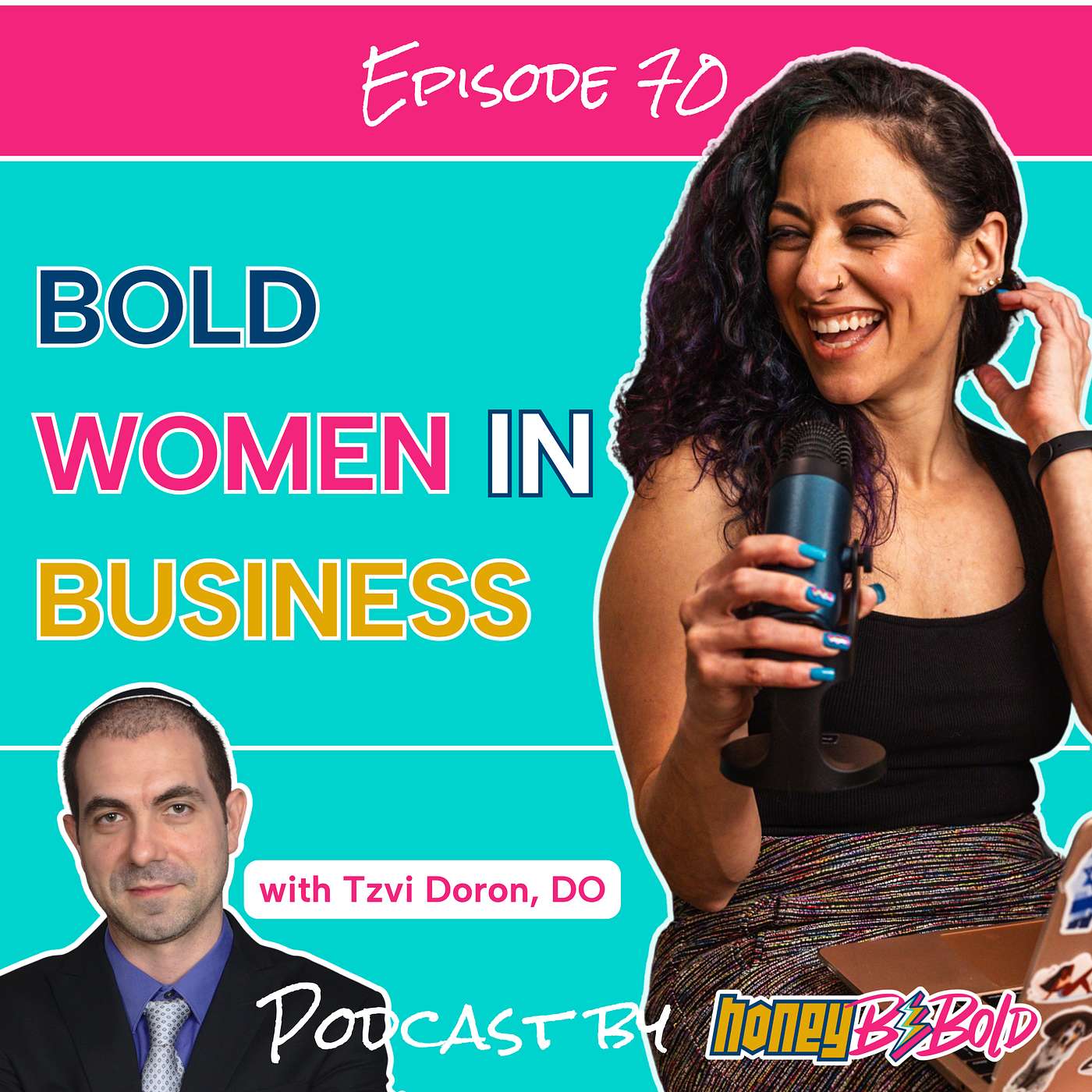
Bold Women in Business: Content Marketing + Branding for Female Entrepreneurs · Rachel Honeyman of HoneyBeBold | Content Strategy for Female Entrepreneurs
✨ Episode Summary Most people say they aim to live a values-driven life, but when push comes to shove, that’s not always the case. It’s not that they don't want to, but looking things in the eye is objectively uncomfortable, and the path of least resistance is always easier. In this episode, I brought on the most important person in my life, my husband, Tzvi, to talk about what values-driven actually looks like in practice. If something in your business has felt off and you couldn't quite name it, this conversation might be exactly what you needed to hear. Here's what we're getting into: Why having values isn't enough, and why you need a hierarchy for when they clash The hardest person to be honest with A practical framework for getting underneath any dilemma to see what's really at stake The Physical Tell: how your body already knows when you're out of alignment The Bullshit Meter: why you can't fake it with your audience for long Why Tzvi walked away from a high-status, high-paying role, and why it was the most values-aligned thing he's ever done If you've been building a business that doesn't quite feel like you, this one is for you. 📌 Resources & Links Mentioned NeetoCal — The calendar booking tool I use to keep my business running smoothly Tzvi's Substack — Deep dives on ethics, life, and becoming a better human Tzvi's LinkedIn — Connect with Tzvi directly 🔥 Action Items 🎧 Subscribe, rate & review to help the show grow. Every bit helps and means the world! Subscribe on your platform of choice: Spotify | Apple | iHeartRadio 👯 Let's be friends! LinkedIn | Instagram | Facebook Curious about working with us? Interested in growing your business with us? Set up a free 15-minute vibe check. Hosted by: Rachel Honeyman Music by: Shmukulele Produced by: Podium Studios Boldly stalk us: Website | Facebook | Instagram | LinkedIn | YouTube Subscribe to the pod on your podcast platform of choice
0:00I just think that a lot of people are wandering around very much with their heads in the sand and not wanting to look things in the eye, because when you are faced with challenges that give you an opportunity, right, challenges really are opportunities to say, what is my highest value here? And what's the decision that I want to make? That's going to lead me down a path, and it's an opportunity to really do some self-reflection. But I think a lot of people are so scared of the self-reflection that they either just take the path of least resistance or, you know, they just never take that opportunity to begin with. And it's a shame that many people live their lives that way. You're listening to the Bold Women in Business podcast, the show for women who are building something that actually matters and who are ready to stop hiding behind the polished and perfect and start showing up as their bold, magnetic human AF selves. I'm Rachel Honeyman, your guide to finding your true magic and putting it front and center in your brand. I'm so glad you're here. Let's dive in.
1:11Hey. Beautiful human. Welcome back to the Bold Women in Business podcast. I'm your host, Rachel Honeyman. If you're watching and wondering why I'm in a different setup, it's because I have a special guest today, and the logistics for my other setup with a guest was too complicated, but I have a very special guest to kick off season four. This is the first guest of the season, and I brought the most important person in my life. My husband's. Fedorov and I have talked about him in various ways on this podcast before, but you haven't really gotten to know him and he is such an important person, obviously, in my life, but also behind the scenes, like he's someone who I ask lots of questions. He's the person that I go to for advice when I'm having any sort of dilemma in my business. He's kind of this guiding voice behind the scenes, and someone who I learn a tremendous amount from every day. And so I wanted to bring him on, because in this episode, I want to talk about what it actually means to build a values driven business and to live a values driven life. The reason I brought XVIe in particular is because he is the person, the number one person I know, who embodies living a values driven life. Like full stop. I say this all the time, both to his face and to everyone else. Sophie is literally the best person I know in that he is the most ethical person I know, period. I don't know anyone else who is so clear on their values that it drives every decision that they make, big and small. And as you'll see in this conversation, he says, you know, he's human. It doesn't mean that he always makes decisions that are driven by his values. But I have never seen him make a decision again, big or small, without first thinking about is this in line with my values? He's human, so sometimes he doesn't make that decision right. But most of the time he does. And he's so in tune with his values that he's always asking that question. So I thought he would be the perfect person to talk about this topic. And I think you'll agree, this conversation was really interesting and it's such a unique perspective. And I thought it would be really, really helpful for you. So enjoy. Quick pause. I want to tell you about a tool I use in my business every single day that I could not live without medical. It's a calendar booking tool that lets anyone who wants to book a call with me, whether that's a potential client, an existing client, or anyone in between to just click a link. Pick a time and boom, we're done. None of that back and forth email nonsense we all hate. I switched to needto call from calendly because frankly, the pricing was getting ridiculous and the call is not even in the same ballpark as any of their competitors. But they're not cutting corners. They offer the same features as everyone else, but they intentionally keep their prices low because they believe in making their products accessible to small business owners like you and me. And as someone who talks a lot about building a sustainable business, that mission means a lot to me. With medical, you can customize everything. You can brand your calendars.
4:40The settings are super flexible, and you can have as many calendars as you like. And I should know because I've thought about a million of them. If you are paying through the nose for Calendly or another calendar booking tool, seriously, go check out Neato Cal. The link is in the show notes and you can thank me later. Okay, let's get back to the episode. Thank you for being here in your office down the hall. Um, Sophie and I have our offices very close to each other, but I'm so excited to have you here on the podcast. Um, it's been a long time coming, and, uh, why don't you just first introduce yourself to people? Tell. Tell us who you are and what you do and all that. And then we'll get into into the episode. Okay. My name is Swetha. Wrong. I'm Rachel's husband.
5:29I'm also a physician. I'm a family physician by training. Um. I started my career in primary care. Um. And then a couple years after that, I moved into telehealth. In a leadership role. I worked for quite a while for a company called ROE from 2017 till 2023.
5:50Um, after that, I spent about a year and a half doing consulting. Um, and then I went back to clinical practice for a little while, and now I'm back in the telehealth space. I worked for work for a company called fountain. Um, and we provide services for women in menopause and perimenopause and for men with testosterone deficiency. Okay. Amazing. So the reason that I wanted to have you on this episode in particular is I talk a lot. You know, this obviously, you know my work better than anyone, but I talk a lot about the importance of building a business that is values aligned. And the women that I work with are very mission driven.
6:33They are trying to do work that has a positive impact in this world, and I help them kind of bring that to life. But I think that there's often a misconception around what it even means to live by your values and you are far and away the most values driven person I know. So I thought you'd be perfect to talk about this. So what do you think most people get wrong about this idea of living by their values and living by is in all aspects of life. Obviously we're talking about business, but business is just a microcosm of our of our lives. It's one piece of our lives. So what do you think most people get wrong about this idea of living by their values? Yeah, there's a lot here. I think the first thing, the very first thing is to know what your values are. You have to have those clear in your mind, like crystal clear, and also to not only know what your values are, but to know the hierarchy of your values. You need to know what your highest value is, because the life is complicated and there's going to be times when your values conflict with each other. This is not a question of if, but when. So in those cases, you need to know what the highest value is. So for example, if your. Your highest value is to live with integrity. That means tell the truth, but you also have a value. Let's say for instance, to not hurt other people's feelings, right? Those are going to be in conflict with each other at times. Um, and you have to know how to put them against each other. By the way, even the the hierarchy is not always 100% clear. For example, there's a difference between telling person a sort of, you know, mini lie or half truth that is basically inconsequential versus telling a lie that actually has substance and that matters, right? So, um, telling the truth usually means that at times you're going to hurt somebody's feelings. That might even still be for their good. For instance, a person is going down some path that is clearly a bad idea. Telling them that their choice is, you know, probably harmful to them is going to hurt their feelings. But, um, is that necessarily a bad thing? I can't tell you exactly, because we're not talking about a specific case, but you can see how these can come in conflict with each other. Um, of course, when it comes to telling the truth, the first person you need to tell the truth to is yourself. And that also often hurts, right? Um, you have to look at your choices and different things that you're doing and decide, like, is this really a good idea?
9:31Um, is it has it been successful? Does it have, you know, legs to it or whatever the case may be?
9:38So, um, clarity is one of the most important things, um, in living by your values, you need to be clear about what your values are. You need to understand how they rank against each other, at least generally. And then you need to have the courage to actually move forward.
9:56Sometimes that means you know it's painful. Sometimes it means abandoning things that you're attached to. Sometimes it means, um, you know, um, taking losses in certain ways. Right. I mean, it may mean not being the most financially successful temporarily or even permanently, depending on, you know, the specifics. Um, hopefully that is clear. Yeah. So how how does one build that clarity? And and I think that another question that's related to that is you are someone who I always say, like you're the most value driven person I know. Did you always have Clarity on your values, or was that something that came with time? Yeah, that's a good question. I did not always have clarity, but I always had clarity that I wanted to live this way. That part was not a struggle for me. I was always ready to endure some pain in order to live what I considered a good life. I just didn't always know what that good life was. That takes time. It takes maturity. It takes experience. It takes basically making some mistakes as well. Because sometimes the only way to know, you know, what feels like you, you didn't do the right thing is to unfortunately not do it and look back and say like, wow, that was not the right thing to do. Um, so some people will have an added, um, challenge that they will need to, you know, take some journey to even get to wanting to live that way. Some people will never want to live that way. If you don't want to. Then yeah, that's pretty much the end of the conversation. Um, but yeah, for me. Um, I did not always know what the values were. I did not always know how to do it, but I always knew that I wanted to do it. Mhm. And when people come to you because I know people come to you often to talk through challenging ethical dilemmas. Right. How do you guide them on living or making decisions in accordance with their values. What's what's your advice for people or kind of what's the framework that you work off of?
12:23Um, the framework that I work off is that I never tell people what to do, basically. So I ask them questions. Um, usually with very pinpointed questions you can get underneath, um, the surface, um, dilemmas, the dilemmas that people usually have are not the real thing that they're dealing with. It's not the real challenge. So people may have a dilemma about what to do in a given situation. And the only reason that they're struggling to understand what to do is because they haven't really clarified what is underneath those decisions. It probably would help to have some examples. Uh, yeah. If you want to give a specific example. Sure. Right. So people are often coming when they're struggling with the decision of, let's say, for example, um, whether to stay at a certain job or leave a job. Right, or. Mm. Um, you know, what to do with their children. Right. People struggle a lot with, you know, should I send my kid to this school or should I send them to that school? They, you know, they want to, you know, go to a party with this friend. And I don't feel quite right about it, but I'm not sure if I should say no and have a battle with them, or if I should say yes and let this one go. Um, and first of all, when people ask me these questions, I usually don't know the answer. It's like, well, I don't know what you should do. I can't tell you what to do. So you have to ask questions and get underneath it. And you say, well, the first thing you say is like, what is bothering you? A lot of times one one good way of doing this is asking them the extreme right. What's the worst case scenario in this, and what's the worst case scenario in that? Um, and then you can triangulate that with what's the likelihood of it. Right. Which one is more likely. And then then it becomes a little bit clearer because you say, well, if the worst case happens in this situation and the worst case happens in that situation, which one is which one bothers you more? And even furthermore, why? Right. And then then things start to become clear and they'll say, well, you know, I don't like this place because, you know, right now I'm overworked and overburdened and stuff like that. And that place over there. I think, you know, the day to day would be great. But, um, you know, this came up in the interview and it really bothered me. Well, why did it bother you?
14:47Well, it bothered me because I was concerned that really what they're going to be asking me to do was something that, you know, doesn't coincide with, you know, certain value that I have. Okay. How important is it that you follow that value? Well, I that's, like, very important to me. Well, now we're starting to answer the question without. I don't have to tell you what to do. You already know what to do. Right. Um, and usually people, for some reason, have a little bit of a difficult time getting underneath it right there, looking at the decision level. When the decision level is usually following other things, you need to get underneath all of it to understand what to do.
15:26Mhm. Mhm. Yeah. I mean I think this, this relates so deeply to the work that I do with my clients. Right. Where, where it's all about getting underneath. Like it. This is not just a brand that exists for the sake of having a brand, right? It's it's a brand that exists to have a bigger impact. But in order to have that impact, we need to get underneath. What are the values driving that impact and what is what's underneath your motivation for investing yourself in this and and all of that. And you need to have that deep understanding of the underneath piece in order to make decisions for all aspects of your business and how to, you know, it's like business is a ongoing series of decision making, and, you know, it carries into how you deal with your clients. It carries into how you do your marketing. It carries into everything. But you need to have a clear understanding of that in order to to get there. So very, very related. Um, talk to us about and I know there are several examples, but and you actually just published a blog post about this, but talk to us about a time that you turned something down or made a decision that other people thought were was crazy, but you did it because it was deeply driven by your values. So, um, we can do values or we can do just knowing that I needed to do something different than what other people thought was the thing to do. Which one do you want me to do? Uh, whichever one feels more. Yeah. I mean, I wrote in the blog post about, um, you know, walking away from from that job that I had, which was a great job. You know, I was well respected and well paid, and by all intents and purposes, the company was still on the way up. And probably, you know, that was the case that was still on the way up. But I just knew that my time there was done. You know what I mean?
17:36Um, there's a certain point when there's nothing left for you to do there. Like, it depends what you're doing at a job that's here. Here's. We're getting underneath it. Right. What? What are you doing at a job? Is your purpose of your job? To make a bunch of money and be well respected, or even to progress in your career? Or is your purpose in your job something else? Right? For me?
17:57Um, those are not the only things that are important. They may not even be the most important things. The most important thing is to develop myself as an as a as an individual. You know, I'm religious. We're religious. I think people know that. And my my purpose is to, um, make myself a better person and become closer to God and to serve humanity better.
18:18Well, the question is, is, are those goals best served by staying at this job and those trump the amount of money and respect and status that I have? Well, they weren't being served by that anymore because I had done what I could do there and therefore the rest really didn't matter. So walking away was the right thing to do. Now, that's not necessarily the right thing to do for everybody. Some might say no. My job is to put food on the table for my family, and that's that's the main thing. Well, that's the main thing. Then, you know, your salary and position and all that become the most important things. And you make a decision based on that. And I think a lot of people, for a lot of people, that's what a job is about. And therefore people thought I was crazy and I was saying, well, I'm operating for a whole different value, not necessarily better, but it's just different. I don't I don't do this for the same reasons that you do this, and therefore the decisions that flow out of those values is going to be different. So I left, even though everything, you know was great. Um, from the status, career, uh, financial perspectives, I didn't even know what I was going to do next. And I walked away anyway. So that's an example. Yeah. Yeah. And? And you've done this. I mean, you don't have to go into a whole bunch of examples, but I've watched you do that so many times in. We've known each other for over 17 years, and I've seen you do that many, many, many times because you're so aligned with the those deeper values. You know what's driving you. So you're not afraid to make decisions that are going to go against the grain, right? Or that are going to go against what most people would do. And again, it's not better or worse. I think that's a really important distinction, because the whole the whole thing with your values is that they are they are personal to you, right? They each every person is going to have what's their highest value and what's their, you know, their hierarchy of values. And that's going to be different from person to person. And one isn't better than the other necessarily. But I think that there is something very Unique in being so in touch with the deeper value that it's not even a question, right? It's not even a question. What decision am I going to make? What risks am I going to take all of that? Like, it's not even a question because your highest value is the driver always. And that's super, super powerful.
More Bold Women in Business: Content Marketing + Branding for Female Entrepreneurs episodes →