
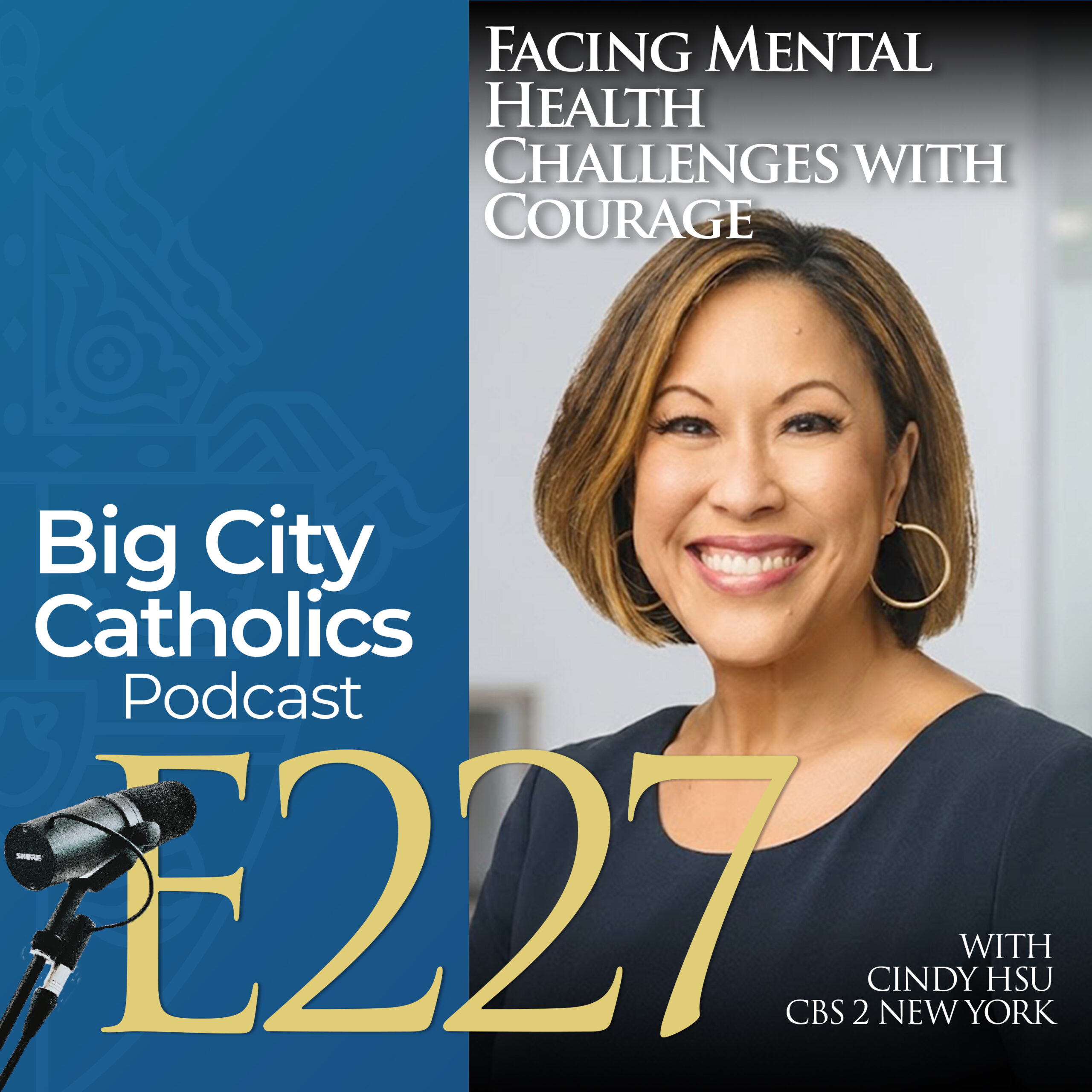
Big City Catholics Podcast · Bishop Brennan Podcast
Longtime CBS 2 New York anchor Cindy Hsu joins Bishop Robert Brennan and Father Christopher Heanue on this episode of Big City Catholics for a powerful discussion on mental health, focusing on breaking the stigma and encouraging people to have the courage to ask for help. In October 2026, Pope Leo XIV dedicated the Church’s prayer intention for mental health ministry.
0:00Speaker AForeign. Welcome to a new edition of our diocesan podcast, Big City Catholics, with Bishop Robert Brennan, the Diocesan Bishop of Brooklyn, serving in Brooklyn and Queens, myself, Father Christopher Henry. Here at St. Joan of Arc Parish in Jackson Heights today, we're delighted to welcome Cindy Hsu, an Emmy award winning journalist and longtime anchor and reporter for the CBS News. Born in Honolulu, Lulu, Hawaii, to Chinese immigrant parents, Cindy grew up moving around the country as a daughter of a United States Coast Guard pilot. A graduate of Virginia Tech, she began her journalism career in Richmond, Virginia, before working in Steubenville, Ohio, and Green Bay, Wisconsin. But in 1993, Cindy joined CBS New York, where she has spent more than 33 years reporting on some of the most important stories affecting New Yorkers. Throughout her distinguished career, she's received multiple Emmy awards and recognition for her reporting on families, education, adoption and community life. Beyond her work in journalism, Cindy has become a passionate advocate for mental health awareness and suicide prevention. In 2021, Cindy courageously shared her personal experience with severe depression and her journey toward recovery. Through her Breaking the Stigma reporting and her involvement with the American foundation for Suicide Prevention, she continues to encourage honest conversations about mental health and remind others that help and hope are available today. We're grateful to welcome Cindy Hsu to Big City Catholics to discuss her career, her journey, the importance of compassion, faith and hope in confronting mental health challenges. Cindy, welcome to Big City Catholics.
1:52Speaker BFather Chris, thank you so much.
1:53Speaker ABefore we begin, Cindy, we'll begin in prayer. There's a beautiful prayer offered to the intercession of Saint Dymphna, who in the Catholic Church is a patroness for mental health awareness and for those suffering with mental health. We pray in the name of the Father, Son and Holy Spirit. Amen. Good Saint Dymphna, great wonder worker in every affliction of mind and body. We humbly implore your powerful intercession with Jesus through Mary for the health of the sick saint, infinite patroness of persons with mental health conditions. Always look out for those men and women for their healing and recovery and for an end to stigma and indifference in society. Amen. In the name of the Father, Son and Holy Spirit. Amen.
2:41Speaker CThank you, Father Henyu. And thank you, Cindy, for joining us today. Your journey is an incredible journey and you are a great advocate for mental health and for those who are suffering. We're glad you're with us today. Could you share a little bit on a personal side of why this is so important?
2:58Speaker BYes. Bishop Brennan, thank you so much. In 2015, I had been at Channel 2 for many many years as a journalist, and I started to feel like I couldn't do stories as quickly as I used to. And I started getting brain fog, and I started getting very stressed from many things. And all of this led to a suicide attempt. And I needed to go to the emergency room. I needed to go to a psychiatric hospital. I was so blessed to have survived. And it was because of this experience that I am now a mental health advocate. Took me many years. It took me, let's see, from 2015. I didn't tell anyone at work until 2021.
3:46Speaker AWow.
3:46Speaker BYeah. So they knew I was gone for months, but I just would say I had a medical issue, and I kind of shut it down. But in 2021, as you were mentioning Covid, everyone, I think, was feeling mentally challenged at that time, with so much isolation, that that's when I decided to do an interview with Dana Tyler and come out with my story, because I felt like people really needed it at that time.
4:12Speaker CThat was a great service to our community, because when somebody does courageously stand forward, first of all, I think there's a sense of identification. You say, okay, I'm not alone in this. And then secondly, maybe the courage it inspires, the courage that's needed to be able to talk about it.
4:29Speaker BThat is so true. I mean, I was very fearful of how people would react. I was also fearful of, would I lose my job? Not that work can cut you off, but you know what I mean, if there's. If all the viewers suddenly think badly of you and don't respect you, that was a fear. And the opposite happened. I had so many people and people who were in my office who I had no idea they had different paths with mental illness. And there are so many different kinds, from depression to bipolar, all sorts of things. And that's also what I. What I found from the viewers is so many of them will just come up to me and hug me and say, I'm so glad you did that story. I was able to talk to this family member, that family member, and three, they understood. And so I really feel like that's why I'm so glad that you're doing this subject on your podcast, because we need to talk about it, we need to hear it, and we need to hear it from people like you.
5:23Speaker AIn previous episodes of our podcast, we were highlighting through this month of October, a month of respect Life in the church. We celebrate that here, but it's also Mental Health Awareness Month. And there's such a beautiful connection, I think, between respecting life means we Respect the dignity, the value of all life. And that means we walk with people, with compassion, with kindness, with love. It's rooted in the Gospels. It's rooted in the messages of our scriptural readings. Even this week is walking with compassion, with kindness, with love. I really do appreciate as well, I echo the words of Bishop, you know, for. For bringing this to such light and in your work in advocating for awareness and. And removing the stigma, what seems to be a common concern or stumbling block for people as they. As they move forward in this awareness and in seeking help?
6:16Speaker BWell, I think there's the fear factor that I was talking about of how are people going to react? And especially in communities, immigrant communities, communities of color, it is especially difficult because many of us are brought up. I can talk about my Asian experience, to not be a burden, to not complain, and it would put shame on my family. That's how I thought it was going to be. And incredibly, it wasn't that way. And no history of issues in my family. And yet I think my mother is such a strong faith is so important to her, and I think that really, really helped her because she is the one who found me in my attempt. And you can't, you know, that has to be so traumatic. But she never came out in anger. She never, you know, people lash out. And when. When something like this happens, it affects the whole family. It affects everybody. So the church was very important.
7:17Speaker AYou mentioned culturally and Bishop, we often talk about how, you know, you're the bishop, the diocesan bishop of the Diocese of Immigrants. There's so many cultures. Bishop and I share an Irish heritage, and I speak on that Irish theme, that there's a stigma. There is certainly a stigma that is present within the community, and there's other, sadly less productive ways of dealing with one's issues that sometimes leads to addictions, addictions of alcohol or drugs, and we see that. And, Bishop, in your work, how do you experience this stigma or even how do you experience the cultural concerns with mental health awareness?
7:58Speaker CWell, I think there are other concerns as well. I think that's a very important one. But when you look about the community, like Brooklyn or Queens, you raise questions about access, access to mental health, language abilities, the support of a larger network, and really some of the experiences right now. So, you know, right now I'm very concerned about children in some of our communities. We talk about it a lot in the Haitian world, with the whole tps we're talking about, what is this effect on children? There's something else that I think I've seen in the years that I've been a bishop, not only here, but in Columbus, Ohio and on Long Island. And that is that we're facing it at younger and younger ages that so many children are filled with anxiety and feel sort of like they're outcasts on the fringe. So those issues of mental illness are really far reaching among the young.
8:53Speaker BThat is so true. I don't have them on the top of my head, but the statistics of how young people are suffering from mental illness are devastating. I talked to a lot of doctors, as you said, Father Chris. I do Breaking the Stigma for Channel two. So I focus on mental health and a lot of it is children. The American foundation for Suicide Prevention is actually going to merge with the Jed foundation, which focuses on young people. I also feel like, you know, we were talking about languages. It's important for these different resources to have it in different languages. We have a program at AFSP called Talk Saves Lives and it's now in many different languages in Spanish. And also the other thing is we go into churches and talk to pastors and religious leaders because we do know that so many people, that's where they go for help.
9:48Speaker CThat's true. And the other thing too is I think parents, in the case of children, families in general really struggle because it's not just stigmas, but the idea, what am I doing wrong?