
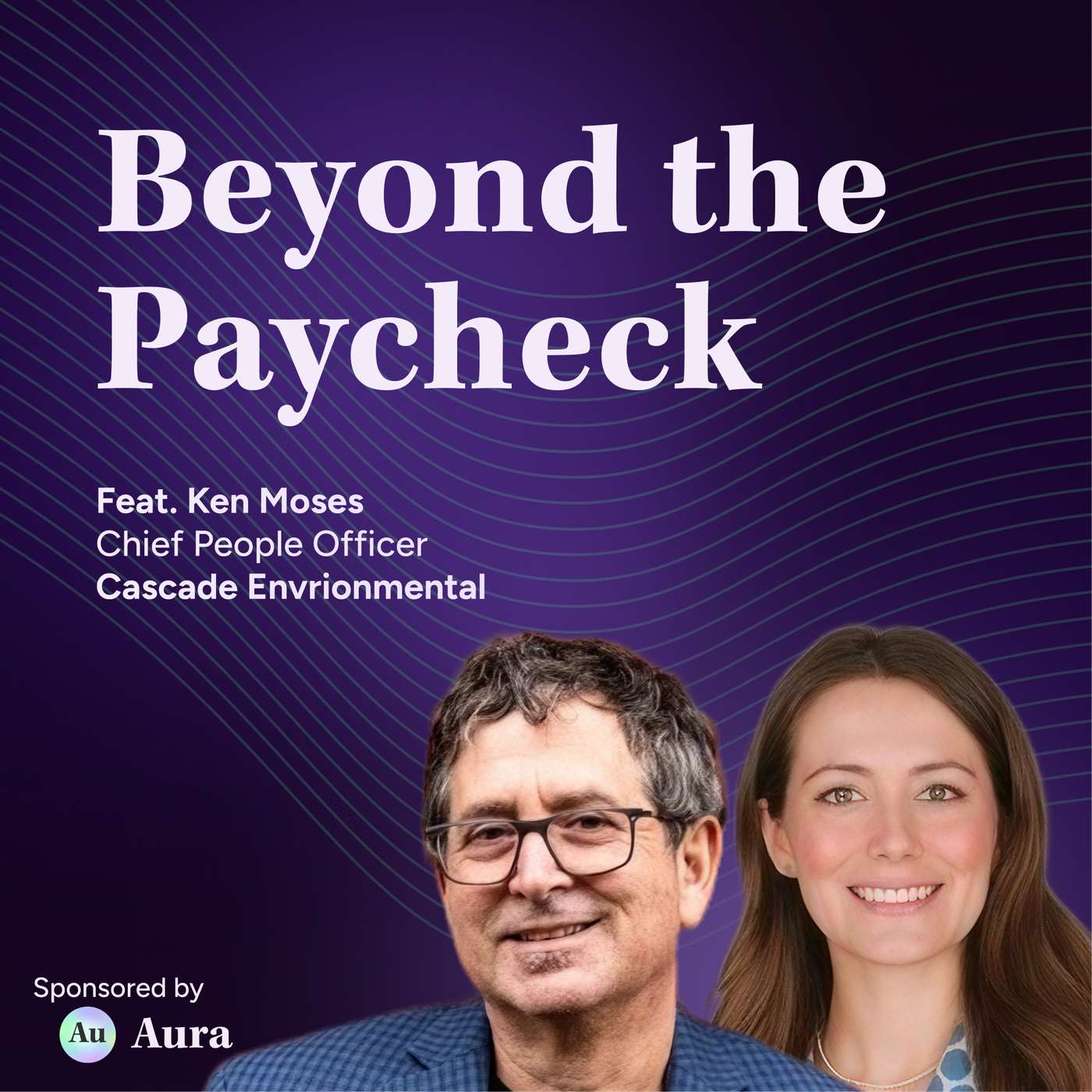
Beyond the Paycheck · Aura Finance
Summary Employee retention gets easier to discuss when the numbers change. Ken Moses, Chief People Officer at Cascade Environmental, joins Kelsey Willock on Beyond the Paycheck to explain how an employee-centered approach helped reduce voluntary turnover among field employees from 44% to 24%. With roughly 850 employees across 35 U.S. locations, Cascade has built a first-year progression program, an internal drilling academy, and a nine-month leadership development experience whose alumni have seen about a 30% promotion rate. Ken also shares how his team supported furloughed employees during the pandemic, why quarterly career and stay conversations can be more useful than one annual review, and how employee feedback shaped a higher 401(k) match. He discusses financial counseling, incentives for quality healthcare, the challenge of proving benefits savings to a CFO, and a practical approach to AI in HR: embrace the tool without ignoring ethics or the business. Chapters 00:42 Ken Moses and Cascade Environmental 02:46 From aspiring lawyer to HR—and the first paycheck 04:58 Supporting the whole employee through uncertainty 06:41 Leadership development and a roughly 30% promotion rate 08:49 Moving from annual reviews to quarterly conversations 09:50 Reducing voluntary field turnover from 44% to 24% 11:38 Financial wellness, counseling, and retirement readiness 12:52 Measuring benefits and following employee feedback 15:02 AI in benefits and the compensation outlook 16:20 Compliance, ethical AI, and understanding the business Takeaways - Employee-focused retention is measurable: Ken reports voluntary field turnover falling from 44% to 24%, alongside first-year milestones and an internal talent pipeline. - Leadership development needs a path to real opportunity. Cascade's nine-month program blends in-person and virtual learning with executive capstones; roughly 30% of participants have since been promoted. - Replace one annual performance event with deliberate conversations about goals, career direction, and the reasons employees stay. - Listen before redesigning benefits. After about 66% of surveyed employees preferred a higher 401(k) match, Cascade later made the increase. - Benefits ROI requires follow-through: compare expected savings with year-end claims and behavior, and keep AI use both practical and ethical. Connect with the Guest Ken Moses LinkedIn: https://www.linkedin.com/in/kenmoses/ Cascade Environmental: https://www.cascade-env.com/ Sponsor Beyond the Paycheck is sponsored by Aura Finance, a financial wellness platform designed to help employees feel more confident and in control of their money. Learn more: https://aurafinance.io
Kelsey (00:42) Welcome Ken Moses, Chief People Officer at Cascade Environmental. So excited to have you this Tuesday morning. To kick us off, I'd love for you to share a little bit more about your career, background, current role, and where you're calling in from today. Ken Moses (00:56) Sure, Kelsey, and thanks for having me on your podcast. looking forward to our conversation. as you said, I'm Ken Moses, Chief People Officer for Cascade Environmental. we're based out of Seattle, 850-ish employees across the US and 35 locations. I've been with the company coming up on 10 years. I was brought into Cascade to build up a human resources function and show the value and impact HR can have on a business. Ken Moses (01:24) my journey throughout HR started in the in the late 1980s as I was working on my master's degree. we had to work in a practicum or an internship. I worked for Unisys at the time in compensation, actually. and then prior to graduating, the comp manager retired actually, and I was forced to learn compensation on my own. I realized that. Ken Moses (01:45) there's more to HR than just comp and benefits. So throughout my career I've had positions where I was a specialist in comp and benefits, where I was a generalist, where I finally grew my management career into comp and benefits and then as an international HR person. so variety of experience, love to talk about HR and where I see the industry going. And you know, let me know if there's anything else I can tell you about myself. Kelsey (02:09) Well, we're certainly going to get into a whole lot more about you and and some of the interesting work that you're doing at the company. I'm just curious, tell us a little bit about what Cascade does. Ken Moses (02:19) Sure. we're environmental drilling and remediation. So we are typically hired by you know engineering and consulting firms to take a look, monitor the soil, do some w well development, and then if needed, remediate the soil through a variety of different mechanisms. We can do chemical, we can do thermal, or we can do Ken Moses (02:40) big dig and haul and move the dirt out of there. So essentially what I like to say is we're saving the world one hole at a time. Kelsey (02:46) I love that. So before I I get into all the amazing work that you do at Cascade, I want to take a peek into the past. So tell me about your first job and if you remember what you spent your first paycheck on. Ken Moses (03:00) Okay, so we're gonna go start before my first job. So the decision to go into human resources was not my first choice. throughout being a child and into college, I wanted to be a lawyer. I wanted to go into sports and entertainment contracts, thought that was really cool, social, a little hedonistic. but when I took the LSAT, I did okay, but not to the level of the type of school I wanted to go to. Ken Moses (03:24) and I also realized that my attention to detail for contracts isn't really the best. So I was doing research with a professor at UC Santa Barbara in the social psychology department, and she taught a class on personnel. she knew my personality, she knew what I was looking for in a job. She said, Go sign up for taking notes in my class. You could you can audit it, I can learn about it. So I did. Ken Moses (03:49) And then, and I thought about it. I talked to her afterwards. And I guess she was my first mentor. And I said, yeah, this is something I can do. It it gave me, you know, my love of math and statistics. It gave me the legal aspect. And also gave me the humanistic and engagement and motivation aspects of it. So, yep. Went and got a master's degree. and then part of it was an internship at Unisys manufacturing company, which was Ken Moses (04:15) in California in Orange County. and my first role was working with the the comp manager on developing a salary structure which I've never done before looking at internal rate comparisons and market equity. So a lot of computer work. And that's one of the things I think I brought in to that organization was a love of an appreciation of what computing could be. I think I had the first laptop Ken Moses (04:39) in the department. what did I spend my first paycheck on? I probably took my wife out to a nice dinner to celebrate the job. Kelsey (04:50) I love that. And that is a gift on many ends that probably paid dividends. So thanks for sharing that. Kelsey (04:58) One of the things that's becoming abundantly clear even in the early parts of our conversation is, alignment with, doing good is a part of, your core ethos, whether it's working for the company, doing good, digging holes, and beyond. So I think it's a good segue into something I'm fascinated around, which is investing in the whole person. tell me a little bit about an example that you're extremely proud of. Kelsey (05:21) of investing in the whole person, whether it has to do with their mental health, their physical health, their financial health, there's certainly so much more that companies are doing these days. So I'd be particularly curious what you're doing today at Cascade. Ken Moses (05:34) Sure, a Ken Moses (05:35) few things. Clearly, mental health has been a big focus, right? Especially going through the pandemic. one of the things I'm proud of what we did is, I'll go back to the pandemic. it was a scary, uncertain time for a lot of people. we were fortunate enough that, given our industry, we were able to still continue working. however, we had to bench some of our employees. But fortunately with the governance Ken Moses (05:58) enhanced unemployment, we're able to keep them. no one wanted to be the last one out, first one into another job. What my department did was put together a bunch of different documents for employees who are being furloughed. And you know, here's what your unemployment rules are, here's mental health, here are some strategies to keep yourself busy. Ken Moses (06:20) although we're, over eight hundred employees, my team did calls to each of the employees who were laid off twice during the nine month furlough process to make sure they're doing okay. we have a lot of employees from the military. It was like a military wellness call. that was appreciated. when you take a look forward in developing the employees. Ken Moses (06:41) When it came to Cascade, we had very little leadership and management development for our group. be careful what you ask for. I've been saying we need this, we need this. And finally my boss, the CEO, said, All right, here's the time to do some training. it was doing one of our annual kickoffs, operations r kickoff reviews. And we brought in somebody to start slowly with the DISC, because everyone loves the DISC and it's very easy to Ken Moses (07:03) Have fun with it. It's easy to look at it and understand your style and other styles. So we built upon that into a leadership development program for managers and above. It was a it's a nine-month program, in person, online, and it ends with the capstone project presented to the executive team. Ken Moses (07:26) The way I measure the success of that is taking a look at how many of the employees who are part of that program have since been promoted into higher roles. and we're up about 30%, which is phenomenal. Kelsey (07:36) I love how you think about supporting the whole human, not just in, whether it's mental health, but also the development of, you know, how they move up at a company, how they see themselves, how they lead at a company. I think it's such a an an important piece of the puzzle that's often left out of this conversation. Kelsey (07:53) How do you think about supporting your people and the quality of their output? Are you using tools to specifically measure the success of these programs? and how do you know that they're working? Ken Moses (08:05) That's a great question. it's always hard to measure the impact of of training. Right? you can see it on performance reviews. we see it on our engagement survey, whether the manager's scores are have increased or not. But we also do a survey back to the manager and and back to the employee. what concepts are you still using? How can we better support you? Ken Moses (08:26) Does your manager see the same output and effectiveness that you're seeing? and we try to bring them together to have that conversation. Kelsey (08:34) I really like that because it it really mixes the combination of the qualitative and quantitative. Their perception of its usefulness matters just as much as is this moving the internal metrics that we intended of the company. Ken Moses (08:49) Right. And on performance management, at least with us, we're trying to do an evolution in performance management. rather than the annual, here's my goals, here's my evaluation, moving more towards Kelsey (08:58) Mm-hmm. Ken Moses (08:59) conversations, quarterly conversations, which will be intentionally designed. One will be around obviously setting goals, one will be around career conversations. where do you want your next step to be? one will be Ken Moses (09:13) a stay interview. What's keeping you here? What would make you pick up that phone call? So I'm excited about those changes. And, we're trying to also at the same time use technology like AI to help us deliver that. Kelsey (09:24) So going back to you had mentioned you've done some mental health investing, how do you make the internal case for investment in your people when the spreadsheet doesn't so obviously support it? investing from a perspective of leadership can be very direct, but there's a lot of ways investing in people that are more indirect. So how do you think Ken Moses (09:43) Sure. Kelsey (09:44) about that case and especially finding effective partners within the organization, such as the CFO? Ken Moses (09:50) I'll give you great story. So, two-thirds of our employees are field direct labor, semi-skilled in and laborer type of positions. when I came to the company our turnover in that group was forty-four percent voluntary. we're down now back to twenty-four percent. And how do we do that? By focusing on the employee. We changed our culture, became more of an employee-centric culture. Ken Moses (10:13) for the new hires, we developed a program for the first year. There was a series of goals, and if they got their goals done, they received a 50 cent increase and a new title change. So you know, especially with a new generation who wants to see career progression and compensation frequency changes, we're able to accomplish that. we also have now, through our leadership program, have designed Ken Moses (10:37) A Cascade drilling academy. So taking the entry-level people and taking our current drillers and making them better. So you want to take a look at the qualitative reason why we needed to do that. We took a look at turnover, right? We know we can bring in entry-level positions, but for us to be able to bring in the experienced roles is difficult. we felt it it would be more beneficial to bring them up and train them. Ken Moses (11:04) In the Cascade way internally. So we looked at turnover. We also looked at sustainability, right? People forget that sustainability is not just recycling, it's growing and keeping your company going to the next level. And by having these programs, we're able to keep the company sustainable and moving forward. Kelsey (11:23) So talking about a little bit sustainability, I I think this is also a good segue into the concept of financial health. Tell me how important financial health is to the company and if it is, you know, why is it important? Ken Moses (11:38) Well, twofold. One, financial health to the cop company is obvious because we want to succeed as a company. We need to be financially healthy. To the employee, it's important. to create awareness and financial stewardship. So, you know, through 401k plan, we offer a lot of different webinars quarterly on Ken Moses (11:57) Different aspects, whether it's retirement, whether it's saving, whether it's, you're having your first child. the 401k plan, isn't the only, avenue to retirement. if you take a look at the numbers, it's quite difficult to say, I just have a 401k. I'm gonna retire on that. through our 401k advisor, they offer financial counseling. Ken Moses (12:18) Our EAP provides financial counseling. We want to encourage our employees to take their financial wellness into their own hands and do something about it. Kelsey (12:30) I appreciate that the company understands it goes beyond, once you've left the company and and you've retired, it's, what do I do with my paycheck today and tomorrow? financial stress is certainly a a growing concern within the workforce right now. So it's becoming a much larger topic. How do you better measure if your benefit strategy is actually working for employees? Ken Moses (12:52) A few ways. Obviously we take a look at claims, right? We take a look at, did we put in the right mechanisms to help control costs, not just to the company, but also to the employee? So some Kelsey (13:03) Mm. Ken Moses (13:03) of the changes we're doing, you caught us at a great time. We're in the midst of rolling out the 2027 benefits. And we put in some fun changes to help the employees. We put in a program through Ken Moses (13:15) Garner Light which is an organization that ranks doctors and they take a look at your own network and they have preferred doctors within your network. And if you use that, the employee can get up to a thousand dollars back on their claims. so it's incentives to get better care, they get better care. Our claims potentially are reduced because of it. Ken Moses (13:37) we we take a look at what the employee has to say. a couple of years ago in our engagement survey, we asked a simple question: would you prefer to have higher employee contributions or a higher 401k match? And lo and behold, 66% of our employees, two thirds of employees said we want a higher 401k match. And last year we were able to deliver on that. Kelsey (14:00) So for you, a huge part of it is it working is are employees satisfied? And is it in the direction of what they they're really, banging on the door asking for? Ken Moses (14:09) are we saving the costs that were anticipated at the beginning of the year? Right. Ken Moses (14:16) we have to present, to the CFO and to the CEO, here's what the renewal was, here's what we anticipate the savings to be. it's great on paper because some of the savings are predicated on, employee behavior, let's say, and using certain prescriptions. Ken Moses (14:33) Well, how are you gonna know if you save that money unless you do the analysis at the end of the year? And that becomes your business case for the future years. Kelsey (14:40) Right. And we certainly know that cost savings right now, given, the rise in healthcare costs are are few and far between as they continue to rise. Ken Moses (14:47) yeah. Ken Moses (14:48) I've heard horror stories this year from from friends who are in HR roles. Kelsey (14:52) Yes, I certainly have interviewed plenty of folks that have shared those. what's a compensation shift in benefits or comp that you see coming that most HR leaders are not ready for? Ken Moses (15:02) Wow. Of all the questions, that that one I've been pondering the most. Kelsey (15:07) Hmm. Ken Moses (15:08) Now I think one of the benefit shifts I'm seeing now is the use of AI in benefits to help drive decisions for the employee. so it becomes more, I'll say, augmented AI rather than you know agentic AI. that is a tool for employees to help make make the decisions for them. I I think if you look at comp. Ken Moses (15:30) What's funny about compensation is over the past 10 years, it's been pretty stagnant. It's been the same merit increase budgets have been between three and four percent. Promotion budgets have been one percent. I don't see any any change in that. I don't see us going back to more on the risk side, at least in our industry, right? we're a very traditional conservative industry. We're not going to have, Kelsey (15:54) Mm-hmm. Ken Moses (15:54) a salesperson who is highly leveraged at a 50/50 split, right? You Kelsey (15:59) Mm-hmm, mm-hmm. Ken Moses (16:00) know, it's it's gonna be more base and then a bonus at the end of the year that they're eligible for. So I don't see a lot of change in comp. I think equity is a big play in high tech. And I think that's a great tool to attract and retain people. Ken Moses (16:15) well, my horizon's hopefully four years. I don't see a lot of changes in the next four years. Kelsey (16:20) So, thank you so much again, Ken, for for spending the time with us this Tuesday morning and your busy schedule. Really appreciate you coming on the show. Ken Moses (16:27) I appreciate it, Kelsey. Enjoyed it. Thank you. Have a great day.