
Better Advertising with BTR Media · Destaney Wishon and Justin Nuckols
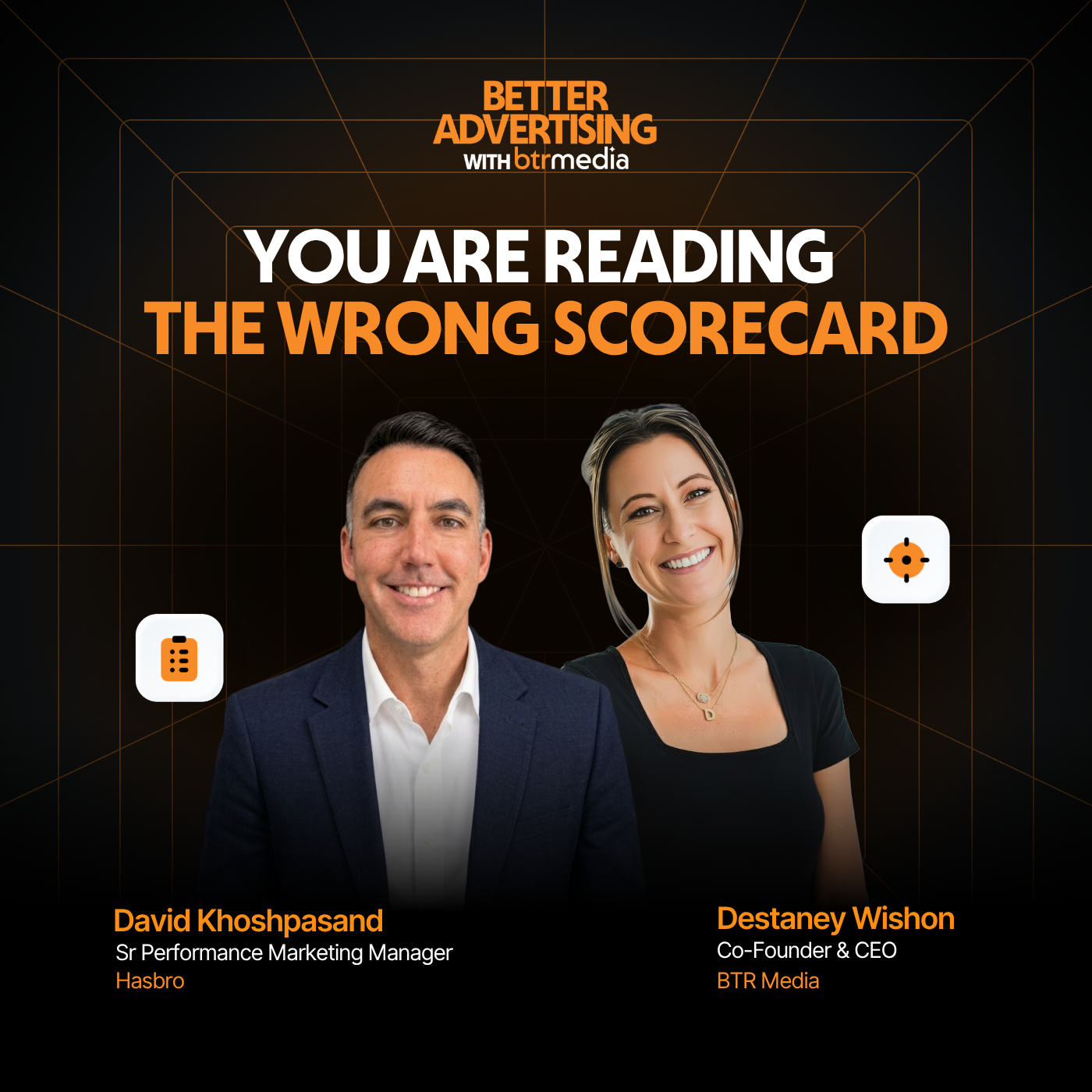
David Khoshpasand has spent years at Hasbro figuring out why retail media keeps getting blamed for things that are not its fault. The answer almost always comes back to the same problem. Brands are using the wrong scorecard. In this episode he and Destaney get into why total OPS is a terrible way to measure retail media effectiveness, why a high ROAS and a low ROI can exist at the exact same time, and why one competitor going viral overnight can tank your organic share in ways that have nothing to do with your ads. Connect with David on Linkedin: https://www.linkedin.com/in/dkmarketing/ Connect with Destaney on Linkedin: https://www.linkedin.com/in/destaney-wishon/
BTR Media: Welcome back to Better Advertising with Better Media. Today we have a longtime friend on the podcast back again. David, you hopped on maybe a year and a half ago, or if not longer, and we had a really fun conversation around shiny object syndrome and prioritization. Now you've been at Hasbro for quite some time. Think you got thrown into managing a brand of that scale. Which came with its own unique challenges. And I'm just super excited to have you back on. So what have you been doing the p last year? Well, I appreciate you having me back. ⁓ you know how fondly I think of you, and I know that you like really help the industry in terms of education. So thank you for that. So in this past four years, I've really been digging into not only understanding how to, you know, look at our measurement and efficacy and see like are we effective with ads, but also looking at total business performance. And and I think there's a lot of opportunity, particularly with enterprise brands, to think about ⁓ organic performance and what the share means to total OPS and what that relationship is with retail media. So I'm super excited today to kind of dig into some of that. I was excited when you reached out on this topic because it's a question I'm having to answer all of the time. And to your point, there's almost a split of The brands that are actually having this struggle typically have to be in stores. You see it a little bit if they have a really incredible D2C presence or a meta presence, but I think a lot of the times when we audit some of the enterprise brands, we're taking a look at, they're all struggling with some of the same things. It's what is the proper spin of branded versus non-branded? What type of advertising is actually incremental? And also, how does that balance out to your point with their organic revenue? This is such a key call out because historically, a lot of the enterprise brands had, I would say, in my opinion, like this inflated organic rank. Their conversion rate was inherently better than their competitors because I think they had a lot of brand equity and their volume was high, which, as we know, are the two key factors for organic revenue. Nowadays, I think that we're seeing kind of the playing field shift a little bit. So, from your perspective, you know. How do you view the relationship between organic and ads? Well, start with the basics. Yeah, I think historically some of the challenges that existed have been that retail media will make up, let's just say I'm ballpark 20 to 30 percent of the outcome, but it's being asked to explain the hundred percent of the result. And that's that's where we got to really dig in, you know, to to really understand. I I think about organic share, which normally takes up the bulk of of sales, that it's like a s imagine like a swimming pool and you have two hoses and there's a larger hose that's that's filling up the pool and that's full of organic. And then you have a smaller hose that's retail media. If the larger hose starts to slow down, right, that doesn't mean that the second hose is faulty. And that's where we kind of need to dig in and to understand that there are possibilities where Total sales will be down, but you had really great retail media performance. Yep. ⁓ and that's where I think we can start to kind of break down exactly why. To your point, actually I'm just gonna ask the question, why do you think retail media is usually under a microscope? I think because it it's getting a lot of larger investments than historically ⁓ for companies. So Because we've seen some positive progress and that investment is starting to increase across a lot of brands, from small to big, right? So it's going to naturally come with some more scrutiny. I think that the natural inclination, and and it's intuitive, right? Like I d I don't I empathize with a lot of this is to assume that if I put money into retail media, then my sales should go up. Right. And that's an assumption that's based on that your organic sales, like we're talking about, makes up the bulk is flat, right? And and sometimes that happens, right? So it's like, Hey, maybe year over year the organic sales are flat and we were able to kind of bump up top line. But for any brand, you're not going to grow consistently every single week, every single quarter in in year. There's going to be some slow times, right? So that's where we really need to understand that we're thinking about the ordered revenue in Amazon's case, what we call total OPS, minus incremental sales. And I think that's a second part that we got to kind of dive into is that, you know. Notice I didn't say attributed sales, I said incremental sales. ⁓ and that's a big part. But I think that's where the scrutiny is coming from and as well as it should from leadership. Yeah. I couldn't agree more. And I think there's still a lot of misconceptions when it comes to the Amazon space as a whole. I think when you look at Amazon versus a retail shelf, in my opinion, the Changes your competitor could make have a greater effect on your positioning when it comes to the digital shelf. The retail shelf maybe not as much or not as fluid changes, but on Amazon, for example, one competitor can go viral. They can see a huge influx of traffic, and you can immediately have a lower organic rank on the page. So just due to one viral post of your competitor, you're now likely going to see lower organic. ⁓ ordered units. And I think this is an important call out because when people look at share, they typically I think look at it in a silo. And on a digital shelf, things move so much quicker. So to your point, you could have the exact same investment. But if your competitors are immediately seeing a ton of additional traffic, it's likely that you're going to see less total sales. So To your point, that ratio just immediately flips almost overnight. And it's nothing that you're doing wrong. Yet retail media may be the one that gets called out for no longer driving as efficient or as incremental sales. But in reality, you kind of have to zoom out and look at the whole ecosystem. A hundred percent. And to your point, if you think about when when those shifts happen, because let's say in a borrow moment, retail media and organic don't have equal power. So for instance, if and it's just arithmetic, really, like if you get down to the math. So if you had a one percent move on organic, that could be, you know, millions of dollars. Whereas if you had a a one percent move on retail media, that could be hundreds of thousands or you know, ⁓ you know, whatever the case may be, it's it's a lot lower. So when we start to see any like decreases or increases, right, on organic, that's gonna have a major shift. So for for instance, when we're thinking about like scorecards and how to to think about your business. A lot of times the the order revenue or total OPS is a is a determinant about how successful your retail media is. I think that's a mistake. I think when we're saying, like, is your retail media effective? I think we need to look at incremental sales, the ROI, and the lift. Now we're thinking about is your business healthy? Look at organic sales. And then if at last if we're saying, should I spend more in retail media or should I decrease, decrease? I think that's really your threshold of return. And then looking at your ROI. But often We go to that default of looking at total OPS. ⁓ and and that's where I think things get tricky. And so there's a lot of education, I think, that could happen. And I see a lot of potential there. And then and technically I feel like that's part of my job is to figure out how can I bring more education into understanding this dynamic because it is tricky and it is different than than historical brick. Yeah. I couldn't agree more. It's also really hard to track at scale. I mean, if you have two to three SKUs, it's realistic that you can track, you know, your aggregate share in relation to your ad spend and see a little bit more of a correlation. But I know brands that try to go down to the BSR level and they're pulling, you know, hundreds of keywords. Here's my organic rank, here's my sponsored rank. And it's not Fantastic. I mean, on the vendor central side, we don't even get access to things like search query performance report, which is a little bit limiting, I think, when you're trying to understand your performance relative to the category on the search term level. So I think brands have to find this balance of how do you prioritize your organic business as a whole and judge it by a different success metric. I don't think that there's a great way to I still don't think there's a great playbook for it. Cause I don't think that OPS is really high level. As you've mentioned, it's always correlated almost to your ROAS and to your market share. But then you almost need to go a step further. And the further that I see brands go, it's almost a negative. They try to go too detailed. But then at the end of the day, there's also this factor of like people still aren't a hundred percent sure how to affect the algorithm. It's like, yeah, everyone knows you need to update your title to improve your organic, but like what else can you do? Right. ⁓ I'll tell you probably the most significant thing that we've done in terms of clarity for me this year has been partnering with incremental because once we've done that, we can actually see what the true impact of ads are. And You can and they do a lot of testing rigorously to get to that number too, right? ⁓ which we can talk about too if you want. But we we can see at the campaign level what the incrementality returns are, start to start to optimize, right? Like we've even optimized and been able to like productively increase IRI by thirty percent on some brands. We can test new features and see whether it works or not, like performance plus. We can say, Hey, let's put let's actually test that and then see where the returns are. But when we're We're thinking about that organic sale. If you only go it from attributed sales, there actually might be a delta where you're seeing a high ROAS, but the ROI is showing really low. And then you could say, ⁓ well, we're actually taking credit for sales that might have happened anyway. And if you didn't have that knowledge, you would continue investing because finance says, Hey, we're actually seeing good returns for you. Keep doing what you're doing, right? So you keep investing in ways that aren't effective. And then on top of that, if competition is in increasing, right? So CPCs are increasing, now you're paying a premium for a sale that would have happened anyways. So that's where to really get to that baseline, I always say order revenue minus incremental sales and not attributed sales, because then you really start to understand like, do you have a healthy business? What what percentage of retail media are we attributing to Lyft? And what decisions can we make there forward? Absolutely. And I will Also, shout out the Incremental Partnership. We've worked with them for quite a few of our brands and we see similar. I think to your point, being able to drill down to the campaign level is incredibly advantageous. Cause if you have your campaign segmented in a way that is very strategic, similar to how we do at BTR, then you're able to really drill down, even outside of your branded versus non-branded terms. You can look at these key category terms or placements, whether it's a sponsored brand's video or Top of search, ⁓ custom image, I guess custom image legacy campaigns are still alive, but see how long they last. You can drill down and see what is actually driving more of that incremental sale. And I think what David's really calling out here is if you solely look at your advertising from a ROAS perspective, there's a good chance it's not really working the best for you. There's a lot of other variables that I think you can dig deeper to maximize your presence. And some of those other placements may be lower ROAS, but maybe they're driving a lot more value. Cause if a customer is going to the platform and they were going to buy from you anyway, but they just happen to click on your ad, now your ad gets all of that credit, you're just spending money that probably could have been better spent elsewhere. And I've never talked to any brand that has an unlimited budget. So when we're all on set budgets, we need to be a lot more street strategic around how we're deploying that spend. Absolutely. Like ROAS is good for looking at your advertising efficiency, right? Because at the end of the day, it's the sell or the spend. So it's really great in that silo. But then when you start to understand what the impact is on the business, that's where it's starting to get tricky. And I think we've become reliant on ROAS and and Obviously, there's a lot more discussion and there's like a lot of forethought about incrementality, which is great. ⁓ and that's where we kind of lean to. Another cool thing that I've seen ⁓ that's worth thinking about is we've seen targeting behave differently across different brands. So but what that what I mean by that is there's instances where non brand keywords are working really well for this brand, and maybe conquesting is like a little slower. And then in reverse for another brand, actually it's the flip. Conquesting is working, right? And non-brand keyword. So when we first were all, I mean, mean we've both been in the game for a long time, right? It's like when we first started out, right? It only made sense to say, hey, if you want to go for volume, the best play we can go for is to go non-brand keyword and conquesting and really try to steal that share as much as possible, right? And that's still, you know. Theoretically correct, but now what we can actually drill down another level and say, okay, but what is the most effective for you incrementality wise? Right. So we could even layer it even further. And that's what's really cool about you know this like statistical modeling and they do like real experiments on top to actually validate it to see like, hey, what is the best investment decision for us and where are we maxing out and what could we do more? Absolutely. This really comes into play when you have Tightened media investments off of Amazon. You have in-store presence. I think an interesting situation that you have to consider is the brand loyalty and the names behind all of your brands. That's where, in my opinion, similar to Lego, your branded versus non-branded also gets relatively complex. You're not just having to consider Hasbro or Lego as your brand terms, right? You're actually having to consider the halo of Who all you have partnerships with, or what again is going viral, or what is synonymous with one of your products. That's where things get really complex. And I think incrementality can get really, really difficult unless you're working with a partner. It's it's it's not an easy position to be in. And I think to the point, I'm also kind of waving a yellow flag around brands that are also solely focused on incrementality. Cause something I've seen is I am the shopper that will pull up all three side by side. I'll pull up in-store, Amazon, and Walmart and say, what can I get the quickest? And if I were to optimize solely for incrementality, there's a good chance that I would turn off ads for someone like me. When in reality, I'm just like comparing times. And I think we're seeing that a lot as well with customers of like, there's no perfect path to purchase. You need more touch points than ever before. And I think loyalty is. maybe lower than ever, especially with the younger generation coming up. So it's like really having to play both sides of where can I get the most ⁓ most bang for my buck, but also knowing like human psychology and having to cater to that with your media. Yeah, it's interesting to think about that too, because the switching costs are so low that it's it's so easy for you to to jump to another retailer. Or, you know, I love the fact that on Amazon they're starting to introduce the idea of omnichannel sales. I know they like that was kind of introduced to like us. I remember when I was at Tenuity, like four years ago, it was just kind of seeping through the idea of it. ⁓ but now they're starting to kind of get like individual retailers involved about like where it comes from. There's definitely some more scrutiny to take there. But to your point, you could have been looking on Amazon, but then you decided to to shop at Target. And Amazon's not going to get the credit for that because of the walled garden. So it's just like you know, you're actually impacting other retailers with your ads, but you don't get the credit. So there there's definitely ⁓ that to take into account and that the walled gardens is like so difficult, especially to if it's difficult for us, imagine having to to explain it to to leadership. I mean it's really difficult. It's it's one of those challenges that we have to work towards and we have to figure out and try to do our best. Yeah. And it's kind of fun seeing the partnerships that are bubbling up as well. I think Walmart and TikTok have some level of attribution where Walmart can prove that, hey, this person viewed your TikTok and then shopped in stores. That's a really cool one. Amazon reached out their omnichannel reporting, I think, in the last few weeks. So for DSP, you can say, Hey, whenever you spend this amount of money, it influenced this many sales and all the retailers. But at the end of the day, I think there's always going to be a trust issue when that data's first party. Like every retailer wants to say that they're influencing sales elsewhere because that's how they're going to get the media budgets. So I think there's a little bit of trust. That's where I think you and I both have gone with a third party solution for that. But it changes fast. And I think the consumer habits change incredibly fast as well. So it's interesting to see like the future of ⁓ e com. Yeah, a hundred percent. Well, one last question to end out the show. Is there anything fun that you are doing with AI? ⁓ honestly, I I like exploring the different ways that Performance Plus is bringing in audiences. The fact that it's like real time reactive to whereas in a manual campaign, ⁓ honestly, because I come from s like traditional search, I almost think of it like as an auto campaign. Right? It's just like and it and that became like a best practice. You know what I mean? Yeah, ⁓ yeah, souped up auto campaign where it's just like, you know, you have your manual targets and ⁓ let's just call ⁓ audiences for DSP, but then you have this auto that's like stretching out and discovering, you know, different different people that that are, you know, willing to buy in that moment. ⁓ we we see it work and I I think I wanna, you know, continue to explore and test how is that gonna shape up. And then the second part is something I I wanna get involved more into is model context protocol, you know, connecting Everything from your Amazon vendor central account to your ads, having them speak together. I think currently, ⁓ when it comes closest to that, Pacview, we you know, we partner with Pacview as well, has done a really great job with Pacview Agent ⁓ in terms of like quickly identifying when you ask it a question and the fact that it has context to your ads and is all connected. Me and you've talked before about like the power of context is everything. ⁓ so I'm excited to see where this frontier goes. And obviously, you know. We're all students in in this new university. So ⁓ I'm just trying to learn as much as possible and see, you know, see how things shape up. I love it. Well, thank you so much for hopping on the podcast and sharing so much value for the second time around. At this rate, I'm sure you're gonna be on again for a third time at some point. So thank you, David. And if anyone wanted to find you, you also post incredible content on LinkedIn. Do you want to give a quick shout out on the best places for people to reach out? Yeah, I'd say LinkedIn is the best spot. Send me a message. ⁓ more than happy to connect and ⁓ yeah, let's learn from each other. Amazing. Thank you so much, David. Appreciate you. Thank you.