
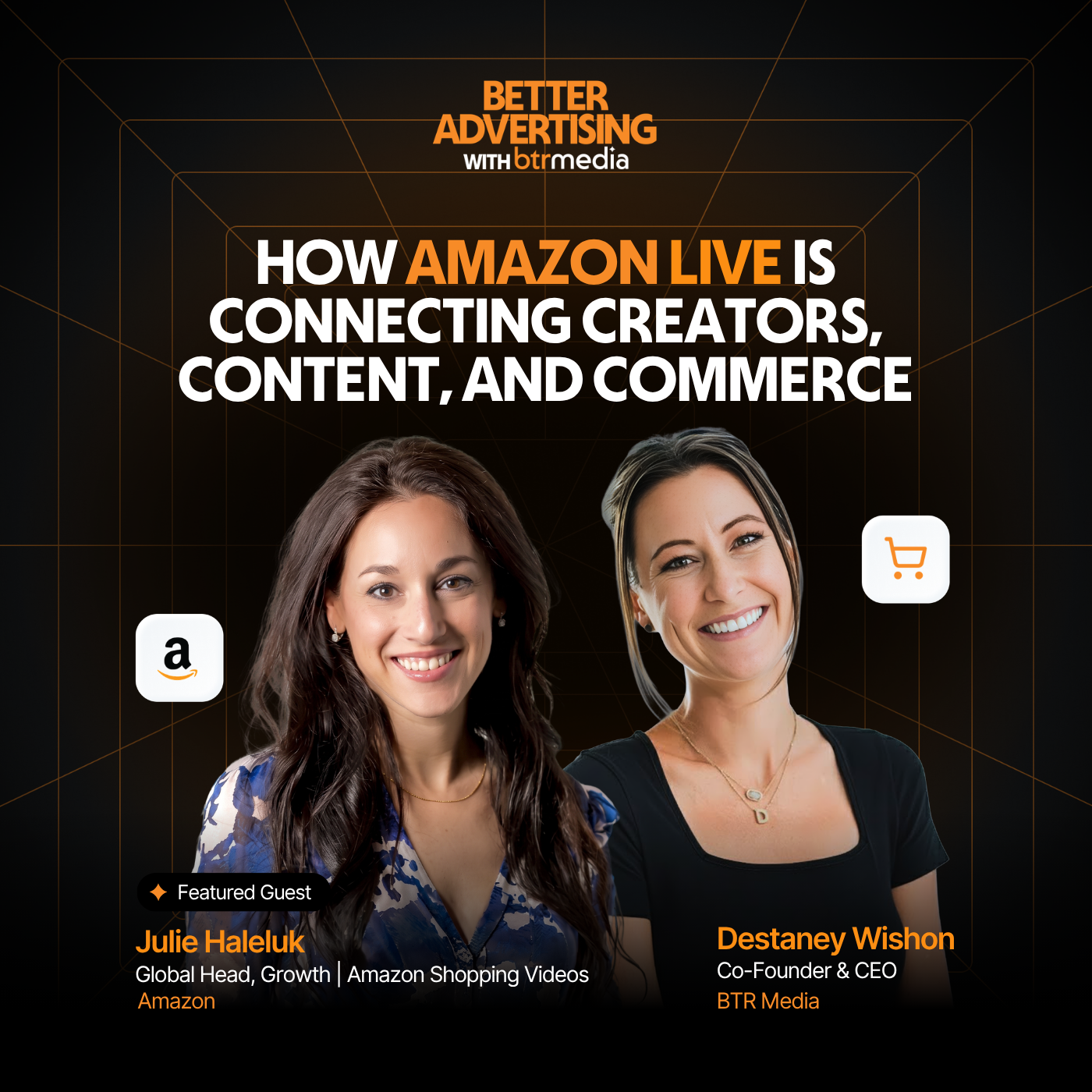
Better Advertising with BTR Media · Destaney Wishon and Justin Nuckols
In this episode, Destaney sits down with Julie Haleluk from Amazon Live to talk about the rise of shoppable video, creator-led commerce, and how brands can use Amazon Live to build trust, create demand, and connect the dots across the customer journey. They discuss why video should be viewed as a full-funnel campaign amplifier, how AMC is making measurement stronger, and why brands that move fast with creators have a major competitive advantage. Connect with Julie on Linkedin: linkedin.com/in/juliehaleluk Connect with Destaney on Linkedin: linkedin.com/in/destaney-wishon
BTR Media: Welcome back to Better Advertising with Better Media. My name is Destiny Wishon, and I am incredibly excited to be sitting here today during Can Lions with Julie Halleluck. Julie, you are the business development of Amazon Live. Can you give us a little bit of insight into, first of all, what does that actually mean? Well, it's funny because my title is Global Head of Growth, and growth means something different literally every single place that you go. So I find myself being like, okay, so here's what that means every time. So it's so funny that that's where you start. ⁓ so for us, what that means is that I lead a team of business developers and marketers that are really focused on driving adoption of shoppable video across Amazon, whether it's with brands, customers, across the board, across the multifunctional team. Well, what better place to be? This year, Can Lions, everyone's calling it the creator can. Yeah. So a lot of the beaches, a lot of things that we're seeing are, you know, building these spaces for creators to go live. Can you talk a little bit about how Amazon is describing social shopping and looking to adopt social shopping ⁓ on the platform? Yeah, I would love to. So it's really interesting because video in and of itself has really permeated the the customer journey. I think I I saw a stat 82% of internet traffic is all video now. So if you think about that, and then it's across different experiences. And it's you know, they're going from one experience to the other, et cetera. And it's really important to create that connective tissue tissue. And so while customers discover on Amazon, but they discover across the open internet as well, ninety-four percent of creator influenced ⁓ purchases actually happen on Amazon. Wow. And so we have this incredible opportunity to think about how to bring social shopping ⁓ experiences both on and off Amazon, right? And make it really seamless for the customer. So we can Meet them with the content that they're looking for across their journey. Wow, that's incredible. I was watching one of the viral shows this week and I was being served this streaming TV ad and it was pretty impressive. You know, Amazon's obviously integrated the ecosystem incredibly well, but someone took a maybe a generic UGC video that a creator had used for their brand and they incorporated it into their streaming TV ad. So instead of having a professional production, they had that thirty second clip built directly into their streaming TV ad with, you know, the buy now button. And I think that's a little bit of what you're talking about when you talk about the ecosystem and how you can connect those dots. Someone may be viewing a video on a different platform, but then you're able to See it again directly on your TV and then also immediately check out, which is very, very integrated. Totally. And so what's really cool with Amazon Live in particular is that it's social shopping, meets shoppable carousel, meets always on content engine at the end of the day, right? And so it allows for this long-form storytelling that has the live moment, but then always continues to be always on after the fact. Really up to the the brand or the creator's choice for however long it lasts. But it also in a enables ⁓ a ton of asset development. So you create this long form content, but then you can create cut downs. So that can be an S T V ad, that can p that can, you know, be for digital media, for social c for social video, on and off Amazon, et cetera. And it's just this entire creative infrastructure all stemming from kind of one piece of production. Which is incredible because I think when a lot of people think of creators, they think it's a little bit difficult to scale, you know, in The world I play in with general retail media, you buy an ad unit and it's applied to multiple different placements. I think brands struggle to understand creator adoption because it seems ⁓ a little bit difficult to scale. They often take the mass approach. You're saying that that one video can be cut down and used in multiple different assets and placements. Yes. That's amazing. Well, and to your point, one of the things that's always been a challenge when it comes to creator driven content or even social content is ⁓ is measurement. And I get questions all the time about how to think about live shopping and measurement put together. Is it, you know, the in the moment, quick, immediate results, or how do I think about it? And the real answer that we see is using the ⁓ the live specific metrics to help optimize the content. So you understand what's really engaging your customers and what they want, how they're thinking about it, what they're leaning into more, what they want to learn about, right? But then at the end of the day, the when we think about live, because it's this always on engine, ⁓ is that we see it as a campaign amplifier. And so when live is added to a full funnel campaign, right? So, you know, as a customer, I'm seeing I'm seeing advertising that could be on social, that could be across the open internet, could be on Amazon itself. Once I've clicked through and now I'm high intent, I want to learn more. I'm met with that longer form content that allows me to engage. more deeply. So what does that do? It builds trust. It helps, you know, drive consideration and eventually purchase. So coming back to measurement, how we recommend is to think about campaign amplification. So when live what does a campaign look like with life or without? And what we repeatedly see is upside in terms of ⁓ in to the overarching campaign in terms of purchase rates, branded search rates which are really helpful. ⁓ detail page view rates, et cetera. And so it really has that amplifier effect, which we're really excited about and proud of. That's incredible. I think something that brands may be a little bit spoiled by is having too much access to instant gratification insights. We see this a lot with just, you know, inherent PPC. When someone is searching for something, they're looking to purchase thin. So when we're educating brands on kind of zooming out, looking a little bit more upper funnel, this is a lot of what we're talking about on the measurement side. We need to expand that viewpoint. Again, I think social media has us trained on instant gratification. But think about how many times you're scrolling and you see an influencer. You don't always immediately check out. One of the things you called out was branded search lift. I've actually worked with a supplement brand who worked with the live team. I've had a chance to tour the studios and it's absolutely incredible. We loved having you. It was a lot of fun. But the way this supplement brand started viewing the space was they actually partnered with one of the live creators that was focused on cooking. So they did a cooking class where they integrated the protein directly into different recipes and things like that. So to your point, on the immediate gratification side, we are really looking for a branded search lift. That was an easy tie-in. The moment the campaign went live, what happened to our branded search? Branded search is always advantageous because it typically means higher intent, less competitors are being seen within a search result page, things like that. But I think one of the big things that we saw there on after is our top keywords had a higher conversion rate. Because what the live did is it actually educated people ahead of time. And I think that's something that a lot of people are forgetting. You know, they really focus on the instant gratification aspect of capturing demand. They forget to create their own demand. And that's something I love about working with creators is you're actually creating demand that maybe didn't inherently exist within your category. I mean, it takes twenty, actually, I think it's more than twenty touch points before a customer makes a purchase decision. And so when you think about that, it's very important across a number of touch points. To be very consistent to build that message and allow the customer to engage that on their terms. So exactly what you're saying, the live drives to that branded search. ⁓ we see differences in branded versus co-branded assets when they're mentioning that there's a live, we see differences in intent and so on and so forth, right? And and it really is ⁓ has a payoff in building trust with the customer. And then that pays off in thinking about loyalty. And you know, ⁓ lifetime value for the brand. Lifetime value and trust. Those are heavy hitters here. A lot of people again are are trained on, you know, I need a review advantage, I need a price point advantage. But if you really want to get into that relationship building aspect, it's building the trust and authority. And I think creators are a great way to do that because it's also relatable. You're seeing someone who potentially relates to your current situation, advocate or evangelize a product which drives so much trust and authority, giving you an inherent competitive advantage. Absolutely. Creators have this just amazing way, and I've probably said this too much, of making a one to many relationship feel one to one and feel personable. And it could be a scaled creator, it could be a niche creator, but for whatever reason you find something that you identify with them, right? I mean And you it's actually funny, you can really learn a lot about a person by understanding all the different people that they follow. But it builds it, you know, there's something there that builds that trust. And because of that, right? So, you know, even something as simple as we've talked a lot about live, but even shoppable videos, which are the videos that are on product detail pages, they can come from brands, creators, customer reviews, ⁓ sh PDPs or product product detail pages, sorry, with with a video have a 22% ⁓ higher conversion rate. But they also have less returns. Wow. Right. And the reason is because you're seeing something and understanding it. But also when you find something and you watch a video from a creator that you trust and is authentic to you, right? Then you know what you're getting. Right. And by the way, honesty matters as well. Right. So how many creators do I have like have I seen where they're like, ⁓ you know, I love this dress and here's how it fits me. Here's what's not great for me. You know what? Sometimes that actually helps me make a purchase decision because I'm like, okay, I get why you don't like that. But for me, that's cool. Absolutely. And that to your point can be a good thing. A lower return rate removes a badge off your product detail page at times. You're filtering out customers that may not be the best fit for your brand, which can be a negative in the long term. You're actually finding a much more aligned audience. Absolutely. So if a brand comes to you and said, video did not work for me, we've talked about all the reasons, you know, why it's a positive. What is your first response? ⁓ it's almost always the lens that it's being looked at. And I think it goes back to that point of instant gratification and how we're how how they're looking at the signals. ⁓ so f it comes down to what was the initial objective when we were thinking about the start of the campaign, whether it's with us or, you know, luckily we're very grateful we have a very high client satisfaction rate. But When, you know, if it's somebody else that's thinking about it and says, ⁓ this is this you know, we've tried it, not not not for us. It usually comes down to what was the objective, how were they trying to communicate with the customer, and you know, what were the ⁓ measures of success that they identified from the door and then it's really an education to drive them back to look at to look at that point of overall campaign amplification. It's become much simpler for us to help educate customers, ⁓ especially in the United States, because Amazon live signals are now integrated into AMC, the Amazon Marketing Cloud. So that allows us to show things like path to purchase and the impact overarching to the campaign. And then once customers can see that type of information or, you know, aggregate case studies, et cetera, for others if they're if they're just learning, I think it helps significantly. Absolutely. Definitely a big education gap. I think video is incredibly overwhelming. It's moving incredibly fast. And to your point, people don't realize the pieces that can be connected. You shout out Amazon Marketing Cloud. One of the examples that we love to utilize with our brands is if we know someone's running a streaming TV campaign. Streaming TV is typically considered a little bit more upper funnel. You're showing someone an ad while they're sitting on their couch. With Amazon Marketing Cloud, you can pull in those insights and you can actually adjust your bottom-of-the-funnel campaigns. So for example, if a customer viewed my streaming TV ad and then goes to Amazon and makes a search for a general keyword that may be a little bit competitive. Maybe they forgot my brand name, but then they saw my commercial and they're like, ⁓ I need to search for that. We can actually adjust our bidding strategy. So you're able to directly impact the bottom of the funnel assets you have based on how a user is engaging with something upper funnel. And I think to your point, that's something that's really been missing. When people think about video and they think of performance marketing versus brand marketing, they see them as two separate buckets. But in reality, because of a lot of the AMC signals, you can now Connect the dots on that whole ecosystem. And the consumer journey is not siloed. Right? So, as marketers, right, fortunately or unfortunately, so many teams are organized by it's a performance marketing team versus a commerce versus a retail media versus social. And and really that that challenge organizationally actually manifests in how a lot of campaigns are planned. But when you actually take a step back and think as a customer, That journey is spanning. And that that's where this opportunity comes in for driving that consistency, that cohesion, and optimizing all these pieces together. And so when we talk about that education gap, honestly, many of the conversations I have with people, they say, wait, that makes a lot of sense. Because that's how I behave as a customer. But I don't know how to start. I don't know how to do that because internally. Okay, so I need to go talk to that team. I need to go talk to that team. And we're all, you know, we're all planning our separate pieces. And you know what? That's part of the shift, right? But we need to we need to keep up with the customer, right? And you know, our mission is really to make it easier for customers to make confident purchase decisions at the end of the day. Like that's that's really what we're at. I mean, I know everybody at Amazon says it and we really believe it that that the customer's at the center of everything we do, but it's really like it's really the truth, right? And so That is at the end of the day the core strategy and why we want to build the content to meet the customer where they are, because we see it in terms of how the customer behaves. The the signals on the other side just prove that when you meet the customer, that's really what they want. Absolutely. And I I believe the stat you said was twenty touch points. It takes a average of twenty touch points to actually drive that conversion. So when you think about twenty touch points across all of these different platforms, all of the different teams that are involved. That's where I think everyone gets overwhelmed. Rightfully so. Rightfully so. And actually it's funny because I think that's where smaller businesses have such an ad advantage because they don't have all of the ⁓ the weight of all the organizational, I don't know, the tax, right? Of of what that of what that could look like, right? Bureaucracy goes into it. Exactly. So they can just move fast, right? Instead of turning the oil tanker, they can, you know, turn around like a speedboat. But that allows them, you know, it may feel for a smaller business a little bit more overwhelming because maybe they don't feel like they're experts in marketing or understand, you know, they have a little bit more to to learn about, you know, the tools or or what have you, because, you know, not everybody knows how to run a query, right? Things like that. but at the end of the day, that's where they can move faster and think significantly holistic you know, think very holistically. And I think that's why you also see so many businesses. growing really quickly when it comes to creator driven social commerce, whether that's on Amazon or off, because they're able to move faster and and think holistically and continue meeting that ⁓ meeting that customer. Absolutely. Some of the ⁓ the best disruptor brands over the last few years, I feel like have driven all of their authority in growth through the non traditional route of working with creators first. That's right. And thinking about, okay, here's how I'm gonna use many creators, here's how I'm gonna double down on a couple, and then here's how I'm gonna build my storytelling. So when the customer shows their intent, I can allow them to go deeper. ⁓ and so, you know, that's what that's what we're hopefully, you know, trying to offer more and more brands ⁓ and creators and customers at the end of the day. ⁓ I love it. We are at CAN. So one last bonus question. Sure. Looking ahead, where do you see the biggest opportunity with video, especially from a brand perspective. Where do you recommend brands really plan for the future when it comes to working with creators? ⁓ man. ⁓ that's a great question. I think we're still in the early innings of getting it right, right, because there's such an education gap of video meets social commerce. So I think the thing that I'm most excited for is that we actually don't even know. Yes. Right? Because, you know, I started at Amazon no what is it, a little over four years ago. And as and I've been on the shopping video team the whole time. And how we've evolved because we're constantly learning and listening. I w I don't know that I could have projected that we would have the products that that we have today, right? So I think that's probably what I'm most excited about is that we're early, we're listening and we're paying attention and we're constantly making it a little bit better. So You know, I think, you know, a couple years from now, I hope that ⁓ that evolves into making it even easier for brands and creators to communicate with their customers. ⁓ and it's even more cohesive. Absolutely. I think if brands are listening in, the one key takeaway is to move fast. Yes. The industry changes quick and you have a major competitive advantage by being someone that can be a first mover on things like this. And think holistically. Don't think piece by piece because I think that is literally the difference. Between the ability to take this in and learn, ⁓ and you know, otherwise you can be misguided because if you just look at one small piece, it can lead you down one rabbit hole that is not exactly telling of the full story, which is which is both scary, right? And and a little dangerous. So we're we're really excited to really help brands to look. Well, amazing. Thank you so much for joining me, Julie. And I'm sure we'll talk again on all of the exciting video updates in the future. Thank you so much for having me.