
Better Advertising with BTR Media · Destaney Wishon and Justin Nuckols
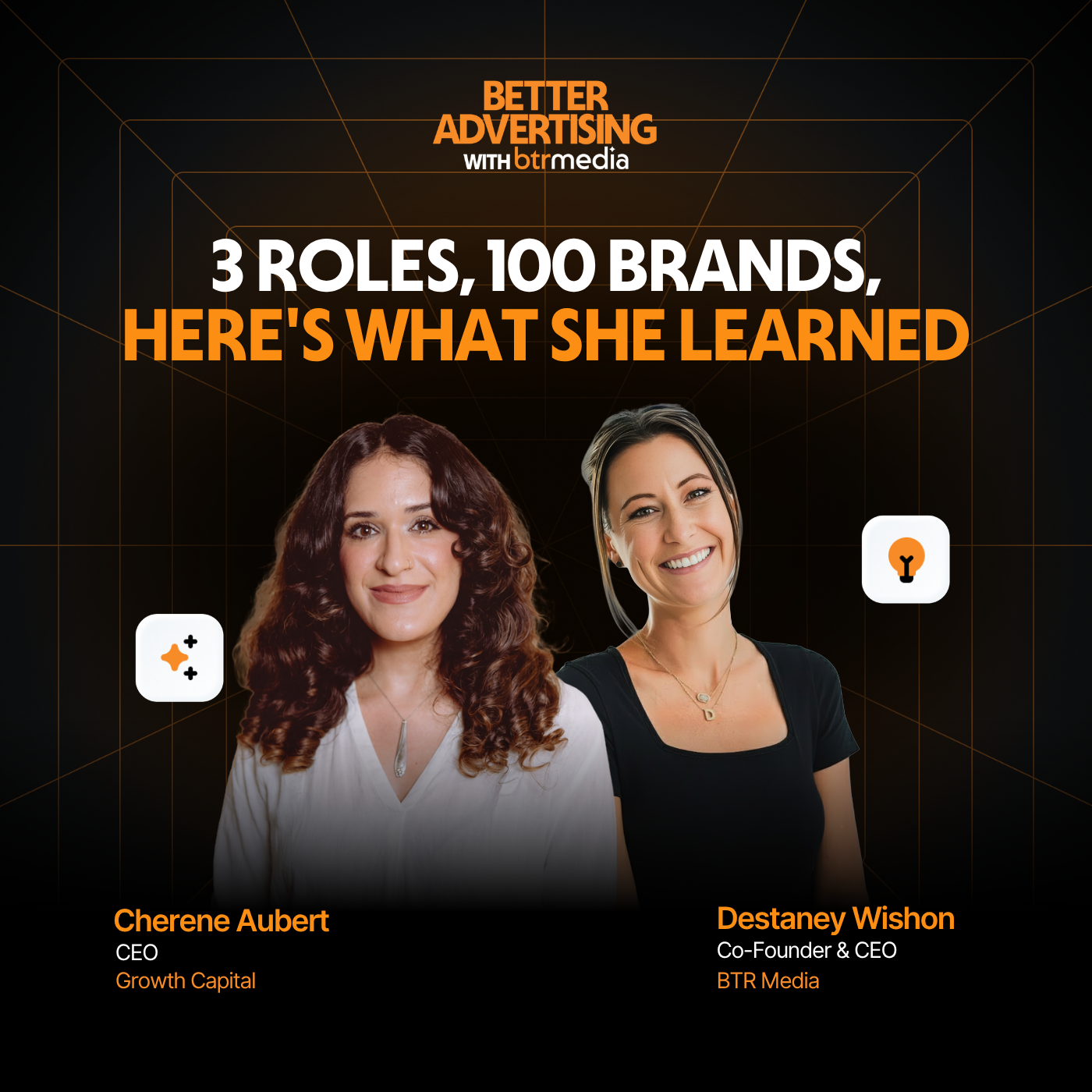
Cherene Aubert went from agency operator to VP of Growth at Bobby to head of digital at Ilia Beauty, and then left her dream job to start Growth Capital. In this episode she breaks down the pattern recognition that comes from seeing a hundred plus brands up close, how to think about media budget distribution at every stage of growth, and why copying someone else's channel strategy is one of the most expensive mistakes a brand can make. Connect with Cherene on Linkedin: https://www.linkedin.com/in/chereneetemadi/ Connect with Destaney on Linkedin: https://www.linkedin.com/in/destaney-wishon/
BTR Media: Welcome back to Better Advertising with Better Media. Today I'm exceptionally excited to have on Sh Shereen Aubert, the CEO of Growth Capital. Shireen, you've had an incredible journey. You've worked agency side, brand side, and now CEO. Can you give the audience a little bit of insight into what that journey has looked like? Yes, I'm so excited to be here, Destiny. Thanks for having me. So, you know, I started at agencies. I, you know, was fortunate enough to be at the I would say the ramp up of e-com ⁓ at a software design and dev agency. And then I got to be at a few different agencies. So I got to see a hundred plus different brands, different size sizes, stages. ⁓ and I got to operate the agency in those roles. So not only driving client strategy, but building agency teams, building systems. ⁓ and I I look back at that time in my career. I'm like, how valuable was it to like not just do marketing, but operate and scale marketing teams and systems, especially now with a little bit of a tangent. Like AI, you have to be a systems thinker. And if you can systematize your work, you can scale it and automate it. ⁓ and so after my agency career, I went in house at a few high growth brands. So I was at Bobby as their VP of ⁓ growth and data. We went from zero to a hundred in two years, expanded into all targets, acquired a competitor. it was insane. And then I joined Ilia Beauty ⁓ post acquisition. So they had exited to the Clarence family ⁓ office and I, you know, oversaw their Amazon, D2C, global advertising, CX data, AI enablement, ⁓ just An amazing, amazing brand. And I love my time there so much. It was jumping into the deep end of the beauty industry and really like driving the digital business end to end. ⁓ and I I like to say that I quit my dream job to start my own business. And that's that's when you know it's like real that you're giving up something that you worked your whole career for. but yeah, I I, you know, saw ⁓ Brand struggling ⁓ and wanted to fill a gap that it that I saw existed. That is exceptional. And not to mention that you have the perfect trifecta before kicking off entrepreneurship. You had the agency side. So you saw the systems and the people and the strain that I think happens with agency growth. And then you went into the startup world, which is really just a hundred miles an hour. You almost don't prioritize the systems near as much because you're moving way too quick and growing way too quick. And then you went to the post-acquisition state, which is typically a little bit more, I would say, managing up, a little bit more education and expectation setting. So you hit all three of them before kicking off your own thing, which I think gives you a very good foundation for being successful in this role. Yeah, I feel so blessed to have seen like so many case studies in e-commerce and digital and marketing at different stages. And I I think that is what makes me feel like this is what I'm meant to do. ⁓ because I I I see it. I see that most brands have the same issue. They're growing quickly, they're maturing, their goals are becoming more ambitious. They have numbers to hit that they've never hit before. ⁓ and some brands are at the stage where no one in their industry has even been in that, you know, seen that before. And then you have like the growth marketing talent pool. Which is like it's such a it's such a new industry. It's so nascent. ⁓ and there aren't that many people who have seen, you know, that many businesses at different sizes. And so brands have this like kind of misaligned expectation where they bring in a head of growth that maybe has been at one or two other brands before. ⁓ and they're putting unrealistic expectations on one person to drive the go growth of the business. Or they're bringing in agencies that are made up of junior people that haven't been in brands before. And so you kind of have this like this misalignment of everyone's capabilities and expectations. And so for me, that was like, ⁓ wow, you know, I have seen a lot of things, not everything. I've seen enough. And I know enough people. And when you get good, you know, when you get to a certain part of your growth career, most people realize. Hey, there's there's a lot of demand for my skill set, and I can probably make a killing not working a job and just being a consultant. And you know, I'm lucky enough to have ⁓ a a lot of amazing people in my network who are at this stage of their career, who've been in brands, who've been at agencies, who've seen almost almost seen it all. And ⁓ that's how I assembled my team. And I I think the the thesis being, hey, we Have experience, like let's come into brands and actually help them close the gaps and see the things that they can't see yet and ⁓ be those strategic partners. I love that. And I also love the story arc of everyone almost thinks they can start as a consultant and then the flywheel keeps spinning. And before you know it, you're an agency owner. If you are to your point, if you are good at what we do, there's a lot of opportunity. And I think you identified the Key point. I think there's definite misalignment in expectations. Another area we're seeing is a misalignment in education as well. I feel like especially for a lot of your traditional brick and mortar brands, your higher growth disruptor brands, they hit this point where your e-commerce team can't necessarily run in a silo anymore. No, we saw it a lot. I come from Bitonville. So the the Walmart world was, hey, you know, yeah, you go figure out this e-commerce thing, start selling on Amazon and see what happens. Well, this created like this silo of e-com. And now we're at a point where, like, look, those things overlap. They converge. Customers are shopping on both platforms at all times, but the leadership teams And the the manager the managing expectations across leadership teams to econ teams, like there's misalignment. There's misalignment on the education side. What does ROAS and incrementality actually have to do with in-store sales? There's misalignment, I think, to your point on expectations. Now, that being said, you've worked both sides. You're now advising brands from the outside instead of running them in-house. Is there anything that you can see clearly now that you're like, Yeah, I I miss that as an operator. And this is where brands are actually making mistakes now that you've been able to zoom out a bit. It's such a good question. And I feel like the way that we've structured the agency is has been to be more like an integrated team, which is incredibly unscalable as an agency, which sometimes I'm like, what am I doing? I'm like, I I'm taking the hard route, but I'm taking the playbooks that worked as an operator. you know, and the the issues that brands face are so similar across different br it's like crazy. It's like, ⁓ wow, you guys all have the same issue. This is great because I figured out a solution. And now I'm trying to systematize it within your business. and that is unscalable. So I I think the thing as an outsider. looking in that is most helpful that I feel like may like I I look at it as like how can I be the best partner to brands? ⁓ we just see so many different brands now and we see what's working across different brands. And like, yeah, you can't share exact tactics between brands, but you you start to gain this pattern recognition, which I loved having at the agency and which is what I think made me a good Brand side operator is like this pattern recognition. And you you start to see like the thing with digital is it doesn't you can't just keep repeating what works. If you repeat what works, everyone does it and it it doesn't work anymore because the c customer gets fatigued. The ad algorithms get fatigued, they they're craving newness. And so the benefit is like we get to see what's new and what's working and what's cutting edge. And you get to really see like how slow moving some brands are in their decision making. And that's really what prevents growth from happening. It's like, okay, this brand that's, you know, you you may be a fifty, hundred million dollar brand, but this twenty million dollar brand or this ten million dollar brand has unlocked this tactic that you are overcomplicating and and ⁓ and that's really hard because That's just the n the nature of scaling is how do you scale a business and have infrastructure to support scale while allowing the business to still be agile and nimble as it relates to digital and growth? Absolutely. And you see brands on both ends of the spectrum to your point. You have your your kind of old school enterprise brands that move way too slow. I mean, way too slow. We've been sitting in a lot of conversations for, you know, TikTok shop integration. And a lot of your kind of OG brands don't love the thought of just sending out their products to a bunch of creators and allowing the creators to create content for them. You know, they're their concerns about the negative backlash or what their brand's gonna be associated with. And that's why you have, you know, brands like Cruons or Mary Ruth's. They're just eating up market share because they're moving exceptionally quick. But to your point, there's the other side of the spectrum as well. You have brands that aren't taking the time to come up with their unique edge or competitive vantage or creative set, and they're just copying the exact same playbook. I mean, everyone can scroll LinkedIn and see the comment me's for the here's the grooms D2C playbook. Go copy and paste it. It's like one, yes, to your point, the the customer fatigue. No one wants to see that exact same ad over and over again. But then you talk about like the CPMs. It's exactly why we saw this. You know, struggle in the D2C brand space is because Meta worked so well. And then CPMs got a little bit more expensive. And they realized, hey, maybe I do need to diversify to a platform like Amazon where my customer acquisition costs are a little bit cheaper. And I think that's something that I've seen you post quite a bit about is not just copying and pasting someone else's style, but actually uniquely identifying your competitive advantage and figuring out what that edge is before going to market, especially when it comes to creative. Yeah, there's so many things that can be transferable between brands. And then there's so many things that are specific to a category or even a s an individual brand. And I mean Amazon is such a great example. There are products where you can pour money into ⁓ into ⁓ search ads on Amazon and you will drive incrementality all day every day because the customer is there and they're doing discovery on Amazon for the first time. It's not a highly considered purchase. They want to find like the one at the best reviews, the top ranked and the first one and you win. And then there are categories like premium beauty is a great example and Amazon has done a great job building confidence in their premium beauty program and consumers are becoming more aware that Amazon is a destination for pre premium beauty. But the customer, the beauty lover, the beauty fanatic is not doing discovery for the first time on Amazon. It's a it's a completely different shopper that's doing discovery for the first time for beauty. So premium beauty brands still have to do their discovery TikTok and in social and know that their customer is going to then purchase on Amazon as the path of least resistance. And eventually it'll get there to where, you know, consumers will do discovery for those types of products for the first time on Amazon. But like it's still so social and influencer driven. ⁓ and and so I see brands make this mistake sometimes too, where they they're like, wow, Amazon is an incredibly profitable channel. It's our most profitable channel. As a matter of fact, Why are we putting any money into paid social or TikTok or Meta and D to C, which is margin dilutive now? ⁓ and it's so hard and expensive and no customer wants to shop there. Let's put all of our money into Amazon and it's profitable. We have a, you know, we have a 10 X or 10, you know, 10 tacos, 10% ⁓ tacos, like, and then they they put a bunch of money into Amazon and The incremental sales don't come or the daily average sales stays consistent and they're like, What what happened? Like, what's what's wrong? And then the roads will start dropping because what they didn't realize is it was inflated by branded search, driven by by off-platform. Exactly. And even on the non-branded side, like the type of customer that's doing non-branded discovery for let's say a concealer may not be ready to buy. $30 or $40 concealer, the person that's doing discovery for a concealer on Amazon may want to maybe a value shopper and a convenience shopper, which is not the premium shopper yet. And so, you know, it's amazing. And I think this is where incrementality testing ⁓ and ⁓ having a full funnel media strategy and understanding like where does retail media and marketplace media buys fit? And where does upper funnel consideration stage like influencer content fit? Where does brand content fit? It's like almost, you know, everyone's looking at it so siloed, but you going back to fundamentals, you need to build a content strategy and a media strategy by funnel and understand your customer journey and your customer funnel. And so yeah, it is, it is that that's the answer to it, it's so different for every brand in every category. Absolutely. And to your point, that's where the pattern recognition really comes into play. When you are working brand side, you're often in a silo of this is what has always worked best for us. And you maybe don't pull in those associations. Something that I love that you just mentioned is the different buckets of marketing. And I think that's another area where we're seeing teams really struggle. Is there's a lot more overlap now than there ever used to be. And the lines are also blurring quite a bit, you know, Amazon. And Walmart and the streaming TV race and really pushing for more of those budgets. And then things like AMC make it a little bit tricky where you can now, you know, curate an audience across upper funnel media, but also with your bottom of the funnel search. So when you're working with a brand, really, how do you advise them on how they look at that budget distribution? When do they focus on pure performance measurement? When do they focus on brand building? Of course, again, it is one of those, it really just depends. But do you have any like key guidelines that you like to give brands? Yeah, it's the billion dollar question. And I think incrementality testing does help us get closer. And and same with like MMM. but really not every brand has the budget to invest in those tools yet. And so this is where it becomes like a little bit art and a little bit science. ⁓ And and the things that that I've seen to be true is is there are stages. So if you're an early stage brand, you're, you know, and you're spending a thousand dollars a day in media, you it probably not the right time to invest in TV and like brand awareness media. Your direct response media is you're building your brand awareness. And so your focus should be in the beginning, in the early stage, if you know, the best, depending on your Sales channel mix. If you're ⁓ a D to C brand, for example, and you're starting on meta, and that's where the co concentration of your budget is. Some brands have the ⁓ temptation to like diversify their media investment like that early. And it's like, no, don't even think about that. Like if you're playing in meta and you're in D to C, think about diversifying your content first. Your content should be Different funnel stages. So don't just have static ads, don't just have conversion ads, like have some influencers, have some education, have, but still run it in a meta direct response conversion campaign and get an understanding and get learnings. As the brand starts to scale, and depending on the category, there is like some framework around the next best channel based on your category and sales channel mix. and like using beauty as an example because that's where, you know, I've spent so much of my time and career in testing and even other categories. Like I would say TikTok is such an amazing brand awareness channel. Again, like you don't need to go into TV right away. Like TikTok is not as good at meta at driving last click direct. Response conversions because the user doesn't want to exit the app. But it's a huge like awareness channel. And then you go one layer deeper, and it's TikTok Shop, which is this powerful content affiliate awareness conversion, full funnel engine that drives Halo to Amazon and retail and is incredibly powerful. and then I think as the brand grows and matures, yeah, then you start to layer in, you start to think about okay. Direct response has been a core part of our strategy. There are diminishing returns on our customer acquisition cost. We are omnichannel. We want to grow our awareness as fast as we're growing our distribution. This is, I think, a good stage at which brands should start to think about channel diversification, not even channel diversification, but expanding their media budgets and investing in brand media more seriously. That was a textbook. Let's crop the episode, drop that on LinkedIn, and everyone can walk away with immediate value. I don't think you could have answered that better. That was incredible. Why, thank you so much. It takes lots of experience and being, you know, some level of hands-on keyword keyboard to really understand, I think, that ecosystem. Like you, you need multiple reps before it starts to click. We've worked with so many brands that have like this one off. you know, got lucky moments and they'll like be like, okay, we need to go all in on TikTok shop because of this. But I think that is exactly what brands really need to focus on and how much it relates to your overall brand goals and journey as well. I love that you mentioned the milestones and the stages. Brands like to, you know, look up to someone that maybe isn't exactly where they should be or are and they want to try to replicate that system, not realizing the resourcing that could be difference between the two. Yeah, and you said something there, like hands on keyboard. I I as a marketer, as a digital professional, as anyone that wants to stay current as it relates to the changing ecosystem, which right now with AI, everything is ch gonna be continue to change so quickly. I a hundred percent believe that you have to stay hands on keyboard. ⁓ I will never stop opening the ad accounts. I will never stop opening the email platforms or the Shopify admin panel. Once you stop opening the accounts, you start losing touch. And I I I mean, like I'm in Cloud Code, I'm in Codex, I'm building AI agents. The day that you stop experimenting in this industry, you are your career starts dying. So I yeah, I think that is so key. I love that. And I've always said the same thing. One of my favorite challenges is still logging into Amazon ads. And I will challenge myself to look for all of the new things that have maybe been rolled out in the last week. Amazon likes to sneak in little betas in places. So it's like a personal gamification to go find it because of the exact same reason. The industry moves so exceptionally quick that you have to be involved or else time passes and you're gone. Yeah. And I think this is like there's a lot of glamour at being at a brand. and when I was at a brand, I was like, I will never start an agency. That's not what I want to do. I'm gonna start a business. It will never be an agency. I won't do that. but there is something, you know, that I forgot, which I loved about my agency career, which is that the like hive. Mind network effect learning that happens across so many businesses. And when you're working along so many peers that have a similar skill set, you just become so much sharper. And I feel like right now is the best time ever to be in an agency, especially with how quickly AI and tech is changing and how much digital advertising is changing. Like if you're not in it, you you lose touch. And I I think it's cyclical too. Like there are cycles of innovation or there are periods of ⁓ stagnation in like what what worked and what didn't. And like being at a brand too long is can also be detrimental to your career, I think. So this is just my PSA that agencies are awesome. Like I've come I've come around and I'm like, this is an amazing like business to be in and to learn and a time to learn. I couldn't agree more. And you know, for those listening in, Sharina and I actually had a big bonding moment about this ahead of time. And we'll hopefully do another episode where we talk more about agency life. But we both worked at, you know, agencies where you saw the strain of working at an agency. High turn, stress spread way too thin. And I think when we went into this, our roles as CEOs of agencies. That was a big prioritization of ours is balancing both. And I think that's where others and some of our competitors mess up. And it's a competitive advantage for us. But it's like, how do you do both? How do you take care of your people? How do you grow when you wake up in a world that always feels like you are behind? And I think that's something I'm incredibly passionate about, and you are as well, which was really cool to talk about. Totally. And it's, you know, the growth, like any kind of digital advertising or growth agency is I think so much different than other service businesses because you are on the hook for delivering outcomes that are business critical. And you have to balance your own business, your own agency's growth versus your clients' growth. And that can be a diversion of focus. And so for me, the way that I want I want those goals to be aligned is the Like what the brand achieves, what what our clients achieve is our goal. That's our main goal. Cause if the client achieves if if we're just working to improve and and grow the client's business, like by default, our business will grow. We'll get great referrals. We'll, you know, we'll keep our clients like that's the most important thing. And I think when you lose sight of that and you focus on how do I grow this agency business like and scale it into oblivion, you lose that. quality that you're giving to your clients, which is like the invaluable thing that they're paying for. So I think there's like just always going to be a natural tension there. Absolutely. I could not agree more. Now I know my listeners are begging for me to ask you this question. So I'm going to leave it as a little bit of a bonus. Codex and deep diving into Claude and all of the things with AI. Do you have any bold predictions or opinions when it comes to AI utilization, whether on the agency side or on the brand side? I have quite a few. I mean, I I think Codex is amazing right now for code. I think it's winning for coding. I think Claude is really great as it relates to planning ⁓ and strategy. And so I personally use them both. I have not fallen into the camp that one is better than the other. I think they have their unique strengths and I'm like, I'm gonna use them both as much as I can until I get priced out at some point. ⁓ But I hear this a lot. I hear the software is dead argument a lot from people that are like very deep in AI. And there is a potential reality that software will die. but I I think like my big take right now is that software is not dead. As a matter of fact, like there's a bigger need for new software than ever before. And, you know, you saw I saw it firsthand in e com like when e comm started. There was a ton of open source software. Magento was the core platform. And then Demandware and, you know, all of these kind of open source software where you could build these amazing custom sites and have these huge ⁓ dev teams and everyone can build whatever they wanted. It was like, you could build whatever you want. It's amazing. And then Shopify came along and was like, hey, we actually like ⁓ kind of simplified it and we we just like pre-built. what you need. And then there's a whole network of apps that exist that can plug into our system and and they pre-built everything else that you need. And you actually don't need these major big tech teams because the software is the solution. And I think with AI, we're kind of going into this like, I don't need it, I don't need this software anymore. I could just code I could vibe code my own version of it this. platform and then everyone it's like, yeah, there's like a period where everyone does that and then they're like, ⁓ wow, this this sucks to maintain. So I'm gonna bring in an AI engineer or an AI expert and they're gonna maintain it. And then everyone has these like Frankenstein systems that they're building and none of it is replicable or scalable. And then someone's gonna build a software that does it like 10 times better and their core focus is maintaining and building that piece of the the stack. ⁓ And I think like small businesses starting out with AI, building their own infrastructure is an amazing way to get immediate leverage and like keep your OpEx low. But there will be there are going to be better solutions that are scalable that many people can use without having the time of building and maintaining that I think will still exist. I couldn't agree more. I I think it's a really great middle ground of I think it's a democratizing engineering and time to products ⁓ quite a bit. So your softwares, which have always been a little bit heavy when it came to new releases and customizations, to your point, are gonna have that flexibility to provide more customization similar to what an agency can provide. On the flip side, to your point, all of these smaller companies have an opportunity to really have a competitive advantage in this area. So it's it's a fun space to be in. Totally. And I think we also underestimate How long it takes businesses to adapt change. And they don't even need to be behemoth billion dollar legacy corporations. It's like even the businesses that have a hundred employees and are doing a hundred million, it's gonna take them so long to adopt across their whole organization new tech. and that's where software and service providers come in and help. Absolutely. I'm looking up this stat because it reminded me of it, and I cannot remember what it is, but it was like this stat around organizational change and how long it takes like this waterfall effect to actually impact the whole org. And this is absolutely something that we're seeing. Like I consider it one of our biggest advantages that we are small, lean, and flexible because now we can all hop on it incredibly quickly. Like our engineering team has been trained since day one how to implement. But much larger agencies, like you have your pre-existing systems that need to be kind of revamped and so many other elements. And that is definitely something that needs to be considered. Not to mention like the human elements. Not many people can move at the rate of change that I think we do in the e-commerce space. Like we are very accustomed with the retail media networks or the retailers pushing change on a weekly basis almost. You start. Expanding that out into other industries, they're not accustomed to that. So trying to keep up with something like AI can be exhausting and maybe an unrealistic expectation as well. Yeah, exactly. And there's gonna be a new generation of experts that come up and make amazing careers out of it. Absolutely. Well, we are close to time. Shereen, this has been an amazing episode. Thank you so much for joining. Do you want to just give a shout out to any of your personal socials or your Growth Capital site so people know where to find and reach out to you? Sure, would love to. You can find me on LinkedIn for my very professional takes. And then you can go to Twitter to find me for ridiculous takes and questionable, questionable value. and then if you want to learn more about the work that we're doing, ⁓ you can find us at growthcapital.co. I love it. Thank you so much for joining, Shireen. Thank you, Destiny. Loved the conversation.