
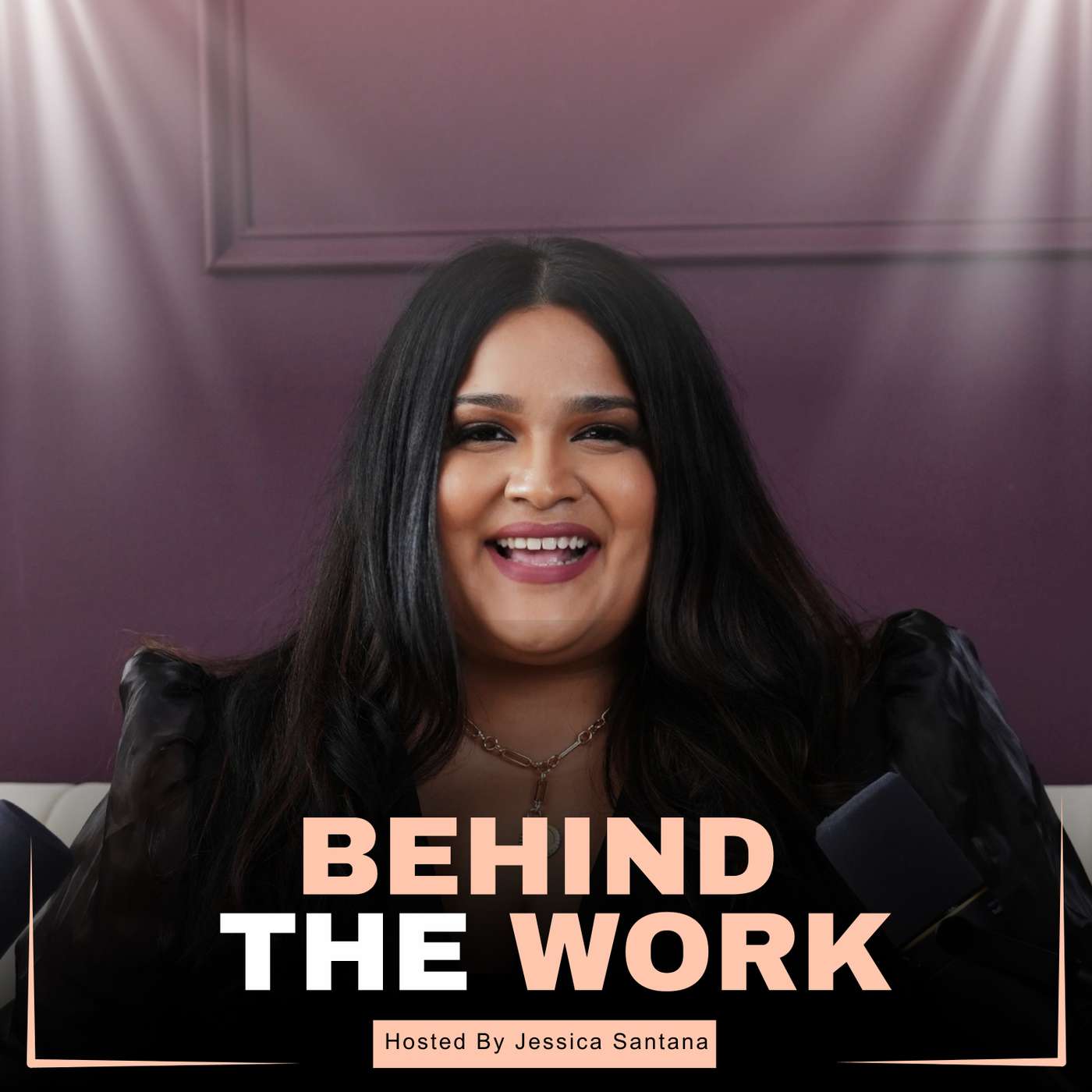
Behind The Work by Jessica Santana · JESSICA SANTANA
We need to talk about burnout. Not the buzzword version. Not the "take a bubble bath and drink more water" version. The real thing — the kind that creeps in quietly, disguises itself as dedication, and doesn't announce itself until you're already running on empty. In this solo episode, Jessica Santana gets honest about burnout, what it actually looks like for high-achieving, purpose-driven people, and why the solution isn't another productivity hack or a long weekend. It's something most of us have been conditioned to feel guilty about: a life outside of work. Because here's the thing nobody tells you when you're building something — the work will always be there. The emails will always be there. The to-do list will always be there. But the version of you that can show up with clarity, creativity, and conviction? That one has an expiration date if you don't protect it. Jessica breaks down why detaching from work isn't a luxury or a sign that you don't care enough — it's actually the thing that makes you better at it. We get into why high achievers are often the most at risk, what it looks like to build a real identity outside of your job title, and why "I'll rest when it's done" is one of the most dangerous lies we tell ourselves. This episode is for you if: - You've been running on fumes for so long that exhausted has started to feel like your baseline. - You find it hard to disconnect — even when you're technically "off the clock." - Your entire identity is wrapped up in what you do, and the idea of slowing down feels like falling behind. - You've been telling yourself you'll take a break once you hit the next milestone — and that milestone keeps moving. - You're high-achieving, purpose-driven, and secretly worried that rest will make you less of all the things you've worked so hard to become. - You know something needs to change but you haven't given yourself permission to actually change it. Connect with our host, Jessica Santana: Subscribe to the Behind The Work newsletter: https://jessworldwide.substack.com/ Follow Jessica on Instagram: http://instagram.com/@jessworldwide Follow Behind The Work on Instagram: http://instagram.com/@behindtheworkshow Follow Jessica on TikTok: http://tiktok.com/@jessworldwide Follow Behind The Work on TikTok: http://tiktok.com/@behindthework About Behind The Work: Behind The Work is the show for the ambitious person looking to level up their lives, their career, and their businesses. Hosted by Jessica Santana, Behind The Work goes deep with the executives, founders, and leaders who are building from a place of power. Each episode pulls back the curtain on the real work — the strategy, the setbacks, the pivots, and the purpose — behind the people, companies, and organizations shaping what's next.
Jessica Santana: Hi, everyone. Welcome to another episode of Behind the Work, the show for the very ambitious person looking to level up their lives, their careers, and their businesses. I'm your host, Jessica Santana. And if this is your first time tuning in, I wanna say welcome to the show. So lately, I've been thinking about the concept of burnout and how that no longer exists in my life and the work I've had to do so that it no longer exists in my life. And I'm realizing that in the world, we've been having the wrong conversation about burnout. We talk about it like it's personal, like it's about discipline, time management, boundaries, self care. Like if we just woke up earlier and drank more water and took a yoga class, that you wouldn't feel that you were burnt out. And don't get me wrong. Those things do matter. I love me a good morning routine, but they're not the root of the problem because you cannot self care your way out of a system that is designed to take more from you than it is to give back. Let me tell you the truth about what burnout actually looks like because it's not just about being tired. It's not just about needing a vacation. Burnout is deeper than that. It's waking up already exhausted even after a full night's sleep. It's about opening up your laptop and immediately feeling behind before the day has even started. And for women in leadership, especially for women of color, it comes with layers. It looks like carrying your workload and the emotional weight of everyone around you, being the fixer, the translator, the one who smooths things over, the one who makes things work even when the system doesn't. It's being in rooms where you are the only one or one of the very few, where you are constantly aware of how you're being perceived, your tone, your language, your presence, where you are leading but still in subtle ways having to prove you deserve to. That's not a time management issue. That's a structural one. But here's where it gets complicated because a lot of high performing women don't recognize burnout right away because it doesn't show up as weakness. It shows up as ambition. It sounds like I've got this. I'll figure it out. It's just a busy season. I just need to push a little bit harder. And if you're honest, and if we're all honest, that mindset has probably worked for you. It's probably what got you here. It's how you earned trust, how you built your reputation, how you became the person people rely on. So you keep going and you keep pushing and you keep delivering until one day pushing harder stops working. You're still performing, but something feels off. You're more irritable, more drained, less patient. The things that used to excite you don't hit the same. The winds feel smaller, the pressure feels heavier. And then comes the moment a lot of people don't talk about. The quiet realization, I don't know how much longer I can do this like this. Let me make this personal. There was a season in my life where everything looked good on paper. I was producing, delivering, showing up. From the outside, it looked like momentum, like success, like I was exactly where I was supposed to be. But internally, I was exhausted. Not just physically, mentally, emotionally. I felt like I was constantly on, always thinking about work, always anticipating what was next, always carrying something. And what made it harder was this. I didn't feel like I had a reason to complain because I had worked for this. I had earned this. So how could I be burnt out by something that I wanted? That's the trap. Because burnout doesn't always come from doing something you hate, sometimes it comes from doing something you care about in a way that is unsustainable. And here's the truth I had to learn the hard way. I didn't choose burnout. I adapted to survive in an environment that rewarded overextension. And a lot of women are doing the same thing every single day. We are rewarded for going above and beyond, being dependable, being the one who gets it done, but rarely do we stop and ask at what cost. Because when overextension becomes your normal, rest starts to feel uncomfortable. Slowing down feels like falling behind and saying no feels like letting people down. So you keep saying yes, even when you're tired, even when you're stretched, even when you know something has to give. And eventually, something does give. So yes, burnout is structural. Yes, companies need to change. They need to be rethinking workload expectations. They need to stop rewarding burnout disguised as dedication, recognize the invisible labor women carry, and actually support leaders, not just give them more responsibility. All of that matters, but it's not the whole story Because there is another conversation, we don't have enough. Women need to build lives outside of work. Not as a luxury, not as something you get to once everything else is handled, but as a necessity. Because when your entire identity is tied to your work, everything becomes heavier. Everything. Every piece of feedback feels personal. Every missed opportunity feels like failure. Every setback feels like it says something about who you are. There is no separation, no buffer, no space to just exist without performing. And that makes you more vulnerable, not just to burnout, but to staying in an environment that drains you. Because when work is your only source of validation, community, identity, and achievement, leaving doesn't just feel like a career move. It feels like losing a part of yourself. So you stay longer than you should, and you tolerate more than you should, and you give more than you should, not because you're weak, but because you're invested. So let me ask you something. Who are you outside of what you produce? Do you have relationships that have nothing to do with your career? Spaces where you are not responsible, moments where you are not performing. Do you have joy that isn't tied to achievement? Because if the answer is no, then of course, work has too much power over you. This isn't about working less. It's about living more because a full life outside of your career changes how you show up inside of it. When your identity is not dependent on your job, you make different decisions. You set clearer boundaries. You speak up sooner. You walk away faster when something doesn't feel right. You stop overperforming for under recognition, not because you don't care, but because your entire sense of self is no longer on the line. That's not disengagement. That's power. And let's be clear. This isn't easy, for women who have had to fight to be where they are, especially for women of color where success often feels like responsibility, representation, and proof. Taking your foot off of the gas, even a little can feel risky, like everything you've built could slip away. But here's the truth. If your success requires you to disappear to maintain it, it's not sustainable. So maybe the goal isn't just to fix burnout, maybe the goal is to build a life where burnout doesn't get to define you. A life where work is important, but not everything. Achievement matters, but doesn't determine your worth. Rest is normal, not something you have to earn. Enjoy exists outside of productivity because work will take what you give it and then ask for more. So the question becomes, what are you keeping for yourself? What are you protecting? Because at the end of the day, the most sustainable version of success is one that leaves room for you, not just your output, not just your performance, but you as a person, a whole present person who's alive. And that that is something no job can give you and no job should be allowed to take away. So as we wrap up today's episode, I really want you to consider how to build a life where you do not burn out, where you take a driver's seat and you ask yourself questions about how to pour into yourself outside of the career you're building. It would behoove you to think critically about the things that energize you and how to create detachment from what you produce so that you become a version of yourself that is not tied to your career achievements. If you like today's episode of Behind the Work, I would encourage you to give us a thumbs up, subscribe on Apple Podcasts and on Spotify, leave us a rating, and follow us on social media. I really hope that you enjoyed today's episode and that you share it with a friend who might be experiencing burnout. See you all next week. Thanks for tuning in to today's episode of behind the work. If you enjoyed today's episode, make sure that you subscribe to our channel on YouTube. Check us out on Apple Podcasts, Spotify, and follow us on social media. I'm really looking forward to seeing and hearing how this show is leaving an impact on you.