
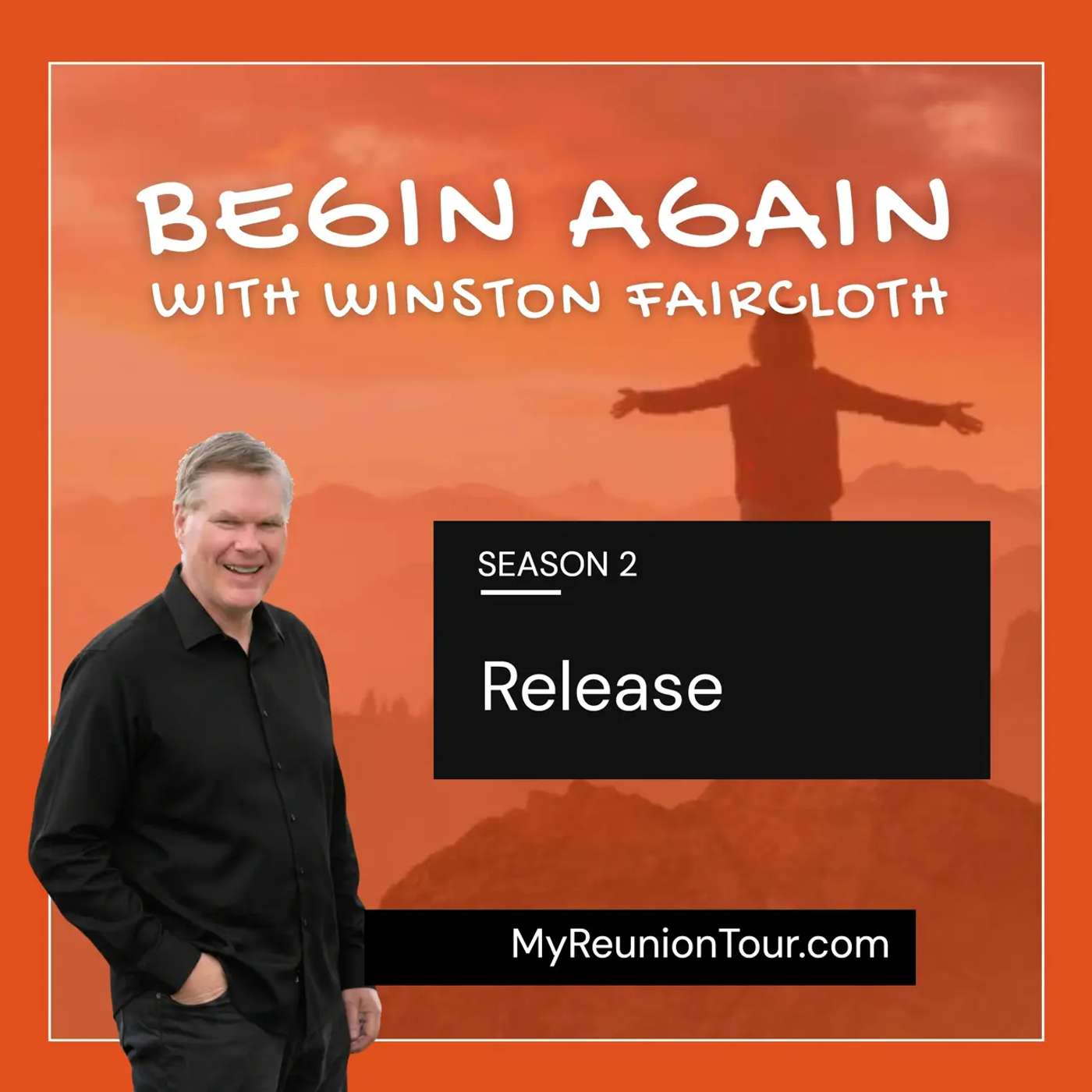
Begin Again with Winston Faircloth · Winston Faircloth
Episode 15: Hair on Fire with Teresa McCloy Release Movement — A Conversation with Teresa McCloy All season, listeners have heard her name: the balcony is her image, and the farm in central Illinois where so much of this story happened is her family's farm. Today, you meet Teresa McCloy. Teresa is the founder of The REALIFE Process, a coach, a certified spiritual director, and the author of Do What Matters: Live from Rest, Not Rush. Just before the pandemic, at a mastermind in Franklin, Tennessee, she sat next to a very tall, very frustrated man on a crowded back row and recognized exactly where she had been. She had the courage to say so. Winston credits that moment as the beginning of his path back. In this conversation, Teresa tells what living with her "hair on fire" looked like, the three quiet minutes that began to change it, and what becomes possible on the far side of lament. In This Episode • "My worth became in my doing": how Teresa's pattern of "everything depends on me" ran through motherhood, ministry, and a decade of walking with her son Eric through addiction, until his death in 2017. • "And what am I supposed to do?": the mentor who asked her to sit still for three minutes in a church nursing room, and the emotion her busyness had been holding back. • Recognition from the outside: why the biggest gift we can give one another is to say what we see. • The back row in Franklin, Tennessee, told from Teresa's side: the armor she saw, the "teddy bear" behind it, and why she says she probably didn't say it gently. • Release in Teresa's story: naming and honoring Eric's need to be known, and how grief that has been grieved can become a gift. • A high-school senior's question, "How do you deal with grief?", and Teresa's answer: write to your dad. • A first step for anyone whose hair is still on fire: Teresa's REST practice, and the invitation to "come away with me." Featured Poems Hundreds of poems available at https://myreuniontour.com/my-reflections • Tour Day 990: "Slowly" (opening) • Tour Day 992: "Next" (closing) Mentioned in This Episode • Teresa McCloy and The REALIFE Process® → https://www.therealifeprocess.com • Do What Matters: Live from Rest, Not Rush, Using the REALIFE Process, by Teresa McCloy (now on audio) → learn more here • Rest Notes: A Year of Quiet Noticing, Teresa McCloy's new book → pre-sale coming Nov 9th • Rory Noland, Teresa's mentor • Sibyl Towner (Episode 4) and Erica Vinson Stearns (Episode 12) Resources & Links • My Reunion Tour program → https://myreuniontour.com/the-journey • Schedule a conversation with Winston → https://chatwithwinston.com • My Reflections (poems + photos) → https://myreuniontour.com/my-reflections • Subscribe → Audible • Apple Podcasts • Spotify • Amazon Music • Search for "Begin Again with Winston Faircloth" in your favorite podcast streaming app If This Episode Resonated If today's conversation stirred something in you — visit https://chatwithwinston.com. Schedule a 30-minute,...
Winston Faircloth: Hare on fire. Welcome to begin again. If you're new here, this is the release movement of my reunion tour, a faith based journey for people in the second half of life who sense that the identity they've been carrying no longer fits. Last episode, we sat with Lamet, the grief I walked all the way through with my dad and the grief I skipped for my mom. And near the end, you heard a voice I've been promising you all season. Hold your story close, she said, until it's been grieved. Today, you get to meet her. Teresa McCloy is the founder of the Real Life Process. She's also the author of do it matters, live from rest, not rush, and a brand new book called rest notes, A Year of Quiet Noticing. She's a coach and certified spiritual director. She and her husband, Dale, live on their family's farm in Central Illinois, the farm where so much of my story happened. The four day retreat, the little house, the porch, and an image I borrowed all season for senior life from above, the balcony is hers. But long before any of that, Teresa was the person who first saw me. Just before the pandemic at a mastermind in Franklin, Tennessee, she sat next to me on a crowded back row, watching me wrestle with a career that was no longer working and recognized her own story and mine. And she had the courage to say so. I credit that as the beginning of my path back. Before we begin today, a poem. This one's called Slowly. It's from tour day nine ninety. Always looking for harvest, these are not your ways. Seed planted, tended, and watered as you number our days. In the waiting, there's movement, unseen yet unfolding it grows. Control we release and follow, a path only he alone knows. Gradually, we begin to recognize a pattern, a vow, or promise. Will we ever leave the boat or no longer doubt like Thomas? We'll both honor and lament stories that no longer fit. When we take a small step, a new way we can commit. The unknown with you is safe as we decide to follow holy. Seeds planted today will grow deeply and slowly. The poem says seeds planted today will grow deeply and slowly. Teresa planted a seed in me on a crowded back row in early twenty twenty, and it took years to blossom and grow. But before we get to that, I want you to hear how the seed was first planted in her. Here's my conversation with Teresa McCloy. I started where so many people meet Teresa's work with a phrase she's written about for years, living with your hair on fire. I asked her what that looked like on an ordinary day. Teresa McCloy: Yeah. The hair on fire is a funny phrase that I just developed. I don't remember where I first heard it. Not original with me. Always laugh because I have a full set of gray hair. So I always laugh about the fact that my hair didn't become gray because of, but I actually did gray very early. Maybe it was just all the... What was stress in my life. And so hair on fire represents a pattern of living for me. It was how I adapted. My adaptive behavior was everything depended on. So my lack of dependence on God, my lack of ability to ask for help, think at its deepest root, it goes down to worthiness and a feeling of worth, unworth that I didn't believe, probably, at that season of my life that God loved me unconditionally and that I was a beloved child of God no matter what. So my worth became in my doing. In my forties, when many of us are in that, who am I gonna be? What's my career? What am I known for? Phases. Everything from I'm gonna be the perfect mom. I'm gonna clip the coupons. I'm gonna have the card box that is organized by all the tasks that I have to do at home, and they're all in a three by five card. Line that behind the days of the week, Sunday through Saturday. That desire for organization, desire for structure, but always around accomplishment or doing. Then as I became a pastor, my role was creative arts. So it was turning around the service, the complete hour long service every seven days. So it was all the slide decks, all the music, all the things. And in that season, didn't ask for a lot of help. I just did it partly because my pride said I'm the only one that can write. And I was really looking, though, for people's affirmations of my worthiness. And so staying up late at night, I tell stories of staying all night at church on an Easter weekend to get it done to... It was very performance oriented, those types of things. And then as we walked a hard season for about ten or twelve years with our son's struggles with addiction to alcohol and heroin. And eventually, the loss of Eric in 2017 when he passed away. So sped up to a place of I need to fix this. It's your child. You're gonna do whatever, whenever. So I lived with my hair on fire, partly because you never knew what shoe was gonna drop that day when you're struggling with addiction. But instead of letting shoes drop, I finally let them drop. I thought I needed to be the one that fixed it, resolved it, so that others didn't get hurt, so that others can still have a fruitful career and still do all the things. So hair on fire is never just usually in one area of our lives. Don't think people might see only one area, but you're really feeling it everywhere. Winston Faircloth: I next asked Teresa whether there was a moment or even a slow dawning when she realized she couldn't keep living this way. Teresa McCloy: I reached out to someone. It was actually a spiritual director. Although I didn't know, I hired him as a coach and a mentor, Rory Nolan. I thought I was hiring him to help grow my ministry team and do my career better as a pastor and had a lot of respect for him. I'd read his books. He really took me into was the deep internal work I need to do. I just did never wanna slow down enough to do it because it was scary work. It was hard work. I was in the nursing mother's room at our church because it was the quietest place you could go, sitting at a rocking chair in there so nobody could hear my conversation with him. And I would say, Teresa, just want you to sit quiet for about three minutes. I was like, and what am I supposed to do? Because there was nowhere in my life I wasn't doing something all the time. A master of multitasking. He just recognized that till I got quiet and still... And a lot of why I didn't wanna go there a lot, Winston, was so much emotion would come. Had to really sit with the goodness of who God was or how God saw me, and yet he loved me anyway. There were many things in my story clear back into my childhood that I just didn't want God to know he did and loved me anyway. Those were the first moments of me recognizing, I gotta peel this back. I'm so grateful. I really truly believe that if I hadn't have, would I still be married today? I don't know. Would I be living that kind of life that that is from a place of rest, not rush? I don't think so. The damage could have been done. What have been done? Winston Faircloth: And what am I supposed to do? I laughed inside when Teresa told me that because I know that answer. It's the loyal soldier's answer. If I'm not producing, what am I good for? But listen to why she didn't wanna sit still. So much emotion would come. That's what the business is protecting her from. And that's what three quiet minutes at a nursing mother's room finally let in, being fully seen by God and loved anyway. All season, I have described recognition as something that dawns on you slowly from the inside. Teresa reminded me that it often arrives from the outside through someone else. Teresa McCloy: Many times, recognition, you have it on your own self, but a lot of times, God is so faithful and good to give you other people recognize things in you. Biggest gift we can give to one another, I think, sometimes is to speak those things. And... Because you may have had an inkling, but you would hear it differently coming from Winston Faircloth: Problem, someone else, from another voice outside yourself. That's what exactly what happened to me. So I shared with Teresa something I've wanted to say for a long time, and then I asked her to tell it from her side. I wanna come back. You said something that I just want to acknowledge, and I've said this on the podcast before. We'd been part of a mastermind together. I credit you speaking into me in that way as the beginning of my path back? Teresa McCloy: Probably one of my greatest gifts is knowing while you're walking this Earth that there will be one other person that has the ripple effects. I will never forget being in this mastermind Franklin, Tennessee. So we didn't know each other well. And if y'all listening don't know Winston, he's a very tall man. And we were in a very small space. And we had to crowd into the back row of this u shaped thing. We crowded in together. And throughout that day, and I don't remember exactly the stories you were sharing, but you were super frustrated. It was about 20 people in the room. You were just very frustrated with where life had you. You were trying to build a new career. And I literally feel the tension of your body as I was sitting by you. And just your body language and your frustration with you weren't able to produce what you wanted, and it wasn't going the way you had planned. And I don't know when I said it or when we had the conversation, but I probably... And I've always said this, we're about three or four years apart in our journey. And I just recognized in you that you were where I had been. I've gotta produce it. I gotta do it. Nobody's gonna do it for me. I have this big protection around this big tall six foot seven guy, just this wall of armor around me. Yet I could see in there, in some ways, just this biggest teddy bear guy too. And if anybody cracks that, this is gonna be a beautiful thing. I don't know why I had the courage, right, to see you that day. Winston Faircloth: It took somebody else to see that and name it before I could even receive that. I'm not sure I really liked your comment at first. You were the catalyst for that season of my life, And so I'm so grateful for that. I can't tell you, Fred, how fortunate I am that you had the courage to speak when you did. Teresa McCloy: I probably didn't do it very gently. I was probably trying to fix you instead of listen to you. But as we grow and as we mature, how to listen well and how to be with others, there are ways we can vent truth to them because it may unlock something for them that they hadn't even considered because they're in such a pattern of survival or because of past hurts, past offenses that God really gave us in those seasons of our life to protect us. It's currently it says, it's time to let it go and move out of those pattern, move away from those things. Winston Faircloth: It was a catalyst. I needed to hear it exactly the way you spoke it. Past defenses that God really gave us to protect us. Teresa named my loyal soldier without using the words, a wall of armor that once kept a boy safe and that kept everyone else for over fifty years. She said she probably said it rudely. Maybe so. But it took someone a few years further down the same road, yet close enough to feel the tension in my shoulders to see the teddy bear behind the armor. And it took courage, the kind she still fully can't explain. Last episode, I described this release movement in four parts. Name and honor, grieve and lament, befriend and forgive, finally, bless and serve. When I sat down with Teresa, I realized I'd been watching her live those parts for years. So I shared with her what I'd noticed. You've named and honored. You have grieved and lamented. You have forgiven and befriended, and now you're being a blessing for the sake of others. I'm speaking that over you because that's what I notice in your work. Any of those phrases resonate with you and in your story you'd want to share? Teresa McCloy: That one resonates with me. The name and honor. When our son passed in 2017, I was just really beginning my coaching practice. I hadn't even really fully fleshed out what we now call the modern day rule of life process. Part of the reason I do the work I do, Name and Honor, is because Eric's story, because of his need to be known and his struggle to be known and be seen. There were opportunities for him to do that, never quite fully recognized for him. And so I don't want others to feel that they're not known, that they're not seen, and have a pathway to freedom. And so the works that I do is a lot of combination of all of this naming and honoring. Winston Faircloth: Next, Teresa told me about something that happened the very morning we recorded when she was speaking to a room full of high school seniors. Teresa McCloy: I just had the experience this morning that I'll share. I was speaking to some high school students this morning, and I don't dwell a lot with them, the fact that, but we were talking about the importance of relationships. Who are the people that matter in their life? And these are seniors in high school. And just getting to recognize that it's not all about you. There's people and things, and it's always so cool to hear what's important. And I said, because those people won't always be in your life. And I shared that we lost our son. I recently just lost my dad. And I had a young girl, probably 17, come up to me afterwards and just really touched me. She pulled me aside. She goes, can I ask you a question? I go, yeah. She goes, I lost my dad when I was 14. How do you deal with grief? So she recognized in me, oh, you're someone that I just heard you say two losses in your life. She recognized that in me and had the courage to sit. And, of course, we're in a room full of people who didn't have a lot of time and just gave her a hug and said thank you for sharing. Recognizing in her, she's a 17 year old girl, what could she do? And I said, write write to your dad. Write about your days. Write what you would want to tell him. Winston Faircloth: Write to your dad. Write what you'd want to tell him. A couple weeks after my father died, that's exactly what I did, and it became the poem I opened the last episode with called forever. Daddy, I miss you so. Here's how Teresa described what makes a moment like that possible. Teresa McCloy: Now I can talk about so many things that were a part of my story that are for the sake of others and helpful and healing just like I shared about the girl asking me about grief and how do I that I couldn't have done. But God has done the healing work, so I'm in a different place. And it's now that grief and lament is through. So I can be a blessing. I can do... Not I, but God through can do that. Winston Faircloth: What Teresa just described is the far side of lament. A grief held close, honored, and wept over until one day it becomes something you can offer a teenager in a crowded room. Not I, Teresa says, but God through me. You may have noticed one part was missing from her story. Befriend and forgive. That one deserves its own conversation, and we'll get there next time. To close our conversation, I asked Teresa what she'd say to someone listening right now whose hair is still on fire. She pointed to a practice that she's been developing called rest. Four letters for healthy relationships, embodied energy, head, heart, and body, intentional slowing, and how we are with our time. We'll come back to rest in a future episode. But for now, here's where she'd start. Teresa McCloy: Check-in with yourself. Say... If I had to say on a scale of one to five, how are my relationships right now, this last week, in the last month? Then if you go, that's two. Or how am I with my head, heart, body? Do I even understand that? Do I know? And I'm in my head all the time. And just go through each of those and give yourself some type of scoring system that you have. And then pay attention to which one God's inviting you to. For a lot of you, if you're identifying and you're listening and you say, it's here on fire, that s of intentional slowing, getting off devices, being out in creation. Where is God? Where do you meet him? Where is that for you? Is it water? Is it land? Is it in the forest, in the trees? Is it at the beach? Come away with him. I think for most hair on fire people, but you might recognize in yourself that you don't even know how to intentionally slow. As Rory asked me, I want you to sit for five minutes and do nothing. And I was like, and do what? Or if that resonates with you, it's probably god's invitation to come away with me. Winston Faircloth: Come away with me. For most of us with our hair on fire, the invitation isn't to do more. It's to stop long enough to hear it, experience it. Teresa, thank you. For the back row in Franklin, for the farm in the little house, and for having the courage to say out loud what you saw in me before I could see it in myself. I don't think I fully understood until we sat down to record this how much of my journey began with someone else's recognition. Sybil saw every valley that would be useful. Erica saw a story about soldiers coming home that might be for me, And Teresa saw a frustrated man on a crowded back row and recognized where she had already been. None of us do this work alone. So I'd like to close with a poem. This one's called Next, and it's from tour day 992. I'd like to close with a poem. This one's called Next. It's from tour day 992. All these days have come to this with a new beginning and an end. Doors closing and opening on him we will depend. So thankful for the wisdom given freely to help us through, families, coaches, mentors, friendships we seek to renew, mountain peaks, darkest valleys, joy mixes with sadness together, you always present, always near, no matter our inner weather. With the days we still have left, let us treasure each one apart, being present to all his people, our gift, a kind and loving heart. When tomorrow is uncertain, we trust you unperplexed. A small right step unfolds without certainty what is next. Family, coaches, mentors, and friendships. I wrote that line thinking of all the people who've walked this road along with me. Erica, Sybil, Teresa, just to name a few so far this season. Wisdom given freely to help us through. And notice where the poem lands. Not on but on a gift, being present to all of his people with a kind and loving heart. That's what Teresa did for me on that back row. It's what any of us can do for someone else one small step at a time. So here's the question I'd like you to carry into this week. Who saw something in you before you could see it yourself, and who might be waiting for you to see them? Again, who saw something in you before you could see it yourself, and who might be waiting for you to see them? If someone comes to mind for the first half of that question, maybe this is the week you tell them. If someone else comes to mind for the second half of that question, ask God for the gentleness and the courage to say what you see. Next time, we turn to the third part of this release movement, the one that Teresa and I didn't get to today, befriend and forgive. Forgive is Sybil's word, and it's a big one. We'll take it slowly. If Teresa's story stirred something in you, you'll find her book, Do What Matters, Live From Rest, Not Rush, now on audio as well along with her podcasts and resources and her brand new book coming out at thereallifeprocess.com. Links will be in the show notes. If today's conversation has stirred a desire for you to do this work, I'd love to walk that path with you. If you're ready to begin, visit myreuniontour.com or review the show notes for resources, including a link to schedule a chat with me. It's just an honest conversation about where you are and whether this is the right season for you. It's totally free, about thirty minutes. I'd love to connect with you. Thanks for listening to the begin again podcast. Subscribe wherever you listen to podcasts. Just search for begin again with Winston Faircloth on your favorite podcast streaming app. And finally, if today's conversation reminded you of someone whose hair's been on fire for a very long time, make sure to share this episode with them. I'm Winston Faircloth, and you're right where you're supposed to be.