
Base by Base · Gustavo Barra
Chovanec P et al., eLife - When CRISPR/Cas9 cuts DNA, editing is usually judged by the small insertions and deletions left at the break. But a cut can also be repaired by swapping DNA between the two identical sister chromatids, an exchange that leaves no sequence change and is invisible to standard sequencing. Using sci-L3-Strand-seq, a single-cell method that reads which parental template strand each daughter cell inherited, this study mapped Cas9-induced sister chromatid exchange (SCE) in human cells, after cutting either one unique site or 237 repetitive Alu sites at once. Key terms: CRISPR/Cas9, sister chromatid exchange, Strand-seq, DNA double-strand break repair, structural variants. Study Highlights: Duplex Cas9 cleavage at a single site or at 237 repetitive targets caused a pronounced G1/S arrest within 24 hr, while the D10A and H840A nickases did not measurably perturb cell-cycle progression after washout. Cutting a unique locus strongly enriched SCE at the break site, reaching 41% in the same cell cycle and 17% in the subsequent division. Across all cells, cutting 237 Alu sites gave only mild on-target enrichment, 1.20-fold in the post-washout condition (n=2547 cells), but a high-SCE subset of 261 cells showed 1.39-fold enrichment with an average of 14.61 on-target SCEs per cell. Reciprocal daughter-cell pair analysis found that 14 of 50 Cas9-induced SCE events were coupled with structural variants, in contrast to 87 of 87 spontaneous SCEs in XRCC1-null cells that were reciprocal and copy-neutral in a companion study. Cutting inside LIG3, LIG4, XRCC1 and XRCC4 did not change genome-wide SCE counts, with a median of three SCEs per cell in all four conditions, consistent with delayed functional loss after editing. Conclusion: Cas9-induced double-strand breaks are potent local triggers of sister chromatid exchange, and a measurable fraction of these exchanges carries structural alterations that conventional sequencing cannot see, so they do not universally reflect error-free homologous recombination. All experiments were done in wild-type cells, Cas9 can cut the same site several times so individual outcomes cannot be tied to a single cleavage event, and the deletion signature pointing to a TRAIP/under-replicated-region pathway rests on a single daughter-cell pair. Article title: Genome-wide mapping of Cas9-induced sister chromatid exchange across single and over 200 genomic sites in human cells First author: Chovanec P Journal: eLife DOI: 10.7554/eLife.112073 Reference: Chovanec P., He S., Yin Y. Genome-wide mapping of Cas9-induced sister chromatid exchange across single and over 200 genomic sites in human cells. eLife, 15. (2026). https://doi.org/10.7554/eLife.112073 License: This episode is based on an open-access article published under the Creative Commons Attribution 4.0 International License (CC BY 4.0) – https://creativecommons.org/licenses/by/4.0/ Support: Base by Base is independent and ad-free — no sponsors, no...
0:03Picture two decks of cards, identical in every way. Same cards, same order, ace to king. The only difference is the backs. One deck has blue, backs the other red.
0:14Now cut both decks at exactly the same card and swap the halves. Turn them face up and nothing has changed. Every card is still in perfect order.
0:24Turn them face down and the swap jumps out at you. Blue gives way to red right at the cut.
0:30Now ask yourself, what if your cells do this to their own chromosomes every time we edit them?
0:41This is base by base. Every episode is built with AI tools from a real open access paper curated by a human. And every claim is checked against the paper before we publish. You'll find this episode's fact check score on our website. Now back to the story.
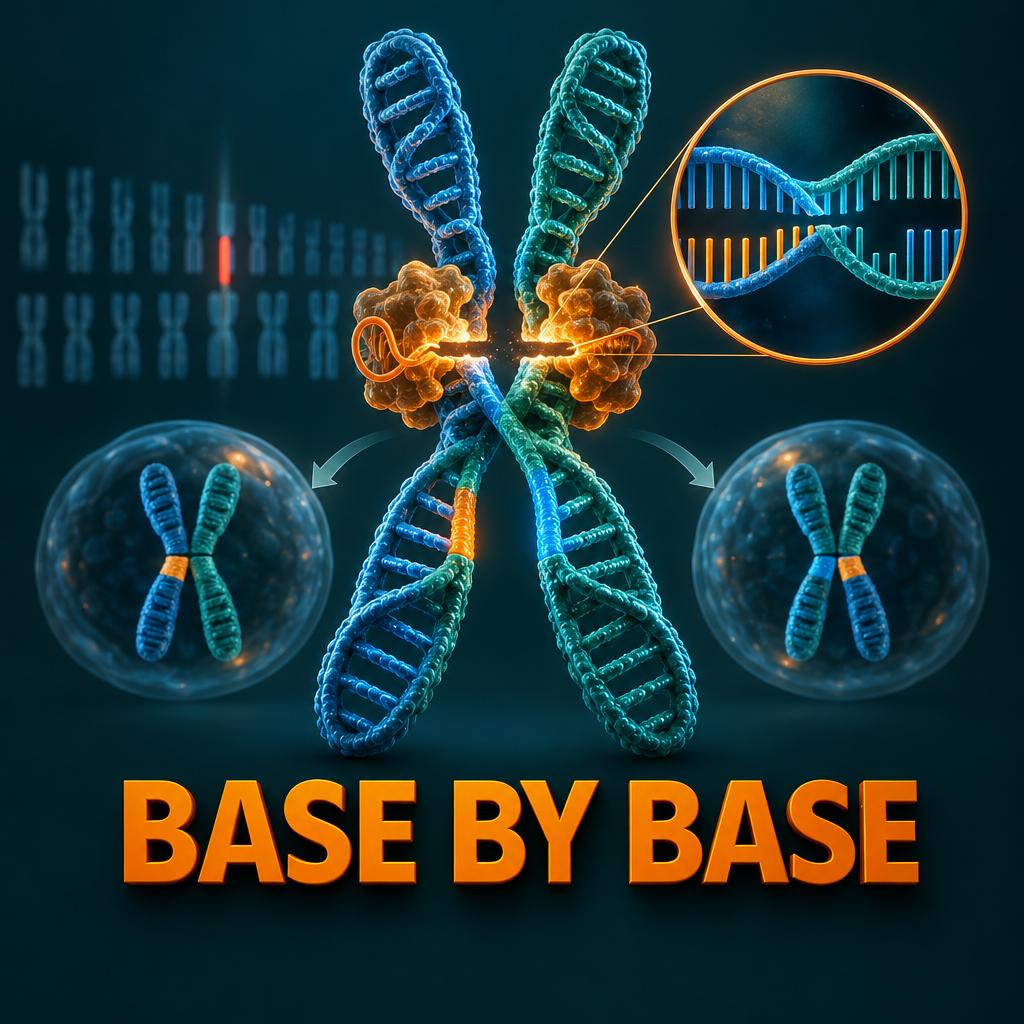
1:02Here is why that question matters. When a cell copies a chromosome, it makes two identical sisters joined in the middle. If one sister breaks, the cell can repair it by trading pieces with the other.
1:16Because the sisters are identical, the trade changes no DNA letters at all. It is the fake face up deck. Standard sequencing reads only the letters, so it cannot see the swap. To see it, you need a way to look at the backs of the cards.
1:33And the scissors in this story are the most famous ones in modern biology. Cas9 cuts DNA at a site chosen by a short guide. Labs use it every day to switch off genes.
1:45We usually judge an edit by what it leaves behind of the cut.
1:49A few letters added or lost.
1:52But what if many cuts are repaired by a silent swap between sisters instead?
1:57And what if some of those swaps are not as clean as they look?
2:01How would anyone know?
2:08Today we celebrate the work of Peter Chovinek, Cheong he and Yi Yin from the Department of Human Genetics at the the David Geffen School of Medicine who have advanced our understanding of how cells repair the cuts we make in them.
2:23This base by base episode is based on their Open Access article. Genome wide mapping of Cas9 induced sister chromatid exchange across single and over 200 genomic sites in human cells. Published in eLife in October 20.