
Automotive industry Quality and Engineering · Veljko Massimo Plavsic
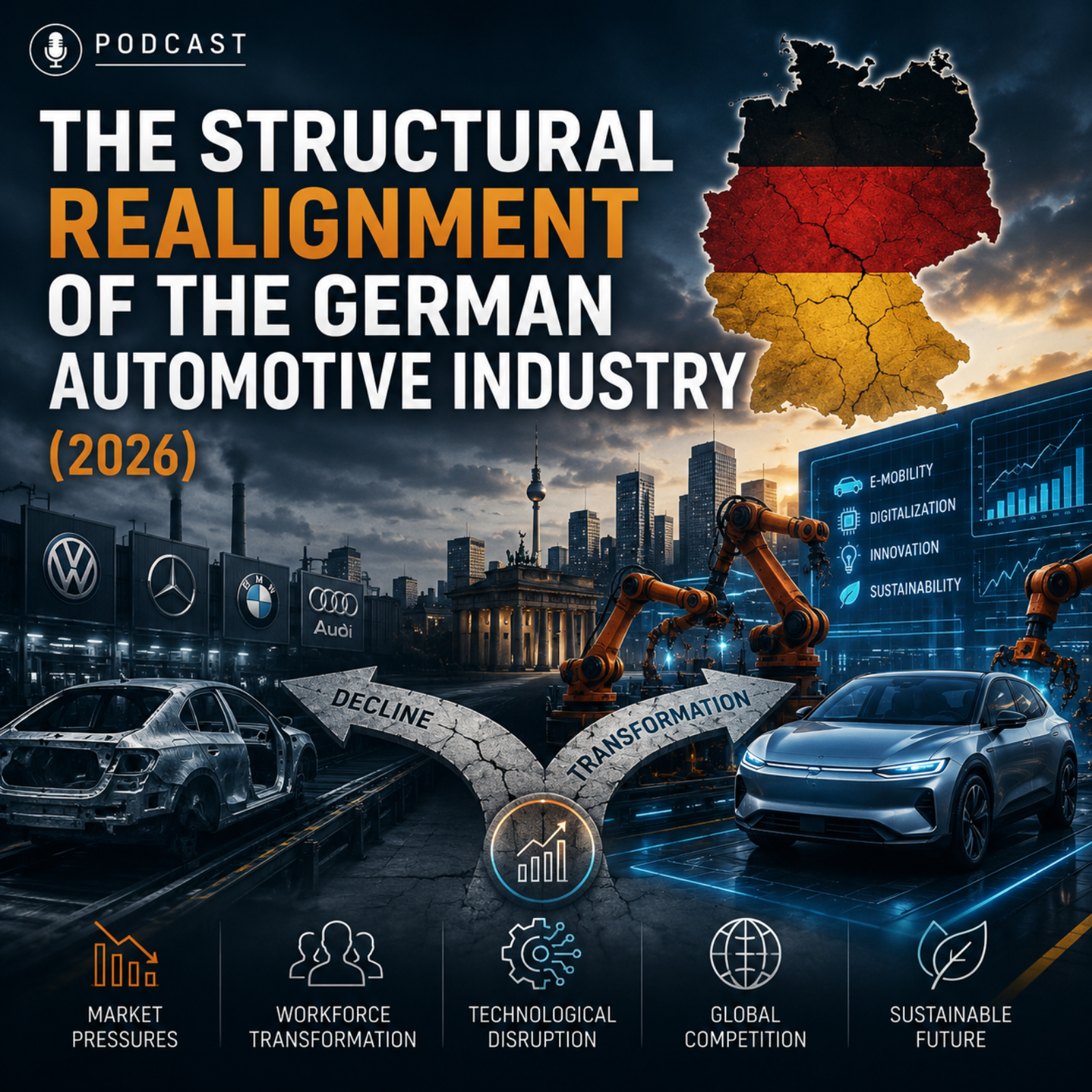
Got something to say to this podcast? Send a voicemail, and you might hear yourself on the next episode! You can use my promo code AUTO25 to get discount on many great deals Follow my deals page on link below: https://mydeals.page/sc8t Scenario Analysis: The Structural Realignment of the German Automotive Industry (2026) 1. The Industrial Crisis: A Systemic Overview of the German Automotive Sector The massive workforce reductions currently rippling through Germany’s marquee automotive manufacturers signal a definitive structural capitulation rather than a standard cyclical downturn. For decades, the German industrial model relied on a virtuous cycle of engineering superiority and export-led expansion. However, the 2026 landscape reveals a fundamental erosion of this traditional market dominance. The current downsizing represents a strategic retreat—a recognition that the competitive asymmetries introduced by the electric vehicle (EV) transition and the rise of the PRC automotive ecosystem have rendered the legacy operating model obsolete. Manufacturer Planned Redundancies Targeted Divisions Strategic Rationales BMW Up to 8,000 Administration & Development (Germany) Preemptive cost optimization to fund technological transformation and mitigate Chinese market volatility. Volkswagen Up to 100,000 Group-wide (of 650,000 total staff) Reactive emergency liquidation of excess capacity following plunging profits and volume contraction. Porsche 9,000 (by 2035) Group-wide (20% of total workforce) Defensive downsizing following a failed electric trajectory in the Chinese and North American luxury segments. The severity of the crisis is further illuminated by the divergence in organizational responses. BMW has adopted a program of "voluntary redundancy," a preemptive optimization strategy designed to lean-size its corporate core while preserving production capacity. Conversely, Volkswagen has been forced into a "drastic volume" approach, including the confirmed closure of four factories and a halving of its model lineup. This move toward factory closures represents a reactive emergency liquidation of industrial infrastructure, underscoring that for high-volume legacy players, traditional cost-cutting is no longer a sufficient buffer against obsolescence. These internal labor crises are the direct result of a catastrophic shift in external market dynamics, primarily originating from the East
0:00Imagine you were looking at a corporate balance
0:02sheet, and you see a record 1 .4 billion euro
0:06profit for the quarter. I mean, that sounds pretty
0:09fantastic. Right. The numbers are spectacular.
0:12The margins look super healthy. And then, and
0:15this is the part that is just wild to me, management
0:18turns around, walks into the factory floor, and
0:21announces they are firing 20 % of the workforce.
0:24Wow. 20%. One in five people gone. And the crazy
0:30thing is, this is not some hypothetical business
0:32school case study. That is Porsche right now.
0:36Yeah, it really, it just shatters the conventional
0:38wisdom of how corporate restructuring is supposed
0:40to work, you know? Totally. Because job cuts
0:43on that massive scale, they're traditionally