
Automotive industry Quality and Engineering · Veljko Massimo Plavsic
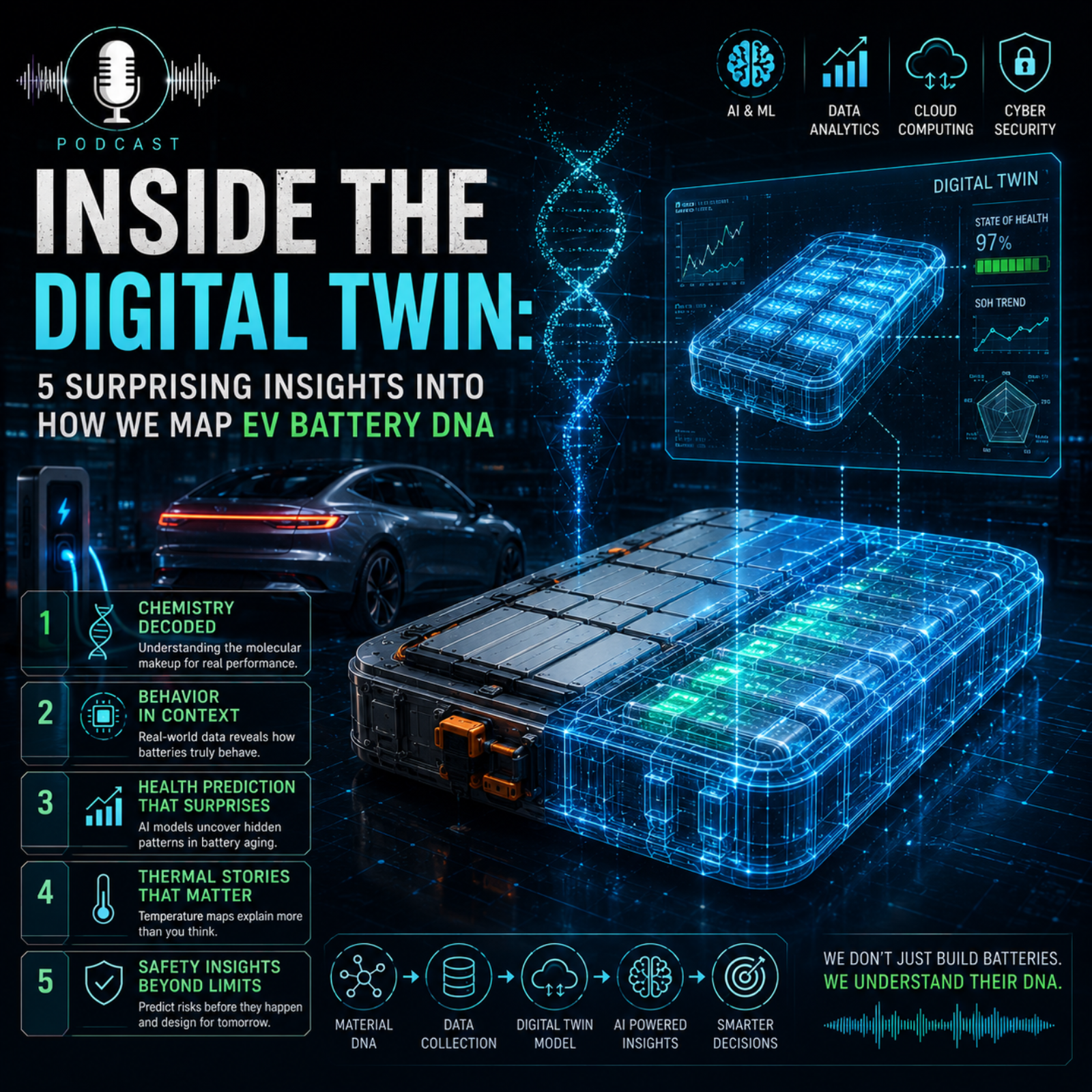
Got something to say to this podcast? Send a voicemail, and you might hear yourself on the next episode! You can use my promo code AUTO25 to get discount on many great deals Follow my deals page on link below: https://mydeals.page/sc8t Predicting the behavior of an electric vehicle (EV) battery is one of the most significant challenges in modern power electronics. For many drivers, the state of charge (SOC) indicator on the dashboard can feel like a best guess fluctuating based on how hard they accelerate or how cold the morning air is. This uncertainty exists because a battery is not a simple tank of fuel; it is a complex, dynamic chemical system that lives and breathes. To master this complexity, engineers perform Characterization. This is the rigorous process of extracting the electrochemical fingerprint of a physical cell ,such as the BAK N18650CL-29 lithium-ion cell,to create a high-fidelity Digital Twin. By mapping the underlying DNA of the battery, we can predict exactly how it will perform before it ever hits the road. Your Battery is a Different Creature at 0°C vs. 45°C A battery is a moving target. Its fundamental properties shift entirely based on its environment, making temperature the ultimate gatekeeper of performance. To build a robust digital model, characterization must be performed across a rigorous thermal spectrum. In the lab, we subject cells to Hybrid Pulse Power Characterization (HPPC) at five specific ambient breakpoints: 0, 10, 25, 35, and 45°C. At 0°C, internal resistance sky-rockets as ions struggle to move through the electrolyte; at 45°C, chemical reactions accelerate, potentially compromising the cell's lifespan. By mapping these thermal breakpoints, we ensure the vehicle’s software can accurately calculate range and power delivery whether the car is navigating a Norwegian winter or an Arizona heatwave. Short vs. Long Relaxation: Why Batteries Need Breathing Room When you stop drawing power, a battery's voltage doesn’t just snap back to a resting state; it relaxes over time. This relaxation is where the most valuable data is hidden, and it is measured using different rest periods to derive Resistor-Capacitor (RC) pairs. In our digital twin, a Resistor (R) represents the energy lost as heat (efficiency loss), while a Capacitor (C) represents the voltage lag or chemical memory of the cell.
0:00Imagine an electric vehicle, right, cruising
0:02at, say, 70 miles per hour down the highway on
0:06just this blistering July afternoon. Oh, yeah.
0:10Incredibly hot out. Exactly. And underneath the
0:12floorboards, inside that massive battery pack,
0:15there's this microscopic thermal chain reaction
0:18that's, well, it's always just one mechanical
0:20failure away from happening. Which is a terrifying
0:22thought, honestly. It really is. So how do automotive
0:25engineers predict, and more importantly, how
0:28do they prevent that kind of catastrophe years
0:31before the car is ever even built? Right, before
0:33the factory even exists. Yeah. Today on this
0:36deep dive, we're exploring a concept that borders
0:38on, like science fiction, but it is actually